What is B2B marketing and how does it work?

B2B marketing gets a company that sells to other companies chosen. It decides who you're for. It makes you known and trusted by the people who buy. It creates demand when they're ready, and it gives sales what it needs to close. It's one system, run by the leadership, over years.
This page is for founders, CEOs and heads of marketing in B2B companies who want the whole picture before they spend another franc or euro. You'll see how business buyers decide today, which four parts a working B2B marketing system has, how to split budget between brand and demand, and who should run it. The other articles in this guide go deeper on each part.
What does B2B marketing mean?
B2B marketing is marketing by a business for buyers who purchase on behalf of their own organization. The American Marketing Association defines marketing as creating, communicating, delivering and exchanging offerings that have value for customers, clients, partners and society. In B2B, the customer is a company, and the people who decide carry the risk for it.
That last point shapes everything. A buyer in a company spends other people's budget, has to justify the choice to colleagues and lives with the result for years. So B2B marketing runs on memory, trust and proof. Impulse plays a small role. Its job: when a company needs what you sell, your name is on the shortlist, and the people involved can defend choosing you.
Some people still read B2B marketing as lead generation. That's the narrowest part of it. My take: most B2B companies don't have a marketing problem. They have a nobody-has-time-to-run-it problem, because nobody owns the whole system.
How is B2B marketing different from B2C marketing?
B2B marketing differs from B2C marketing in who decides, how long it takes and what's at risk. Several people from different departments decide together, purchases are rare, and a wrong choice damages careers. Consumer marketing can win one person in a moment. B2B marketing has to win a group, often months before anyone asks for a quote.
| Aspect | Typical in B2B | What it means for marketing |
|---|---|---|
| Who decides | A buying group, about 13 people on average according to Forrester | Content and proof for each role in the group |
| How often they buy | Rarely; many services are switched every few years | Stay known between purchases |
| How they research | Mostly alone and online; Gartner found 61 % prefer no sales rep | Website and third-party sources do the early selling |
| What is at risk | Budget, projects and the buyer's reputation | Proof, references and clear pricing logic |
The gap is smaller than it looks. People in companies are still people. Binet and Field's analysis of B2B campaigns for the LinkedIn B2B Institute found that emotional messaging works in B2B too, and that B2B brands respond to share of voice almost exactly like consumer brands.
How do B2B buyers buy today?
B2B buyers research mostly on their own, in groups, and more and more with AI assistants. Forrester's State of Business Buying 2024 reports an average of 13 people in a buying decision, with 89 % of purchases involving two or more departments. Gartner found in 2025 that 61 % of B2B buyers prefer a buying experience without a sales rep.
The same sources show how often this goes wrong:
- Stalled purchases. Forrester reports that 86 % of B2B purchases stall during the buying process, and that 81 % of buyers are dissatisfied with the provider they chose.
- Mixed messages. In Gartner's survey of 632 buyers, 69 % saw inconsistencies between a supplier's website and what its sellers told them.
- Irrelevant outreach. 73 % of buyers in the same survey said they actively avoid suppliers who send irrelevant outreach.
- AI in the process. Almost 95 % of buyers in Forrester's study expected to use generative AI to support a purchase decision within the next 12 months.
Put together, these numbers say one thing. Most of the decision happens before your sales team is in the room. And buyers notice when your website, your sales deck and what AI assistants say about you tell different stories.
What are the parts of a B2B marketing system?
A working B2B marketing system has four parts that build on each other: positioning, brand, demand and sales support. Positioning decides who you're for and why you win. Brand makes that known and remembered. Demand turns it into conversations with buyers who are ready. Sales support helps those conversations close. Skip a layer and everything above it gets weaker.
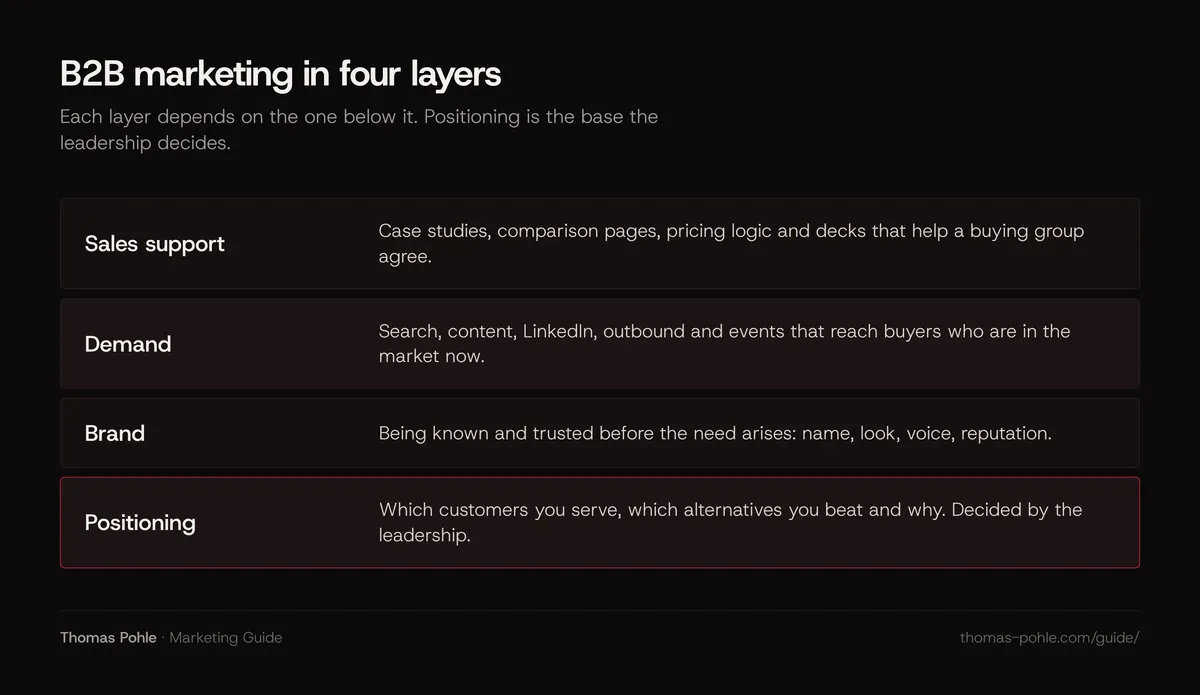
- Positioning. The leadership decision about which customers you serve, which alternatives you beat and why. The guide to B2B positioning shows how to find yours.
- Brand. Everything that makes buyers remember and trust you before they need you: name, look, voice, reputation, presence in the places they read. The guide to B2B brand management covers it in depth.
- Demand. The work that creates and captures interest from buyers who are in the market now: search, content, LinkedIn, outbound, events, account-based programs. The guide to B2B lead generation goes into detail.
- Sales support. Case studies, comparison pages, pricing logic, decks and follow-up material that help a buying group agree.
A typical scenario: a company starts at the top. It buys ads or hires an outbound agency, then wonders why the leads don't convert. The cause usually sits two layers lower. Nobody decided who the company is for.
Why are most of your buyers not in the market right now?
Most business buyers aren't in the market for what you sell at any given moment. Professor John Dawes of the Ehrenberg-Bass Institute estimates that up to 95 % of business buyers are out of the market for many goods and services at any one time. So marketing mainly works by building memory that pays off when a buyer's need appears.
Dawes shows the arithmetic in his paper for the LinkedIn B2B Institute. If companies change a provider such as their bank or law firm about every five years, only about 20 % are in the market in a year and about 5 % in a quarter. With a two-year cycle, it's 50 % a year and around 13 % per quarter. He stresses that 95 % is a heuristic. Don't treat it as a precise rule.
| Average time between purchases | In the market per year | In the market per quarter |
|---|---|---|
| 5 years (Dawes's example) | About 20 % | About 5 % |
| 3 years (same arithmetic) | About 33 % | About 8 % |
| 2 years (Dawes's example) | About 50 % | About 13 % |
A worked example: a software company sells to 2,000 target accounts, and contracts in its category run about five years. Then roughly 100 accounts enter the market per quarter and around 400 per year. A campaign can win a bigger share of those 100. It can't create the other 1,900 buyers. That's why one quarter of heavy spend followed by silence rarely works, and why Dawes advises spending with the long term in mind.
Get your own number. Ask customers how often they buy in your category, or look at your contract terms. The answer tells you how patient your marketing has to be.
How should you split budget between brand and demand?
B2B companies grow best when they fund both brand building and sales activation. Les Binet and Peter Field's analysis of the IPA Databank for the LinkedIn B2B Institute found that B2B marketing efficiency peaks at around 46 % of the budget for brand and 54 % for activation. In consumer markets the optimum is closer to 60 to 40.
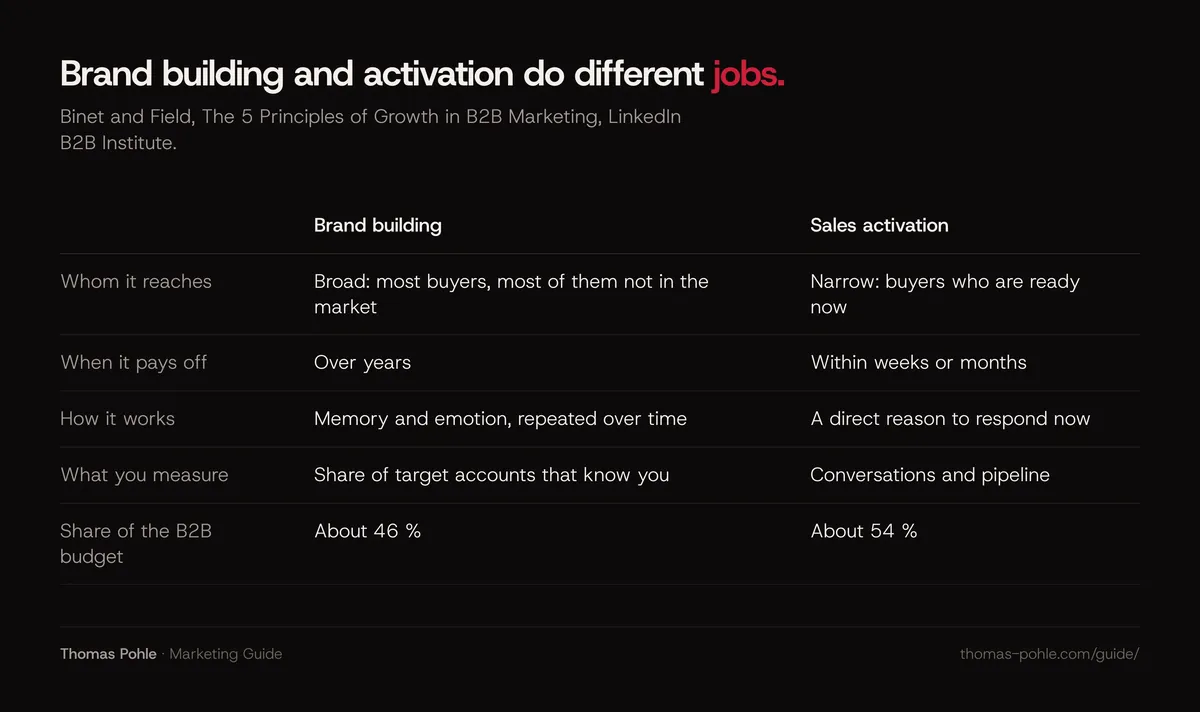
Use the ratio as a guide. Binet and Field write themselves that their small B2B sample only allows a rough estimate, and that the right mix varies by category and context. Two more findings from the same report help with planning:
- Share of voice. B2B brands whose share of voice exceeds their market share tend to grow. Ten points of extra share of voice were linked to about 0.7 percentage points of market share growth per year. The authors call the result tentative.
- Different jobs. Activation should be tightly targeted at buyers who are ready now. Brand building needs broad reach and repetition, and pays off over years.
With a small budget, my rule of thumb is simple. Don't spend everything on capturing the few buyers who are in the market this quarter. Keep a steady part for being known by the many who will be.
Which channels and measures belong in B2B marketing?
The right B2B channels are the places your buying group already reads, searches and asks. For most companies that's a clear website, search and AI answers, LinkedIn, direct outreach to named accounts, PR and selected events, all connected by a CRM. Start with one channel that fits your buyers. Run it well before you add the next.
- Website. Your most important sales asset in a rep-free buying process. It has to say who you're for and what happens next.
- Search and AI answers. Buyers ask Google and AI assistants for options. How to get found and cited is in the guide to answer engine optimization, and how to plan the content behind it in topic clusters and internal links.
- LinkedIn and content. Where B2B buyers and their colleagues spend professional attention. Content works when it answers what sales hears every week. See LinkedIn for B2B marketing and what content marketing is.
- Outbound and account-based marketing. Direct, relevant outreach to a defined list of accounts, explained in the guide to account-based marketing. Gartner's 73 % figure is the warning. Irrelevant outreach costs you the account.
- PR, events and partners. Third-party trust your own channels can't buy. More in what B2B PR is.
- CRM and automation. The memory of the system: who is who, what happened, what comes next. See marketing automation.
- Proof. Customer stories that buyers and AI systems can quote. See how to write a B2B case study that gets cited.
Measure the system by the pipeline it creates and the share of target accounts that know you. Clicks alone tell you little. The guide to marketing measurement covers the metrics, and measuring organic and AI search visibility the search side. Turning all of this into a written plan is the subject of the B2B marketing strategy guide.
How is AI changing B2B marketing?
AI changes B2B marketing in two places: how buyers research and how marketing teams work. Buyers ask AI assistants for shortlists and comparisons, so your positioning has to be clear in the public sources these systems read. My take: teams can now run research, content, outreach and reporting with far fewer people, as long as a human checks what goes out.
On the buyer side, Google states that there are no extra requirements or special optimizations needed to appear in AI Overviews or AI Mode; a page must be indexed and eligible for a snippet. The work is the same as good B2B marketing. Say clearly what you do and for whom, and back it with proof on pages that can be crawled.
On the team side, ask one question for every recurring process: can AI do it faster, or do it for you, with a person checking the result? The fundamentals stay the same. Here's my view: AI makes a clear positioning faster to spread, and an unclear one faster to ignore. The guide on where to start with AI in B2B marketing shows the first processes to change.
Who should run B2B marketing in your company?
B2B marketing needs one owner with enough seniority to make positioning decisions and enough time to run the work every week. Depending on size, that's a founder, a head of marketing, an interim or fractional marketing lead, or an advisor working with the team. Agencies and freelancers can execute parts. They rarely own the system.
The options, as I see them after more than ten years in B2B marketing, in-house at Link11, Beekeeper and smino:
- Agency. Executes well. Usually doesn't understand the business deeply enough to make positioning calls.
- Classic consultant. Delivers analysis and slides, often without the execution that should follow.
- Freelancer. Covers one channel well, rarely the whole system.
- Full-time hire. The right long-term answer for many companies. Slow to find, and expensive if the role isn't clear yet.
- Senior operator or advisor. Runs the system with your team while you keep control, and hands the knowledge over. That's how I work, so weigh my view accordingly.
Whoever owns it, judge them by pipeline. In a previous in-house role, I raised marketing's share of the sales pipeline from under 10 % to over 50 % within two years. That's the kind of target you can hold an owner to. The guide to the head of marketing role in B2B covers when a full-time hire makes sense.
What to do this week
You can test your B2B marketing system in a week without buying anything. Check each layer from the bottom. Is the positioning written down? Does the website say it? Do you know how often your buyers buy? Does one channel get steady attention? Does sales get material it actually uses?
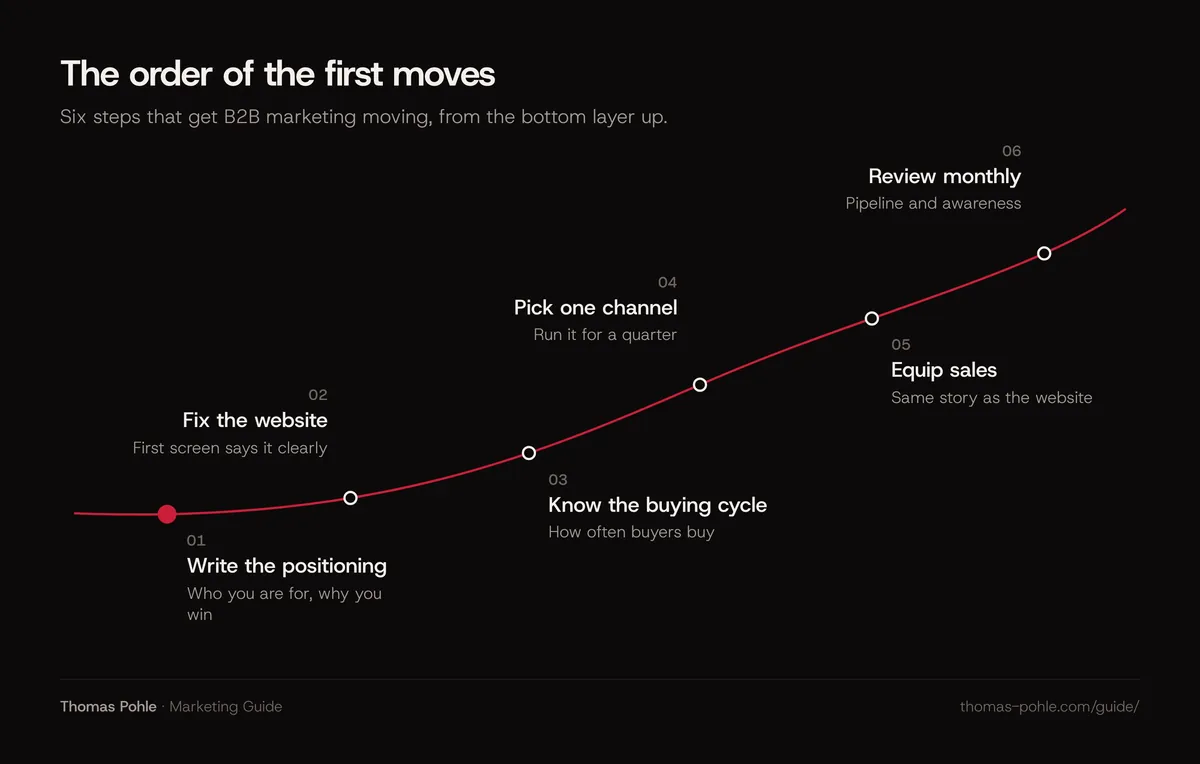
- Write your positioning in three sentences: who you're for, what they'd do without you, why you win. If leadership disagrees, that's your first task.
- Read your homepage as a buyer. Does the first screen say who it's for and what happens next?
- Ask three recent customers how often they buy in your category, and calculate your in-market share per quarter.
- List every marketing activity and sort it into brand or activation. Compare the split with Binet and Field's rough 46 to 54.
- Pick one channel your buyers use, commit to it for a year and check the first signals after a quarter.
- Ask sales which three documents they send most. Check that they match the website.
- Ask ChatGPT or Perplexity for providers in your category. Note whether and how you appear.
If you end up with a long list of gaps and nobody has time to close them, that's normal. A one-day Momentum Workshop sets positioning, ideal customer and the first channel. Your team leaves with a plan it can run on Monday.
B2B marketing isn't complicated. It's a few clear decisions, made by the leadership and kept up long enough to work. The companies that win are the ones that keep the system running.
Frequently asked questions
What is the difference between B2B marketing and B2B sales?
Marketing makes sure buyers know you, trust you and come to you when they're ready. Sales works with the specific buying group to reach a decision and a contract. In B2B the two overlap, because buyers do most research alone and expect the website, content and sellers to say the same thing. Gartner found 69 % of buyers see inconsistencies there.
How much should a B2B company spend on marketing?
There's no reliable universal percentage. Published benchmarks vary widely by industry, growth stage and source. Start from your goal instead: the pipeline you need, the share of target accounts that should know you, and the share of voice you want relative to your market share. Binet and Field's share of voice rule gives you a method for that.
Which B2B marketing channel works best?
The one your buying group already uses and that you can run consistently. For many B2B companies that's search and AI answers, LinkedIn or direct outreach to named accounts. Pick one and connect it to your website and CRM. Check the first signals after a quarter, give it a year, judge it by conversations and pipeline. Then add the next.
Is B2B marketing only for large companies?
No. My take: small B2B companies often benefit most, because a clear positioning and one well-run channel can make them the obvious choice in a niche. Their constraint is usually time. Budget comes second. What a small company needs first is one person who owns the system and makes the decisions.
How long does B2B marketing take to work?
Activation, such as outreach or search ads, can produce conversations within weeks. Brand building works over years, because most buyers aren't in the market at any given time. Dawes estimates up to 95 % of business buyers are out of the market for many products at once. Plan for both horizons and measure each on its own terms.
Sources
- American Marketing Association: Definitions of Marketing
- Forrester: To Master B2B Buying Mayhem, Providers Must Prioritize Buyers' Needs (The State of Business Buying, 2024)
- Gartner: Sales Survey Finds 61% of B2B Buyers Prefer a Rep-Free Buying Experience (June 2025)
- John Dawes, LinkedIn B2B Institute: Advertising effectiveness and the 95-5 rule
- Les Binet and Peter Field, LinkedIn B2B Institute: The 5 Principles of Growth in B2B Marketing
- Google Search Central: AI features and your website
- Ehrenberg-Bass Institute: How B2B Brands Grow (2023)

Thomas PohleB2B marketing advisor in Zurich. More than ten years in B2B marketing at Link11, Beekeeper and smino, most recently as Head of Marketing. CEO and co-founder of TEISENDA. Researched and drafted with AI tools, checked against the sources listed above. More about Thomas