How do you build a B2B marketing strategy?

Your B2B marketing strategy is five decisions, made by the leadership team and written on one page: the market you play in, the customer you win first, the promise you make them, the one or two channels that carry it, and the budget and time you commit. The campaign list, the content calendar and the tools follow from those five. Prepare well and the decisions fit into one workshop day.
This is for founders and CEOs of B2B companies with a product that works, a sales team that could sell more, and marketing that's either a list of activities or nobody's job. You get the five decisions, what research says about timing and budget, a decision table for the first channel, and the agenda for doing it in a day.
What is a B2B marketing strategy, and what is it not?
A B2B marketing strategy is a small set of choices that says where marketing will create revenue and where it won't: which buyers, with which promise, through which channels, with how much money. It isn't a list of activities, a channel plan or a slide deck. The plan and the tactics come after the strategy, and they change more often.
Michael Porter put the core of it in one sentence in his Harvard Business Review essay "What Is Strategy?": the essence of strategy is choosing what not to do. Trade-offs, he writes, create the need for choice and purposefully limit what a company offers. Use that as the test for your marketing strategy. If it doesn't rule anything out, it's a wish list.
| Level | What it answers | Who decides | How often it changes |
|---|---|---|---|
| Strategy | Which market, which customer, which promise, which channels, which budget | Leadership | Once a year, or when the market shifts |
| Plan | What happens when, who does it, which targets per quarter | Head of marketing with leadership | Every quarter |
| Tactics | Which post, which ad, which event, which email | Marketing team | Every week |
The classic frameworks fit into this picture. The marketing mix, four Ps or seven, describes the levers you pull once the strategy is set. Content strategy, brand strategy and social media strategy each cover one area. They work best when they inherit the five decisions. Don't let them invent their own.
Which five decisions make up a B2B marketing strategy?
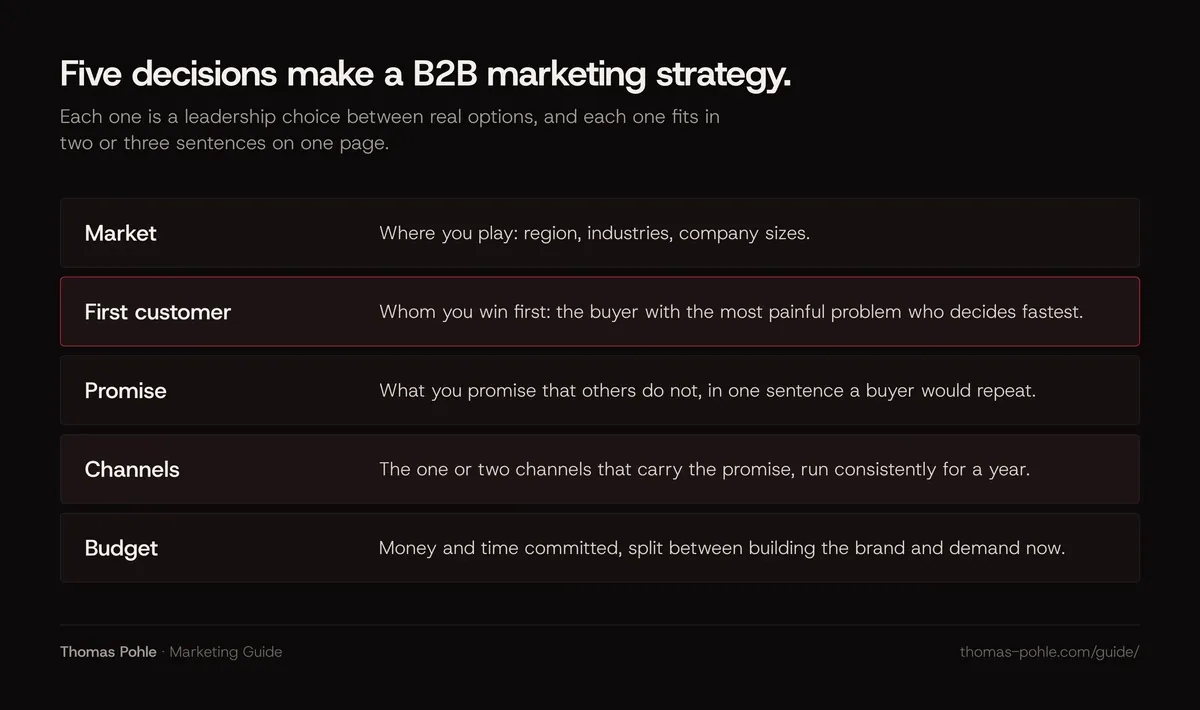
Five decisions make up a B2B marketing strategy: the market, the first customer, the promise, the channels and the budget. Each is a choice between real options. Each is made by leadership. Each fits in two or three sentences. Together they tell the team what to do on Monday and what to stop doing.
Market
Where do you play: which region, which industries, which company sizes? "DACH, mid-sized manufacturers with 50 to 500 employees" is a market. "Companies that need software" isn't. Entering a new country? Then the market decision includes language and how you'll be present there.
First customer
Within that market, whom do you win first? Pick the buyer whose most painful problem your product solves and who decides fastest. Describe the person and the company: role, trigger, what they use today, why they'd switch. Your sales strategy and customer acquisition strategy build directly on this choice.
Promise
What do you promise this customer that others don't? That's positioning, written as one sentence a buyer would repeat. When I positioned my own advisory, I listed every situation that makes buyers call me: stuck, no time, no starting point, no pipeline. The common denominator was standstill. So the promise became momentum. My take: the method works for any B2B company. Collect the real reasons customers bought, then find the one word under all of them.
Channels
Which one or two channels carry the promise to the first customer? Pick where those buyers already spend attention and where you can stay consistent for a year. A LinkedIn strategy, a content strategy or an outbound program are channel decisions. My rule of thumb: ten channels at half strength lose against two at full strength.
Budget
How much money and time do you commit, and how do you split it between building the brand and generating demand now? Most strategies leave this decision out. It's the one that decides whether the other four happen. The next two sections cover what research says about it.
Why does a B2B strategy need to reach buyers before they buy?
Your strategy has to reach buyers before they're in the market, because most of them aren't in the market at any given time, and those who are have often chosen already. Professor John Dawes estimates that only about 5 % of business buyers are in the market in a given quarter. Marketing aimed only at active buyers competes late, for a small group.
Dawes, of the Ehrenberg-Bass Institute, makes the case in a paper for LinkedIn's B2B Institute. Companies change providers such as their main bank or law firm around once every five years on average. That puts about 20 % of buyers in the market over a year and something like 5 % in a quarter. He presents it as a heuristic, not a precise rule. His conclusion: advertising mainly works by building memory links to the brand that activate when buyers come into the market.
Survey data from the vendor side points the same way. In its 2024 Buyer Experience Report, 6sense says B2B buyers are nearly 70 % through their purchasing process before they engage sellers, and 81 % have a preferred vendor at the time of first contact. 6sense doesn't publish its sample size in the release. Read it as a direction. It isn't a measurement.
For your strategy, that means two jobs run in parallel. One reaches the many buyers who aren't looking yet, so they know you when the need comes up. The other converts the few who are looking now. A strategy that only funds the second job will feel efficient and grow slowly.
How do you split the budget between brand and demand?
Split the budget roughly in half between building the brand and generating demand now, then adjust to your situation. Les Binet and Peter Field found in IPA Databank cases that B2B marketing efficiency peaked at about 46 % brand and 54 % activation. They call it a guiding principle from a small sample. Don't treat it as a formula to follow precisely.
Their report for the B2B Institute adds a second rule, for the size of the budget. B2B brands that set their share of voice above their share of market tended to grow, at about 0.7 percentage points of market share per year for every 10 points of extra share of voice. The authors stress that these B2B results are tentative. They still give you a starting logic: decide what share of attention in your category you want, then estimate what it costs.
A worked example shows how the in-market math changes the plan. The numbers are hypothetical. Use Dawes' method with your own data.
- Your market. 2,000 target companies in DACH.
- Buying cycle. They replace a solution like yours about every five years, so roughly 400 enter the market in a year and about 100 in a quarter.
- What a campaign can do. A three-month demand campaign can, at best, compete for those 100. It can't create the other 1,900 buyers.
- What it means for the split. Put all budget into activation and you fight hard for 100 companies a quarter, many of whom already prefer a competitor. Spend part of it on reaching the other 1,900. That's how you become the preferred vendor for next year's 400.
Dawes adds a practical point: spend the whole budget in one quarter and you're off the air for the rest of the year. You miss the buyers who enter the market then. Plan budget as a year-round presence with peaks. One launch isn't a plan.
How do you choose the first channel?
Choose the first channel by the situation your company is in. What competitors do is irrelevant here. A company without a marketing owner needs a channel one person can run. A company short on pipeline needs a direct route to buyers. A company new in a market needs visibility where its buyers already look. My take: one channel done well for a year beats five started at once.
Three situations typically make B2B companies call me: nobody owns marketing, nobody knows where to start, or sales is short on pipeline. Add a company entering a new market and you have four starting points. The table is my rule of thumb for the first move in each.
| Situation | First channel I would pick | Why |
|---|---|---|
| Nobody owns marketing | LinkedIn from the founder or CEO, two to three posts a week | One person can run it, and it builds reach among buyers who aren't looking yet |
| Nobody knows where to start | Website and a handful of answer-first guide pages for the questions sales hears | Every other channel needs a place to send people |
| Sales is short on pipeline | Outbound to a named account list, with one clear offer | It reaches the few buyers in the market directly, and first meetings can come within a quarter |
| Entering a new market | Local presence: events, partners and local-language content | Buyers there don't know you yet; in Switzerland and Germany they first want to get to know a provider |
The last row comes from my own observation. Buyers in the US and the UK tend to be more direct and decide faster. Buyers in Switzerland and Germany first want to get to know you, and Swiss buyers are especially local. That's my observation. It isn't a study. It still changes the channel choice for market entry.
For content-led channels, structure decides whether the effort compounds. The guide on topic clusters and internal links shows how to build pages that support each other. The guide on answer engine optimization covers how to get cited by AI assistants.
How do you build the strategy in one day instead of six months?
Build the strategy in one day by preparing the facts beforehand and spending the day on decisions only. The leadership team brings customer data, win and loss reasons and the current budget. The day walks through market, customer, promise, channels and budget, in that order. You leave with one page and a first plan the team can start on Monday.
That's the format of my one-day Momentum Workshop: positioning, ideal customer and the one channel that moves first, with a plan the team can run on Monday. Here's how I'd structure the day.
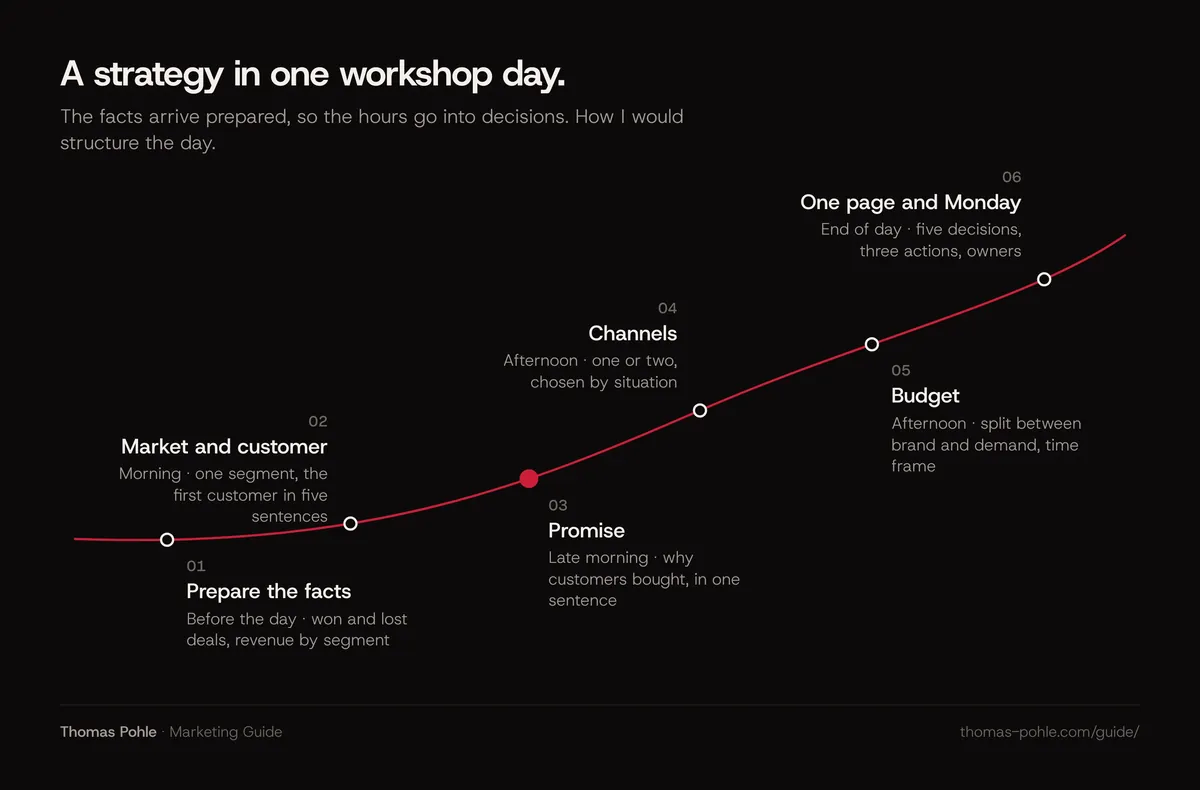
- Before the day. Ten recent won and lost deals with the reason, revenue by customer segment, current marketing spend and activities, three competitor websites.
- Morning, market and customer. Pick the segment with the best mix of pain, budget and speed. Describe the first customer in five sentences.
- Late morning, promise. Collect why customers bought, find the common denominator, write the one sentence. Test it against the competitor sites.
- Afternoon, channels and budget. Use the decision table, choose one or two channels, set the budget split and the time frame.
- End of day, one page and Monday. Write the five decisions on one page, list the first three actions, name an owner for each.
It works because leadership is in the room. These are leadership decisions. A strategy written by a junior marketer or an agency without them tends to stay on a slide.
How do you turn the strategy into a plan and measure it?
Break the five decisions into quarterly goals, a short list of initiatives and named owners. Then measure every initiative against the revenue chain. The yearly marketing plan answers what happens when. The strategy page stays fixed unless the market changes. Review progress monthly and the strategy itself once a year.
- Quarterly goals. Pipeline and opportunities needed, derived from the revenue target.
- Initiatives. Three to five per quarter, each tied to one of the five decisions.
- Owners and dates. One name per initiative, one review date.
- Measures. Which link of the revenue chain each initiative moves.
The guide on measuring marketing success in B2B shows how to build that chain backward from revenue and which numbers belong in the leadership meeting. For proof that supports the promise, such as customer stories, see how to write a B2B case study that gets cited.
My take: AI changes the speed of execution more than the strategy. It drafts content, researches accounts and assembles reports, so a small team can run more of the plan. The guide to AI in B2B marketing covers where to start.
Which strategy mistakes do B2B companies make most often?
The most common B2B strategy mistakes are an activity list sold as a strategy, a target group that includes everyone, a promise copied from competitors, too many channels at once, and no decision on budget. Each one comes from dodging a trade-off. The fix is the same every time. Make the choice and write down what you won't do.
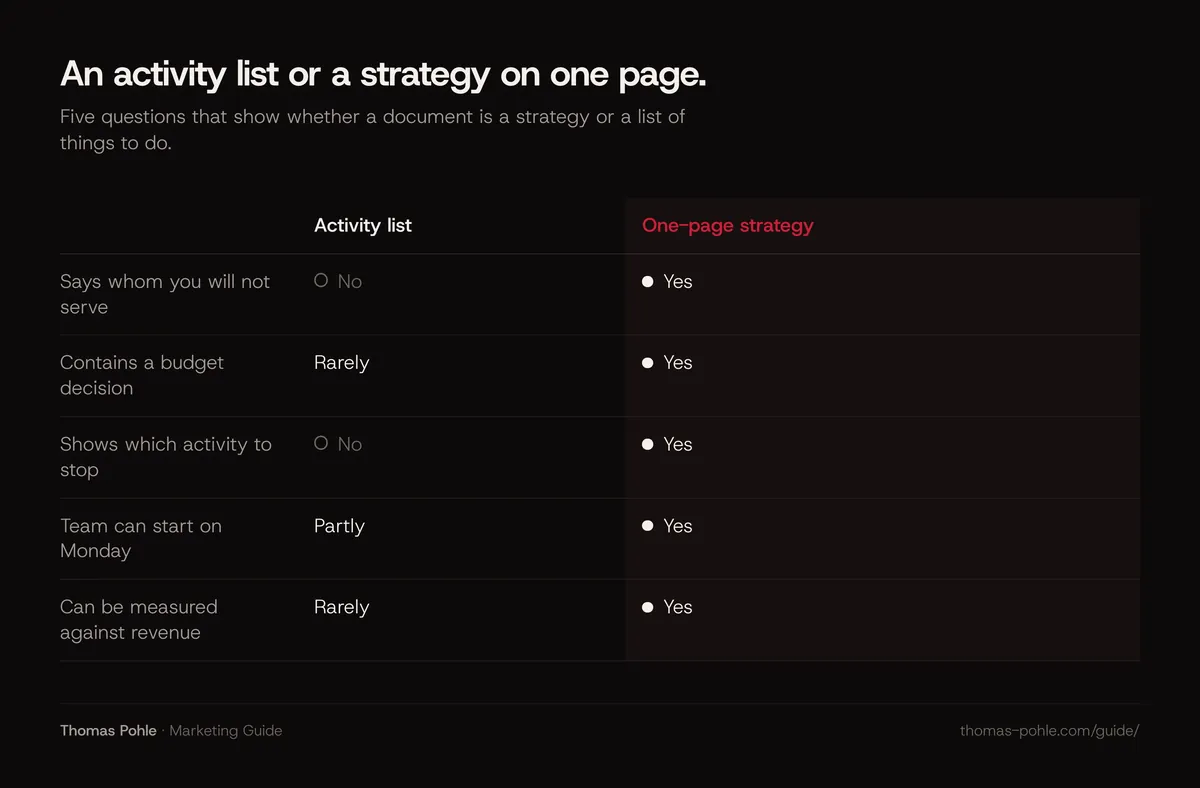
- Activity list as strategy. Webinars, posts and a newsletter are tactics. Without the five decisions, nobody can say which of them matters.
- Everyone as the customer. A message for every buyer reaches none of them clearly.
- A borrowed promise. If your claim fits a competitor's website, it isn't a promise.
- Ten channels. My rule of thumb: each channel needs a year of consistency. Spread thin, none gets there.
- No budget decision. A strategy without money and time attached stays a wish.
- Judging too early. Brand effects take quarters. Binet and Field report that long-term effects start to dominate after about six months.
What to do this week
- Write down your current answer to the five decisions, one sentence each. Mark the ones where the leadership team would disagree.
- Pull your last ten won and ten lost deals and note the real reason for each.
- Estimate how often your customers replace a solution like yours, and calculate how many of your target companies are in the market per quarter.
- List every marketing activity running today and mark which decision each one serves. Stop one that serves none.
- Check your budget split between brand and demand. If it's close to 0 and 100, plan a first step toward the middle.
- Pick the one channel you'll run consistently for the next twelve months, and name its owner.
- Book half a day with the leadership team to decide the open points.
Strategies rarely fail because the ideas were wrong. They fail because nobody made the choices or nobody ran the plan. Five decisions on one page, owned by leadership and run by a named person, beat a hundred-slide deck every time.
Want to make those decisions in one day, with an outside view? That's exactly what the Momentum Workshop is for.
Frequently asked questions
What should a B2B marketing strategy include?
Five decisions at its core: the market, the first customer, the promise, the one or two main channels, and the budget with its split between brand and demand. Add how you'll measure progress against revenue. Everything else, from the content calendar to the tool stack, belongs in the marketing plan that follows from it.
How long should a B2B marketing strategy document be?
One page for the decisions. If you can't write each of the five choices in two or three sentences, they aren't decided yet. Supporting material such as customer research or competitor analysis goes in an appendix. The marketing plan with quarterly goals and initiatives is a separate, longer document.
What is the difference between a marketing strategy and a marketing plan?
The strategy says where and how you'll win: market, customer, promise, channels, budget. It changes rarely. The plan says what happens when, who does it and which targets apply per quarter. It changes every quarter. A plan without a strategy is a list of activities with no way to decide which ones matter.
How much should a B2B company spend on marketing?
No universal percentage fits every company. Binet and Field offer a logic instead: B2B brands whose share of voice exceeded their market share tended to grow. Decide the share of attention you want in your category, estimate its cost, and check it against your revenue target and margins.
How often should you review a B2B marketing strategy?
Review the strategy once a year, and whenever the market shifts in a way that hits one of the five decisions: a new competitor, a new segment, a price change. Review the plan quarterly and the numbers monthly. If you change the strategy every quarter, it was never decided.
Sources
- Michael E. Porter, Harvard Business Review: What Is Strategy?
- John Dawes, Ehrenberg-Bass Institute for LinkedIn B2B Institute: Advertising effectiveness and the 95-5 rule
- Les Binet and Peter Field for LinkedIn B2B Institute: The 5 Principles of Growth in B2B Marketing
- LinkedIn B2B Institute: How B2B Brands Grow
- 6sense: 2024 Buyer Experience Report press release

Thomas PohleB2B marketing advisor in Zurich. More than ten years in B2B marketing at Link11, Beekeeper and smino, most recently as Head of Marketing. CEO and co-founder of TEISENDA. Researched and drafted with AI tools, checked against the sources listed above. More about Thomas