What is answer engine optimization (AEO)?

Answer engine optimization (AEO) is the practice of getting your content quoted and linked when ChatGPT, Perplexity, Microsoft Copilot or Google AI Overviews answer a question. It sits on top of classic SEO. A page has to be crawlable and indexed first. Then it has to state a clear answer, from a source the system trusts, in a form it can lift and attribute.
For a B2B company the stakes are simple. Your buyers increasingly ask an assistant before they ask a vendor. The answer names a competitor and links to their guide? Then you were never in the conversation.
What does answer engine optimization mean in practice?
An answer engine is any system that replies to a question with a written answer instead of a list of ten links. The answer usually comes with citations: links to the pages the system used. AEO is everything you do to become one of them.
In practice, you have three jobs:
- Access. The crawlers that feed these systems can reach your pages, and your pages are in the indexes they search.
- Answerability. Each page answers one question directly, early and in plain language, so a short passage makes sense on its own.
- Trust. Your company, authors and claims are consistent across the web, so the system has reasons to prefer your page over a hundred similar ones.
None of this is magic. It's good SEO and good editorial discipline, aimed at a reader that happens to be a machine summarizing for a human.
How is AEO different from SEO and GEO?
SEO gets your pages ranked in search results. AEO gets them quoted inside a direct answer. GEO, a term from academic research, aims at visibility in AI-generated responses in general. The terms overlap, and people use them loosely. Here's how I separate them.
| Term | Goal | Where it shows up | Main success signal |
|---|---|---|---|
| SEO (search engine optimization) | Rank pages in search results | Google and Bing result pages | Impressions, rankings, clicks |
| AEO (answer engine optimization) | Be the quoted source for a direct answer | AI Overviews, AI Mode, ChatGPT search, Perplexity, Copilot, featured snippets | Citations and links inside answers |
| GEO (generative engine optimization) | Increase visibility inside AI-generated responses | Generative engines broadly | Share of mentions and citations |
GEO comes from academic research. A 2023 paper titled GEO: Generative Engine Optimization by Aggarwal and colleagues, accepted at KDD 2024, introduced the term and reported that its methods could raise visibility in generative engine responses by up to 40% in the authors' test setup. That's a lab result on a benchmark. It shows content changes can matter. It doesn't predict what will happen on your site. Microsoft also uses the term GEO for its new citation reporting in Bing Webmaster Tools.
AEO and GEO describe nearly the same work. I use AEO. It keeps the focus on the question a buyer asks and the answer you give.
How do AI assistants choose which sources to cite?
Most AI answers that cite sources follow a retrieval pattern. The system turns the user's question into one or more search queries, pulls candidate pages from an index, reads the relevant passages and writes an answer that links to some of them. Training data shapes how the model writes. Retrieved pages shape what it cites.
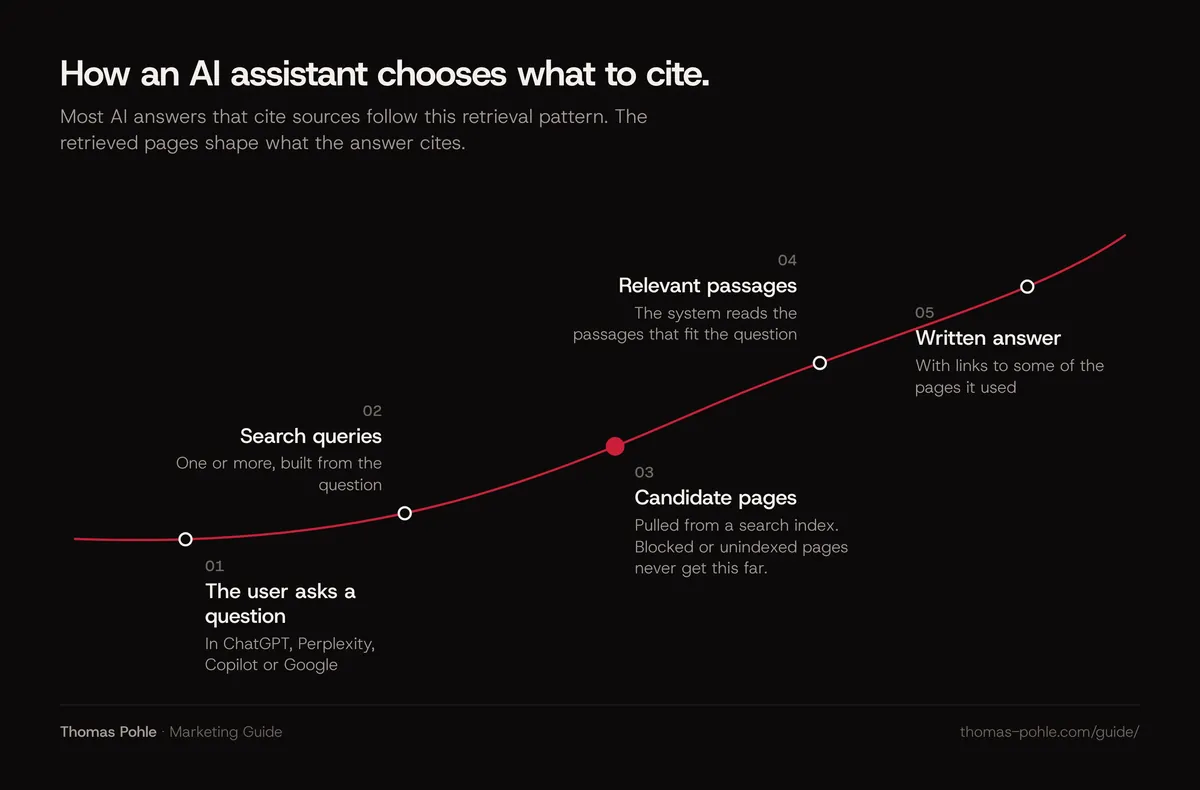
The providers document parts of this. Here's what they say:
- Google. AI Overviews and AI Mode may use a technique Google calls query fan-out, issuing multiple related searches across subtopics and data sources to build a response. Google says this lets it show a wider and more diverse set of supporting links than a classic search.
- OpenAI. ChatGPT search relies on a crawler called OAI-SearchBot. OpenAI states that sites opted out of OAI-SearchBot won't be shown in ChatGPT search answers.
- Perplexity. PerplexityBot is designed to surface and link websites in Perplexity's search results, and Perplexity says it isn't used to crawl content for training AI foundation models.
- Microsoft. Bing calls this process grounding and says Microsoft grounding powers nearly every major AI assistant on the market. Bing Webmaster Tools now reports how often your pages are cited in Copilot and AI-generated Bing summaries.
The takeaway: an AI answer can only cite what its retrieval step finds. Is your page blocked, unindexed or buried? Then the quality of your writing doesn't matter. The full crawler setup is in my guide on how to get cited by ChatGPT, Perplexity and Google AI Overviews.
What does Google say about AI Overviews and AI Mode?
Google says you need nothing special to appear in AI Overviews or AI Mode. An indexed page that's eligible for a snippet qualifies. Its Search Central page AI features and your website is unusually direct about this. Read it before you buy any AI search tactic. Its main points:
- There are no additional requirements to appear in AI Overviews or AI Mode, and no special optimizations are necessary.
- To be eligible as a supporting link, a page must be indexed and eligible to be shown in Google Search with a snippet.
- You don't need new machine-readable files, AI text files or special schema.org markup to appear in these features.
- Robots.txt rules for Googlebot are the control for crawling. Snippet controls (nosnippet, data-nosnippet, max-snippet, noindex) limit what Google shows, including in AI features.
- Google-Extended limits AI training and grounding in some of Google's other systems, such as Gemini Apps. Google states it doesn't affect inclusion or ranking in Google Search.
- Traffic from AI Overviews and AI Mode is counted in the Search Console Performance report under the Web search type.
Google also says AI Overviews often don't trigger. They appear only when its systems decide they add something to classic results. So for Google, AEO is mostly SEO done well. The fundamentals in my technical SEO checklist for B2B websites are the entry ticket.
What actually helps a B2B website get cited?
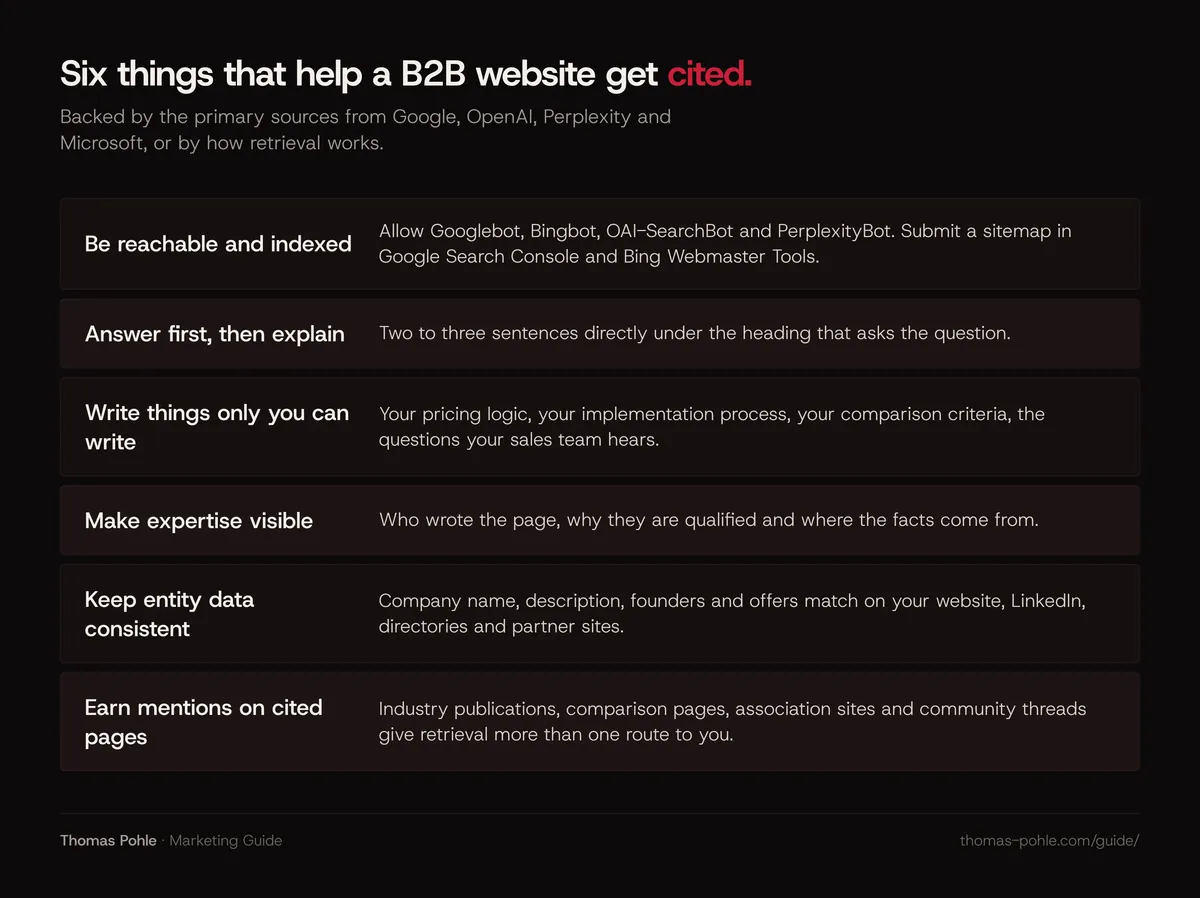
Six measures get a B2B website cited: being reachable, answering first, writing what only you can write, showing expertise, keeping entity data consistent and earning mentions elsewhere. Most rest on primary sources from Google, Bing and OpenAI. Where I add my own judgment, I say so.
1. Be reachable and indexed everywhere answers come from
Allow Googlebot, Bingbot, OAI-SearchBot and PerplexityBot in robots.txt, and check that your CDN or firewall doesn't silently block them. Google explicitly mentions CDN and hosting infrastructure in its guidance. Submit a sitemap in both Google Search Console and Bing Webmaster Tools.
2. Answer first, then explain
Put a two to three sentence answer directly under the heading that asks the question. Retrieval systems work on passages, so write for them. A passage that starts with the answer, names the subject and avoids pronouns that depend on earlier paragraphs is easier to quote correctly. Bing's guidance for its AI Performance report recommends clear headings, tables and FAQ sections for the same reason.
3. Write things only you can write
Google's guidance on AI search tells site owners to focus on unique, non-commodity content. In B2B, that's your pricing logic, your implementation process, your comparison criteria and the questions your sales team hears every week. A generic "what is a CRM" page competes with thousands of others. A page on how a 50-person Swiss manufacturer should evaluate CRM migration risk competes with very few.
4. Make expertise visible
Show who wrote the page, why they're qualified and where facts come from. Google's guidance on helpful, reliable, people-first content asks exactly these Who, How and Why questions. I go deeper in how to show expertise to Google and AI.
5. Keep your entity data consistent
Your company name, description, founders and offers should match on your website, LinkedIn, directories and partner sites. Organization structured data helps Google understand your administrative details and disambiguate your organization. See which schema markup a B2B website needs and how to connect your website and profiles into one brand.
6. Earn mentions on pages that already get cited
Assistants often cite industry publications, comparison pages, association sites and community threads. An accurate mention there gives retrieval systems another route to you. I can't point you to a provider document that quantifies this. My take: it follows from how retrieval works. More relevant pages about you means more chances to be found.
What does not help, or is still unproven?
Be careful with tactics sold as AI shortcuts. llms.txt, special AI schema, mass-produced AI content and blanket bot blocking all get pitched to B2B teams. Google says it needs none of the first two. It treats the third as low effort, or as spam when it aims to manipulate rankings. The fourth can cost you citations.
- llms.txt. A proposed file that summarizes a site for language models. Google states that no AI text files are needed for its AI features. Whether other providers use it isn't clearly documented. Details in what llms.txt is and whether you need one.
- Special AI schema. Google says there's no special schema.org markup for AI features. Structured data still helps with rich results and entity understanding. Keep it, and keep it consistent with the visible text.
- Mass-produced AI content. Google describes using generative AI to produce lots of content without oversight as little to no effort, and using automation mainly to manipulate rankings violates its spam policies.
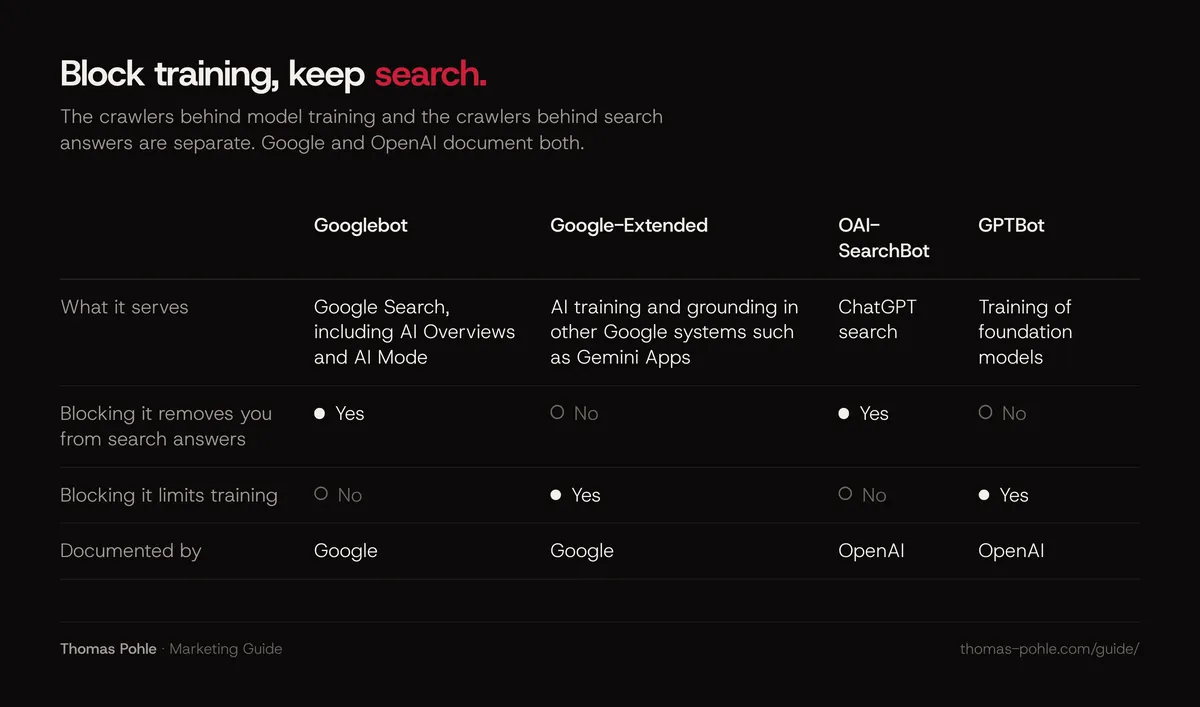
- Blanket bot blocking. Some sites block every AI crawler to keep content out of training. Then they wonder why they never get cited. GPTBot and Google-Extended are separate from OAI-SearchBot and Googlebot. You can block training and still allow search.
How do you know if AEO is working?
Measurement is still immature. You still have four sources to work with: Google Search Console, Bing Webmaster Tools, your own analytics and a monthly manual check of what assistants cite. Together they show whether your pages get used. None of them gives you the full picture alone.
- Google Search Console. AI Overviews and AI Mode traffic is inside the Web search type of the Performance report. Since 31 August 2026 a separate Generative AI performance report shows their impressions for all sites. It doesn't show their clicks.
- Bing Webmaster Tools. Since February 2026 the AI Performance report, in public preview, shows how often your pages are cited in Microsoft Copilot, AI-generated summaries in Bing and select partner integrations, plus sample grounding queries.
- Your analytics. Watch referral traffic from AI assistant domains and the conversions it brings.
- Manual checks. Ask the assistants your buyers' real questions once a month and log who gets cited.
The full setup is in how to measure organic and AI search visibility.
Where should you start this week?
- Write down the 10 questions prospects ask most in first sales calls.
- Ask each question in ChatGPT, Perplexity, Copilot and Google. Note which sources get cited.
- Check robots.txt and your firewall for Googlebot, Bingbot, OAI-SearchBot and PerplexityBot.
- Verify your site in Google Search Console and Bing Webmaster Tools and submit your sitemap in both.
- Pick the three questions where you have the strongest first-hand expertise. Rewrite or create one page per question with a 40 to 60 word answer right under the heading.
- Add a byline, an author bio and links to the sources behind your facts.
- Repeat the assistant check in four to six weeks and compare.
My rule of thumb for B2B: ten sharp, answer-first pages beat a hundred thin ones. Want help picking the questions and building the first pages with your team? That's exactly what a one-day Momentum Workshop is for.
Frequently asked questions
Is AEO replacing SEO?
No. AEO depends on SEO. Google says a page must be indexed and eligible for a snippet to appear as a supporting link in AI Overviews or AI Mode, and AI assistants retrieve pages from search indexes. Without crawlability, indexing and solid content, there's nothing for an answer engine to cite. AEO adds answer-first writing and entity consistency on top.
Do I need special markup or files for AI Overviews?
No. Google's Search Central documentation states that you don't need new machine-readable files, AI text files or special schema.org markup to appear in AI Overviews or AI Mode. Standard structured data still helps with rich results and with understanding your organization. It just has to match the visible content on the page.
Does blocking GPTBot remove my site from ChatGPT search?
No. OpenAI documents GPTBot and OAI-SearchBot as independent. GPTBot covers content that may be used to train foundation models. OAI-SearchBot is what surfaces sites in ChatGPT search. You can disallow GPTBot and still allow OAI-SearchBot. OpenAI says robots.txt changes can take about 24 hours to take effect for search.
How long does it take to see results from AEO?
There's no documented timeline. Google says recrawling can take several days to several months depending on how often a page is refreshed, and OpenAI says robots.txt changes take about 24 hours to reach its search systems. My rule of thumb: give a new page one to three months before you judge it, and recheck citations monthly.
What is the difference between AEO and GEO?
They describe almost the same work. GEO, generative engine optimization, comes from a 2023 research paper by Aggarwal and colleagues and is the term Microsoft uses for its Bing citation reporting. AEO, answer engine optimization, frames the same goal around questions and answers. Both aim to make your content the source an AI answer cites.
Sources
- Google Search Central: AI features and your website
- Google Search Central Blog: Top ways to ensure your content performs well in Google's AI experiences on Search (May 2025)
- Google Search Central: Creating helpful, reliable, people-first content
- Google Search Central: Google's common crawlers (Google-Extended)
- OpenAI: Overview of OpenAI crawlers
- Perplexity: Perplexity crawlers
- Bing Blogs: Elevating the role of grounding on the AI web (February 2026)
- Bing Webmaster Blog: Introducing AI Performance in Bing Webmaster Tools public preview (February 2026)
- Aggarwal et al.: GEO: Generative Engine Optimization (arXiv 2311.09735, KDD 2024)
- Google Search Central Blog: Introducing Search Generative AI performance reports in Search Console (June 2026, rolled out to all sites 31 August 2026)
- Search Console Help: Generative AI performance report (Search)

Thomas PohleB2B marketing advisor in Zurich. More than ten years in B2B marketing at Link11, Beekeeper and smino, most recently as Head of Marketing. CEO and co-founder of TEISENDA. Researched and drafted with AI tools, checked against the sources listed above. More about Thomas