How does SEO change when AI answers the search?

When AI answers the search, SEO keeps its foundation: your pages must be crawlable, indexed and trusted. The payoff is what changes. Fewer people click through, so the goal shifts from ranking a page to being the source an AI answer cites. Leadership has to decide three things now: which AI crawlers get access, which content is worth citing, and how you measure success.
This guide is for founders, CEOs and marketing leads of B2B companies who hear "SEO is dead" from one side and "you need GEO now" from the other. Neither is true as stated. Below: what stays, what changes, what loses value, the three decisions that belong on the management agenda, and how to optimize, measure and pick an agency.
What actually changes in SEO when AI answers the search?
The mechanics of SEO change less than the headlines claim. The economics change more. Google says there are no extra requirements for AI Overviews or AI Mode beyond normal SEO. But when an AI summary appears, people click far less often. That's the real shift.
Pew Research Center analyzed the browsing data of 900 US adults in March 2025. About 18 % of their Google searches showed an AI summary. With a summary, users clicked a traditional result in 8 % of visits. Without one, in 15 %. Links inside the summary got a click in only 1 % of visits. And 26 % of pages with a summary ended the browsing session, against 16 % without.
Google reads the same shift differently. In a May 2025 post, John Mueller of Google Search Relations wrote that clicks from AI Overviews are "higher quality", with users spending more time on the site, and that people ask longer, more specific questions. Both can be true. Fewer visits, better ones. Search Console reports AI impressions but no separate AI clicks, so you can't verify Google's claim on your own numbers yet.
How do AI Overviews, AI Mode and ChatGPT search choose their sources?
AI search systems first retrieve pages from a search index. Then they write an answer from them and cite some as sources. Google says a page must be indexed and eligible for a snippet to appear in AI Overviews or AI Mode. ChatGPT search depends on OpenAI's search crawler, OAI-SearchBot, being allowed on your site.
Google describes a technique called query fan-out: AI Overviews and AI Mode may issue "multiple related searches across subtopics and data sources" to build one answer. What that means for you: a single page can get pulled in for a question it never targeted, as long as it answers one sub-question clearly.
For ChatGPT, OpenAI's crawler documentation is explicit: sites that opt out of OAI-SearchBot "will not be shown in ChatGPT search answers". GPTBot is a different crawler, used for model training. Perplexity runs PerplexityBot to surface and link websites in its results and states that it isn't used to crawl content for AI foundation models. How each system ranks the retrieved pages isn't published. The details of crawler access are in the guide on getting cited by ChatGPT, Perplexity and Google AI, and the retrieval mechanics in what answer engine optimization is.
What stays the same from classic SEO?
Almost everything technical stays. Pages still need to be crawlable, indexable, fast and clearly structured. Google states plainly that you don't need new machine readable files, AI text files or special markup to appear in its AI features. The foundation of SEO is the foundation of AI search.
| Classic SEO element | Still matters? | What changes in AI search |
|---|---|---|
| Crawling and indexing | Yes | More crawlers to decide on: search bots and training bots are separate |
| Helpful, people-first content | Yes | Each section must answer one question on its own, because answers quote passages |
| Keywords | Partly | Questions get longer; you write for the question, not the exact phrase |
| Rankings as the main KPI | Partly | Citations, mentions and inquiries matter as much as position |
| Structured data | Yes | Must match the visible text; it helps machines identify who you are |
| Backlinks and mentions | Yes | Mentions help assistants describe you; how much is not published |
| Volume of pages | No | Mass-produced pages risk the spam policy on scaled content abuse |
If your technical base is weak, start there. The technical SEO checklist covers crawling, indexing, canonical tags and Core Web Vitals, and the guide on what SEO is covers the basics. I've seen what a better website can be worth. In a previous in-house role, a new website and online funnel I designed more than tripled organic traffic and doubled conversion rates.
What loses value when AI answers the question?
Three habits lose value fast: publishing many thin pages, writing around a keyword instead of answering a question, and reporting rankings as if they were revenue. Questions are the searches most likely to get an AI summary. In Pew's data, 60 % of searches starting with who, what, when or why showed one. That traffic is under the most pressure.
- Thin pages at scale. Google's spam policies name "using generative AI tools or other similar tools to generate many pages without adding value for users" as scaled content abuse.
- Keyword stuffing. In the GEO study by Aggarwal and colleagues (KDD 2024), keyword stuffing offered little to no improvement in generative engine answers. Adding citations, quotations and statistics did best.
- Ranking reports alone. The Pew data shows the same position earns fewer clicks when an AI summary sits above it. A report that only shows positions hides that.
- Generic definitions. My take: "What is X" pages without your own view or data are the first ones an AI summary makes redundant. Pages with first-hand experience, numbers and a clear opinion give it something to cite.
Which three decisions does leadership need to make now?
AI search is a management topic. Three of its choices affect brand, risk and budget: whether AI crawlers may use your content, what kind of content you pay for, and what you count as success. Marketing can prepare all three. Someone with budget authority has to sign them off. Otherwise nothing changes.
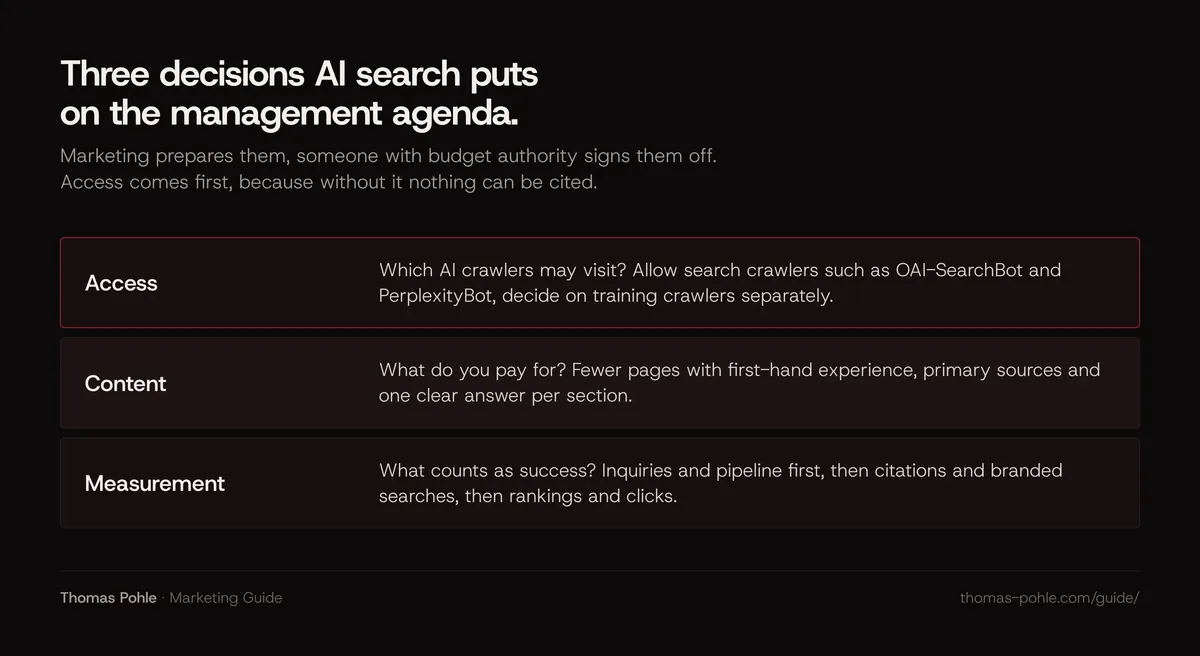
| Decision | Default I would choose | Choose differently if |
|---|---|---|
| Access: which AI crawlers may visit | Allow search crawlers (Googlebot, Bingbot, OAI-SearchBot, PerplexityBot); decide on training crawlers (GPTBot, Google-Extended) separately | Your content is your product, for example paid research or data you sell |
| Content: what you invest in | Fewer pages with first-hand experience, primary sources and one clear answer per section | You sell into a category where buyers search many specific product questions; then add focused question pages |
| Measurement: what counts as success | Inquiries and pipeline first, then citations and branded searches, then rankings and clicks | You sell self-serve; then traffic and signups stay the primary measure |
The access decision has a detail people get wrong. Blocking GPTBot only signals that content shouldn't be used for training. ChatGPT search visibility is governed by OAI-SearchBot. Google-Extended controls use for training Gemini models and doesn't affect inclusion or ranking in Google Search. So you can refuse training and still get cited.
On content, my rule for my own site is the one this guide follows. Every page answers one question in its first paragraph. Every number has a source. Nothing goes up that I can't trace back to where it came from. I built this guide that way on purpose, with a direct answer first, a FAQ and primary sources. The stated goal is to be the answer an assistant can quote.
How do you optimize a website for AI search?
Optimizing for AI search means making each important page easy to retrieve, easy to quote and easy to attribute to you. Open the door for search crawlers. Rewrite key pages so each section answers one question. Make your company a clear entity across the web. And earn mentions on sites that AI systems already trust.
- Access. Check robots.txt, your CDN and any bot protection. Google's page on AI features asks you to make sure crawling is allowed in robots.txt and by any CDN or hosting infrastructure.
- Answer-first pages. Put a complete 40 to 60 word answer under every question heading. My take: that passage is what an assistant is most likely to lift.
- Rewrite, don't multiply. Take your ten most valuable existing pages and restructure them before you write new ones. Add your own numbers, examples and sources.
- Entity clarity. Use the same company name, description and founder details on your site, LinkedIn and directories, and mark them up with Organization and Person schema. The guide on connecting your website and profiles into one brand walks through it.
- Proof that others can check. Author bylines, dated facts and named sources. The guide on E-E-A-T for B2B shows how to show expertise without exaggerating.
- Mentions elsewhere. Trade media, partner pages, podcasts and review sites. In my view, what others write about you shapes how an assistant describes you, even though no provider publishes how much it counts.
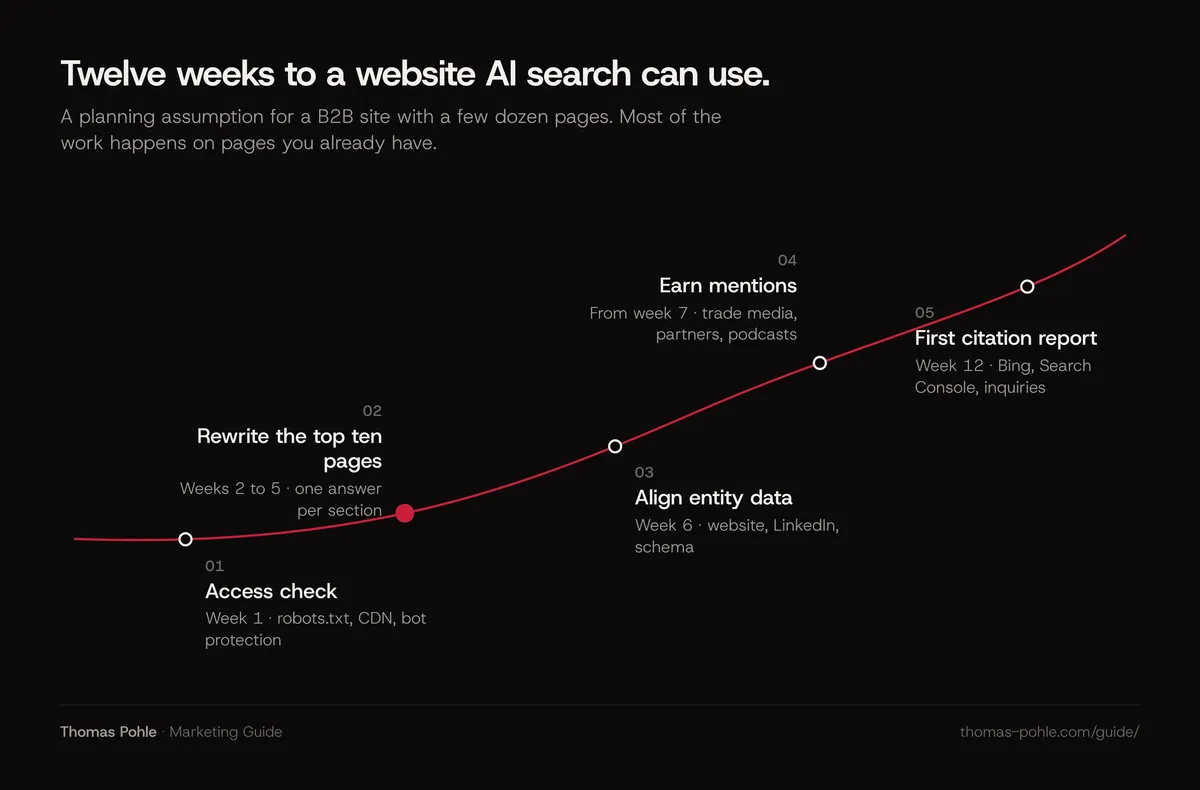
The timeline above is how I'd sequence it for a typical B2B site with a few dozen pages, from the access check in week one to the first citation report in week twelve. It's a planning assumption, not a benchmark. My own site has the access and identity basics in place: llms.txt, JSON-LD for Person and ProfessionalService, a sitemap and hreflang for English and German. Treat llms.txt as optional. Google says you don't need AI text files, and the llms.txt guide explains its honest status.
Do you need SEO, AEO and GEO, or just one of them?
You need one program with three lenses. SEO makes your pages findable and eligible. Answer engine optimization (AEO) makes them quotable as direct answers. Generative engine optimization (GEO) aims at being included and cited in AI-written responses. My view: the work overlaps far more than vendors selling a separate GEO package admit.
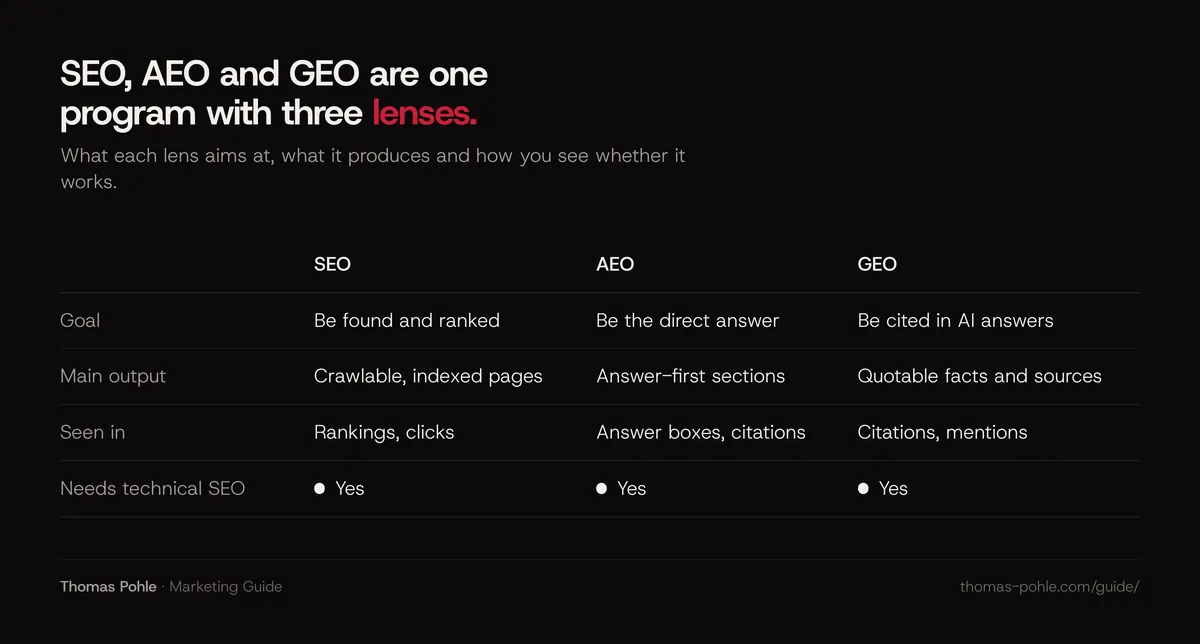
The term GEO comes from a 2023 research paper by Aggarwal and colleagues, accepted at KDD 2024. It reported that optimization can boost visibility in generative engine responses by up to 40 % on its benchmark of 10,000 queries, and that the effect varies by domain. That's a lab result on test engines. It guarantees nothing for ChatGPT or Google. I use AEO as the umbrella term in this guide because it keeps the focus on the buyer's question.
Budget follows from this. Paid search (SEA) buys visibility today and stops when you stop paying. SEO, AEO and GEO are one investment in pages that keep working. For most B2B companies I wouldn't create a separate GEO budget line. I'd make AI citations a goal of the existing SEO and content budget.
Which SEO tasks can AI take over, and which can it not?
AI is good at the repetitive parts of SEO: clustering keywords, drafting outlines and meta descriptions, finding pages without internal links, summarizing Search Console exports and suggesting structured data. It's weak at the parts that create trust. First-hand experience, judging what's true, original data and decisions about positioning stay with you.
- Hand it over. Research summaries, first drafts, title and description variants, alt texts, schema drafts, log and report summaries, internal link suggestions.
- Keep it human. Choosing topics from what sales hears, adding experience and opinion, fact-checking every number, final approval of anything published.
- Watch the line. Google's guidance on generative AI content allows AI help but asks you to fact-check output, including metadata and structured data, and warns against mass-producing pages without added value.
My hard rule: AI may draft. It never decides what's true. A number without a source doesn't go on the page, however good it sounds. For the wider question of where AI fits in marketing work, see where a B2B company should start with AI in marketing.
How do you measure visibility in AI search?
Measure AI search visibility in three layers: what the platforms report, what reaches your site, and what reaches sales. Search Console reports AI Overviews and AI Mode, with impressions in a separate report. Bing Webmaster Tools reports citations in Copilot. Referrals from chatgpt.com and perplexity.ai show up in your analytics.
- Google. AI feature traffic counts toward the "Web" search type in the Performance report. Since 31 August 2026 every site also has a generative AI report with impressions in AI Overviews and AI Mode by page, country and date. No clicks.
- Bing. Since its public preview on 10 February 2026, the AI Performance report in Bing Webmaster Tools shows total citations, cited pages per day, page-level citation counts and a sample of grounding queries for Copilot, Bing's AI summaries and select partners. Bing's announcement doesn't mention click data.
- Your site and CRM. AI referrers in analytics, and one question in every inquiry form or first call: "Where did you first hear about us?" Answers like "ChatGPT recommended you" are, in my view, among the most direct signals you'll get, even though they rely on the buyer's memory.
Third-party tools that track brand mentions in AI answers sample prompts. Their numbers depend on which prompts they run. Use them for trends. Don't treat them as truth. The guide on measuring organic and AI search visibility sets up a monthly report in an afternoon.
What should you look for in an AI SEO agency?
A good AI SEO agency tells you which parts of its work are proven, which are plausible and which are experiments. It starts with your technical base and your best pages. Be careful with anyone who guarantees rankings in ChatGPT, sells llms.txt as the main lever, or measures success only with its own tool.
- Green flags. Cites Google, Bing and OpenAI documentation; audits crawler access first; rewrites existing pages before writing new ones; reports inquiries next to visibility scores.
- Red flags. Guaranteed AI citations; hundreds of AI-written pages per month; "secret" prompt tricks; no answer to the question how they'd know if it doesn't work.
What to do this week
- Open your robots.txt and check that Googlebot, Bingbot, OAI-SearchBot and PerplexityBot aren't blocked. Ask your hosting or CDN provider about bot protection rules.
- Decide on training crawlers (GPTBot, Google-Extended) separately, and write the decision down with the reason.
- Pick your ten most valuable pages and check whether each section starts with a complete answer of 40 to 60 words.
- Verify your site in Bing Webmaster Tools and look at the AI Performance report.
- Add "Where did you first hear about us?" to your contact form and first-call notes.
- Ask ChatGPT, Perplexity and Google AI Mode the five questions your buyers ask most and note who gets cited.
- Put the three decisions (access, content, measurement) on the agenda of the next management meeting.
AI search will keep changing faster than any guide can. Watch the documentation from Google, Bing and OpenAI. Most claims beyond it are still guesses. Want to make these decisions with your team in one day and leave with a plan? That's what a Momentum Workshop is for.
Frequently asked questions
Is SEO dead because of AI search?
No. Google says AI Overviews and AI Mode have no extra requirements beyond normal SEO, and a page must be indexed and eligible for a snippet to appear. ChatGPT search needs its own crawler, OAI-SearchBot, to reach your site. What declines is the number of clicks per search. So SEO shifts from earning visits to earning citations and inquiries.
What is the difference between AI SEO and GEO?
AI SEO is the broad practice of keeping a site visible when AI answers searches: technical SEO, content and measurement. Generative engine optimization (GEO) is the narrower goal of being included and cited in AI-written answers. The term comes from a 2023 research paper. In practice the work overlaps heavily. Most B2B companies should run it as one program.
Should we block AI crawlers?
Separate search crawlers from training crawlers. Blocking OAI-SearchBot removes you from ChatGPT search answers. Blocking GPTBot only signals that content shouldn't be used for training. Google-Extended controls Gemini training and doesn't affect Google Search. Most B2B companies want to be cited, so they allow search crawlers and decide on training crawlers as a separate policy.
Do we need an llms.txt file for AI search?
It's optional. Google states that you don't need new machine readable files, AI text files or special markup to appear in AI Overviews or AI Mode. An llms.txt file costs little and can help tools that read it. But I know of no major AI search provider that documents using it for ranking or citations. Fix crawler access and your key pages first.
How fast can a B2B company see results from AI search work?
Crawler fixes can take effect within days. OpenAI says robots.txt changes for OAI-SearchBot take about 24 hours. Rewritten pages need to be recrawled and reassessed, which can take weeks. Citations and inquiries are noisy. Judge the effect over a quarter, and compare it against a baseline you recorded before you started.
Sources
- Google Search Central: AI features and your website
- Google Search Central Blog: Top ways to ensure your content performs well in Google's AI experiences on Search (May 2025)
- Pew Research Center: Google users are less likely to click on links when an AI summary appears in the results (July 2025)
- OpenAI: Overview of OpenAI crawlers
- Perplexity: Perplexity crawlers
- Google: Google's common crawlers (Google-Extended)
- Google Search Central: Spam policies for Google web search (scaled content abuse)
- Google Search Central: Guidance on using generative AI content on your website
- Bing Webmaster Blog: Introducing AI Performance in Bing Webmaster Tools Public Preview (February 2026)
- Aggarwal et al.: GEO, Generative Engine Optimization (arXiv 2311.09735, KDD 2024)
- Google Search Central Blog: Introducing Search Generative AI performance reports in Search Console (June 2026, rolled out to all sites 31 August 2026)

Thomas PohleB2B marketing advisor in Zurich. More than ten years in B2B marketing at Link11, Beekeeper and smino, most recently as Head of Marketing. CEO and co-founder of TEISENDA. Researched and drafted with AI tools, checked against the sources listed above. More about Thomas