How do you get your company cited by ChatGPT, Perplexity and Google AI?

ChatGPT, Perplexity and Google AI Overviews cite you when three things are true. Their crawlers can reach your pages. Your pages are in the indexes they search. And your page gives the clearest, best-supported answer to the question. Training crawlers like GPTBot and Google-Extended are a separate decision. Blocking them doesn't remove you from AI search.
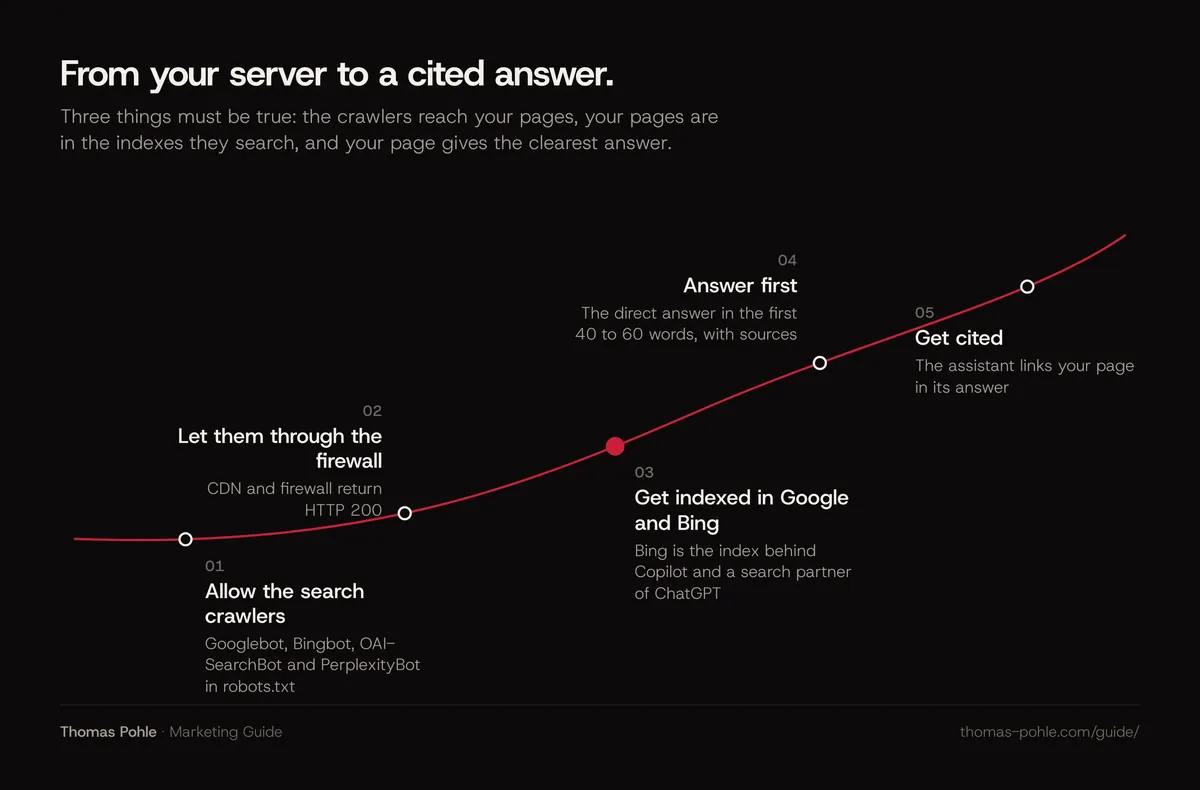
This is the practical version. Want the concepts first? Start with what answer engine optimization is.
Which crawlers do you need to allow?
Each AI provider runs several bots with different jobs. Mixing them up is the most common mistake I see in B2B robots.txt files. The table below is based on each provider's own documentation as of October 2026.
| User agent | Operator | What it controls | If you block it |
|---|---|---|---|
| Googlebot | Crawling for Google Search, including AI Overviews and AI Mode | You lose Google Search and its AI features | |
| Google-Extended | Use of content for Gemini training and grounding in Gemini Apps and Vertex AI | No effect on Google Search inclusion or ranking, per Google | |
| OAI-SearchBot | OpenAI | Surfacing sites in ChatGPT search answers | OpenAI says opted-out sites will not be shown in ChatGPT search answers |
| GPTBot | OpenAI | Content that may be used to train OpenAI foundation models | Signals no training use, independent of search |
| ChatGPT-User | OpenAI | Page visits triggered by a user's request in ChatGPT or a Custom GPT | OpenAI says robots.txt rules may not apply |
| PerplexityBot | Perplexity | Surfacing and linking sites in Perplexity search results | You drop out of Perplexity's search results |
| Perplexity-User | Perplexity | Page visits triggered by a user's question | Perplexity says it generally ignores robots.txt |
| Bingbot | Microsoft | Crawling for Bing, the index behind Copilot citations | You lose Bing, Copilot and partners that use Bing |
For most B2B sites that want AI visibility and no training use, I'd put this in robots.txt:
User-agent: GPTBot
Disallow: /
User-agent: Google-Extended
Disallow: /
User-agent: *
Allow: /
Whether to block training at all is a business decision. If being known by the models matters more to you than control over your text, leave GPTBot and Google-Extended allowed. Both choices are legitimate. Just make yours on purpose.
Timing differs. OpenAI says it can take about 24 hours for its search systems to pick up a robots.txt change. Perplexity says changes may take up to 24 hours. Google says recrawling can take several days to several months.
Check your firewall, too
Robots.txt is only half of access. Many sites sit behind a CDN or web application firewall that blocks unknown bots by default. Google's guidance explicitly says to make sure crawling is allowed by any CDN or hosting infrastructure. Perplexity recommends allowlisting its bots by matching both the user agent and its published IP ranges. OpenAI publishes IP ranges for its crawlers as well. Ask whoever runs your hosting to check the logs for these user agents and confirm they get HTTP 200 responses.
Why does the Bing index matter for ChatGPT and Copilot?
Bing matters because ChatGPT search partly relies on third-party search providers, and OpenAI names Bing as the only one for Enterprise and Edu workspaces. Bing is also the index behind Copilot citations. Many B2B teams still ignore it. That's a mistake.
- OpenAI's help center says ChatGPT search sometimes partners with other search providers and rewrites the user's question into targeted queries for them. For ChatGPT Enterprise and Edu workspaces, OpenAI names Bing as the only third-party search provider. OpenAI doesn't publish how much of a typical answer comes from Bing versus its own crawling.
- Microsoft says its grounding service powers nearly every major AI assistant on the market, without naming them.
- Bing Webmaster Tools added an AI Performance report in public preview in February 2026. It shows how often your pages are cited in Microsoft Copilot, AI-generated summaries in Bing and select partner integrations, which URLs are cited and sample grounding queries.
So verify your site in Bing Webmaster Tools, submit your sitemap and check that your key pages are indexed. Bing supports IndexNow, a protocol for notifying participating search engines (Bing, Naver, Seznam.cz, Yandex and Yep) when a URL changes. Google isn't on that list. IndexNow helps with Bing and does nothing for Google. The technical basics for both engines are in my technical SEO checklist for B2B websites.
How should you write pages that AI assistants quote?
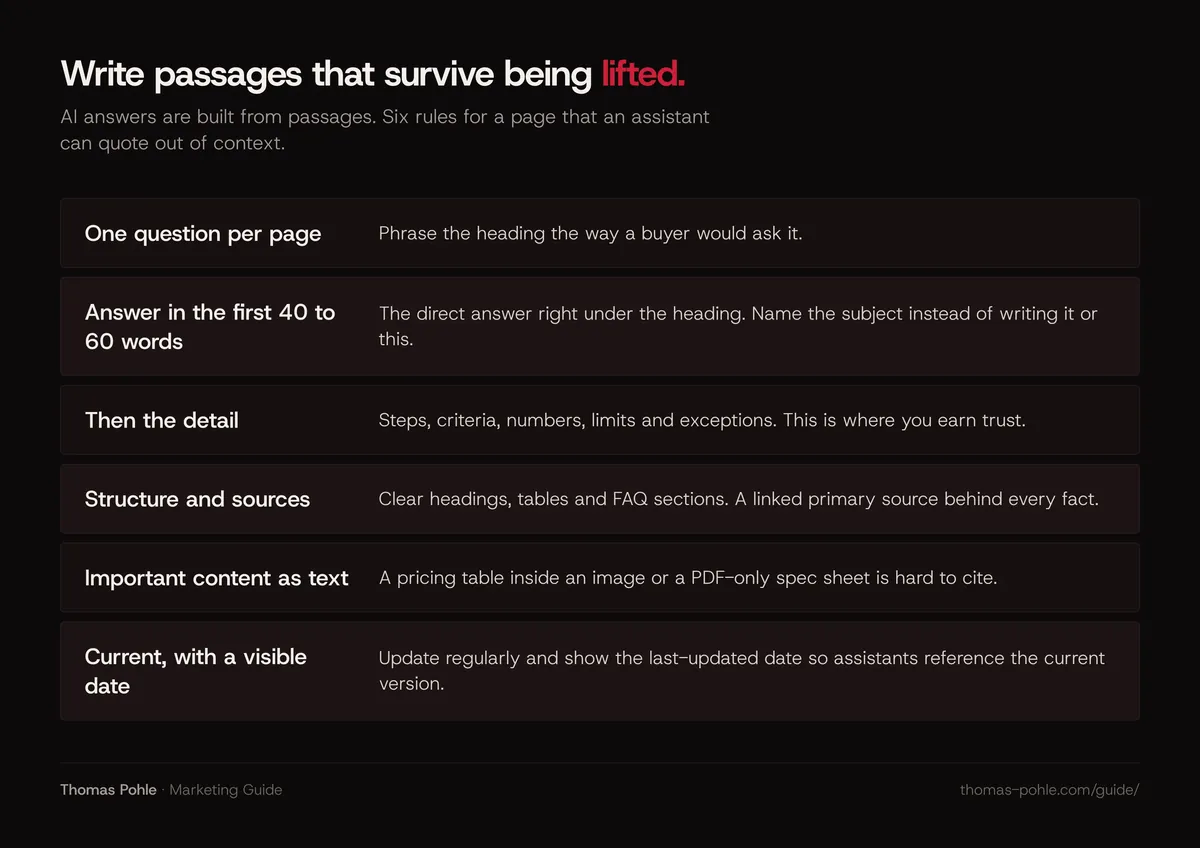
Once access is solved, the page itself decides whether you get cited. AI answers are built from passages. So write passages that survive being lifted out of context.
- One question per page. Phrase the heading the way a buyer would ask it.
- Answer in the first 40 to 60 words. Put the direct answer right under the heading. Name the subject explicitly. Don't write "it" or "this".
- Then give the detail. Steps, criteria, numbers, limits and exceptions. This is where you earn trust.
- Use structure. Microsoft's AI Performance announcement recommends clear headings, tables and FAQ sections so AI systems can use key information accurately.
- Back your claims. Link the primary sources behind any fact. Microsoft recommends supporting claims with examples, data and sources.
- Keep important content in text. Google lists this among the SEO fundamentals for AI features. A pricing table inside an image or a PDF-only spec sheet is hard to cite.
- Keep it current. Microsoft advises updating content regularly so AI systems reference the current version. Show a visible last-updated date.
Google adds one point that matters a lot for B2B: focus on unique, non-commodity content. Assistants have plenty of generic definitions to choose from. They have far fewer pages that explain how your category works for a specific buyer, with real criteria and honest trade-offs. That's where a specialist company wins.
How do you make your company a clear entity?
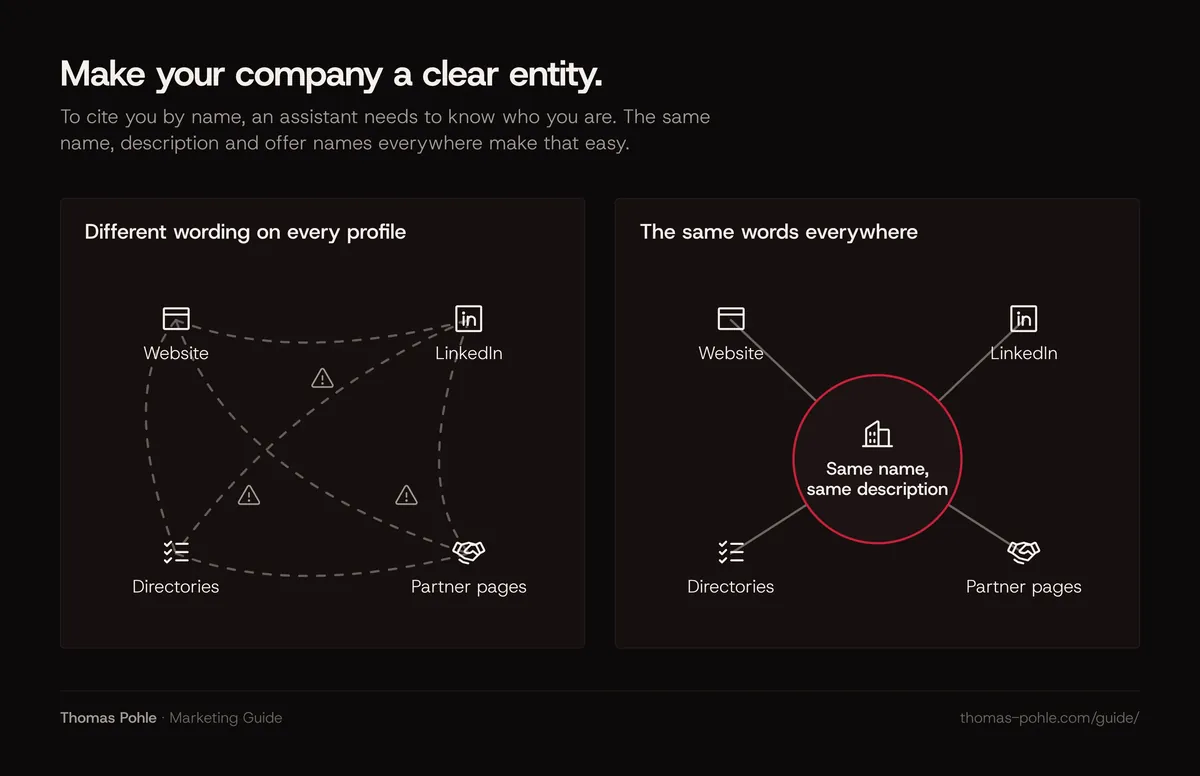
An assistant can only cite you by name if it knows who you are. Make that easy. Use the same name and description everywhere, add structured data, put a named author on every article and publish a plain about page:
- Use exactly the same company name, short description and offer names on your website, LinkedIn, directories and partner pages.
- Add Organization structured data to your homepage. Google says it helps it understand your administrative details and disambiguate your organization in search results. List your official profiles in
sameAs. - Give every article a named author with a bio page that shows real experience.
- Publish an about page that states what you do, for whom and where, in plain sentences.
Details and code examples are in which schema markup a B2B website needs and how to connect your website, LinkedIn and profiles into one brand.
Do third-party mentions help you get cited?
My take: yes, they do. I can't point you to a provider document that quantifies it. The logic follows from how retrieval works. When an assistant searches for "best ERP consultants for mid-sized manufacturers in Switzerland", it finds comparison articles, association member lists, event pages and press coverage. If those pages name you accurately, you appear in the answer, even when your own site isn't the cited source.
In practice, for B2B:
- Keep your profiles on the directories and review platforms of your category complete and accurate.
- Contribute expert quotes or guest articles to the trade publications your buyers read.
- Ask partners and customers who already mention you to describe your offer in the same words you use.
- Speak at events that publish agendas and recaps online.
Skip paid link schemes and mass-produced pages. They don't build the kind of reputation an answer engine can rely on.
What stops a page from being cited?
Before you rewrite a strong page that never shows up in AI answers, rule out the simple blockers. Check these five first. Four are technical. One is about where the answer sits on the page:
- A
noindextag or a robots.txt rule you forgot about. nosnippetor a very lowmax-snippetvalue. Google says more restrictive snippet controls limit how your content is featured in its AI experiences.- A firewall that challenges or blocks crawlers.
- Content that only appears after heavy JavaScript or behind a cookie wall.
- A page that answers the question only in paragraph seven.
A note on llms.txt: Google says you don't need AI text files to appear in its AI features, and adoption by other providers isn't clearly documented. I cover the honest status in what llms.txt is and whether your website needs one.
Checklist for this week
- Open your robots.txt. Confirm Googlebot, Bingbot, OAI-SearchBot and PerplexityBot are allowed. Decide on purpose whether GPTBot and Google-Extended are allowed.
- Ask your hosting or IT contact to confirm the CDN or firewall doesn't block those user agents.
- Verify your site in Google Search Console and Bing Webmaster Tools. Submit your XML sitemap in both.
- Turn on IndexNow if your CMS or CDN supports it.
- List the five questions prospects ask most before buying. Ask each in ChatGPT, Perplexity, Copilot and Google, and write down which sources get cited.
- For two of those questions, publish or rewrite a page with a 40 to 60 word answer under the heading, a named author and linked sources.
- Add or fix Organization structured data on your homepage.
- Check that your company description on LinkedIn matches your website word for word.
Then measure. Watch the Bing AI Performance report, the Generative AI performance report and the Web search type in Search Console, and referrals from AI assistants in your analytics. The setup is in how to measure organic and AI search visibility. Want a second pair of eyes on the questions, the pages and the technical setup? We can work through it together in a one-day Momentum Workshop.
Frequently asked questions
Can I block AI training and still appear in ChatGPT search?
Yes. OpenAI documents GPTBot, which covers training, and OAI-SearchBot, which covers ChatGPT search, as independent settings. Disallow GPTBot and allow OAI-SearchBot in robots.txt. Google has the same split. Google-Extended controls Gemini training and grounding. Googlebot controls Search, including AI Overviews. Google says Google-Extended has no effect on Search inclusion or ranking.
Does ChatGPT search use Bing?
Partly, as far as OpenAI documents it. OpenAI's help center says ChatGPT search sometimes partners with third-party search providers, and it names Bing as the only third-party provider for Enterprise and Edu workspaces. OpenAI also runs its own crawler, OAI-SearchBot. It doesn't publish the share of each. So get well indexed in Bing. It's a sensible precaution.
Can I pay or apply to be cited by AI assistants?
Not for organic citations. Google says there are no special requirements or optimizations for AI Overviews and AI Mode beyond being indexed and eligible for a snippet. OpenAI and Perplexity ask you to allow their search crawlers. None of these providers documents a paid or application route into the cited sources of an answer. You earn it with access and content.
How do I see whether AI assistants cite my site?
Bing Webmaster Tools has an AI Performance report, in public preview since February 2026, that counts citations in Copilot, Bing AI summaries and select partners. Google counts AI Overviews and AI Mode clicks within the Web search type in Search Console. Since 31 August 2026 a separate Generative AI performance report shows the impressions in these features for all sites, without clicks. For ChatGPT and Perplexity, watch referral traffic in your analytics and run regular manual checks.
Sources
- OpenAI: Overview of OpenAI crawlers
- OpenAI Help Center: ChatGPT search
- Perplexity: Perplexity crawlers
- Google Search Central: Google's common crawlers (Google-Extended)
- Google Search Central: AI features and your website
- Google Search Central Blog: Top ways to ensure your content performs well in Google's AI experiences on Search (May 2025)
- Google Search Central: Organization structured data
- Bing Webmaster Blog: Introducing AI Performance in Bing Webmaster Tools public preview (February 2026)
- Bing Blogs: Elevating the role of grounding on the AI web (February 2026)
- IndexNow
- Google Search Central Blog: Introducing Search Generative AI performance reports in Search Console (June 2026, rolled out to all sites 31 August 2026)
- Search Console Help: Generative AI performance report (Search)

Thomas PohleB2B marketing advisor in Zurich. More than ten years in B2B marketing at Link11, Beekeeper and smino, most recently as Head of Marketing. CEO and co-founder of TEISENDA. Researched and drafted with AI tools, checked against the sources listed above. More about Thomas