How do you show expertise to Google and AI (E-E-A-T for B2B)?

You show expertise by making four things obvious: who wrote a page, why that person knows the subject, how the content was made and why a reader can trust it. In practice that means real bylines linked to author pages, first-hand experience only your team can give, sources a reader can check and company details that match everywhere your business appears online. Google calls the underlying concept E-E-A-T: experience, expertise, authoritativeness and trust. It says trust is the most important of the four.
For a B2B company that's good news. Your team usually knows its niche far better than the generic publishers competing for the same searches. Your job is to make that knowledge visible on the page.
What does E-E-A-T actually mean?
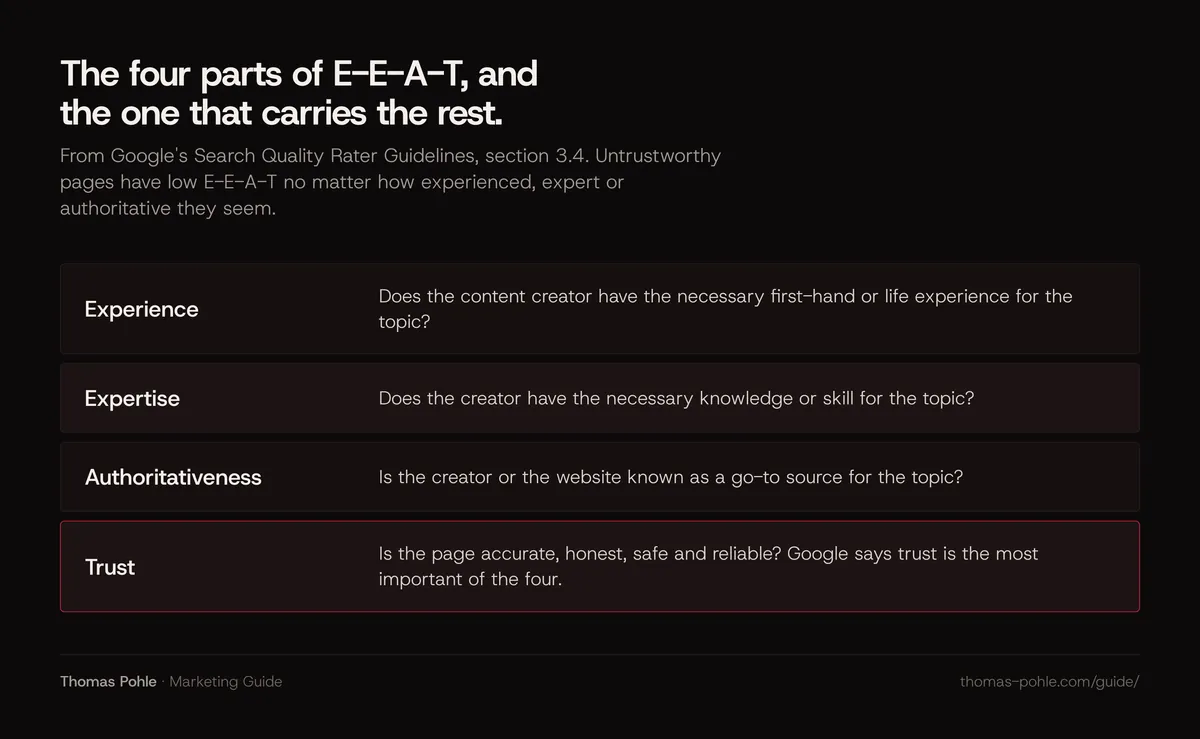
The definitions come from Google's Search Quality Rater Guidelines, the handbook for the people Google pays to evaluate search results. The current version is dated September 11, 2025. In section 3.4, raters are asked to consider:
- Experience. Does the content creator have the necessary first-hand or life experience for the topic?
- Expertise. Does the creator have the necessary knowledge or skill for the topic?
- Authoritativeness. Is the creator or the website known as a go-to source for the topic?
- Trust. Is the page accurate, honest, safe and reliable?
The guidelines put trust at the center. Untrustworthy pages have low E-E-A-T, they say, no matter how experienced, expert or authoritative they may seem. The other three support the assessment of trust, and not every page needs all of them. Some content helps because of the experience it shows. Some helps because of the expertise it shares.
Is E-E-A-T a ranking factor?
No. Google says so directly. Its page on creating helpful, reliable, people-first content states that E-E-A-T itself isn't a specific ranking factor. Google's automated systems use a mix of factors that can identify content with good E-E-A-T. They give it even more weight on topics that could significantly affect people's health, financial stability or safety, or the welfare of society. Google calls these Your Money or Your Life topics, or YMYL.
The raters don't rank anything. Google says search raters have no control over how pages rank and their data isn't used directly in ranking algorithms. Google compares their feedback to the cards a restaurant collects from diners: it tells Google whether its systems seem to work. Google suggests reading the guidelines to self-assess your content and align it conceptually with what its systems reward.
So the practical question is this. Would a skeptical reader, or a rater, find enough evidence on and around your pages to trust them?
Is B2B content a YMYL topic?
Sometimes. The rater guidelines treat YMYL as a spectrum, from clear YMYL to not YMYL, and say many or most topics aren't YMYL. To count, a topic must itself be able to affect people's health, financial stability or safety, or society's welfare.
My reading for B2B: a post about trade show planning is unlikely to be YMYL. Content on tax, payroll, financing, legal compliance, workplace safety or security incidents can move toward the YMYL end. A wrong answer there can cost a company money or expose people to harm. On those pages, raise the bar. Have a qualified person write or review the content, say who reviewed it and cite the law, standard or regulator you rely on.
How do you show who wrote the content?
Google's helpful content page lists three "who" questions. Is it self-evident who authored your content? Do pages carry a byline where one might be expected? Do bylines lead to more information about the authors and the areas they write about? Google says it strongly encourages accurate authorship information, such as bylines, where readers might expect it.
For a B2B site that means:
- A byline on every article. Use a named person. Labels like "Admin" or "Marketing team" tell the reader nothing. If the company is the author, name the company.
- An author page for each regular author. Role, relevant work history, the areas they cover, links to their LinkedIn profile and other places they publish or speak. Keep it factual.
- A reviewer line where it matters. "Reviewed by" a named specialist on compliance, legal or financial topics.
- Author markup that matches the page. Google's Article structured data guidance asks you to include every visible author, use the
Persontype for people andOrganizationfor companies, and addurlorsameAsto help Google identify the author. The details are in which schema markup a B2B website needs.
Don't invent authors. Google's guidance says fabricating creator profiles, such as AI-generated headshots, made-up names or false credentials, is a form of deception that makes a page untrustworthy to users and to its automated systems. My take: a ghost-written article under an executive's name is fine when that executive provided the substance and approved the text. The safest byline is still the person who did the thinking.
How do you show first-hand experience without exaggerating?
Experience is the E that generic content can't fake honestly. Google's helpful content self-assessment asks whether content provides original information, reporting, research or analysis, and whether it clearly shows first-hand expertise and a depth of knowledge. For product reviews, it says readers trust content more when they can see how many products were tested, the test results, how tests were done and evidence of the work, such as photographs.
B2B versions of that evidence:
- Screenshots of your own setup or reports, with sensitive data removed.
- Process descriptions from real projects, at the level your contracts allow.
- Numbers from your own data, with how you measured them and over which period.
- Named client case studies, only with written approval.
- Clear opinions marked as opinions, in first person, from the person who holds them.
My rule for my own writing is simple. If I can't point to where a number or a story came from, it doesn't go on the page. An invented anecdote may read well. It's also exactly the kind of deception the guidelines tell raters to look for.
How should you cite sources?
Google's expertise questions ask whether content presents information in a way that makes you want to trust it, such as clear sourcing and evidence of the expertise involved. They also ask whether the content has easily verified factual errors. Its link guidance notes that linking to other sites, for example when citing sources, can build trust.
- Link to the primary source: the regulator, the standard, the vendor documentation, the original study.
- Use descriptive anchor text so readers know what they'll open. See how topic clusters and internal links build authority for the same rule on internal links.
- Put a visible "last updated" date on pages that change, and change it only when the content changes. Google's self-assessment specifically warns against changing dates to make pages seem fresh.
- Correct mistakes openly. A short correction note builds more trust than a silent edit.
How do you keep your company's entity data consistent?
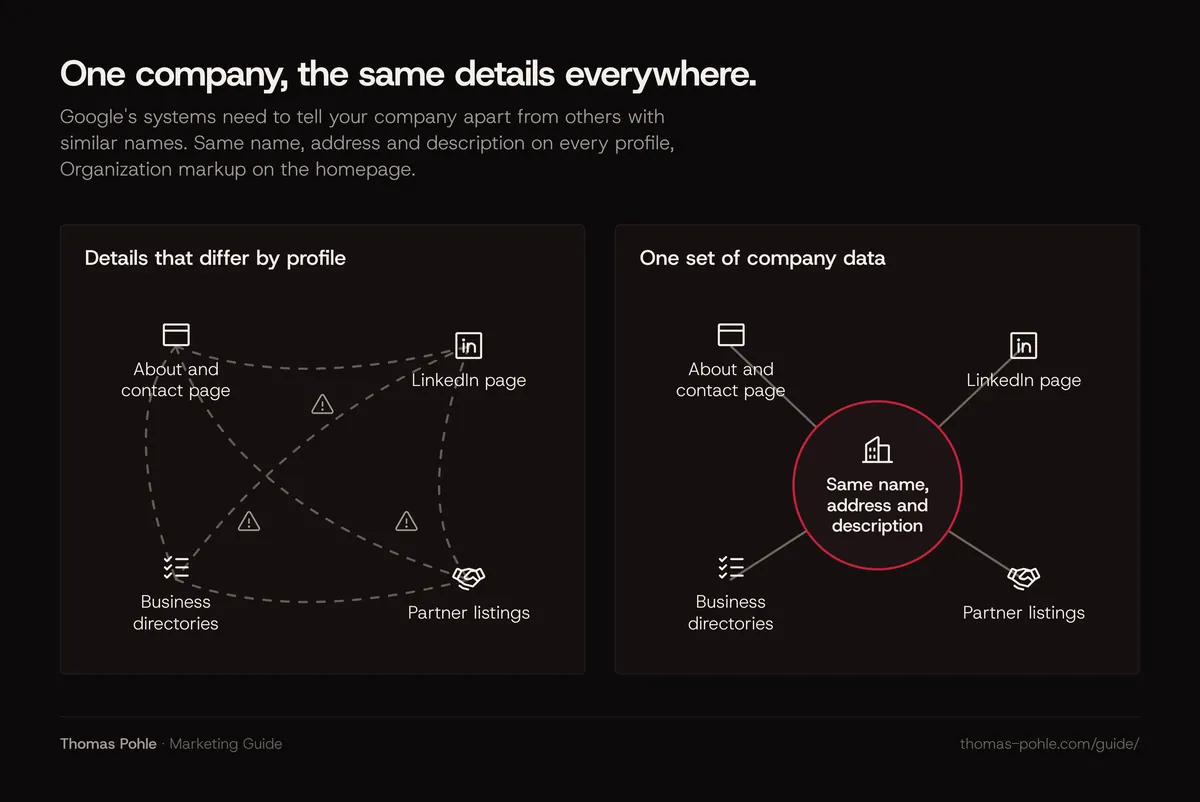
The rater guidelines tell raters to find who's responsible for the website and who created the content, and to look at About, contact and customer service information. They also tell raters to check what others say about a site or creator, through independent reviews, references and news coverage. Google's systems work separately from raters. They still need to tell your company apart from others with similar names.
- Publish a real About page with the legal company name, address, leadership and what you do.
- Make contact information easy to find from every page.
- Add Organization structured data. Google recommends placing it on the homepage and says it helps disambiguate your organization in search results. Its
sameAsproperty lists URLs of profiles on other sites, such as LinkedIn. - Use the same company name, address and description on your website, LinkedIn page, business directories and partner listings.
The full setup is in how to connect your website, LinkedIn and profiles into one brand.
Can you use AI to write content and still show E-E-A-T?
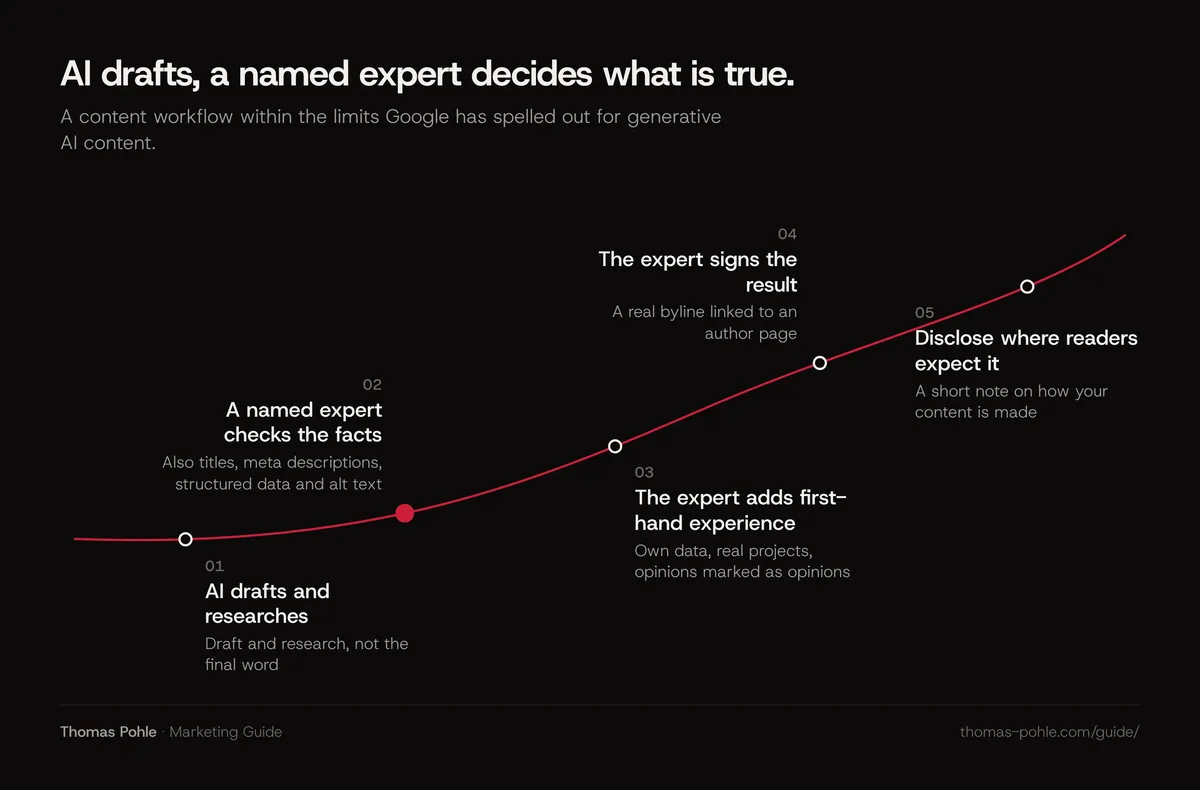
Yes, within limits Google has spelled out. Its guidance on generative AI content says your work must meet the standards of Google Search Essentials. It warns that using AI tools to generate many pages without adding value for users may violate the spam policy on scaled content abuse. AI-generated content must be fact-checked and reviewed for accuracy, it says, and that review also covers metadata such as titles, meta descriptions, structured data and alt text.
The rater guidelines take a balanced line. Generative AI can be a helpful tool, they say, and using it alone doesn't determine a page's quality. They also tell raters to rate pages Lowest when almost all the main content is auto or AI-generated with little effort, originality or added value.
Google also asks whether the use of automation is self-evident to visitors, and suggests disclosures where readers would reasonably expect them. Here's how I'd handle it. AI drafts and researches. A named expert decides what's true, adds the experience and signs the result. That workflow is described in more detail in where a B2B company should start with AI in marketing.
Does E-E-A-T matter for ChatGPT, Perplexity and other AI assistants?
E-E-A-T is Google's framework. For Google's AI Overviews and AI Mode, Google says the same SEO fundamentals apply and no special optimization is needed, and it lists helpful, reliable, people-first content among them. I've found no comparable public documentation from OpenAI or Perplexity on how they judge expertise. Nobody outside those companies can say how they weigh it.
What you can reasonably assume is narrower. Pages with a clear author, specific claims and checkable sources are easier for any system, and any reader, to quote with confidence. For the practical side, see how to get your company cited by AI assistants.
What should you fix this week?
| Check | What good looks like |
|---|---|
| Bylines | Every article names a real person or the company |
| Author pages | Role, experience, topics and external profiles for each regular author |
| Author markup | Person type with url or sameAs, matching the visible byline |
| Sources | Facts link to primary sources, numbers name their origin |
| Experience | Each key page has something only your team could have written |
| Dates | Visible update date, changed only with real updates |
| About and contact | Legal name, address, leadership, contact reachable from every page |
| Entity data | Organization markup on the homepage, same name and details on all profiles |
| AI workflow | Every AI-assisted page fact-checked and approved by a named person |
Start with your ten most visited pages. They show the gaps fastest. Want an outside view on how your expertise comes across, plus a plan to fix it with your team? We can do that in a one-day Momentum Workshop.
Frequently asked questions
Do I need an author page if I am the only person writing?
Yes. Google's helpful content guidance asks whether bylines lead to more information about the author and the areas they write about. One author page with your role, relevant experience, topics and links to your LinkedIn profile answers that question. It also gives readers and raters one clear place to check who stands behind the content.
Does adding author schema improve rankings?
Google doesn't say it does. Its Article structured data documentation says author markup with type and url or sameAs helps Google better understand who the author is. Use it to make authorship unambiguous. The markup must match the visible byline. And it doesn't replace a real author page.
Should I disclose that content was written with AI?
Google suggests disclosing automation where readers would reasonably expect it, and asks whether the use of AI is self-evident to visitors. It doesn't require a label on every page. A short note on how your content is made works fine, for example that AI assists drafting and a named expert reviews everything. It's honest and simple.
How long does it take for E-E-A-T improvements to show results?
Google publishes no timeline, and E-E-A-T isn't a single score that updates. Changes take effect as Google recrawls and reprocesses your pages and as its systems reassess your site over time. Track the pages you improved in Search Console over several months. Compare them with pages you haven't touched.
Can a company with no famous experts still show authority?
Yes. The rater guidelines say most topics have no single official authority and that experience alone can make content helpful. A B2B team that writes specifically about the problems it solves every day, with real examples and clear sources, can show strong experience and expertise. You don't need celebrity authors or press coverage.
Sources
- Google Search Central: Creating helpful, reliable, people-first content
- Google Search Quality Rater Guidelines (September 11, 2025)
- Google Search Central: Guidance on using generative AI content
- Google Search Central: Spam policies for Google web search
- Google Search Central: Article structured data
- Google Search Central: Organization structured data
- Google Search Central: AI features and your website
- Google Search Central: Link best practices for Google

Thomas PohleB2B marketing advisor in Zurich. More than ten years in B2B marketing at Link11, Beekeeper and smino, most recently as Head of Marketing. CEO and co-founder of TEISENDA. Researched and drafted with AI tools, checked against the sources listed above. More about Thomas