Where should a B2B company start with AI in marketing?

Start where marketing work repeats every week and a person can check the result in minutes. For most B2B teams that's four processes: research, content operations, outbound personalization and reporting. Measure how long each one takes today. Let AI do the first pass. Keep a human review before anything reaches a customer, and get the data protection basics right before you scale.
My own stance is simple. Every process starts with one question: can AI do this faster, or do it for us? If yes, the process gets redesigned around AI. If no, you write down why. That habit matters more than any single tool.
How do you choose the first AI use cases in marketing?
Pick processes that pass three tests.
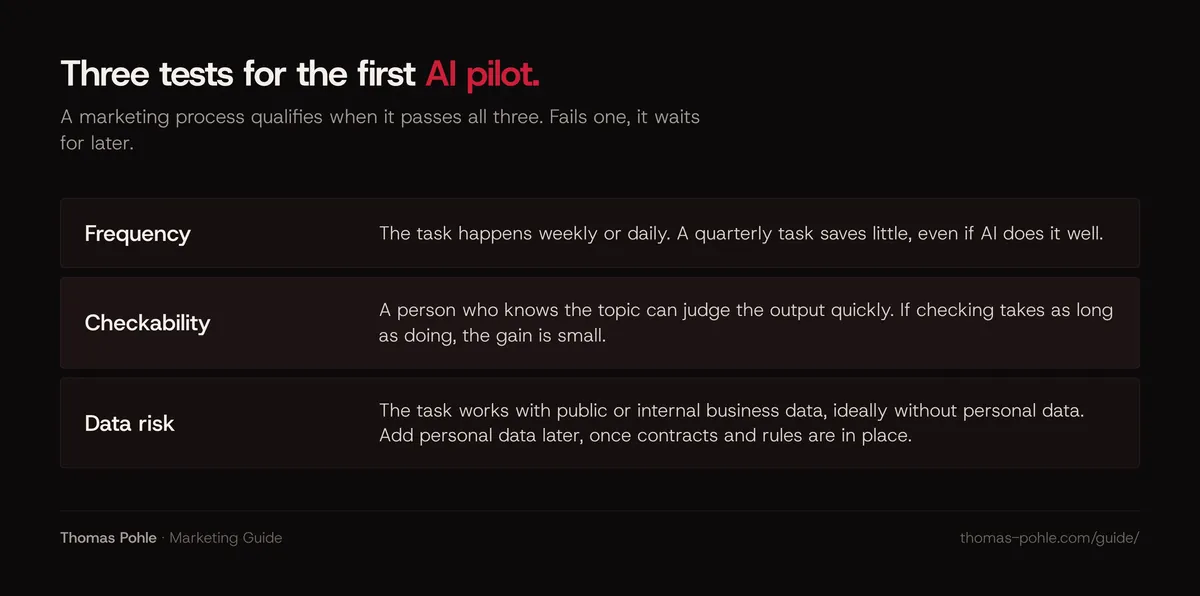
- Frequency. The task happens weekly or daily. A quarterly task saves little, even if AI does it well.
- Checkability. Someone who knows the topic can judge the output fast. If checking takes as long as doing, the gain is small.
- Data risk. The task works with public or internal business data, ideally no personal data. Start there. Add personal data later, once your contracts and rules are in place.
Don't start with the most visible project, like a fully automated content machine or a chatbot on your homepage. Those projects touch your brand, your customers and often personal data, all at once. Start small. Learn how your team reviews AI output. Then widen the scope.
| Process | What AI does first | What a human checks | Data risk |
|---|---|---|---|
| Research | Summarizes markets, competitors, target accounts and call notes | Facts, sources, relevance to your positioning | Low with public data, higher with call recordings |
| Content operations | Briefs, outlines, first drafts, repurposing, metadata | Accuracy, claims, voice, expertise | Low |
| Outbound personalization | Account research and a tailored first line or angle | Fit, tone, whether the claim about the prospect is true | Higher, involves personal data |
| Reporting | Pulls numbers together, flags changes, drafts the commentary | Whether the numbers and the explanation are right | Low to medium |
Which marketing processes should you hand to AI first?
Research
Research is the safest place to start. AI can summarize a market, compare competitor messaging, prepare an account brief before a sales call or cluster the objections from a stack of call notes. The output stays internal, so mistakes don't reach customers. Ask for sources with every summary and spot check them. AI models produce confident errors. One invented fact in a research brief can mislead a whole campaign.
Content operations
Content is where most B2B teams burn the most hours, so the gains are large. Use AI for briefs, outlines, first drafts, turning a webinar into an article, a LinkedIn post and a newsletter, and for the small jobs: titles, meta descriptions, alt text.
Google is clear on the rules. Its guidance on generative AI content says AI can help with research and structure. Generating many pages without adding value for users, though, may violate its spam policy on scaled content abuse. It also tells site owners to fact check AI output, including metadata such as titles and structured data. In practice: AI writes the draft, and an expert adds what only your company knows. First-hand experience, real examples, your opinion. That's also what makes content worth citing, as the guide on showing expertise to Google and AI assistants explains. Planning a content program? Start from a topic plan, as described in how topic clusters and internal links build authority. Then AI speeds up a plan instead of producing random pages.
Outbound personalization
AI is good at reading a company website, a press release or a job posting and suggesting why your offer might matter to that account right now. That turns a generic sequence into something a buyer may actually read. Two rules. First, a person approves every message before it goes out, at least until you trust the process. Second, this use case involves personal data about real people, so your data protection homework comes first. More on that below.
Reporting
Monthly reporting eats hours in many marketing teams. AI can combine exports, flag what changed and draft the commentary for leadership. The person who owns the numbers still checks every figure and every explanation. A model will happily invent a reason for a drop. For a lean reporting setup for search and AI visibility, see how to measure organic and AI search visibility.
Where does a human have to stay in the loop?
Write the review rules down before you start. Here are mine.
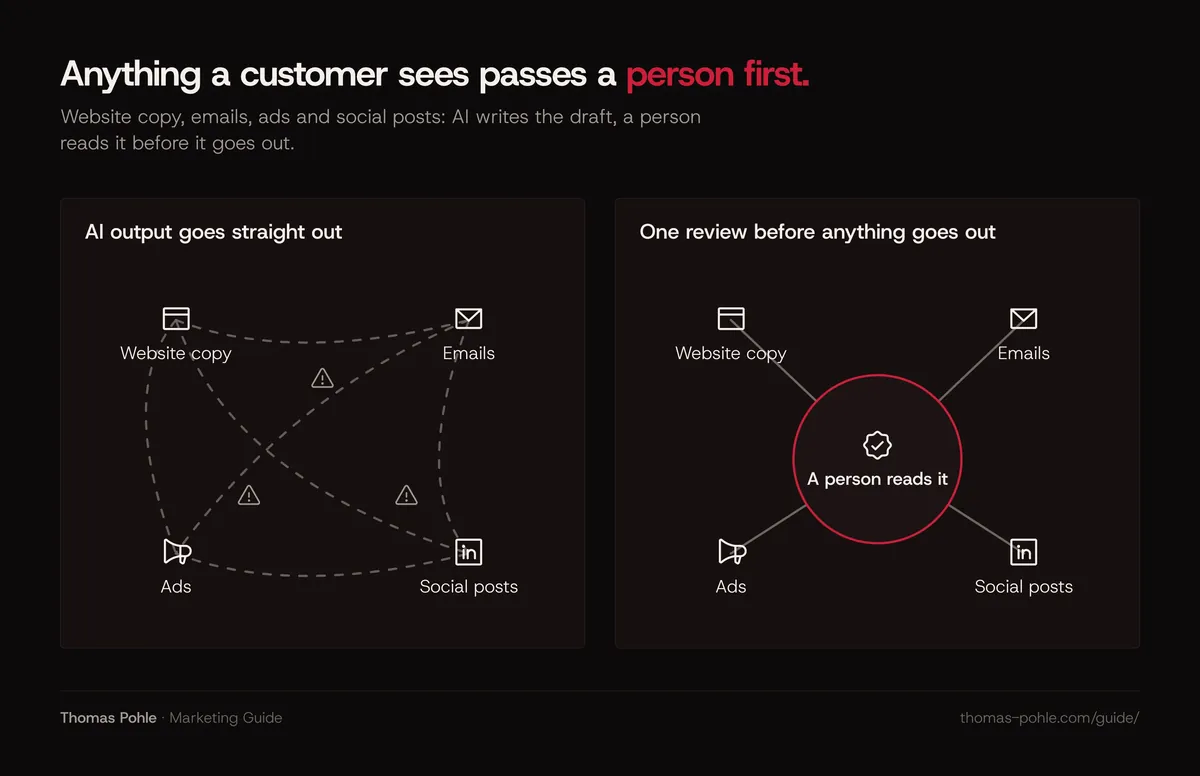
- Anything a customer sees gets read by a person before it goes out: website copy, emails, ads, social posts.
- Every fact, number and quote gets checked against a source. No source, no claim.
- Claims about your product get checked by someone who knows the product and the contracts.
- Decisions about people, such as scoring or excluding leads in ways that matter to them, need special care. The GDPR (Article 22) protects people against decisions based solely on automated processing that produce legal or similarly significant effects. The Swiss FDPIC also points out that people can ask for a human review of automated individual decisions.
Review is also how you train the system. When a reviewer fixes the same issue twice, turn the fix into a rule in your prompt, your style guide or your template.
What do GDPR and the Swiss FADP mean for AI in marketing?
This section covers basics only. It isn't legal advice. Talk to your data protection officer or a lawyer before you put personal data into AI tools.
- The rules apply to AI. If an AI tool processes personal data, data protection law applies. The Swiss Federal Data Protection and Information Commissioner (FDPIC) states that the revised Federal Act on Data Protection, in force since 1 September 2023, is directly applicable to AI-supported data processing.
- Contracts with vendors. Under GDPR Article 28, a processor that handles personal data on your behalf needs a binding agreement that sets out what it may do with the data. Check whether your AI vendor offers one and whether it uses your inputs to train its models.
- Transparency. The FDPIC expects providers and users of AI to make the purpose, functionality and data sources of AI-based processing transparent. It also says people have a right to know whether they're talking to a machine.
- Impact assessments. GDPR Article 35 requires a data protection impact assessment where processing is likely to result in a high risk, including systematic and extensive evaluation of people based on automated processing such as profiling. The FDPIC also requires impact assessments for high-risk AI processing.
- Legal basis. In its Opinion 28/2024, the European Data Protection Board described a three-step test for relying on legitimate interest in AI development and deployment. Decide your legal basis for using personal data in AI-supported marketing case by case.
The EU AI Act adds its own timeline. According to the European Commission, it entered into force on 1 August 2024. Prohibited practices and AI literacy obligations apply since 2 February 2025, rules for general-purpose AI models since 2 August 2025. The main application date, including transparency obligations, was August 2026. The AI Omnibus, in force since 27 July 2026, moved the high-risk deadlines to 2 December 2027 for Annex III use cases and 2 August 2028 for AI built into regulated products. Most marketing use cases aren't high-risk. AI literacy and transparency still hit marketing teams directly. Swiss company selling into the EU? Ask counsel whether and how the AI Act applies to you.
How do you measure whether AI in marketing works?
Measure before you change anything. Without a baseline, every AI project looks like a success.
- Time per unit. Hours per article, per account brief, per monthly report. Measure for two or three weeks before and after.
- Throughput. How many units the same team ships per month.
- Quality. How many corrections a reviewer makes, and how many errors slip through. If time drops and errors rise, you've just moved the work to the reviewer.
- Business outcome. Replies to outbound, qualified pipeline from content, visibility in search and AI answers. These move slowly. Judge them over a quarter.
AI also changes how buyers find you. People ask ChatGPT, Perplexity and Google AI Overviews for vendor shortlists. The guide on answer engine optimization explains how those systems pick their sources and what you can do about it.
What can you do this week?
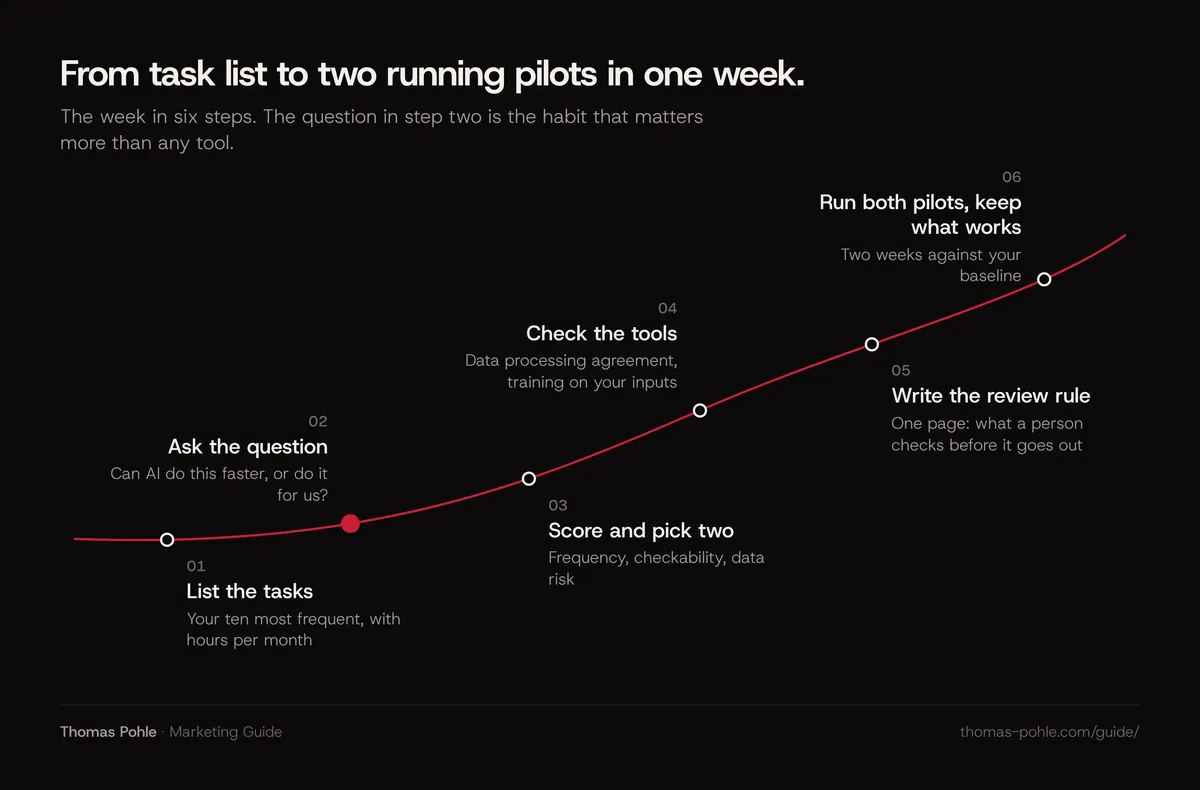
- List your ten most frequent marketing tasks and note the hours each one takes per month.
- Ask the question for each one: can AI do this faster, or do it for us? Mark the answer and the reason.
- Score the candidates on frequency, checkability and data risk. Pick two with low data risk.
- Check your AI tools: is there a data processing agreement, and are your inputs used for training? Write the answer down.
- Write a one-page review rule: what a person must check before anything goes out.
- Run both pilots for two weeks and compare time and corrections with your baseline.
- Keep what works, turn reviewer fixes into rules, then pick the next two processes.
Want an outside view on which processes to start with? A one-day Momentum Workshop with Thomas is built for exactly that decision.
Frequently asked questions
Which AI tools should a B2B marketing team buy first?
Decide the process first and the tool second. Most teams can start with a general AI assistant on a business plan that offers a data processing agreement and keeps your inputs out of model training. Add specialized tools only when a pilot shows a clear time saving and the general assistant has become the bottleneck for that specific process.
Can we publish AI-written content on our website?
Yes. Google doesn't ban AI-assisted content. Its guidance says AI content must meet the same quality and spam policies as any other content, and that mass-producing pages without value for users can count as scaled content abuse. Have an expert fact check every draft. Add first-hand experience, examples and opinions only your company can provide.
Do we need consent to use AI for outbound personalization?
It depends on the data, the channel and the country, so ask your data protection advisor. Under GDPR you need a legal basis for processing personal data, and the EDPB has described a three-step test for legitimate interest in AI contexts. Email marketing rules apply on top. This is general information, not legal advice.
Does the EU AI Act apply to marketing teams?
Parts of it can. AI literacy obligations apply since 2 February 2025, and transparency obligations followed in August 2026, according to the European Commission. Most marketing uses aren't classed as high-risk, whose deadlines the AI Omnibus moved to December 2027 and August 2028. Check with counsel how your specific use cases are classified.
How long until AI in marketing shows results?
Time savings in research, content drafts and reporting usually show within a few weeks of a pilot, as long as you measured a baseline first. Effects on pipeline, replies and search visibility take longer. Review them over a full quarter. Don't draw conclusions from the first month.
Sources
- European Commission: AI Act, regulatory framework and application timeline
- FDPIC: Current data protection legislation is directly applicable to AI (update)
- Swiss Federal Council: revised Data Protection Act takes effect on 1 September 2023
- EDPB: Opinion on AI models, GDPR principles support responsible AI
- Google Search Central: Guidance on using generative AI content on your website
- GDPR Article 22: Automated individual decision-making, including profiling
- GDPR Article 28: Processor
- GDPR Article 35: Data protection impact assessment

Thomas PohleB2B marketing advisor in Zurich. More than ten years in B2B marketing at Link11, Beekeeper and smino, most recently as Head of Marketing. CEO and co-founder of TEISENDA. Researched and drafted with AI tools, checked against the sources listed above. More about Thomas