How do you use AI in marketing without losing quality?

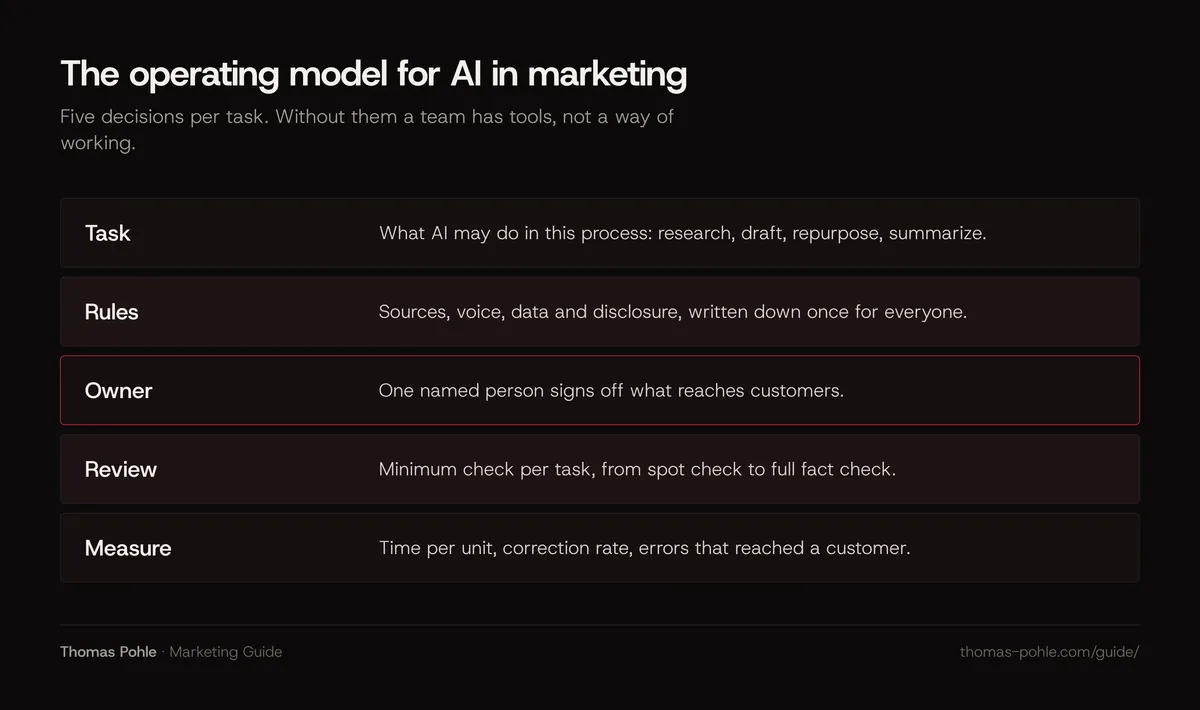
AI in marketing is an operating question. Decide per task what AI may do, which rules it follows and which named person signs off. Let AI research, draft and repurpose. Keep facts, positioning, product claims and final approval with people. And measure correction rates and errors that reach customers next to the time you save.
This guide is for marketing leads and CEOs whose teams already use ChatGPT, Copilot, Claude or Gemini, often without shared rules. It covers what the research says about AI and quality, where quality gets lost, which tasks to hand over, the rules and roles that hold it together, and how to measure the result. Still choosing your first use cases? Start with the guide on where a B2B company should start with AI in marketing.
What does the research say about AI and marketing quality?
Controlled studies show AI can raise both speed and quality on writing and knowledge tasks. On tasks outside its abilities, it lowers quality. The effect depends on the task. So "use AI for everything" and "never use AI" are both the wrong unit of decision for a marketing team. Decide task by task.
Two studies are worth knowing. In an experiment published in Science in 2023, Shakked Noy and Whitney Zhang gave 453 college-educated professionals writing tasks from their own occupations and gave half of them ChatGPT. Average time fell by 40%. Output quality rose by 18%.
A field experiment by researchers from Harvard Business School and others with Boston Consulting Group adds the warning. Among 758 knowledge workers, those using GPT-4 completed 12.2% more tasks and worked 25.1% faster on tasks inside the AI's capabilities, with significantly higher quality. On a task deliberately chosen to lie outside those capabilities, they were 19% less likely to produce a correct solution than people without AI. The authors call this the jagged technological frontier. Tasks of similar difficulty, even in the same workflow, fall on different sides of it.
My reading for marketing: the frontier runs straight through your workflows. Turning a webinar transcript into a LinkedIn post sits inside it for current models. Deciding which customer segment to prioritize, or whether a claim about your product is safe to make, doesn't. One caveat. Both studies measured specific tasks. I know of no public study that measures quality across a whole B2B marketing function. So be careful with any claim that "AI improves marketing by X percent".
Why does quality drop when marketing teams add AI?
Quality drops for four predictable reasons. The model states false things with confidence. Output drifts toward the same generic phrasing everyone else publishes. People stop checking because the text looks finished. And inputs or outputs touch data and rights nobody thought about. The US National Institute of Standards and Technology (NIST) names all four as risks of generative AI.
| Risk (NIST term) | What it looks like in marketing | The guard |
|---|---|---|
| Confabulation | An invented statistic in a blog post, a feature in a sales email that the product does not have | Every number and claim needs a source a person opened |
| Harmful bias or homogenization | Copy that sounds like every competitor, with the same structures and phrases | Voice rules, your own examples, your own opinions, a list of banned phrases |
| Human-AI configuration (over-reliance) | A reviewer skims because the draft looks polished | A named owner signs off, with a short review checklist |
| Data privacy and intellectual property | Customer data pasted into a consumer tool, an AI image too close to someone else's work | A business plan with a data agreement and written rules on what goes in |
Google draws the same line for search. Its guidance on generative AI content says AI can help with research and structure. Generating many pages without adding value for users may violate its spam policy on scaled content abuse. And all AI-generated content should be fact-checked before publishing, including titles, meta descriptions, structured data and alt text. The guide on showing expertise to Google and AI assistants explains what that added value looks like.
My own rule is simple. Never invent a number. Never guess a statistic. Never publish an assumption as a fact. With AI in the loop the rule matters more, because the invented number now arrives in a perfectly written sentence.
Which marketing tasks should AI do, and which not?
Give AI the tasks where output is easy to check and mistakes are cheap: research summaries, first drafts, repurposing, metadata and report drafts. Keep the tasks where judgment is the product with people: positioning, product claims, pricing, final copy customers see and decisions about people. In between, AI drafts and a person decides.
| Task | What AI does | What a person does | Minimum review |
|---|---|---|---|
| Market and account research | Summarizes, compares, cites sources | Checks sources and relevance | Spot check |
| Blog and guide content | Outline, first draft, repurposing | Adds experience, checks facts, edits the voice | Full read and fact check |
| Social media posts | Drafts from your own material | Adds the angle, approves | Full read |
| Sales emails and outreach | Researches the account, drafts a first line | Confirms what is said about the prospect, approves | Every message until the process is proven |
| Automation workflows | Proposes rules, writes variants | Owns the logic and the data | Test before go-live |
| Positioning, pricing, product claims | Collects inputs, argues the other side | Decides | Owner and management |
- Content marketing. AI speeds up the plan you already have. It won't replace the plan, the experience or the opinion. The guide on what content marketing is covers the plan itself.
- Marketing copy and editing. My take: AI is a good editor of your own drafts and a weak author of your voice. Give it your best texts as examples. Ask it to tighten. Don't ask it to rewrite.
- Social media. In my view, a generic AI post is one of the fastest ways to disappear in a feed. Start from your own material, such as a customer call or a decision you made, as described in the guide on LinkedIn for B2B marketing.
- Sales. Account research and call preparation are strong use cases for sales teams. Anything sent under a salesperson's name gets read by that person first.
- Automation. AI can propose and write. The rules that move contacts between stages still need an owner and a test. The guide on marketing automation covers the setup.
I learned where the frontier runs on my own logo. I designed it with AI image models first: seven rounds across several models. Almost everything got rejected. One result became the favorite, but no model could make the one precise change I wanted. So the final mark was rebuilt by hand as vector code. My takeaway: AI image models are good at exploring directions fast and weak at precise final execution. Text often behaves the same way, in my view. That's why the last pass on anything important stays with a person.
Which rules keep AI output correct and on brand?
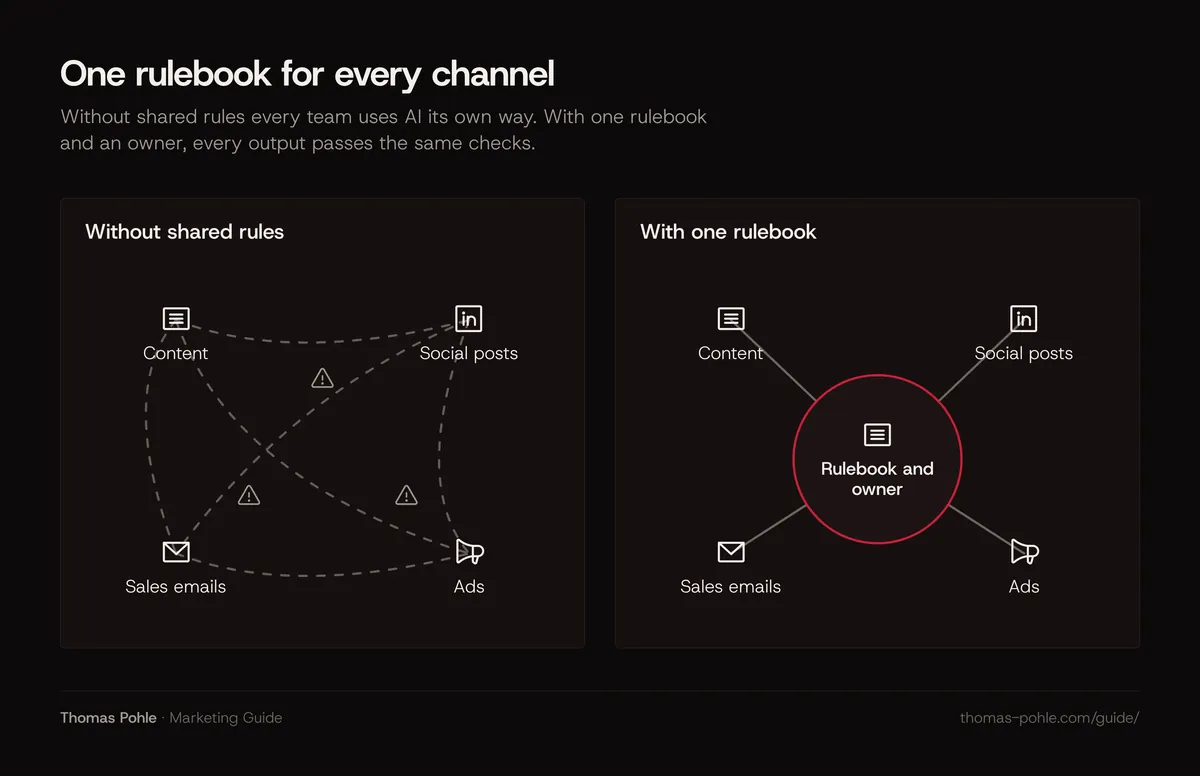
Write the rules down once and give them to every person and every tool: a source rule, a voice guide with examples and banned phrases, a data rule for what may go into which tool, and a disclosure rule. Written rules outlast prompts. They survive tool changes and new team members.
- Sources. Every number, quote and claim about a platform, a law or a competitor needs a source someone opened. No source, no claim.
- Voice. Five to ten of your best texts as examples, a short description of how you sound, and a list of phrases you never use. This is where generic AI copy gets caught.
- Data. Which tools are approved, which data may go into them, and what never does: customer lists, contracts, personal data without a legal basis.
- Disclosure. Google suggests that sharing how content was created can give readers context. Under Article 50 of the EU AI Act, deployers must disclose deep fakes, and AI-generated text published to inform the public on matters of public interest, unless a person reviewed it and someone holds editorial responsibility. Ask counsel how this applies to you. This isn't legal advice.
- Images. No AI image presented as a real customer, event or place.
Then keep the rules alive. When a reviewer fixes the same issue twice, it becomes a rule. That habit is what makes the second month of AI better than the first.
Who is responsible when AI gets something wrong?
The person who publishes is responsible. Never the tool. Name an owner for every output type, define who reviews what, and give the head of marketing the final say on the rules. The EU AI Act points the same way: its disclosure exception for AI-generated text depends on human review and a person who holds editorial responsibility.
- Head of marketing. Owns the rules, approves tools together with IT and data protection, decides when a process is ready to scale.
- Channel owner. Signs off everything AI-assisted in their channel: website, LinkedIn, newsletter, ads.
- Subject expert. Checks facts and product claims before publishing. Often a product manager or a founder.
- Data protection contact. Approves tools and data flows, keeps the data processing agreements on file.
- Everyone using AI. Knows the rules and where they live.
In small companies one person may hold three of these roles. That's fine, as long as the roles are written down. Trouble starts when a draft passes through four people and each one assumes someone else checked the numbers.
Which AI tools and platforms does a marketing team need?
Fewer than most vendors claim. Start with one general AI assistant on a business plan that offers a data processing agreement and keeps your inputs out of model training. Connect it to the places your team already works. Add specialist tools only when a process proves that the general assistant is the bottleneck.
My take: AI should take complexity out of the work. A new tool that adds a login, a dashboard and one more place where content lives does the opposite. When you compare platforms, check five things:
- Data terms. Is there a data processing agreement, and are your inputs used for training?
- Administration. Can you manage users, roles and shared workspaces centrally?
- Data location. Where is data stored and processed, and does that fit your customers' requirements?
- Connections. Does it reach your documents, CRM and calendar, so people don't copy and paste customer data around?
- Cost per real use. In my view, seats nobody uses are the easiest AI cost to overlook.
For sales teams the same logic applies to ChatGPT, Copilot and similar assistants. One approved tool, clear rules on customer data, and prepared prompts for the recurring jobs such as account briefs and call summaries.
How do you measure quality, not just speed?
Measure every AI-assisted process with two numbers: time per unit and correction rate. Add a third, errors that reached a customer, and set thresholds before the pilot starts. If time drops and errors rise, the work has moved to the reviewer or to the customer. Then the process isn't ready.
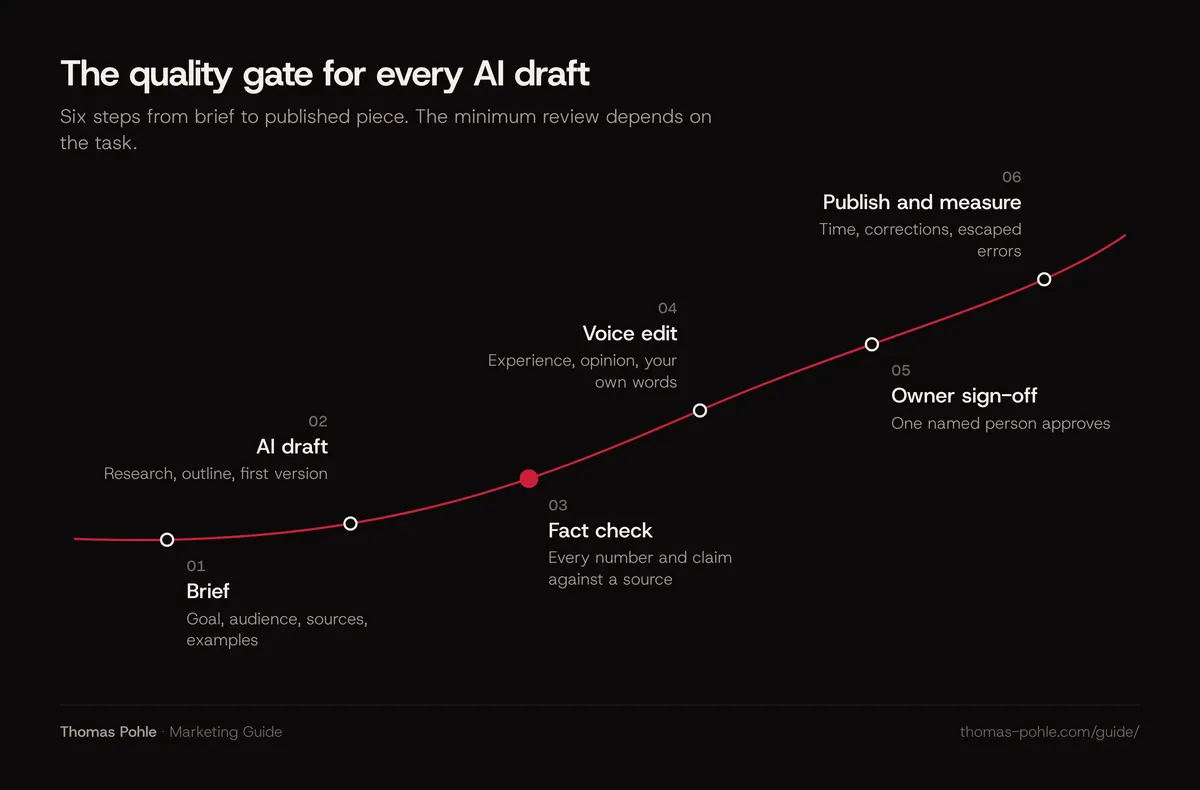
The checklist I'd use. The thresholds are rules of thumb, not research findings:
- Baseline first. Measure time per unit for two to three weeks before AI touches the process.
- Correction rate. Count drafts that need a substantial rewrite. If more than about half still do after four weeks, the task sits outside the frontier or your rules are missing.
- Escaped errors. The target for factual errors that reach customers is zero. Every single one triggers a look at the rule that should have caught it.
- Voice check. Once a month, read five AI-assisted pieces next to five written by hand. If you can tell which is which, your voice guide needs work.
- Business outcome. Replies, qualified pipeline and visibility in search and AI answers, judged over a quarter. The guide on measuring organic and AI search visibility covers the last one.
How do you get your marketing team ready for AI?
Train the team on the workflow. Prompts alone won't do it. People need to know what AI may do in your process, how to check its output, where the rules live and whom to ask. Article 4 of the EU AI Act, in application since 2 February 2025, asks providers and deployers of AI systems to take measures for AI literacy among their staff.
In practice that doesn't need a large program. Three habits carry most of it:
- A shared library of prompts, examples and rules, kept in one place and owned by one person.
- Pairing. Juniors draft with AI, an experienced reviewer explains every correction. The review becomes the training.
- A monthly hour where the team shows what worked, what failed and which rule changed as a result.
Strategy questions sit above this: which processes to change in which order, how marketing and sales share tools, and where a mid-sized company should start. The guide on starting with AI in B2B marketing answers the first of them.
What to do this week
- List every place your team uses AI today, including private accounts. You can't set rules for what you don't know about.
- Map each use to a row of the decision table above and note its minimum review.
- Write a one-page rulebook: sources, voice, data, disclosure, images.
- Name an owner for every output type that reaches customers.
- Check your AI tools for a data processing agreement and a training opt-out. Write the answer down.
- Pick one process, measure time and corrections for two weeks, then switch on AI and compare.
- Put a monthly hour in the calendar to turn repeated corrections into rules.
AI will keep getting better at drafting. Quality will keep depending on what it always depended on: someone who knows the customer, checks the facts and signs the work. Teams that build that operating model now get faster without turning generic. Want an outside view on which processes to start with? A one-day Momentum Workshop is built for that decision.
Frequently asked questions
Does Google penalize AI-generated marketing content?
No, not for the use of AI as such. Google says appropriate use of AI or automation isn't against its guidelines. Its guidance on AI content says AI can help with research and structure, but generating many pages without adding value for users may violate its spam policy on scaled content abuse. Fact-check every piece. Add first-hand experience. Make sure every page answers a real question better than what already ranks.
Do we have to label AI-generated marketing content?
It depends on the content and where you publish. Article 50 of the EU AI Act requires deployers to disclose deep fakes, and AI-generated text published to inform the public on matters of public interest, unless a person reviewed it and someone holds editorial responsibility. My reading: most product marketing falls outside the second case. Check with counsel anyway. Google suggests that explaining how content was created can help readers.
How do you keep your brand voice when using AI?
Give the AI your voice. Don't ask it for one. Collect five to ten of your best texts as examples, describe how you sound in a few sentences and list the phrases you never use. Let AI edit and tighten your drafts instead of writing from nothing. Then compare AI-assisted and handwritten pieces once a month and update the rules where they differ.
Can AI replace a marketing team?
It can take over many hours of work. The judgment stays with people. The research shows large gains on tasks inside AI's capabilities and worse results on tasks outside them, such as complex decisions. A small team with good rules can now cover more channels than before. Someone still has to own the positioning, check the facts and decide what the company says in public.
Which AI tool should a marketing team start with?
Start with one general assistant on a business plan. Skip the stack of specialist tools. Check that the vendor offers a data processing agreement, keeps your inputs out of model training and connects to the documents and systems your team already uses. Add a specialist tool only when a measured pilot shows the general assistant is the bottleneck.
Sources
- Noy and Zhang (2023): Experimental evidence on the productivity effects of generative artificial intelligence, Science
- Dell'Acqua et al. (2023): Navigating the Jagged Technological Frontier, Harvard Business School Working Paper 24-013
- NIST AI 600-1: Artificial Intelligence Risk Management Framework, Generative Artificial Intelligence Profile
- Google Search Central: Guidance on using generative AI content on your website
- EU AI Act, Article 50: Transparency obligations for providers and deployers of certain AI systems
- EU AI Act, Article 4: AI literacy
- European Commission: AI Act, regulatory framework and application timeline
- Google Search Central Blog (2023): Google Search's guidance about AI-generated content

Thomas PohleB2B marketing advisor in Zurich. More than ten years in B2B marketing at Link11, Beekeeper and smino, most recently as Head of Marketing. CEO and co-founder of TEISENDA. Researched and drafted with AI tools, checked against the sources listed above. More about Thomas