How do B2B companies use LinkedIn for marketing?

LinkedIn works in B2B when people carry it. The founder or CEO and two or three experts post from their own profiles every week. The company page backs them up with proof and context. Paid ads push the best posts to a defined list of buyers. Reach comes from people. The page and the ads make it repeatable.
Most B2B companies start the other way round. They post press releases on the company page, collect a few likes from colleagues and decide LinkedIn doesn't work for them. This guide is for founders, CEOs and marketing leads who want LinkedIn as a real channel: who posts what, what the company page is for, when ads are worth the money, how to measure it, and where the deeper guides on each part fit in.
What does LinkedIn do for a B2B company?
LinkedIn keeps a B2B company visible to the people who'll buy from it later, long before they start a purchase. It's the one large network where users are listed by employer, job title and seniority. So you can reach a buying group by name, organically through people's profiles and paid through Campaign Manager.
Size isn't the argument. LinkedIn's newsroom lists more than 1.3 billion members. The argument is timing. LinkedIn's B2B Institute, working with the Ehrenberg-Bass Institute, describes a "95-5 rule": at any moment about 95 % of your potential buyers aren't ready to buy, because B2B purchases happen rarely. Its own example: 75 % of companies buy computers once every four years. The rule is a heuristic. Nobody measured it. The consequence still holds: whoever is remembered when the need arrives gets the call.
My take: LinkedIn is a memory channel first and a lead channel second. Treat it like a sales list and you'll be disappointed. Treat it as the place where your buyers meet your people every week, and leads follow as a side effect.
- Visibility with buyers who aren't in market yet. The 95 % who'll buy in a year or two.
- Trust in your people. Buyers check who they'd work with. A profile with a year of useful posts answers that.
- Hiring and partners. The same posts reach candidates, investors and partners.
- Demand you can steer. Ads put a proven post in front of a named list of companies.
Why do people reach further than the company page?
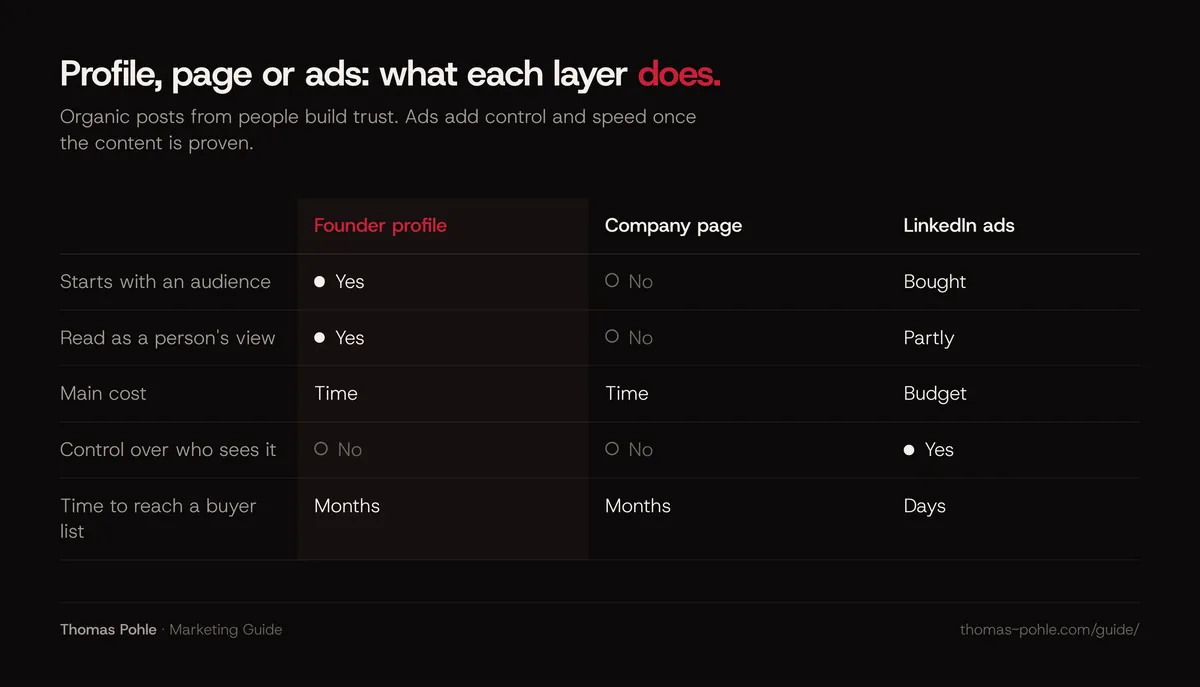
People reach further because LinkedIn's feed runs on relationships. LinkedIn's help center says the feed shows posts from your connections and from people and companies you follow. It counts whether a post comes from someone you're connected to or follow as a ranking signal. A founder with years of connections starts with an audience a new company page simply doesn't have.
LinkedIn names three groups of ranking signals: identity (profile details and professional background), content (topic, recency, who posted it) and activity (the reader's reactions, comments and shares, and who they follow or are connected to). It also says payments from third parties don't influence feed distribution, except for labeled promoted content. Nothing in the documentation says company pages are throttled. They just start with fewer relationships and post in a voice people scroll past.
My take: a personal profile shouldn't feel like the company's distribution channel. The person is broader than the company, and that's exactly why people follow them. My own early signal points the same way. On my profile, a personal founder announcement clearly beat a news-driven AI post, and pure AI thought leadership did substantially worse. That's a small sample, and I treat it as one. It's no rule.
Which four layers make up a LinkedIn presence?
A working LinkedIn presence has four layers: the founder or CEO as the main voice, two to four experts who cover their field, the company page as proof and reference point, and ads that extend what already works. Each layer has its own job. Most companies fail by asking one layer to do the work of all four.
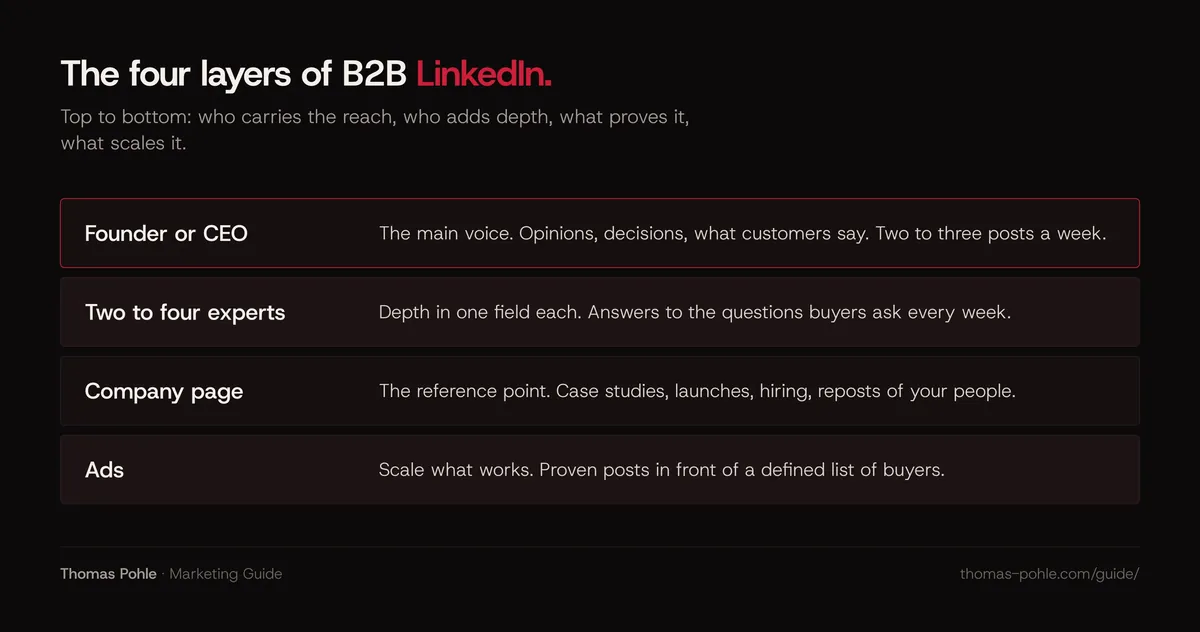
| Layer | Job | Typical content | Start when |
|---|---|---|---|
| Founder or CEO | Reach and trust | Opinions, decisions, what you see at customers | Now |
| Experts | Depth in one field | How-tos, cases, answers to buyer questions | After 4 to 6 weeks of founder posts |
| Company page | Proof and reference | Case studies, launches, hiring, reposts of the people | Set up now, post weekly |
| Ads | Scale what works | Boosted posts, lead forms, retargeting | When an audience of 50,000 or more fits your buyers |
How should founders and executives post on LinkedIn?
My rule of thumb: founders and executives post two to three times a week, from their own profile, in their own words, about what they decide and what they see at customers. The best B2B posts carry one idea, one story or one argument a buyer can use. They end without a sales pitch. Months of consistency beat any single post.
The formats that work are the ones only you can write. A decision you made and why. A mistake. A pattern you saw across customer calls. A number from your own business you're allowed to share. Generic advice is everywhere. Your view on it isn't.
My own LinkedIn rules, the ones I keep on my profile:
- No emojis, no hashtags, no em dashes. The post should read like a person talking.
- No link in the post. The link goes in the first comment. LinkedIn doesn't document how it treats external links, so this is my habit. It's unproven.
- Tags are fine. Tagging people and companies in a post is part of how I work.
- Quality over a fixed schedule. Two to three posts a week is my target. Never post for the sake of the calendar.
The executive doesn't have to write every word. A marketing lead or a ghostwriter can draft, as long as the substance comes from the executive and they approve the final text. A profile that only reposts the company page doesn't work. Buyers notice.
What is the company page for?
The company page is the reference point. Buyers, candidates and journalists check it to see whether the company is real, active and credible. It hosts case studies, launches and job posts, reposts what your people publish, and runs your ads. It rarely drives reach on its own. A weak page still costs you trust.
LinkedIn publishes a few numbers for pages without saying how it measured them. Read them as directions:
- Complete the page. According to LinkedIn, pages with complete information get 30 % more weekly views.
- Post at least weekly. LinkedIn says companies that post weekly see a 2x lift in engagement.
- Use images. LinkedIn says images typically result in a 2x higher comment rate.
- Notify employees sparingly. LinkedIn recommends notifying employees of your most important page posts up to once a week.
Keep the page consistent with your website and your people's profiles: same company name, same one-line description, same logo. That helps buyers. It also helps search engines and AI assistants connect the company to its people. The guide on connecting website, LinkedIn and profiles into one brand shows how.
Case studies are the strongest page content in B2B. A case study written as a citable web page gives the page, the founder and sales the same story to point to.
How do employees and experts fit in?
Employees and experts carry the founder's reach into specific fields. The head of engineering reaches engineers. The customer success lead reaches operators. My take: two to four people who post regularly about their own work beat a company-wide program where everyone reshares the same post. Keep it voluntary, give them topics, and never hand out copy to paste.
Three things make an expert program work. Pick people who already like to explain things. Give them a short list of questions buyers ask every week, because each answer is a post. And measure what they get out of it too: visibility in their field, invitations, candidates.
Their best posts can also be sponsored. LinkedIn's Thought Leader Ads let a company page promote a member's post with the member's permission. LinkedIn's help center lists the conditions: the member's profile must show their full name, the post must be public, and celebrations, documents, polls and multi-image posts aren't eligible. That turns the expert layer and the ads layer into one system.
When are LinkedIn ads worth it for B2B?
LinkedIn ads pay off when three things are true. You can describe your buyers by job, seniority and company. The reachable audience is large enough. And you already have organic posts that work. Then ads put proven content in front of a defined buyer list. Miss any of the three and you mostly buy expensive impressions for content nobody has tested.
LinkedIn's documentation gives the hard thresholds. An ad set needs at least 300 members to run. LinkedIn suggests at least 50,000 to drive results, and at least 300,000 for Sponsored Content and Sponsored Messaging. The minimum daily budget is $10 for any ad format, a new campaign with a lifetime budget needs at least $100, and LinkedIn suggests $25 a day as the default for new advertisers paying in USD. One detail matters for DACH companies. LinkedIn notes that Matched Audiences may be limited in the EEA and Switzerland, where only members who opted in are matched. Your uploaded contact lists shrink.
| Question | Threshold | If no |
|---|---|---|
| Can you name your buyers by job title, seniority and industry? | Yes, in one sentence | Work on positioning first |
| How large is the audience estimate in Campaign Manager? | 50,000 members or more (300 is the hard floor, 300,000 is LinkedIn's suggestion for Sponsored Content) | Widen titles or regions, or stay organic |
| Do you have posts that already work organically? | At least 3 posts with comments from buyers | Run founder posts for 6 to 8 weeks first |
| Can you fund a test long enough to learn? | At least 4 weeks at a steady daily budget | Use Thought Leader Ads on one post |
The audience and budget numbers come from LinkedIn. The other thresholds in the table are my rules of thumb. Here's a typical scenario, with the numbers from LinkedIn's documentation. A Swiss software company sells to finance leads in companies with 200 or more employees in Germany, Austria and Switzerland. The audience estimate in Campaign Manager comes out below 50,000. Instead of narrowing further, the company adds operations leads, who sit in the same buying group. At LinkedIn's suggested $25 a day, a four-week test costs about $700. At the $10 minimum, about $280. The money goes into Thought Leader Ads on the CEO's two best posts. A new ad nobody has seen gets nothing. What that buys in clicks or meetings depends on the market, and I wouldn't trust anyone who quotes a number before the test.
How do you measure LinkedIn marketing in B2B?
Measure LinkedIn by what changes in your pipeline and your conversations. Likes are the weakest signal. Track three levels: reach among the right people (who follows and engages, by title and company), conversations it starts (profile visits, messages, inbound mentions in sales calls) and pipeline it touches (deals where the buyer mentions LinkedIn or engaged with your people).
LinkedIn analytics show impressions, engagement and follower demographics for profiles and pages, and Campaign Manager reports on ads. They can't show the buyer who read your CEO's posts for eight months and then typed your name into Google. That's the normal path in B2B. So add one question to your forms and first calls: "How did you hear about us?" The answer often tells you more than the click data.
- Monthly: followers and engagement from your target titles and companies. Ignore the totals.
- Monthly: inbound messages and meetings where LinkedIn came up.
- Quarterly: share of new opportunities with a LinkedIn touchpoint, and branded search for your company and founder.
The guide on measuring organic and AI search visibility covers the branded search side.
How does LinkedIn fit into the rest of B2B marketing?
LinkedIn is a distribution and trust layer on top of the work you do elsewhere. Positioning decides what your people talk about. Content and case studies give them material. PR earns coverage they can share. Your website is where interested buyers end up. LinkedIn amplifies all of it. It can't replace a clear message.
Plan two connections on purpose. First, PR. An interview or a guest article in a trade medium is the best material for a founder post, and journalists find a founder with a visible profile easier to quote. The guide what PR does for a B2B company covers that side. Second, expertise signals. Google's guidance on helpful content asks whether content is written by someone who demonstrably knows the topic. Named people with an active profile and a consistent role line make that visible, as the guide on showing expertise to Google and AI explains.
This topic is deeper than one page. The parts that deserve their own guide: choosing social channels for B2B and whether Instagram is worth it, social media goals and KPIs, the workflow for a small team, influencer marketing in B2B, and on the paid side ad formats, targeting, Campaign Manager setup and message ads.
What to do this week
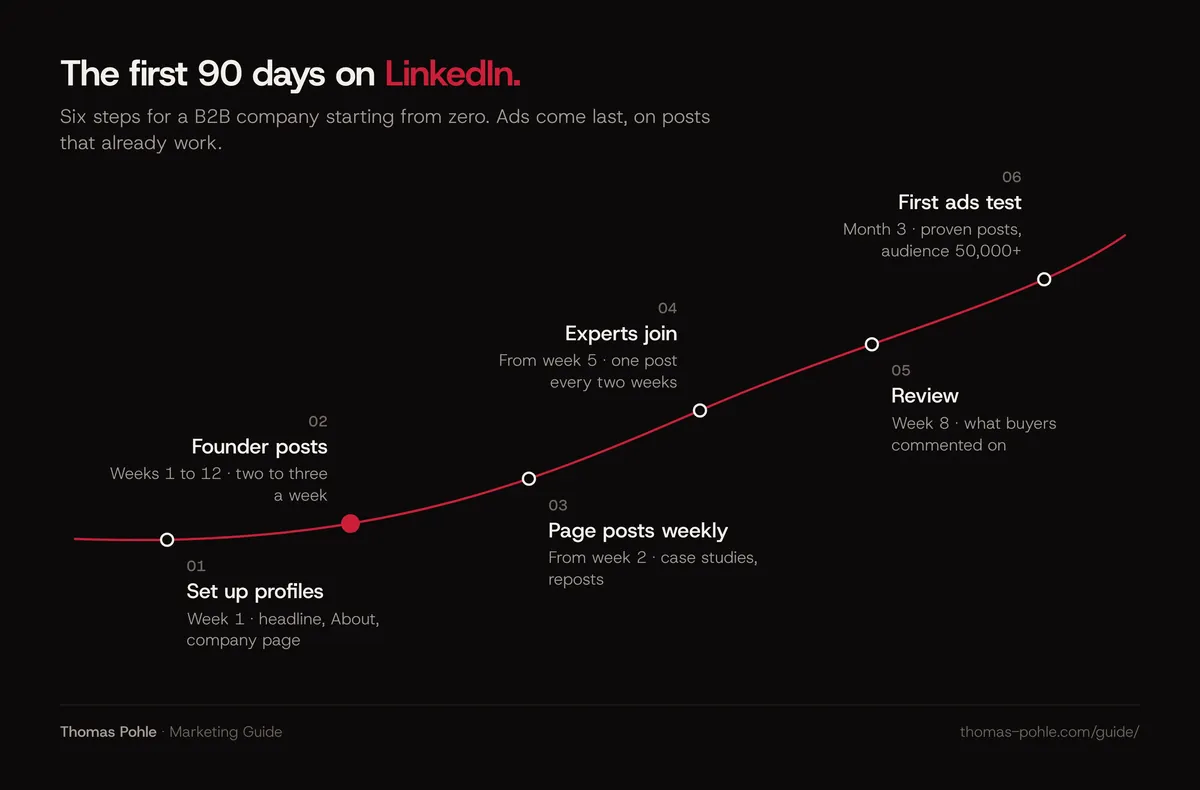
- Pick your main voice: founder, CEO or the one expert who likes to explain. One person. Committees don't post.
- Rewrite that person's headline and About section so a buyer gets in one line what they do and for whom.
- Write down ten questions buyers asked in the last month. Each one is a post.
- Publish the first two posts, no links in the post, and reply to every comment within a day.
- Complete the company page: description, website, logo and the same one-liner as on your website.
- Pick two experts and agree on one post every two weeks each.
- Open Campaign Manager and check the audience estimate for your buyers. Above 50,000? Note it for month three.
- Add "How did you hear about us?" to your contact form and first-call notes.
LinkedIn rewards patience more than tactics. Want a plan for the first 90 days with your team, built in one day? That's what a Momentum Workshop is for.
Frequently asked questions
Should a B2B company post on the company page or the CEO's profile?
Both. They have different jobs. The CEO's profile carries reach and trust, because LinkedIn's feed is built from a member's connections and follows and uses that relationship as a ranking signal. The company page is the reference point for case studies, launches and hiring, and it runs the ads. Start with the CEO. Keep the page complete and post on it weekly.
How often should a founder post on LinkedIn?
Two to three times a week is a good target, as long as the posts have something to say. Months of consistency matter more than frequency. If you have to choose between a weak post today and a strong one on Thursday, wait for Thursday. LinkedIn doesn't publish an ideal frequency for members, so test what you can sustain.
Is LinkedIn worth it for a small B2B company?
Yes, if your buyers are on LinkedIn and someone in the company will post regularly. The organic layer costs time. It costs no money. Ads only make sense once your audience estimate passes about 50,000 members, which LinkedIn suggests as a minimum to drive results, and once you have posts that work.
Do posts with external links get less reach on LinkedIn?
LinkedIn doesn't document that, so nobody outside LinkedIn knows for sure. Many practitioners put the link in the first comment. I do the same, because a post that stands on its own is better anyway. Treat it as a habit to test against your own analytics. It's no confirmed rule.
What do LinkedIn ads cost at minimum?
According to LinkedIn, the minimum daily budget is $10 for any ad format, and new campaigns with a lifetime budget need at least $100. LinkedIn suggests $25 a day for new advertisers. What clicks or leads cost depends on your audience and market. Plan a test of at least four weeks before you judge the channel.
Sources
- LinkedIn Newsroom: About us
- LinkedIn B2B Institute: The 95-5 rule
- LinkedIn Help: LinkedIn relevance, optimizing the member experience
- LinkedIn Marketing Solutions: LinkedIn Pages best practices
- LinkedIn Help: Thought Leader Ads
- LinkedIn Help: Targeting options for LinkedIn Ads
- LinkedIn Help: Target audience size best practices
- LinkedIn Marketing Solutions: Making the most of your budget
- Google Search Central: Creating helpful, reliable, people-first content

Thomas PohleB2B marketing advisor in Zurich. More than ten years in B2B marketing at Link11, Beekeeper and smino, most recently as Head of Marketing. CEO and co-founder of TEISENDA. Researched and drafted with AI tools, checked against the sources listed above. More about Thomas