What is PR and what does it do for a B2B company?

PR, short for public relations, is the work of earning trust through what others say about you: trade media, analysts, partners, event organizers and, today, the AI assistants that quote them. For a B2B company it does three things ads can't. It makes you credible before the first sales call. It puts your name into the sources buyers check. And it gives sales proof that someone independent took you seriously.
Many B2B founders think of PR as press releases nobody reads, or as a crisis tool for large corporations. Both miss the point. This guide is for B2B founders, CEOs and marketing leads. It covers what PR is, what it delivers, which measures work with a small team, how to measure it, and where the deeper guides on press releases, media relations and setting up PR fit in.
What does PR mean?
PR means public relations: the planned, ongoing effort to build understanding and trust between an organization and the people it depends on. The Public Relations Society of America defines it as "a strategic communication process that builds mutually beneficial relationships between organizations and their publics". In B2B, those publics are buyers, journalists, analysts, partners and candidates.
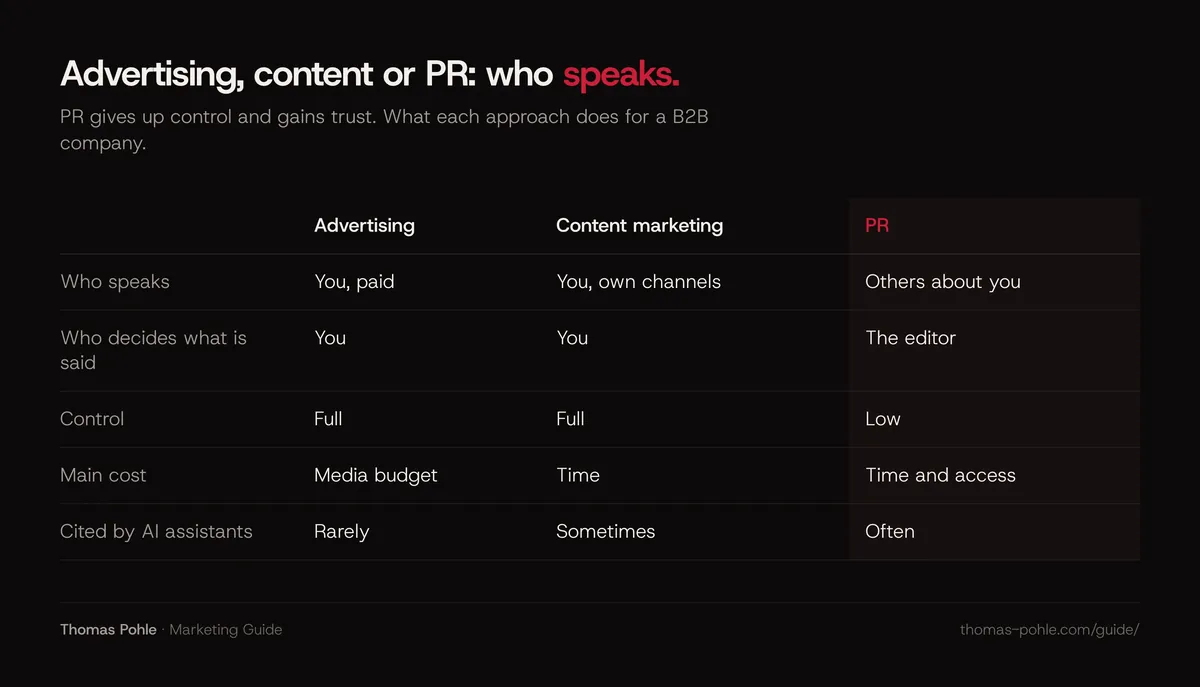
The UK's Chartered Institute of Public Relations puts the core in one line: PR "is about reputation", which it describes as the result of what you do, what you say and what others say about you. That third part sets PR apart. Advertising is what you pay to say. Your website and LinkedIn are what you say. PR works on what others say. That's why buyers believe it more, and why you control it less.
| Type | Who speaks | Example in B2B | Control |
|---|---|---|---|
| Paid | You, for money | LinkedIn ads, sponsored articles, trade fair booths | Full |
| Owned | You, on your channels | Website, blog, newsletter, company page | Full |
| Earned | Others, about you | Trade article, analyst mention, podcast interview, customer quote | Low |
| Shared | People, in their networks | Posts by your founder, experts and customers | Partly |
PR is a family of disciplines. PRSA lists media relations, corporate, executive, internal, crisis and investor communications, speechwriting, events and reputation management among them. My take: a B2B company with fewer than 200 people rarely needs all of them. It needs three: media relations, executive visibility and a clear story.
What does PR do for a B2B company?
PR builds the trust that shortens B2B sales cycles. When buyers research a supplier, they find independent coverage, a founder quoted as an expert and customers who speak in public. It also feeds hiring, partnerships and fundraising. PR rarely creates leads directly. It raises the share of conversations where trust already exists.
B2B purchases involve several people, and most of them never talk to your sales team. The finance lead, the IT security officer and the managing director each check the supplier on their own. What they find decides whether your champion gets a yes. A trade article, a mention in an analyst's market overview or a talk at an industry event answers their question "Is this company serious?" faster than any brochure.
- Credibility before contact. Buyers see that independent sources took you seriously.
- Visibility in the right niche. One article in the trade medium your buyers read beats a mention in a general newspaper they skip.
- Material for every other channel. Coverage becomes a LinkedIn post, a line on the website and a slide in the sales deck.
- Sources for search and AI. Google's self-assessment questions ask about reputation as an authority, and AI assistants cite mostly earned media, as the next sections show.
Who does B2B PR need to reach?
B2B PR has to reach the small set of sources your buyers trust: trade media and newsletters in your industry, analysts and consultants who advise buyers, associations and event organizers, podcasts your buyers listen to, and, increasingly, the AI assistants that summarize all of these. General news media matter far less than in consumer PR.
| Audience | What they need from you | What you get |
|---|---|---|
| Trade journalists | News, data, a named expert who answers fast | Articles and quotes buyers read and search finds |
| Analysts and consultants | A clear category, customer references, briefings | Mentions in the reports buyers use for shortlists |
| Associations and events | Speakers with a useful talk, not a pitch | Stage time in front of a room full of buyers |
| Podcasts and newsletters | A guest with a point of view | Long-form attention from a niche audience |
My rule of thumb: start with a list of 15 to 25 outlets, analysts and events your buyers actually read or attend. Ask sales and your best customers. They know. A short list you work for a year beats a distribution service that sends your news to thousands of addresses.
How does PR shape what AI assistants say about you?
AI assistants build their answers from sources they find on the web. Independent coverage is a large share of those sources. When a buyer asks ChatGPT, Gemini or Claude which suppliers fit their problem, the answer draws on trade articles, reviews and reference pages. A company that only talks about itself on its own site gives them little to cite.
The best available data comes from a vendor. Read it with that in mind. Muck Rack, which sells PR software, analyzed more than 25 million links cited in ChatGPT, Claude and Gemini responses across 17 industries for its May 2026 report. Earned media accounted for 84 % of citations, journalism alone for 27 %, and paid and advertorial content for 0.3 %. Across its editions since July 2025, the earned share ranged from 82 to 89 %.
Google points the same way. Its documentation says there are "no additional requirements to appear in AI Overviews or AI Mode", so the normal quality signals apply. One of Google's self-assessment questions for content asks whether someone researching the site "would come away with an impression that it is well-trusted or widely-recognized as an authority on its topic". That impression comes from what others write about you. That's PR's home ground. The guide on getting cited by ChatGPT, Perplexity and AI Overviews covers the technical side, and answer engine optimization explains how AI answers pick sources.
Which PR measures work for B2B companies?
The PR measures that work best in B2B give journalists and buyers something they can't get elsewhere: your own data, expert commentary on industry news, guest articles in trade media, customer stories told with the customer, and talks at industry events. Save press releases for real news. They don't work as a routine.
| Measure | Best for | Effort | Needs |
|---|---|---|---|
| Expert commentary | Being quoted on industry news | Low, ongoing | A founder who answers within hours |
| Guest article in a trade medium | Depth and authority in one niche | Medium | A clear thesis and an editor's yes |
| Own data or survey | Coverage across several outlets | High | A sample you can defend |
| Customer story with the customer | Proof for buyers in the same segment | Medium | Customer approval, a dated result |
| Talk at an industry event | Buyers in one room, long-term recall | Medium | A useful talk, not a pitch |
| Press release | Real news: funding, launch, partnership | Low per release | Something that's actually new |
PR is where I started. I studied it, with a master's in Public Relations and Corporate Communications from Kingston University London, and I've been a CIPR member since 2017. In one in-house role I placed more than 100 media pieces in Switzerland alone within a year, reaching roughly half a million people. At a cybersecurity company I worked for, thought leadership built around its C-level experts brought the company onto national German TV, in ZDF's heute journal. Start with expert commentary. That's the measure I'd pick first.
My rule for posts and pitches alike: never invent a number, never guess a statistic, never publish an assumption as a fact. A wrong figure in a pitch is hard to take back.
My take: the customer story is the measure B2B companies underuse most. Written as a case study that Google and AI assistants cite, it serves PR, sales and search at once.
What makes a B2B story worth covering?
A B2B story is worth covering when it tells the trade medium's readers something new about their own industry. News about your company alone won't do it. Editors ask one question: why would my readers care? A product update rarely passes that test. Data from your customer base, a trend you can prove, or a sharp opinion on industry news often does.
Run every story through this checklist before you pitch. My rule of thumb: if it fails two or more points, keep it for your own channels. Don't pitch it.
- One sentence without your company name. Can you state the news so it makes sense to a reader who has never heard of you?
- Something new. At least one fact, number or development the outlet hasn't published before.
- Relevance beyond you. It matters to more than one company in the outlet's readership.
- A source for every number. Sample size, period and method ready to send.
- A named person. Someone who can give an interview within 24 hours.
- Fit with the outlet. You've read at least three recent articles by the journalist you pitch.
Press releases still have a place for formal news, and they get cited: Muck Rack's report found press releases show up mostly in AI answers to industry trend questions, at 3.5 times the rate of "best of" queries. Don't treat them as a link tactic, though. Google's spam policies list "links with optimized anchor text in articles, guest posts, or press releases distributed on other sites" as link spam.
How do you set up PR in a B2B company?
Set up PR around one owner in-house. For most B2B companies with fewer than 200 employees, that's the founder or the marketing lead, with a clear story, a short media list and a newsroom page. An agency or freelancer can add contacts and capacity later. Without an internal owner who knows the business, no agency can make PR work.
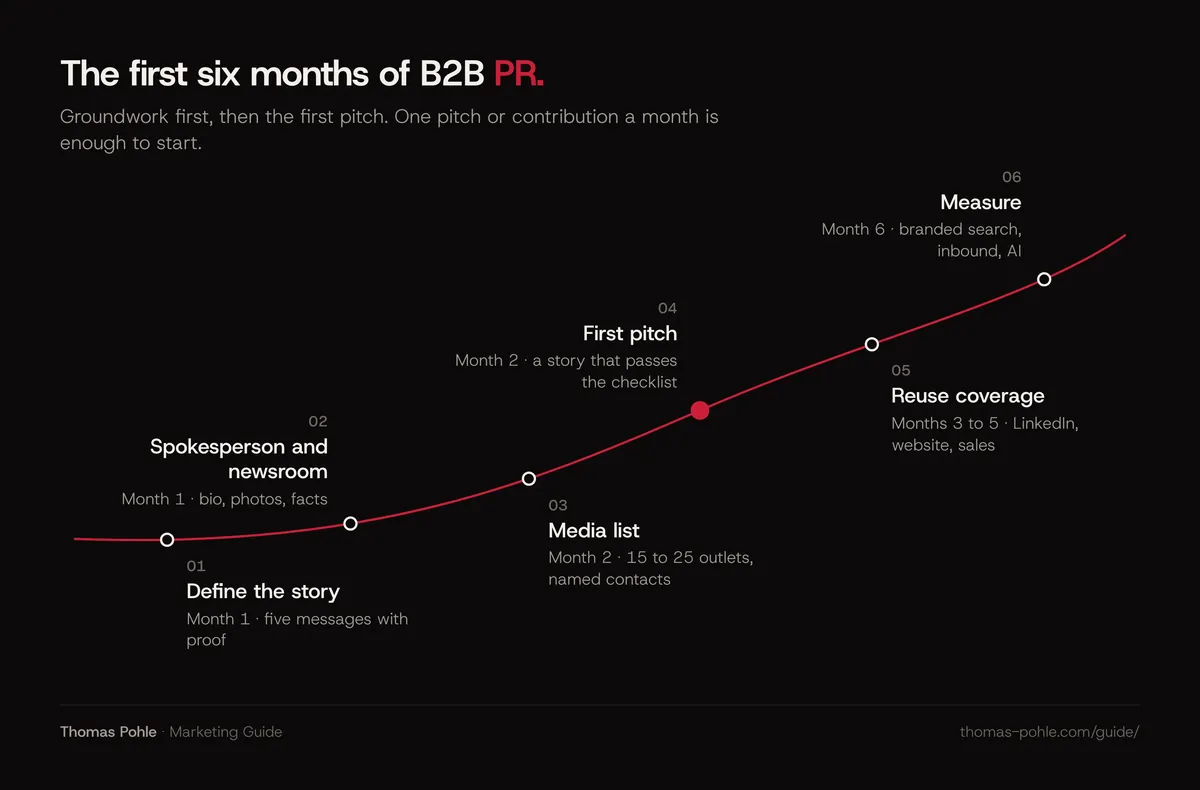
- The story. Three to five messages: what your company does, for whom, why now, and the proof for each. Every interview starts here.
- The spokesperson. One or two named people with a current photo, a short bio and topics they can speak on.
- The newsroom page. Facts, logos, photos, contact and past coverage on your website, so a journalist never has to email you for basics.
- The media list. 15 to 25 outlets, analysts and events with a named contact each.
- The rhythm. My rule of thumb: one pitch or contribution a month is enough to start.
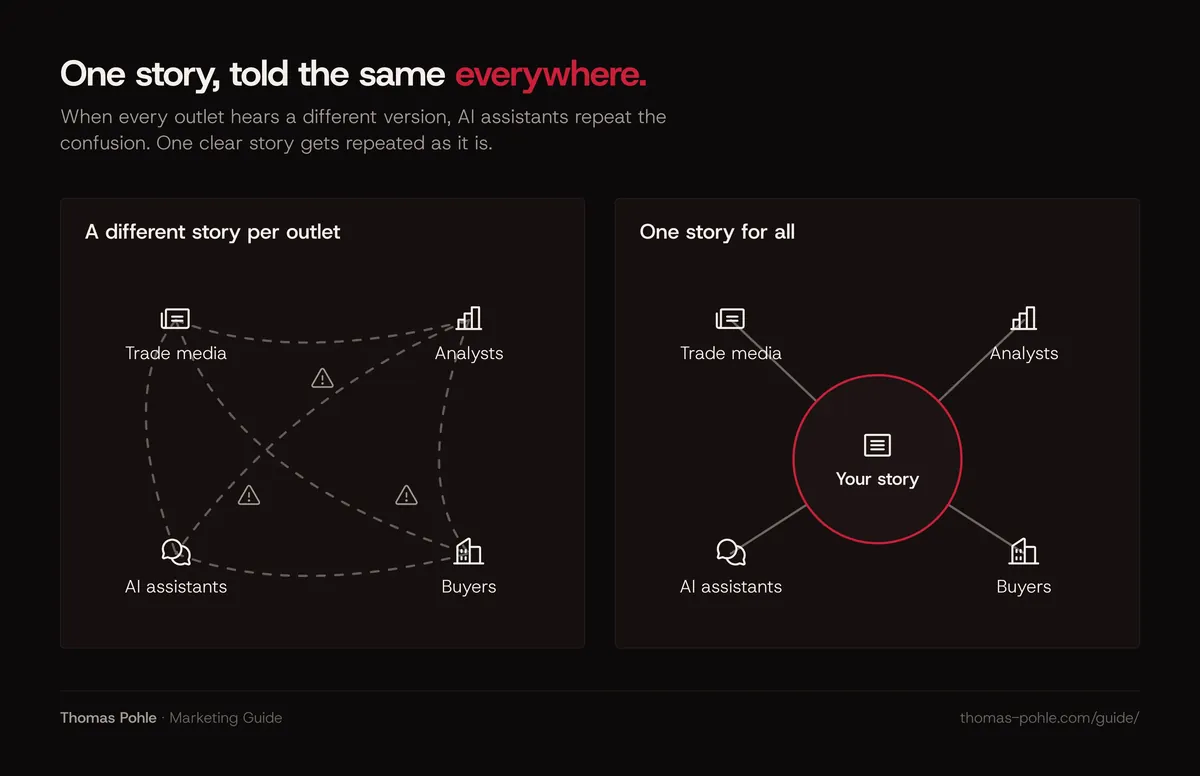
Make sure the company and its people are described the same way everywhere, on the website, LinkedIn and in press materials. Journalists copy what they find. AI assistants combine it. The guide on connecting website, LinkedIn and profiles into one brand covers this, and the LinkedIn guide shows how founders turn coverage into posts.
How do you measure PR?
Measure PR by outcomes. A pile of clippings proves little. The industry standard, the Barcelona Principles 3.0 published by the measurement association AMEC in 2020, asks for goals first, then outputs, outcomes and impact, and states plainly that "AVEs are not the value of communication." Advertising value equivalents only tell you what the space would have cost. Drop them.
- Outputs: articles, quotes, talks and podcast appearances in the outlets on your list. Random outlets don't count.
- Outcomes: branded search for your company and founder, direct visits to the website, inbound requests from journalists and event organizers, mentions of your company in AI answers to your buyers' questions.
- Impact: deals where the buyer mentions an article, a talk or a podcast; shorter time to trust in first calls, as sales reports it.
Check monthly what AI assistants say when you ask the questions your buyers ask, and note which sources they cite. Once your trade articles show up there, PR is working on the channel buyers use more and more. The guide on measuring organic and AI search visibility explains how to track branded search and AI referrals.
Which PR topics should you go deeper on?
PR in B2B splits into a handful of practical topics, each worth its own guide: how to write and send a press release, how media relations works day to day, whether to build PR in-house or with an agency, how PR differs from marketing and corporate communications, how to communicate a technical product, and how to measure reputation over time.
Just starting? Follow the order in this guide. Define the story, pick the outlets, set up the newsroom page, then pitch. Press releases and agencies come later, once there's news and a rhythm to support.
What to do this week
- Write your company story in five sentences: what you do, for whom, why now, and two proofs with a source.
- Ask sales and three customers which trade media, newsletters, podcasts and events they follow. Build a list of 15 to 25.
- Read three recent articles from the top five outlets on the list and note who writes about your topic.
- Create a newsroom page with facts, photos, spokesperson bio and contact.
- Pick one story that passes the six-point checklist above and draft a pitch of under 150 words.
- Ask ChatGPT and Gemini the two questions your buyers ask most and save which sources they cite.
- Set up a monthly check: coverage on your list, branded search, inbound requests, AI citations.
PR is slow. That's its value. Trust that took a year to earn is hard for a competitor to copy. Want to define the story and the first six months with your team in one day? That's what a Momentum Workshop is for.
Frequently asked questions
What is the difference between PR and marketing?
Marketing covers everything a company does to create demand, much of it on channels it controls or pays for. PR focuses on earned attention: what journalists, analysts, event organizers and other independent voices say about you. In B2B the two work best together. PR supplies the credibility. Marketing distributes it on the website, LinkedIn and in sales.
Does a small B2B company need a PR agency?
Usually not at the start. The founder or marketing lead should own the story, the media list and the first pitches. They know the business. An agency or freelancer makes sense once there's a rhythm of news and the team lacks contacts or time. Hire an agency before the story is clear and you mostly buy distribution.
Are press releases still useful?
For real news such as funding, a launch, a partnership or new data, yes. A short release on your newsroom page gives journalists the facts they need. Muck Rack's analysis found press releases are cited by AI assistants mostly in answers to industry trend questions. Don't use them for links. Google treats optimized anchor links in distributed press releases as link spam.
How long does it take for B2B PR to show results?
There's no reliable benchmark. It depends on your news, your niche and how focused your list is. Plan a first test of six months with one pitch or contribution a month. Then judge by outcomes such as branded search and inbound requests. PR compounds. Each article makes the next pitch easier, so a slow start is normal.
What does PR mean in German?
PR stands for public relations, in German Öffentlichkeitsarbeit. German companies often say Pressearbeit when they mean media relations. That's only one part of PR. Both terms are common in DACH B2B, and the English abbreviation PR is widely used as it's.
Sources
- PRSA: About public relations
- CIPR: About PR
- Muck Rack: What is AI reading? (May 2026 update)
- AMEC: Barcelona Principles 3.0
- Google Search Central: Spam policies for Google web search
- Google Search Central: AI features and your website
- Google Search Central: Creating helpful, reliable, people-first content

Thomas PohleB2B marketing advisor in Zurich. More than ten years in B2B marketing at Link11, Beekeeper and smino, most recently as Head of Marketing. CEO and co-founder of TEISENDA. Researched and drafted with AI tools, checked against the sources listed above. More about Thomas