How do you write a B2B case study that Google and AI assistants cite?
A case study gets cited when a machine can quote it as it stands. Put the result in the headline and the whole story in one 50-word paragraph under it. Below that, short sections with real names, dated numbers and a source for each claim. Publish it as an HTML page, never only as a PDF, mark it up as an article, and link to it from the pages that already rank.
Most B2B case studies are built for the sales deck: a logo, three bullet points, a quote nobody said that way. Search engines and AI assistants can't do much with that. Neither can a buyer who lands on the page cold. This guide is for founders and marketing leads with one or two happy customers who want each story to work three times: in a sales call, in Google, and in the answers ChatGPT, Perplexity and Google's AI Overviews give.
What makes a case study citable?
A citable case study is a page a machine can quote without rewriting it. It has a clear question in the headline, a complete answer in one paragraph, named people, dated numbers and a visible source for every claim. Google's guidance on helpful content asks for first-hand expertise and original information. A real customer story is exactly that, if you write it down properly.
Use Google's self-assessment questions as your checklist. They ask whether content provides "original information, reporting, research, or analysis", whether it "clearly demonstrate[s] first-hand expertise and a depth of knowledge", and whether it is "written or reviewed by an expert or enthusiast who demonstrably knows the topic well". They also ask whether you are "writing to a particular word count because you've heard or read that Google has a preferred word count" and answer it right there: "(No, we don't.)"
AI features set the same bar. Google states that there are "no additional requirements to appear in AI Overviews or AI Mode, nor other special optimizations necessary" and that "the best practices for SEO remain relevant for AI features in Google Search". The recommendations are plain: important content in text form, good images, structured data that matches the visible text, internal links. A case study that's a PDF behind a form fails three of those four.
Which elements does a citable case study need?
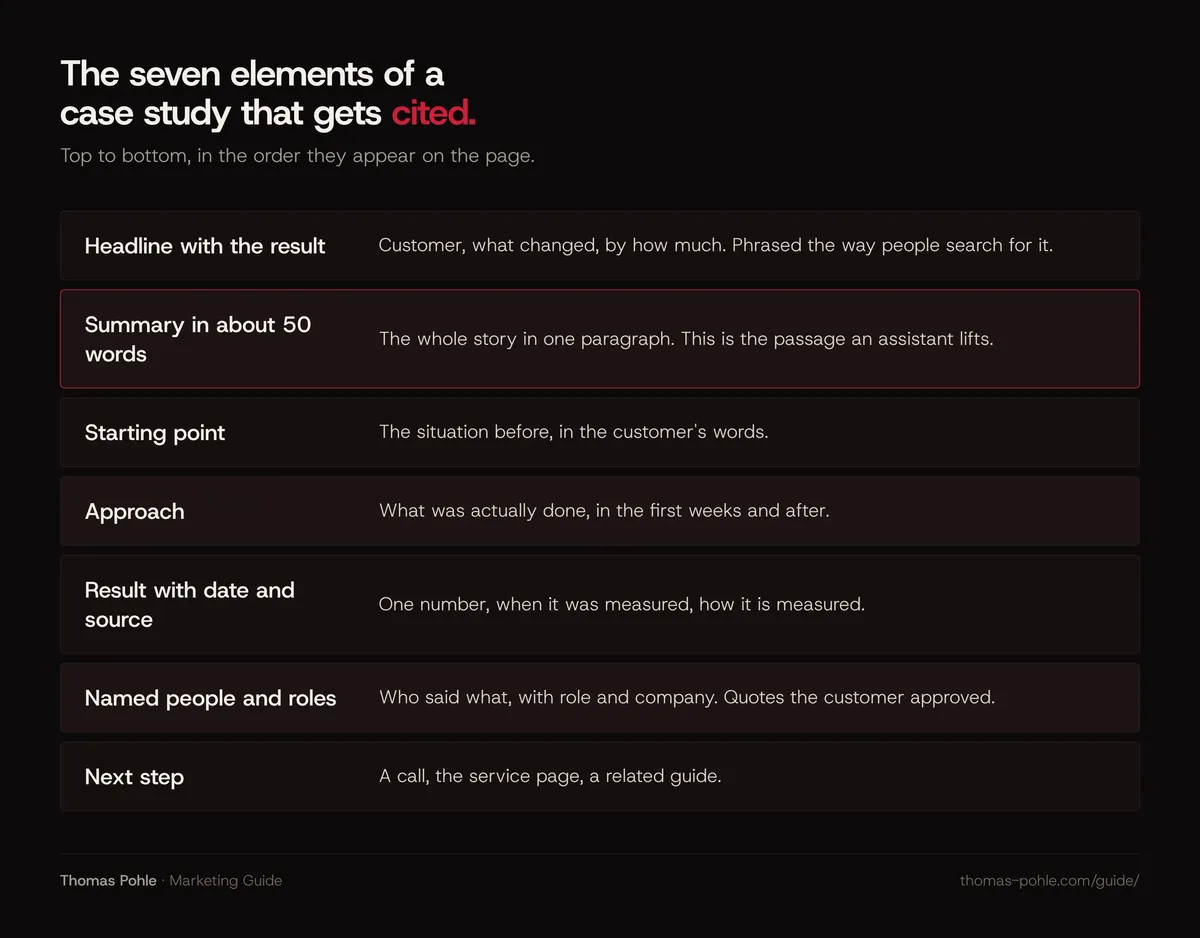
A case study needs seven elements in a fixed order: a headline with the result, a one-paragraph summary, the starting point, the approach, the result with dated numbers, named people with their roles, and a next step. Each one serves the reader first. Each one also gives search engines and assistants something concrete to index and quote.
| Element | What the reader gets | What search and AI get |
|---|---|---|
| Headline with the result | Knows in one line whether this story is for them | A query-shaped title ("How X cut onboarding time in half") |
| Summary in about 50 words | The whole story before the scroll | A passage that can be lifted as an answer |
| Starting point | Recognizes their own situation | Problem vocabulary buyers search for |
| Approach | Learns what was actually done | First-hand detail that generic content lacks |
| Result with date and source | Can trust the number | A verifiable claim instead of a slogan |
| Named people and roles | Knows who stands behind the quote | Entities that connect the page to real companies |
| Next step | Knows what to do | Internal links to the pages that should rank |
Keep that order. Most teams skip the summary, and it's the part that matters most for citation. When an assistant answers "how did company X reduce Y", it needs one paragraph with the customer, the problem, the approach and the result. If yours doesn't have it, the assistant picks a page that does.
How do you get the customer's yes?
Ask early, ask for little, and make approval easy. Name and logo first, numbers second, a quote last. Show the customer the draft before anyone else sees it, give them a deadline for changes, and accept an anonymized version if the alternative is no case study at all. That's how you get the yes.
My rule of thumb: ask right after a result lands. Three months later the energy is gone. Ask the person who felt the result, never procurement, and be specific: company name, one number, one quote, the name and role of the person quoted. A clear list gets a faster yes than "can we do a case study".
- Name and logo. The minimum. Without the company name the story has no entity to attach to, and a reader can't verify anything.
- One number with a date. "Onboarding time went from 14 days to 6 days between March and June 2026." A number without a date reads like marketing.
- One quote from a named person. Role and company next to the name. The quote should say something only that person could say.
- Approval in writing. One e-mail with the final draft attached and a sentence on what gets published where. Keep it.
If the customer says no to the name, publish an anonymized version. It helps in sales conversations. It will rarely get cited, because there's no entity to cite. Ask the next customer.
How do you run the interview?
Run one recorded conversation of about 30 minutes with the person who owned the problem. Ask about the situation before, the moment they decided to change something, what the first weeks looked like, and what they'd tell a peer. Then write the story from the transcript. Your own pitch has no place in it.
Six questions are enough. Ask them in this order and let the answers run long:
- What did a normal week look like before this started?
- What was the moment you decided something had to change?
- What did you try first, and why didn't it stick?
- What did the first four weeks with the new approach look like?
- Which number changed, and how do you measure it?
- What would you tell a peer in your role who is where you were a year ago?
Question six usually gives you the quote. Question five gives you the number and how it's measured. Record the call, transcribe it, and keep the customer's wording wherever it's more concrete than yours. It almost always is.
How long does a case study take from first call to publication?
In my experience a case study takes about four weeks from the first ask to the published page when you run it as a small project. One week to pick the customer and get the yes, one week for the interview and the draft, one week for approval, one week to publish and distribute. Most of that time is waiting for the customer, so start two at once.
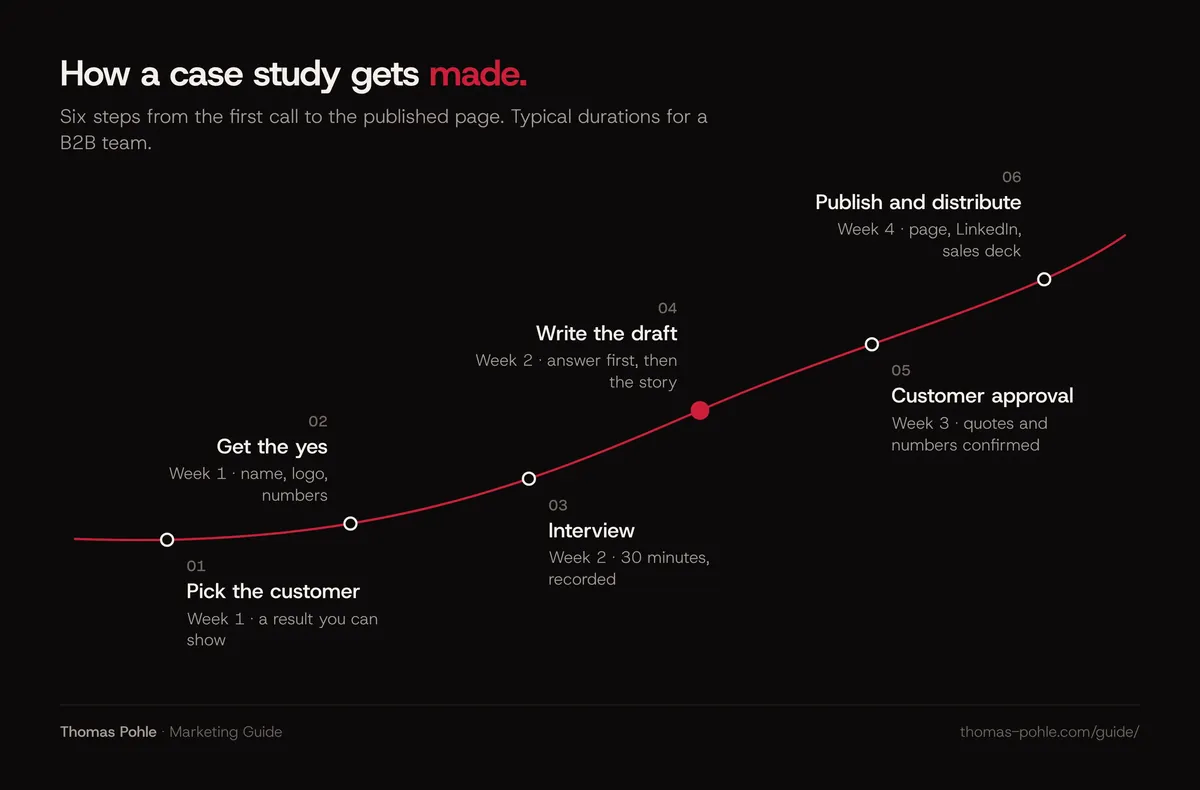
Two habits make it faster. Write the summary paragraph before the interview, as a hypothesis, and correct it afterwards. And send the customer a draft that already looks final. People approve finished things faster than outlines.
Which format gets found, a PDF, a page or a video?
An HTML page is the only format that works for search, AI assistants and sales at the same time. A PDF gets indexed, but it carries no structured data, has no heading structure an assistant can lift passages from, rarely gets linked and rarely gets updated. A video supports the page and the sales call. It doesn't replace the text.
| Criterion | PDF download | HTML page | Video |
|---|---|---|---|
| Indexed as text | Yes | Yes | No (only the page around it) |
| Quotable passages with headings | No | Yes | No |
| Part of your internal link structure | Rarely | Yes | No |
| Structured data | No | Yes | Yes, on the page |
| Works in a sales call | Yes | Yes | Yes |
| Easy to update | No | Yes | No |
Google's guidance for AI features lists "making sure that important content is available in textual form" first. That settles it. If sales needs a PDF, generate it from the page and link it from the page. Never hide the page behind the PDF.
Which structured data and image details help?
Mark the case study up as an Article or BlogPosting with a named author who links to an author page. Give it images in 16:9, 4:3 and 1:1 with descriptive alt text and file names. Don't add review or rating markup to your own customer story. Structured data must describe what's visibly on the page.
Three details from Google's documentation matter here:
- Author markup. Google's Article documentation says: "To help Google better understand who the author is, we strongly recommend using the type and url (or sameAs) properties." Name the person who wrote the case study and link to their page. The same documentation asks that every author shown on the page is also in the markup.
- Images. The same page recommends "providing multiple high-resolution images (minimum of 50K pixels when multiplying width and height)" in the aspect ratios 16x9, 4x3 and 1x1, and says the images "must represent the marked up content". A screenshot of the customer's dashboard with the number visible beats a stock photo of a handshake.
- No stars for your own story. Google's review snippet documentation says that for pages with Organization or LocalBusiness markup, ratings are ineligible for the star feature "if the entity that's being reviewed controls the reviews about itself", with the example of "a review about entity A is placed on the website of entity A". A customer quote on your site is a testimonial. It isn't a review, so don't mark it up as one.
For the images themselves, Google's image guidance calls alt text "the most important attribute when it comes to providing more metadata for an image", warns against keyword stuffing, and recommends file names that are "short, but descriptive" and images placed "near relevant text". In a case study that means the chart sits next to the paragraph that explains the number, with alt text that says what the chart shows. The schema markup guide has the JSON-LD examples.
One more technical point. OpenAI's crawler documentation says that sites which block OAI-SearchBot "will not be shown in ChatGPT search answers". Check your robots.txt. The guide on getting cited by AI assistants covers every crawler.
How do you distribute it without rewriting the story every time?
Make the page the single source and point every channel at it. The sales deck gets the summary paragraph and a link. LinkedIn gets the quote and a link. The newsletter gets the number and a link. Your related guide articles link to the page from the sentence where the problem comes up. One story, one URL, many doors.
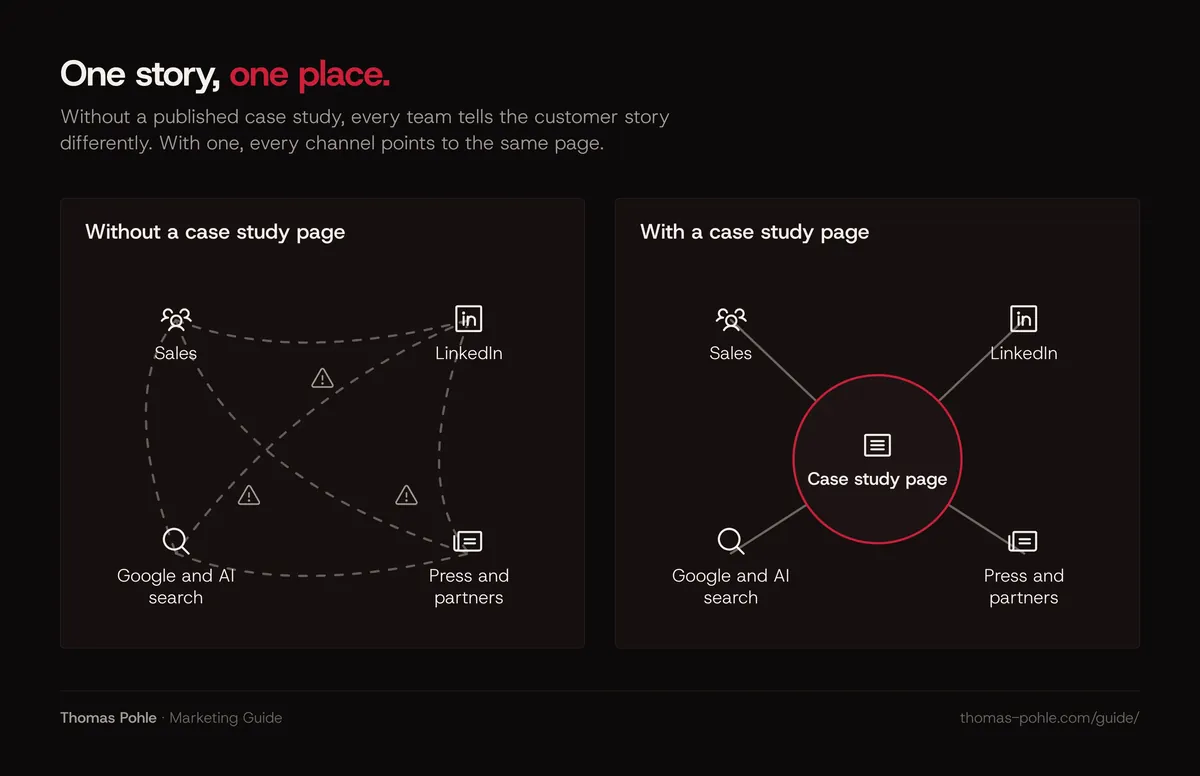
Internal links are what move rankings. A case study page that nothing links to is an orphan, however good it is. Link to it from the service page it proves and from the guide article that explains the method. The topic cluster guide shows how to plan those links.
Length isn't the lever. Ahrefs looked at about 560,000 AI Overviews in December 2025 and found that word count barely correlates with being cited. More than half of the cited pages had under 1,000 words. A 700-word case study with a clear summary, named people and a dated number beats a 3,000-word "success story" that never says what happened.
What to do this week
- Pick the one customer whose result you can state in a single sentence with a number and a date.
- Send the ask: name, one number, one quote, one named person. Attach a two-paragraph outline so they see how small it is.
- Write the 50-word summary as a hypothesis before the interview.
- Book the 30-minute interview and record it.
- Build the page in the seven-element order above, as HTML, with Article markup and a named author.
- Add three images in 16:9, 4:3 and 1:1 with descriptive alt text. No stars, no review markup.
- Link to the page from the service page, one guide article and your LinkedIn profile. Check that OAI-SearchBot isn't blocked.
Do it once and you have a template. The second case study takes half the time. Want to set this up with your team in one session? That's what a Momentum Workshop is for.
Frequently asked questions
Can I publish a case study without naming the customer?
Yes. It still helps in sales conversations because it shows first-hand experience. It will rarely get cited by search engines or AI assistants, because there's no company entity to attach the story to. Describe the customer precisely (industry, country, size), keep the dated number, and ask the next customer for their name.
Should I mark up customer quotes as reviews to get star ratings?
No. Google's review snippet documentation says that for pages with Organization or LocalBusiness markup, ratings are ineligible for the star feature when the entity being reviewed controls the reviews about itself, for example a review about company A placed on company A's website. Mark the page up as an Article or BlogPosting with a named author and present the quote as a quote.
How long should a case study be?
As long as the story needs, usually 600 to 1,200 words. Google says it has no preferred word count, and Ahrefs' analysis of AI Overviews found that more than half of cited pages had under 1,000 words. What counts is the summary paragraph, the headings, named people and a dated number with a source.
Is a video case study better than a written one?
No. A video supports the page and the sales call. It isn't indexed as text and can't be quoted. Publish the written page first, embed the video on it, and put the key quote and the number in the text next to the video so search engines and assistants can read them.
How many case studies does a B2B company need?
My rule of thumb: one per customer segment you sell to, because buyers look for a story that matches their own situation. Three strong case studies with names, numbers and dates do more than fifteen anonymous logos. Start with the segment where your pipeline is weakest.
Sources
- Google Search Central: Creating helpful, reliable, people-first content
- Google Search Central: AI features and your website
- Google Search Central: Article structured data
- Google Search Central: Review snippet structured data
- Google Search Central: Google Images SEO best practices
- OpenAI: Overview of OpenAI crawlers
- Ahrefs: Short vs. long content in AI Overviews

Thomas PohleB2B marketing advisor in Zurich. More than ten years in B2B marketing at Link11, Beekeeper and smino, most recently as Head of Marketing. CEO and co-founder of TEISENDA. Researched and drafted with AI tools, checked against the sources listed above. More about Thomas