What is content marketing, and how does it work in B2B?

Content marketing means publishing useful material that answers your buyers' real questions, so they find you, trust you and choose you when they're ready to buy. In B2B it's a sales instrument. Articles, case studies, guides and posts carry buyers through research they mostly do alone, long before they talk to your team.
This page is for founders and marketing leads of B2B companies who publish content, or plan to, and doubt it does anything for revenue. It defines content marketing, shows which formats move buyers through a purchase and which only tie up budget, and gives you a way to run it with a small team.
My view, stated once: a blog filled in advance is a waste. Every piece needs a job in the sale. If it has none, don't write it.
What is content marketing, exactly?
The Content Marketing Institute defines content marketing as a strategic approach focused on creating and distributing valuable, relevant and consistent content to attract and retain a clearly defined audience and, ultimately, to drive profitable customer action. Three words matter: relevant, consistent and defined. Random posts for everyone don't meet that bar.
Separate content marketing from its neighbors:
| Approach | What it does | How it relates |
|---|---|---|
| Content marketing | Answers buyer questions with material people want to read | The system that plans, produces, distributes and measures |
| Advertising | Buys attention for a message | Can distribute content, but rents the audience |
| SEO | Makes pages findable in search engines | The main distribution channel for written content |
| Thought leadership | Publishes a distinct point of view from named experts | The most demanding form of content marketing |
CMI adds that effective content marketing requires a documented strategy. Skip the long deck. You need a written answer to three questions: for whom, about which questions, and what the reader should do next.
How does content marketing work in B2B?
B2B content marketing works because buyers research alone and buy later. Most aren't in the market when they first meet your content. When a need comes up, they remember who explained their problem well, search for answers and build a shortlist before they contact anyone. Content is how you show up in that research.
Two findings frame the job:
- Most buyers aren't buying yet. Peter Weinberg and Jon Lombardo of LinkedIn's B2B Institute describe the 95:5 rule, based on work by John Dawes of the Ehrenberg-Bass Institute: only about 5% of B2B buyers are in the market at any given time. The share is a rough model that depends on your purchase cycle.
- Buyers prefer to research without a seller. Gartner surveyed 632 B2B buyers in August and September 2024: 61% prefer an overall rep-free buying experience. The same release notes that buyers still want sellers when judging whether an offer fits their company.
So content has two jobs. For the 95% it builds memory. They should know who you are and what you stand for. That's why content marketing and B2B brand management belong together. For the 5% it answers the concrete questions of an active purchase so well that the sales conversation starts further along.
Which content moves B2B buyers through a purchase?
The content that moves B2B buyers answers a question they have at a specific point in the purchase: understanding the problem, comparing approaches, checking a supplier, convincing colleagues. Each format fits one or two of those moments. Build your content plan from these moments. A publishing calendar is the weaker starting point.
| Buyer moment | Question they ask | Content that answers it |
|---|---|---|
| Problem | What is going wrong, and is it normal? | Guides, definitions, opinion posts by named experts |
| Approach | How do others solve this? | Comparisons, methods, checklists, webinars |
| Supplier | Can this company do it for us? | Case studies, references, pricing logic, product pages |
| Consensus | How do I convince my colleagues? | One-page summaries, ROI logic, security and legal answers |
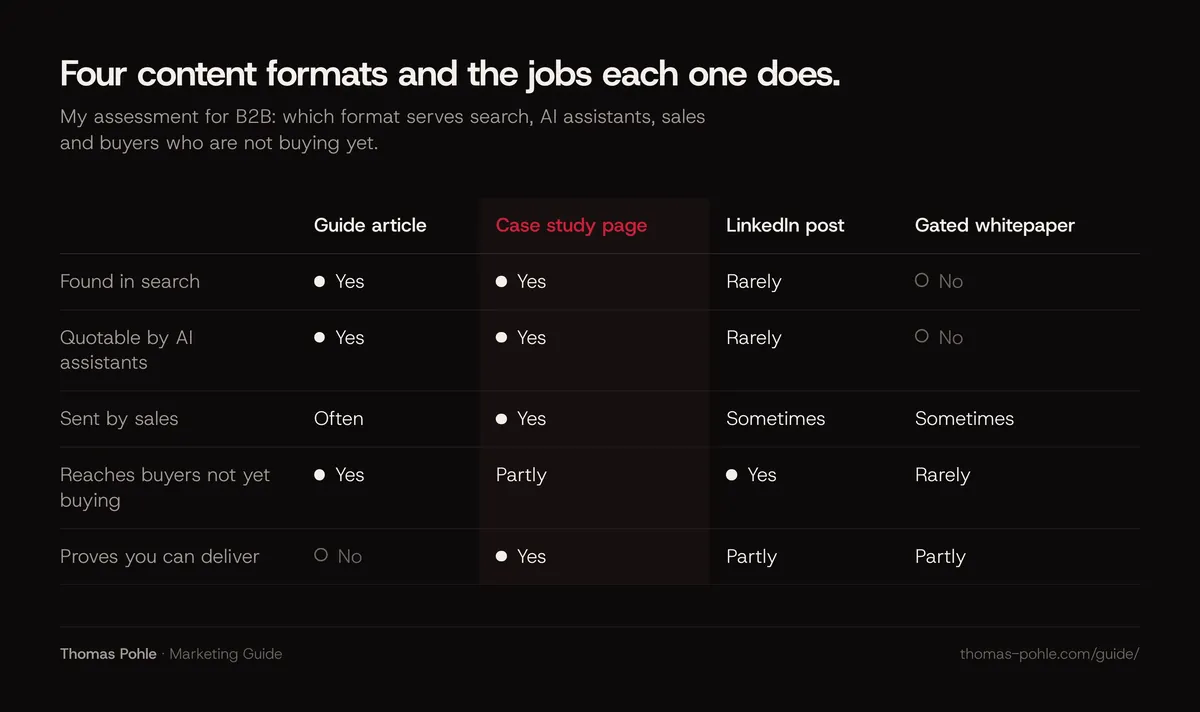
Two formats do more work than most teams expect. First, the case study written as a page that can be cited. It serves the supplier and consensus moments at once. Second, the founder's or expert's own posts, for example on LinkedIn. Buyers meet a person before they meet a company.
Which content only ties up budget?
Content ties up budget when nobody asked the question it answers, when sales never uses it, or when it repeats what a dozen other pages already say. Typical cases: news posts about your own company, generic trend articles, gated PDFs nobody downloads. The fix is a regular keep, fix or cut review with clear thresholds.
These thresholds are my own. There's no industry standard. Adjust them to your traffic and sales cycle:
| Signal after six months | Decision | What to do |
|---|---|---|
| Ranks or gets cited, and sales sends it | Keep | Update facts once a year |
| Fewer than 100 Search Console impressions, but sales sends it | Keep | It works as a sales asset; improve distribution |
| Impressions, but no clicks and no sales use | Fix | Rewrite title and first paragraph to answer the question directly |
| Fewer than 100 impressions and no sales use in 90 days | Cut or merge | Merge into a stronger page and redirect |
A typical scenario: a company has 60 blog posts. Run these thresholds and you see which posts work and which just exist. Where a long tail does nothing, merge it into fewer, better pages. That's often worth more than writing ten new ones.
How do SEO, AI search and content marketing work together?
SEO and AI search are distribution for content marketing. Google says its systems are designed to prioritize helpful, reliable, people-first content, and that there are no additional requirements to appear in AI Overviews or AI Mode beyond SEO fundamentals. So the content that serves buyers best is also the content search engines and AI assistants are most likely to show.
What this means in practice:
- Answer first. Put the direct answer in the first paragraph. A question headline, a 40 to 60 word answer, then detail, FAQ and primary sources: readers and machines can both use that structure.
- Write to the question. Forget the word count. Google asks in its own guidance whether you write to a particular word count and adds that it has no preferred one. Ahrefs analyzed 560,000 AI Overviews and found almost no correlation between word count and being cited (0.04).
- Show first-hand expertise. Google lists first-hand expertise as a sign of helpful content. That's what E-E-A-T for B2B is about.
- Build clusters. One pillar page per topic plus focused articles, linked with descriptive anchors. The method is in topic clusters and internal linking.
The basics of being found are in what SEO is, the AI side in answer engine optimization.
How do you produce B2B content when your experts have no time?
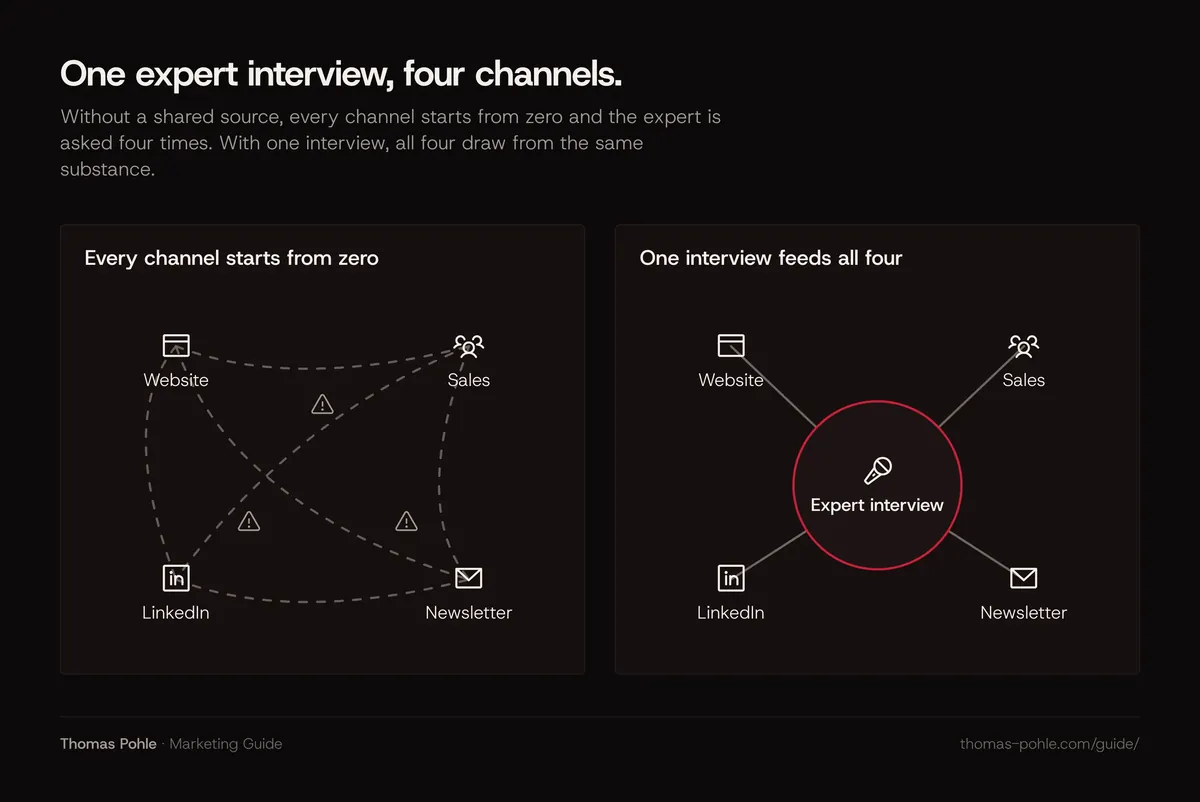
Take your experts' knowledge in short interviews and let someone else do the writing, editing and distribution. The expert spends an hour talking and ten minutes approving. Without that model, content either stops or turns generic. The people who know the answers never write them down.
CMI's research for 2026, a survey of 1,015 B2B marketers, shows the size of the gap. 96% say their organization creates thought leadership content. Yet 37% say participation is minimal, meaning fewer than 5% of employees with specialized knowledge contribute.
A process that works:
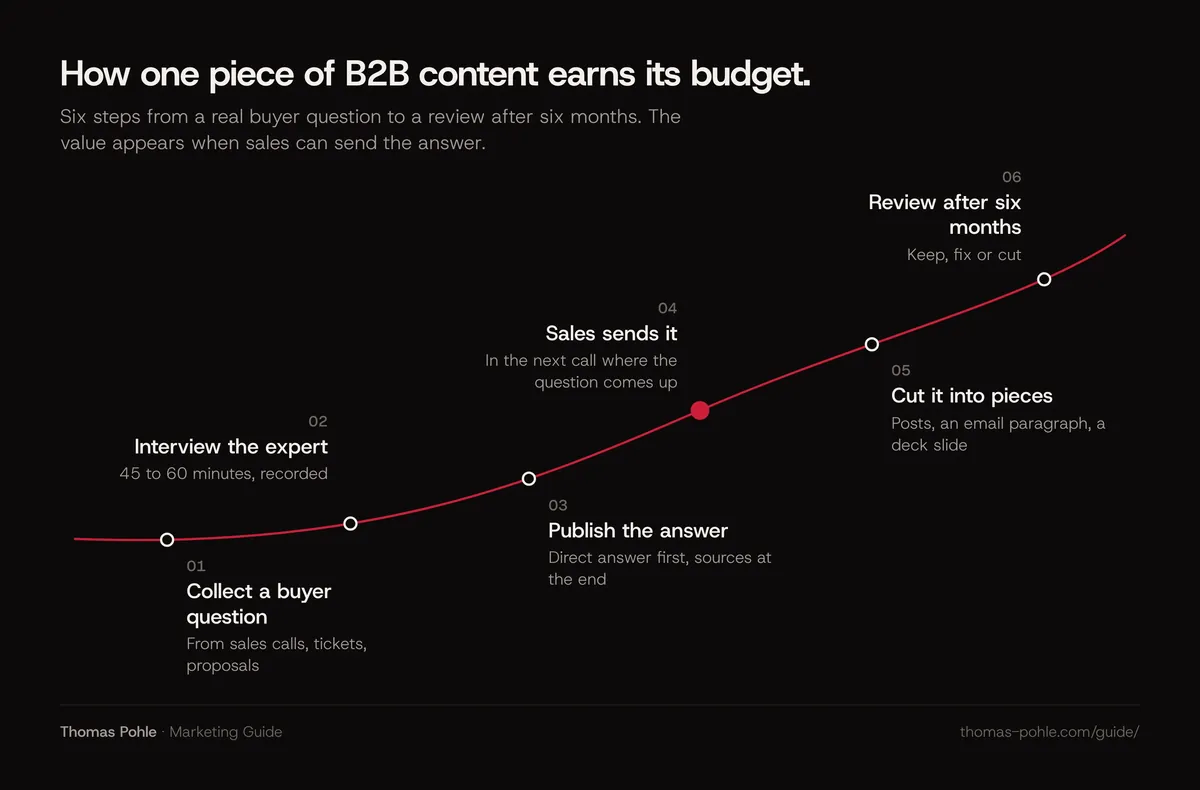
- Collect questions. From sales calls, support tickets and proposals. Every real question is a candidate piece.
- Interview the expert. 45 to 60 minutes, recorded, with three to five questions sent in advance.
- Write from the transcript. One pillar or guide article, plus a case study angle if a customer story came up.
- Check facts and approve. The expert approves the text; every number needs a source.
- Cut it into pieces. Posts for the expert's own profile, a paragraph for the sales email, a slide for the deck.
- Review after six months. Keep, fix or cut, as above.
Two rules keep quality up. First, story before lesson. Good educational content comes from real campaigns, experiments, customer work and mistakes. Lists of lessons don't cut it. Second, I never publish a number I can't trace to a source, and an assumption never goes out as a fact. AI tools speed up drafting a lot. They don't replace the expert who decides what's true.
How do you measure whether content marketing works?
Measure B2B content marketing on three levels: is the content found, do buyers engage with it, and does it show up in deals. The third level is the one that counts. Most teams skip it, because it needs sales to log which content buyers saw or asked about.
- Found. Impressions and clicks per page in Google Search Console, plus spot checks of how AI assistants answer your buyers' questions. The full method is in measuring organic and AI search visibility.
- Engaged. Time on page, newsletter sign-ups, replies to posts. Useful for comparing pieces, weak as proof of revenue.
- In deals. Which pages sales sent, which content a lead mentions in the first call, which case study was in the proposal. One CRM field is enough to start.
CMI's survey shows why this matters. 97% of the marketers say they have a content strategy, yet only 13% of those say it significantly improved their results. Having a strategy is common. Connecting it to deals is rare. You can only steer a number like marketing's share of the sales pipeline once deals carry their source in the CRM. More in marketing measurement.
What to do this week
Start B2B content marketing with what you already have: the questions buyers ask, one expert and a page on your website. This checklist turns that into a first working piece and gives you a way to judge everything you've already published.
- Ask sales for the ten questions buyers asked most in the last three months.
- Pick the one question closest to a buying decision and book a 45-minute interview with your best expert.
- Write the answer as one page: direct answer first, then detail, then sources.
- Send it to sales and ask them to use it in the next three conversations where the question comes up.
- Export your existing content with Search Console impressions and run the keep, fix or cut table on it.
- Add one CRM field: "content the buyer saw or mentioned".
- Put a six-month review in the calendar.
Content marketing compounds when you run it as a system: questions in, answers out, sales use, review. Want the topic, the first channel and the production rhythm set up with your team in one day? That's what a one-day Momentum Workshop covers.
Frequently asked questions
What is the difference between content marketing and SEO?
Content marketing decides which questions to answer, for whom, and what the reader should do next. SEO makes sure the resulting pages can be found, crawled and understood by search engines. In B2B they depend on each other. SEO without useful content has nothing to rank. Content without SEO relies only on channels you pay for or post to.
How long does B2B content marketing take to work?
Single pieces can help sales right away, as soon as a salesperson sends a good answer to a buyer. Search visibility usually takes months, and Google doesn't publish a timeline. Because most B2B buyers aren't in the market at any given time, the memory effect takes longest. Judge content after six months. Six weeks is too early.
How much content does a B2B company need?
Less than most plans assume. My rule of thumb: a pillar page and five to ten articles that answer the questions buyers really ask cover the main topic for many B2B companies. Add pieces when sales hears new questions. My take: ten strong answer-first pages beat a hundred thin ones, and they're cheaper to keep up to date.
Should B2B companies gate their content behind a form?
Gate only what's worth an email address to the buyer, such as a detailed template or benchmark. Keep guides and case studies as open pages. Search engines and AI assistants can read and cite them, and sales can send a link without friction. Content behind a form stays invisible to search engines as text.
Can AI write B2B content marketing?
AI speeds up research, transcription, drafting and reformatting a lot. It can't supply first-hand experience or decide what's true for your company. Google rewards helpful content that shows first-hand expertise, however it's produced. The safe model: AI for the draft, and a named expert who checks facts and approves.
Sources
- Content Marketing Institute: What Is Content Marketing?
- Content Marketing Institute: 9 Takeaways and Insights From the 2026 B2B Content and Marketing Trends Report
- Marketing Week: The 95:5 rule is the new 60:40 rule (Peter Weinberg and Jon Lombardo, LinkedIn B2B Institute, 2021)
- Gartner: Sales Survey Finds 61% of B2B Buyers Prefer a Rep-Free Buying Experience (June 2025)
- Google Search Central: Creating helpful, reliable, people-first content
- Google Search Central: AI features and your website
- Ahrefs: Short vs. long content in AI Overviews

Thomas PohleB2B marketing advisor in Zurich. More than ten years in B2B marketing at Link11, Beekeeper and smino, most recently as Head of Marketing. CEO and co-founder of TEISENDA. Researched and drafted with AI tools, checked against the sources listed above. More about Thomas