What is brand management and how does it work in B2B?

Brand management decides what your company should stand for in buyers' minds and makes every touchpoint say the same thing. In B2B that means one clear position, one way of describing what you do, proof that backs it up, and someone senior who keeps all of it consistent over years.
This page is for founders, CEOs and marketing leads of B2B companies who suspect their brand is a logo file and a slide in the sales deck. You'll see what brand management covers, why it decides more of your pipeline than most teams think, who should own it, and how to run it with a small team.
My position up front: in B2B, brand management is a leadership job. It shapes how much you can charge, how long deals take and whether buyers and AI assistants think of you when a need comes up. Logos are the smallest part of it.
What is brand management, exactly?
Brand management sets what a brand should mean and then protects that meaning across everything the company says and does. A brand is the set of memories and associations people hold about your company. Branding creates its signals. Brand management keeps those signals consistent and checks whether the memories actually form.
People mix these terms up all the time. Here's how I separate them:
| Term | What it is | Who mostly does it |
|---|---|---|
| Brand | What buyers remember and believe about you | The market, based on everything you do |
| Branding | Creating the signals: name, identity, voice, design | Founders, marketing, sometimes an agency |
| Brand management | Keeping the signals consistent and checking the effect over years | CEO and head of marketing |
| Brand marketing | Campaigns that build memory with people who aren't buying yet | Marketing |
The core of a brand is a short set of decisions: who you serve, what problem you solve, why you and not the alternative, and how you sound. Everything else, from the website to a sales email, applies those decisions. Haven't written them down yet? Start with B2B positioning. Brand management without a position has nothing to protect.
Why does brand management matter so much in B2B?
Most B2B buyers aren't in the market when your marketing reaches them. They buy later, from memory and from what others say about you. Brand management decides what that memory contains. Buyers now do much of their research alone, so your brand often makes the shortlist before a salesperson ever gets a call.
Three findings back this up. Each has its limits:
- Most buyers are out of market. Peter Weinberg and Jon Lombardo of LinkedIn's B2B Institute popularized the 95:5 rule, based on work by John Dawes of the Ehrenberg-Bass Institute: only about 5% of B2B buyers are in the market at any one time. Their example is business banking. According to their research, 80% of companies switch business banks once every five years. The figure is a rough model. The real share depends on your purchase cycle.
- Buyers prefer to research alone. In a Gartner survey of 632 B2B buyers from August and September 2024, 61% said they prefer an overall rep-free buying experience. Gartner adds that buyers still want seller input when they judge whether an offer fits their company.
- Brand and activation need balance. Les Binet and Peter Field analyzed B2B cases in the IPA Databank from 1998 to 2018 for the B2B Institute. LinkedIn's summary recommends splitting budget between long-term brand building and short-term sales activation at about 50/50. My take: read the split as a direction. It's no formula.
Put together: the buyers who'll sign next year are forming their opinion this year, mostly without you in the room. Brand management is how you shape that opinion on purpose.
What does B2B brand management actually include?
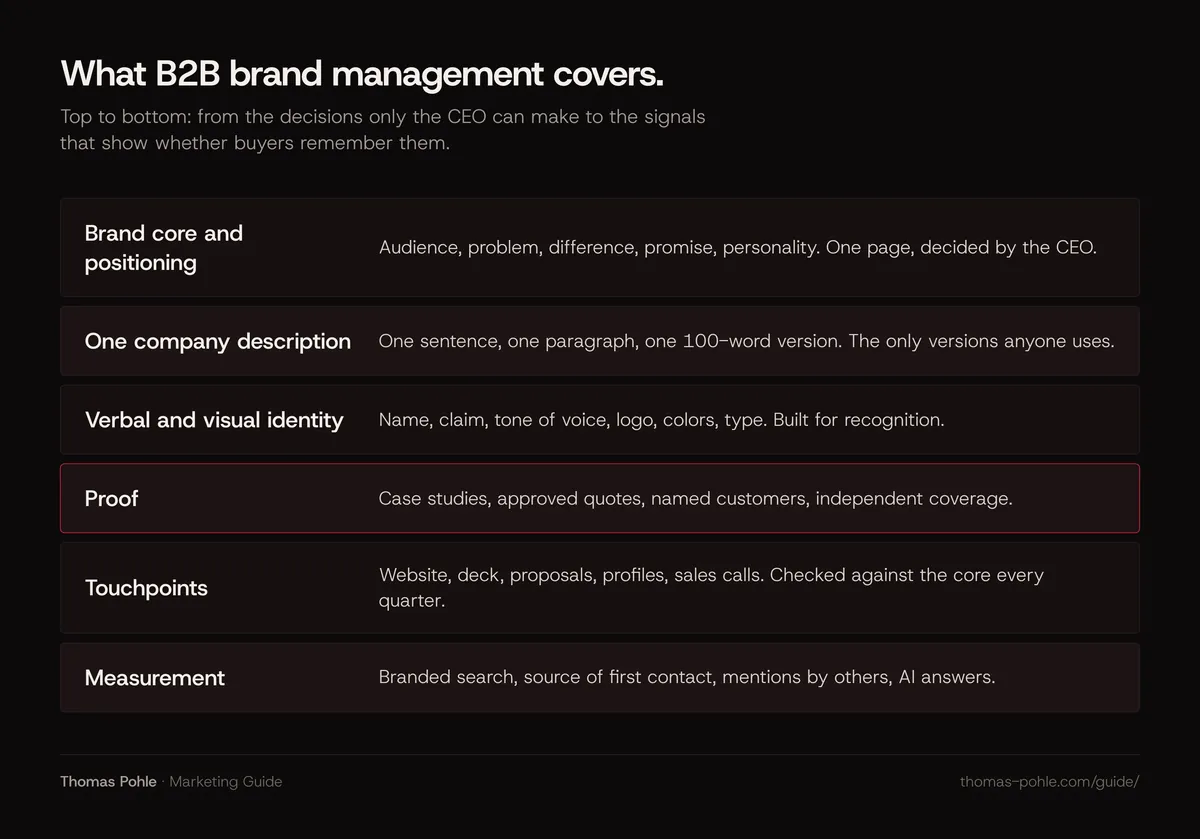
B2B brand management covers four areas: the brand core and positioning, the verbal and visual identity, the proof that makes claims believable, and the consistency of every touchpoint. Measurement sits on top. Most companies pour money into the visual identity and neglect proof and consistency. Those are exactly the parts buyers and AI assistants check.
Brand core and positioning
The written decisions: audience, problem, difference, promise, personality. One page is enough. The promise can be a single word.
Verbal and visual identity
Name, claim, the one sentence that says what you do, tone of voice, words you never use, plus logo, colors, type and image style. In B2B a visual identity exists for recognition. Buyers who see you three times over a year should know it's the same company each time.
Proof
Case studies, named customers who agreed to be named, quotes the customer approved, independent coverage, talks, published methods. Proof turns a claim into a belief. Independent coverage weighs most. In a previous in-house role I brought a cybersecurity company I worked for onto ZDF heute journal, one of Germany's main national news programs, with thought leadership built around its C-level experts. A practical way to produce proof is a case study that search engines and AI assistants can cite.
Touchpoints
Website, sales deck, proposals, LinkedIn profiles of the founders and sales team, email signatures, events, support replies, invoices. In B2B, people carry the brand more than ads do. So the touchpoint list includes what your team says in calls. That's why LinkedIn for B2B and B2B PR are brand work, too.
Who should own the brand in a B2B company?
In a B2B company with up to a few hundred employees, the CEO owns the brand and the head of marketing runs it day to day. The CEO decides position and promise, because the CEO sets pricing, hiring and product focus. Marketing keeps the system consistent. Sales and delivery feed back what buyers actually believe.
Leave the brand only to marketing and it turns into a design topic. Leave it to nobody and every team builds its own version. Here's how I'd split the work:
| Decision | Owner | Review |
|---|---|---|
| Audience, problem, promise | CEO, with marketing | Once a year, or after a strategy change |
| Company description and claim | Head of marketing, CEO signs off | Once a year |
| Visual identity and templates | Marketing | Only when something breaks |
| Proof: case studies, quotes, references | Marketing with sales | Every quarter |
| Consistency of touchpoints | Marketing, every team leader applies | Every quarter |
That's my rule of thumb. It isn't a standard. The principle behind it is simple: whoever decides price and product also decides the promise.
How does the brand affect price, sales cycles and AI recommendations?
A strong brand pays off in three places a CEO cares about. Buyers who already trust you compare less, so deals move faster. A clear difference cuts down pure price comparison. And AI assistants mention companies that get described often and consistently across the web. The evidence for each is real but uneven. I'll tell you where it's thin.
- Sales cycles and trust. Gartner found that 69% of B2B buyers report inconsistencies between a supplier's website and what its sellers say. Gartner's analysts warn that such mismatches can create mistrust and put the transaction at risk. My take: consistency is the cheapest brand work there is.
- Price. Binet and Field list emotion and mental availability among their principles of B2B growth. I haven't found a large primary study that isolates the pricing effect of brand in B2B SMBs. Treat any precise "brand premium" number you see with care.
- AI assistants. Google says there are no extra requirements to appear in AI Overviews or AI Mode beyond SEO fundamentals. Ahrefs studied 75,000 brands and found that branded web mentions correlated more strongly with brand mentions in AI Overviews (0.664) than backlinks did (0.218). Ahrefs stresses that this is correlation. It doesn't prove causation.
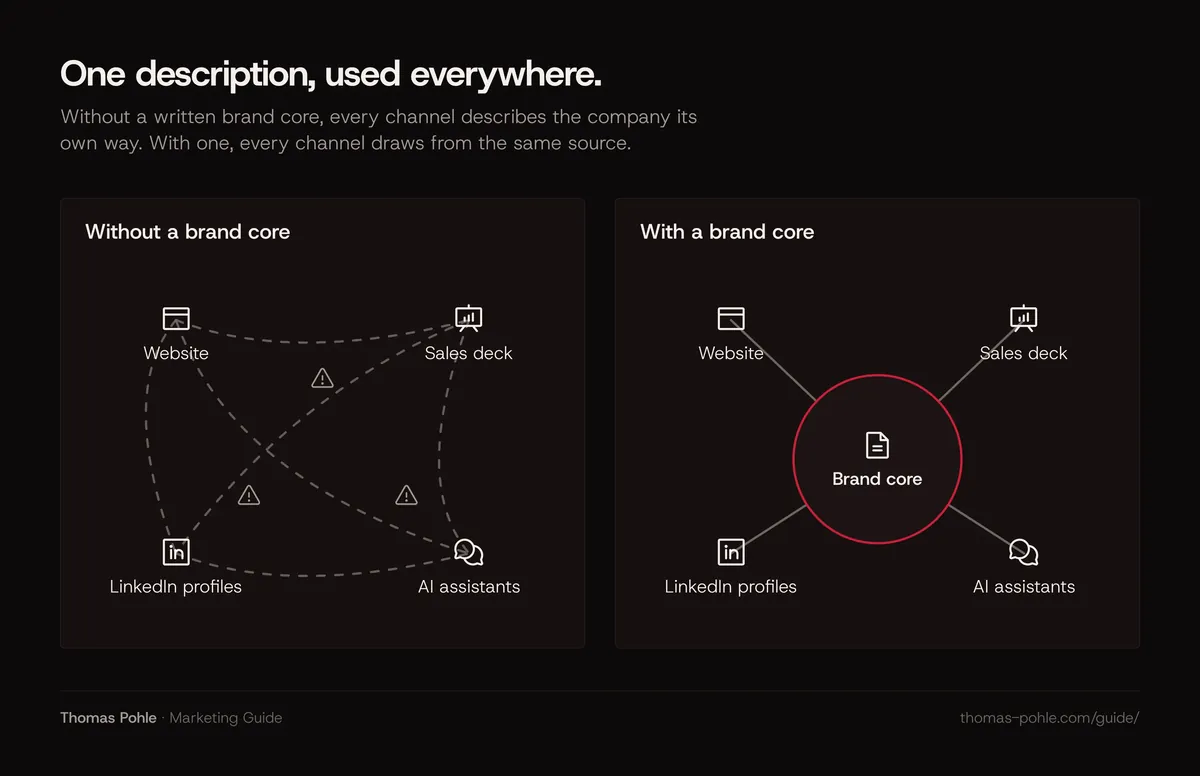
For AI search the practical consequence is the same as for people: one description of what you do, used everywhere, plus mentions by others. I keep my own identity data identical on every profile. One role line, one claim, company names written exactly as the companies write them. I can't prove this caused any AI mention. It's simply the part I control. The technical side is in connecting your website and profiles into one brand, the search side in answer engine optimization.
How do you set up brand management step by step?
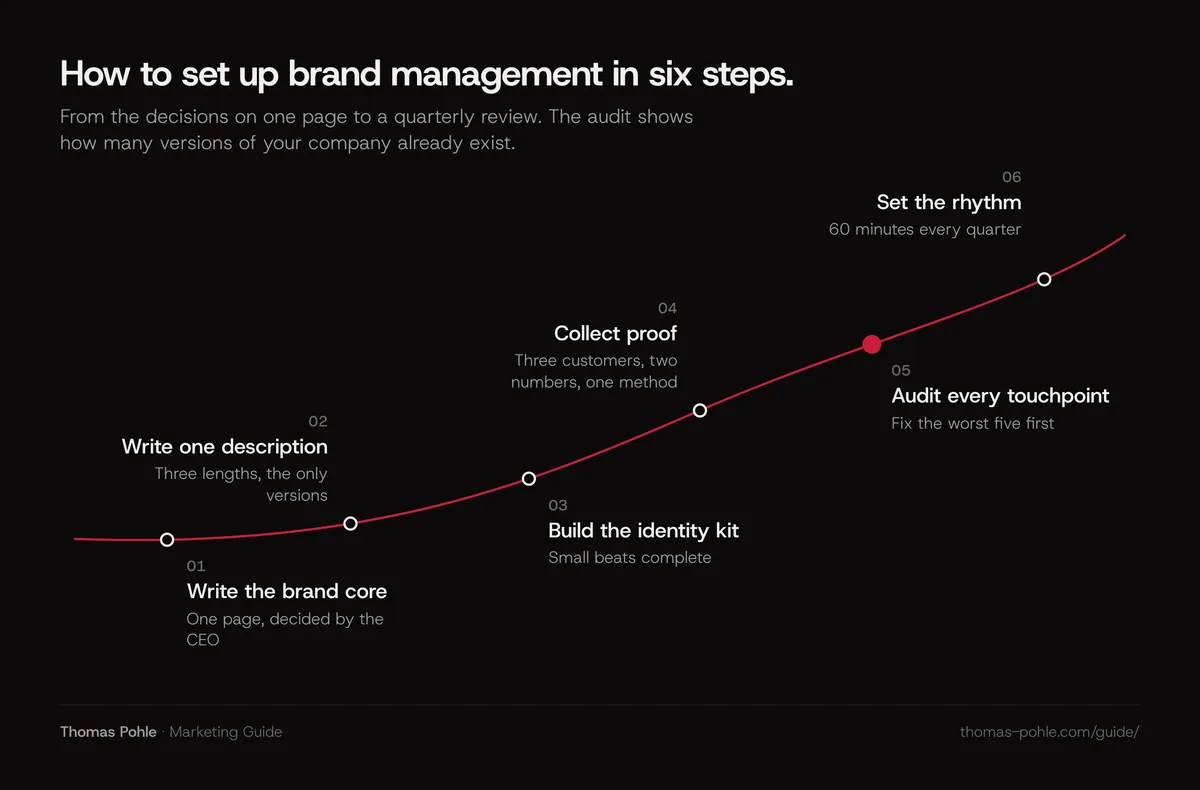
Setting up brand management in a B2B company takes six steps: write the brand core, write one company description, build a small identity kit, collect proof, audit every touchpoint against the core, and set a review rhythm. The first version doesn't need a big team. It needs a CEO who makes the decisions and doesn't delegate them.
- Write the brand core. One page: audience, problem, difference, promise, personality, words you never use.
- Write one description. One sentence, one paragraph, one 100-word version. These become the only versions anyone uses.
- Build the identity kit. Logo files, one color system, one typeface, templates for deck, proposal, social images. Small beats complete.
- Collect proof. Three customers who'd agree to be named, two numbers you can back up, one method you can publish.
- Audit every touchpoint. List each place your company is described and compare it with the core. Fix the worst five first.
- Set the rhythm. A quarterly brand review of 60 minutes with the CEO, marketing and sales.
Here's why the rhythm matters, as a typical scenario with assumed numbers. A software company sells to 400 mid-sized manufacturers. Say they switch suppliers about once every five years, as in the banking example behind the 95:5 rule. Then about 80 of the 400 enter the market in a year. That's about 20 per quarter and roughly seven in a given month. A campaign that only targets active buyers reaches those seven. The other 393 decide later, from what they remember. Brand management is the work aimed at those 393.
How you then build and spread the brand across channels belongs to your B2B marketing strategy and content marketing.
How do you measure whether brand management works?
You measure brand management through a handful of slow signals: how many people search for your name, how often buyers mention you unprompted, whether new leads already know what you do, and whether you show up when AI assistants answer questions in your category. Track them quarterly. Single campaign numbers say little about brand.
- Branded search. Searches for your company name in Google Search Console, compared quarter over quarter.
- Source of first contact. One open question in every first call: "How did you hear about us?" Write the answer into the CRM word for word.
- Description match. Do new leads describe what you do the way your brand core does? Sales can log this in one field.
- Mentions by others. Press, partner pages, podcasts, communities. Count them, and note whether they use your description.
- AI answers. Ask ChatGPT, Perplexity and Google the five questions your buyers ask. Note whether you appear and how you're described. It's a spot check. It has no statistical weight.
Brand equity, the value the brand adds to what you sell, is the result of all this. Formal brand valuation exists. For an SMB, the signals above are the useful part. More on the measurement side in marketing measurement.
Which brand management mistakes do B2B companies make most often?
The most common mistakes: treating the brand as a design project, letting every team write its own company description, showing proof that isn't really proof, and changing the identity too often. All four do the same damage. Buyers meet a different company at each touchpoint and remember none of them clearly.
- Brand as a design project. A new logo without a written position changes the surface and nothing else.
- Many versions of the truth. The website says one thing, the deck another, the founder's LinkedIn a third. Gartner's 69% figure above shows how common this is.
- Weak proof. I removed the logo strip from my own homepage. I had no client approval to show the names, a strip that mixes employers and clients confuses readers, and small unknown logos weaken more than they help.
- Small inconsistencies. Two shades of the brand color, three spellings of the company name, an old claim in the email signature. Each one is minor. Together they make the company look unsure of itself.
- Rebranding too often. Recognition builds over years. Every change asks buyers to learn you again.
What to do this week
You don't need a brand agency to start. You need one decision-maker, a document and an hour a week. This checklist gets the first version of brand management running.
- Write your brand core on one page: audience, problem, difference, promise, personality.
- Write the company description in three lengths and send it to everyone who talks to customers.
- List every place your company is described: website, deck, proposals, profiles, directories.
- Compare the five most visible ones with the new description and fix them.
- Collect three pieces of proof you're allowed to publish.
- Ask the five questions your buyers ask in ChatGPT, Perplexity and Google, and note how you appear.
- Put a 60-minute quarterly brand review in the calendar of the CEO, marketing and sales.
Brand management sounds slow. It is. The upside: the work compounds, and every consistent touchpoint makes the next one cheaper. Want to set the position and the first channel in one day with your team? That's what a one-day Momentum Workshop is for.
Frequently asked questions
What is the difference between brand management and branding?
Branding creates the signals of a brand: name, logo, colors, voice and design. Brand management decides what those signals should mean and keeps them consistent across every touchpoint for years. Branding is often a project with an end date. Brand management is an ongoing responsibility. That's why it needs a senior owner.
Does a small B2B company need brand management?
Yes, in a small form. A company with ten employees needs a written position, one company description and a quarterly check that the website, sales deck and founder profiles still match it. That's a few hours a quarter. Skip it, and every new hire and every new channel adds another version of your company.
How long does it take for brand management to show results?
The internal effects come fast. Once the description and proof exist, sales and marketing use them within weeks. The market effect takes longer, because most B2B buyers aren't in the market at any one time and will only act on their memory of you later. Plan in quarters and years. Campaign weeks are the wrong unit.
Can brand management help a company appear in AI assistants?
Possibly. Nobody can promise it. Google says its AI features need no special optimization beyond SEO fundamentals. Ahrefs found a correlation between branded web mentions and brand mentions in AI Overviews, without proving cause. Consistent descriptions and real mentions by others are the parts you can influence.
Who should be responsible for brand management in B2B?
The CEO owns the position and the promise, because those decisions tie into pricing, product and hiring. The head of marketing runs brand management day to day: the description, identity kit, proof and touchpoint audits. Sales and delivery report back what buyers actually believe. That's the best reality check you'll get.
Sources
- Marketing Week: The 95:5 rule is the new 60:40 rule (Peter Weinberg and Jon Lombardo, LinkedIn B2B Institute, 2021)
- LinkedIn B2B Institute: The 5 Principles of Growth in B2B Marketing (Les Binet and Peter Field)
- Gartner: Sales Survey Finds 61% of B2B Buyers Prefer a Rep-Free Buying Experience (June 2025)
- Ahrefs: An Analysis of AI Overview Brand Visibility Factors (75K Brands Studied)
- Google Search Central: AI features and your website

Thomas PohleB2B marketing advisor in Zurich. More than ten years in B2B marketing at Link11, Beekeeper and smino, most recently as Head of Marketing. CEO and co-founder of TEISENDA. Researched and drafted with AI tools, checked against the sources listed above. More about Thomas