What is positioning, and how does a B2B company find its own?

Positioning decides which customers you serve, which alternatives you beat for them and why. In B2B it's a leadership call, and that includes what the company won't do. You find it in your best customers. Then you make it visible everywhere: on the website, in sales and in the answers of AI assistants.
This page is for founders and CEOs of B2B companies whose marketing feels busy and vague, and whose sales team explains the company differently in every call. It covers what positioning is, its components, the kinds of position you can take, a step-by-step way to find yours, a test with pass marks and how positioning shows up online.
What does positioning mean in B2B?
Positioning in B2B is the place a company deliberately takes in its market: for a defined group of customers, against the alternatives they'd otherwise choose, with a reason to pick you that matters to them. April Dunford, author of the book Obviously Awesome, defines it as how a product is different and better than alternatives for a particular set of customers.
Michael Porter made the same point for strategy in his 1996 Harvard Business Review essay "What Is Strategy?": strategy is the creation of a unique and valuable position, involving a different set of activities. Positioning is that strategic choice, made concrete enough for a buyer to recognize.
People mix positioning up with the terms around it. They depend on each other. They're still different things:
| Term | What it is | Who owns it |
|---|---|---|
| Positioning | The choice of customers, alternatives and the reason you win | Leadership |
| Brand | How that choice is remembered: name, look, voice, reputation | Marketing |
| Messaging | The words used on the website, in decks and in calls | Marketing and sales |
| USP | The one strength that alternatives lack, if there is one | Product and marketing |
Positioning is the base layer of the whole marketing system described in the overview of how B2B marketing works. Brand, demand and sales support all sit on top of it.
Why is positioning a decision for the leadership?
Positioning belongs to the leadership because it means giving things up. A clear position rules out customers, features and deals that don't fit, and only the people who own the strategy can say no to revenue. Porter wrote that the essence of strategy is choosing what not to do. Marketing can find the position and phrase it. Deciding it is someone else's job.
Porter describes trade-offs as the point where more of one thing requires less of another. In positioning it looks like this: if you're the provider for mid-sized construction firms, you aren't the provider for everyone in construction. Many companies dodge that choice because it feels risky. What they get is a website that talks to every buyer and convinces none.
When I positioned my own advisory, I listed every reason buyers call me: marketing is stuck, nobody has time, nobody knows where to start, sales has no pipeline. They shared one denominator, standstill. So the promise became momentum: getting B2B marketing from standstill into motion.
What are the components of a positioning?
A complete B2B positioning answers five questions. In Obviously Awesome, April Dunford breaks positioning into competitive alternatives, unique attributes, value, the target customers who care most about that value, and the market category that makes the value obvious. Each component builds on the one before it. You start from what buyers would do without you.
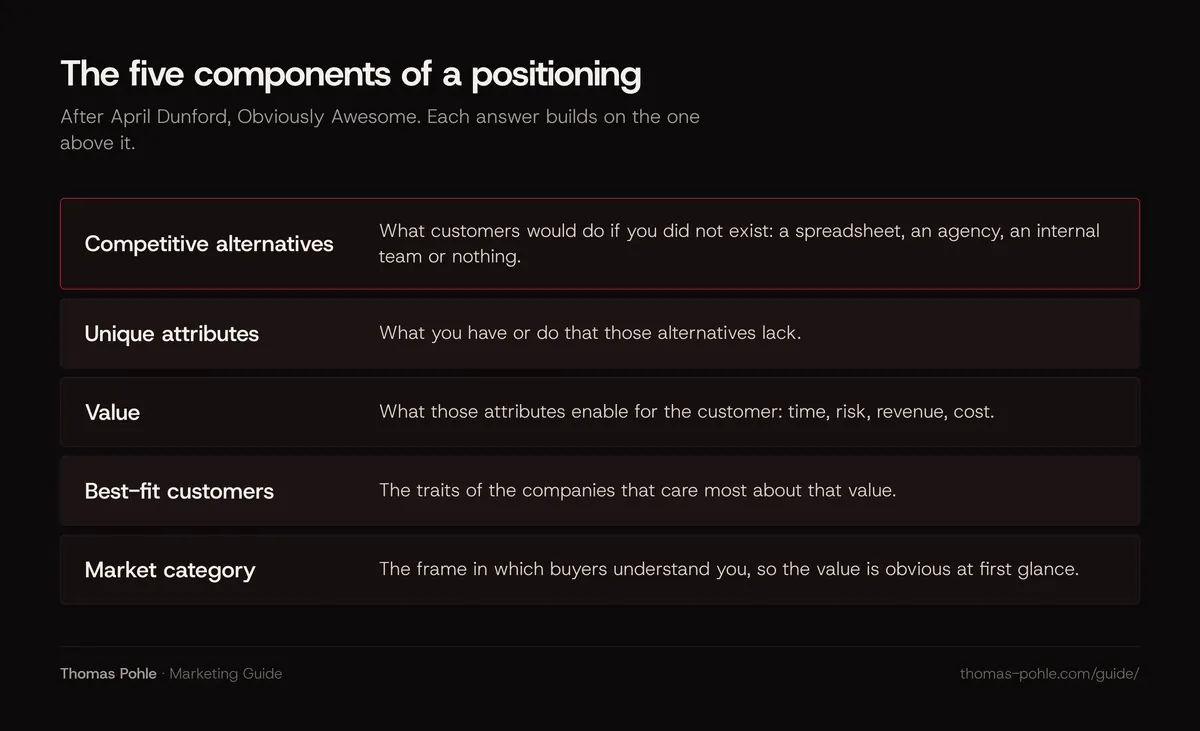
- Competitive alternatives. What customers would do if you didn't exist. Often that's a spreadsheet, an agency, an internal team or doing nothing. Rarely is it only the competitor you watch.
- Unique attributes. What you have or do that those alternatives lack: a capability, a method, a team, a delivery model.
- Value. What those attributes make possible for the customer, in their terms: time, risk, revenue, cost.
- Best-fit customers. The traits of the companies that care most about that value. This is your segmentation.
- Market category. The frame buyers use to understand you, so the value is obvious at first glance.
The order matters. Start with your own features and you'll end up with a list of claims every competitor can make too.
Which kinds of position can a B2B company take?
Porter names three sources of a strategic position: a choice of product or service varieties, the needs of a particular customer group, or customers reached in a different way. Most B2B positionings run on one of these as their main logic. Pick one on purpose, and every later decision about offers, channels and pricing gets easier.
| Source of position (Porter) | Works when | Example of the decision |
|---|---|---|
| Variety-based: what you offer | You do one service or product type better than others, for many kinds of customers | Only implementation, never strategy decks |
| Needs-based: whom you serve | One customer group has needs that general providers serve badly | Only construction firms with their own planning department |
| Access-based: how you reach them | Customers with similar needs are reached differently, by size, region or channel | Only regional mid-sized firms, served through partners |
Which one fits depends on where you're already strongest. Look at the customers you serve best. Do they share a need, a product type or a way of buying? The answer is usually sitting in your customer list. The classic competitive strategies of cost leadership, differentiation and niche belong to the same decision. They'll get their own article in this guide.
How do you find your positioning step by step?
Start from evidence. Opinion comes later, if at all. List the customers who get the most value fastest, find out what they'd have done without you, and name what you do that those alternatives can't and what it's worth. Then describe who shares those traits, choose the category frame and test the result in real sales conversations.
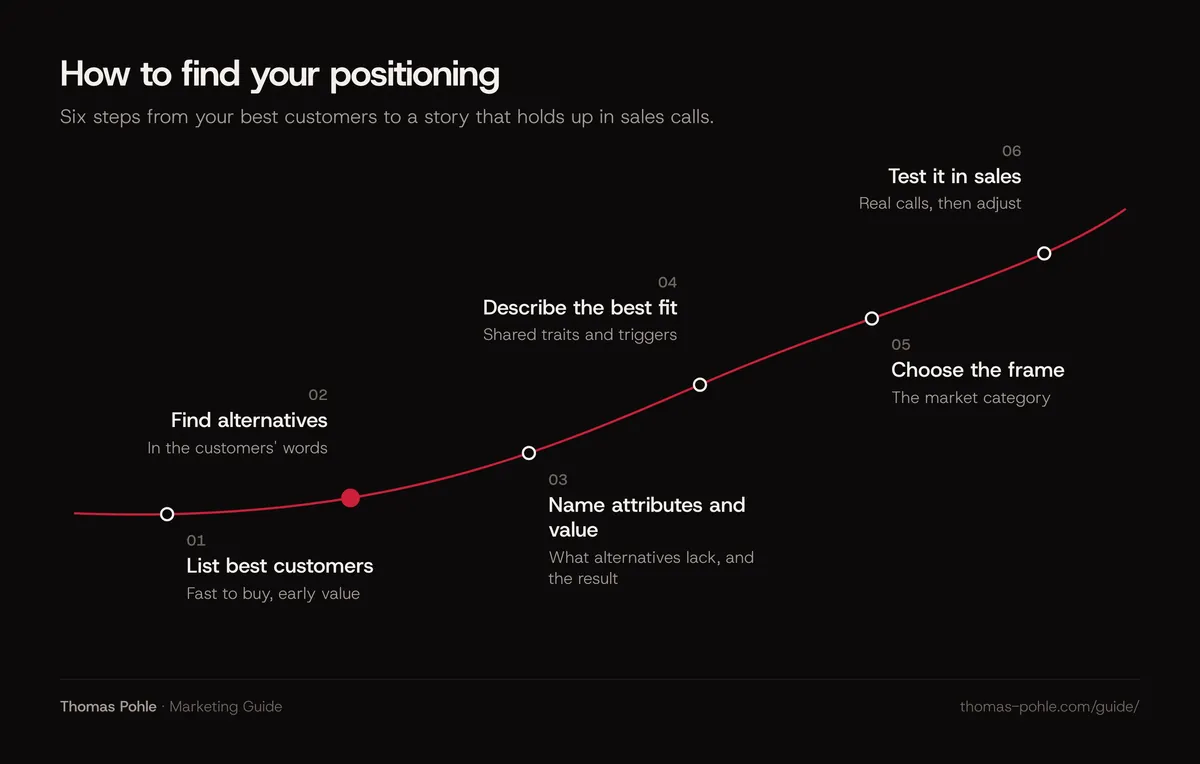
- List your best customers. The ones who bought fast, got value early and would recommend you. Ignore the loudest and the biggest.
- Find their alternatives. Ask them what they'd have done without you. Use their words.
- Name your attributes and their value. What you do that those alternatives can't or don't, and the result each one creates for the customer.
- Describe the best fit. The traits these customers share: size, industry, situation, trigger.
- Choose the frame. The market category that makes the value obvious to those buyers.
- Test it in sales. Use the new story in real calls and on the website. Fix what doesn't land.
Get sales, product, customer success and the leadership into the room. My take: positioning written by marketing alone rarely survives the first sales call.
How do you know whether your positioning works?
Your positioning works when strangers, your own team and outside sources all describe you the same way, and when you win deals for the reason you chose. Six checks test that in a week. The pass marks below are my own suggested thresholds for a quick self-test. They aren't research benchmarks.
- First-screen test. Show your homepage to five people from your target group for ten seconds. Pass: at least four can say whom you serve and what you do.
- Team test. Ask five colleagues from different teams, separately, to name your target customer and main alternative. Pass: the answers match in substance.
- Win test. Write down why you won your last five deals, one sentence each. Pass: at least three name the reason your positioning claims.
- Loss test. Look at your last five losses. Pass: most went to an alternative you consciously chose not to fight.
- Consistency test. Compare your homepage, your sales deck and your LinkedIn profile. Pass: the same customer, problem and reason show up in all three.
- AI test. Ask two AI assistants who offers what you do for your target customers. Pass: you appear, and the description matches your positioning.
Several checks fail? Don't write new copy. Go back to the decision itself.
How does positioning show up on your website, in sales and in AI answers?
Positioning shows up wherever buyers meet you when you're not in the room: the first screen of your website, the deck a champion forwards internally, your LinkedIn profiles, third-party mentions and the answers of AI assistants. All of them have to say the same thing, because buyers compare. Gartner found that 69 % of B2B buyers saw inconsistencies between a supplier's website and its sellers.
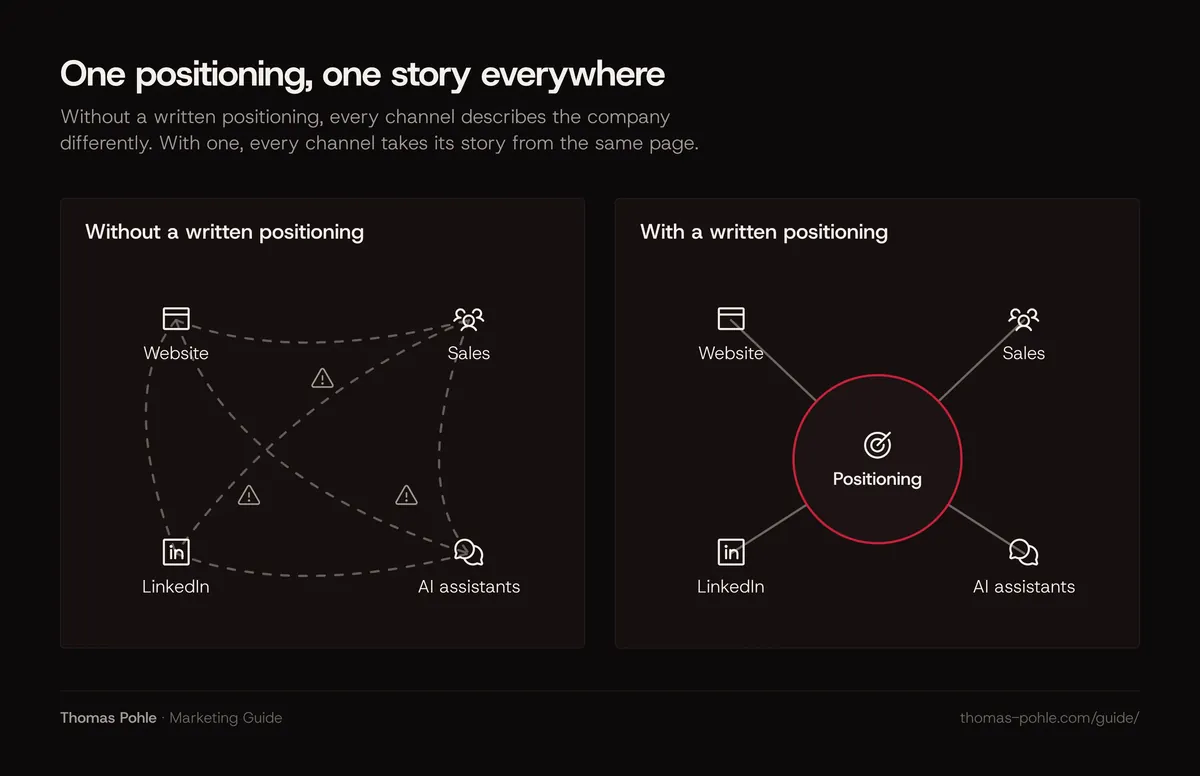
On the website, the first screen has to say who you're for and what changes for them. My own homepage first opened with "Your marketing has stalled." A storytelling review showed that it forced readers to accept a diagnosis first, and people who felt things were going okay didn't feel addressed. I replaced it with a line about momentum, the promise of the positioning.
AI assistants add a new reader. Google says there are no special requirements to appear in AI Overviews or AI Mode beyond being indexed and eligible for a snippet. OpenAI says sites that block its search crawler OAI-SearchBot won't be shown in ChatGPT search answers. My reading: these systems mostly repeat what public, crawlable sources say about you. A vague positioning becomes a vague AI answer. The guides on getting cited by ChatGPT, Perplexity and AI Overviews and on connecting your website and profiles into one brand show the practical steps, and case studies that get cited supply the proof.
Does positioning still matter if buyers barely see differences?
Yes. The evidence just asks for modesty. Researchers at the Ehrenberg-Bass Institute argue in How B2B Brands Grow that brands compete through distinctiveness, such as logos, characters and colors, rather than through meaningful differentiation, and that buyers choose brands that are easy to mind and easy to find. For B2B positioning, a clear choice of customer and problem helps. It also has to be repeated often and recognizably.
I read this as a warning against two mistakes. The first is believing a clever difference sells itself. Buyers have to notice it and remember it, and that takes reach and repetition. The second is dropping positioning because differences are hard to see. The buying group still has to explain internally why you, and a clear position hands them the sentence.
Four more mistakes to avoid:
- Positioning for everyone. A target group of "SMBs and enterprises in all industries" is no choice at all.
- Feature lists instead of value. Buyers compare outcomes. Modules don't interest them.
- Clever names instead of clear words. I once considered naming my offers after situations, such as "Market Entry Booster". I dropped it because names like that sound like an agency kit. The situations became a plain question on the homepage instead.
- Changing it every quarter. A position needs years of consistency to become known.
How positioning connects to name, look and reputation is covered in the guide to B2B brand management.
What to do this week
You can start your positioning work this week with the people you already have. Write down your current positioning in five answers, test it against your best customers and your sales team, and decide what you'll stop doing. The output is one page the leadership signs off. Every channel then works from it.
- List your ten best customers and mark what they have in common.
- Call three of them and ask what they'd have done without you.
- Write the five components on one page: alternatives, unique attributes, value, best-fit customers, category.
- Pick the main logic of your position: what you offer, whom you serve or how you reach them.
- Write down three things you'll stop doing or stop selling.
- Run the first-screen test and the team test from this article.
- Ask two AI assistants about your category and compare their answer with your page.
If the leadership can't agree on the answers, that's the most useful result of the week. A one-day Momentum Workshop settles positioning, ideal customer and the first channel with your team.
Positioning is rarely finished in one session. Once it's written down and agreed, marketing stops guessing, sales tells one story and the market starts repeating it.
Frequently asked questions
What is the difference between positioning and a positioning statement?
Positioning is the decision itself: which customers, against which alternatives, for which reason. A positioning statement is an internal sentence or short paragraph that writes the decision down, so marketing, sales and product work from the same basis. It's never customer-facing copy. The website and sales materials translate it into language buyers respond to.
How long does it take to develop a B2B positioning?
The analysis takes days if the right people are in the room and you have customer evidence. Agreeing on the decision usually takes longer, because it means saying no to some customers and offers. Making the position known takes years of consistent repetition, since most buyers aren't in the market at any given moment.
Can a small B2B company have a strong positioning?
Yes, and it often needs one more than a large company does. A small company can't outspend bigger competitors. It can be the obvious choice for a narrow group of customers with a specific need. My take: Porter's needs-based and access-based positions are especially useful for small firms that serve a segment others treat as an afterthought.
Who should be involved in positioning work?
The CEO or founder, who makes the final call, plus the people who talk to customers every week: sales, customer success and product. Marketing usually leads the process and writes the result. Short interviews with a few of your best customers give the process evidence instead of internal opinion.
How do AI assistants pick up a company's positioning?
They draw on what public, crawlable sources say about you: your website, profiles, articles, case studies and third-party mentions. Google says AI Overviews need no special optimization beyond being indexed and eligible for a snippet. My take: if those sources describe you consistently, AI answers tend to repeat that description. If they contradict each other, the answer gets vague.
Sources
- April Dunford: Positioning (homepage definition)
- April Dunford: Obviously Awesome, publisher page (Page Two)
- Gainsight: Lessons from April Dunford on product positioning (session recap listing the components of her positioning process)
- Michael E. Porter: What Is Strategy? Harvard Business Review, November to December 1996
- Gartner: Sales Survey Finds 61% of B2B Buyers Prefer a Rep-Free Buying Experience (June 2025)
- Google Search Central: AI features and your website
- OpenAI: Overview of OpenAI Crawlers
- Ehrenberg-Bass Institute: How B2B Brands Grow (2023)

Thomas PohleB2B marketing advisor in Zurich. More than ten years in B2B marketing at Link11, Beekeeper and smino, most recently as Head of Marketing. CEO and co-founder of TEISENDA. Researched and drafted with AI tools, checked against the sources listed above. More about Thomas