What is SEO and what does it do for a B2B company?

SEO, short for search engine optimization, is the work of making your website easy for search engines to crawl, understand and show when someone searches for what you sell. Google describes it as helping search engines understand your content and helping people decide whether to visit. For a B2B company, it means buyers who already have your problem find you.
This guide is for founders, CEOs and marketing leads who sign off on SEO without being specialists. You'll learn what SEO is, what it can do when your most important search term has only a few dozen searches a month, how it works with AI answers, and how to judge whether it pays off.
What does SEO mean in plain terms?
SEO means improving your website so search engines can find it, understand what each page is about and show it to people searching for that topic. You don't pay Google for any of this. Google states that it doesn't accept payment to crawl a site more often or to rank it higher. Your site earns the visibility on its own.
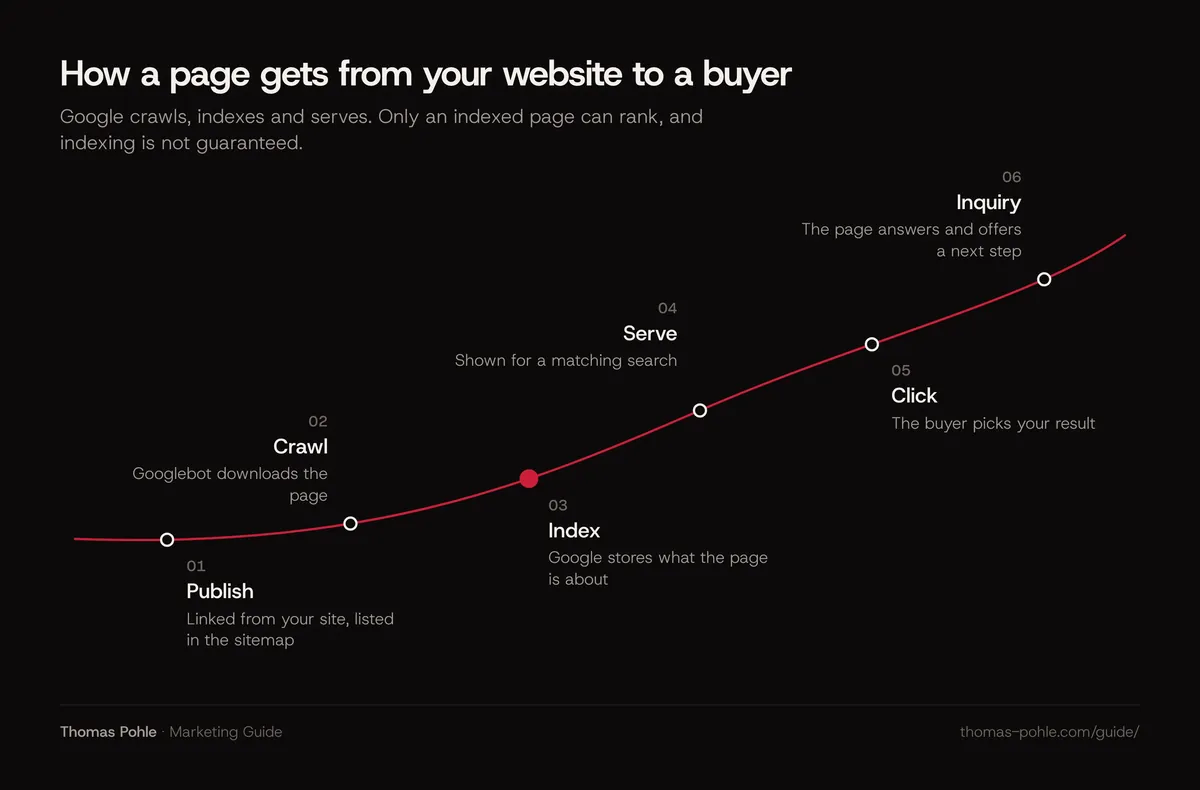
Google Search works in three stages, and SEO has a job in each one.
| Stage | What Google does | What usually goes wrong | What you control |
|---|---|---|---|
| Crawling | Downloads text, images and videos with automated programs called crawlers | Pages blocked, not linked, or behind a login | Internal links, sitemap, robots.txt |
| Indexing | Analyzes the page and stores what it is about in the Google index | Duplicate or thin pages, noindex tags, the wrong canonical URL | One clear page per topic, one canonical URL |
| Serving | Returns the results it finds most relevant for a search | The page answers a different question than the buyer asks | Topic, title, quality of the answer |
Google is explicit that none of this is guaranteed. It doesn't guarantee that it will crawl, index or serve any page, and not every page it processes gets indexed. So the first SEO job on any B2B site is unglamorous: check that your important pages are actually in the index. My technical SEO checklist for B2B websites walks you through it.
How does Google decide which pages to show?
Google ranks pages with automated systems that, in its own words, are designed to prioritize helpful, reliable information created to benefit people. In practice the page that answers the searcher's question best, from a source that looks trustworthy, tends to win. Tricks aimed at the algorithm are exactly what Google's spam policies target. Write for the reader.
Google's SEO starter guide is useful because it also says what doesn't matter. A few points from it that save B2B teams a lot of wasted effort:
- Meta keywords. Google Search doesn't use the keywords meta tag.
- Word count. The length of content alone doesn't matter for ranking. Make a page as long as the answer needs.
- Keywords in the domain. Keywords in the domain name or URL path alone have hardly any effect.
- E-E-A-T. Google says experience, expertise, authoritativeness and trust aren't a ranking factor in themselves. They describe what its systems try to reward. More in my guide on showing expertise to Google and AI.
- Keyword stuffing. Repeating the same words over and over tires readers and breaks Google's spam policies.
The spam policies name practices such as cloaking, link spam, keyword stuffing and scaled content abuse. Sites that violate them may rank lower or vanish from results. My take: a dramatic penalty is rarely the real risk for a B2B company. The real risk is a supplier buying links or mass-producing thin pages in your name, and you finding out a year later.
What are the parts of SEO?
SEO has five parts that build on each other: a technical base that lets pages be crawled and indexed, content that answers buyer questions, on-page signals that say what each page is about, authority from links and mentions on other sites, and measurement that shows what works. A weakness in one part limits all the others.
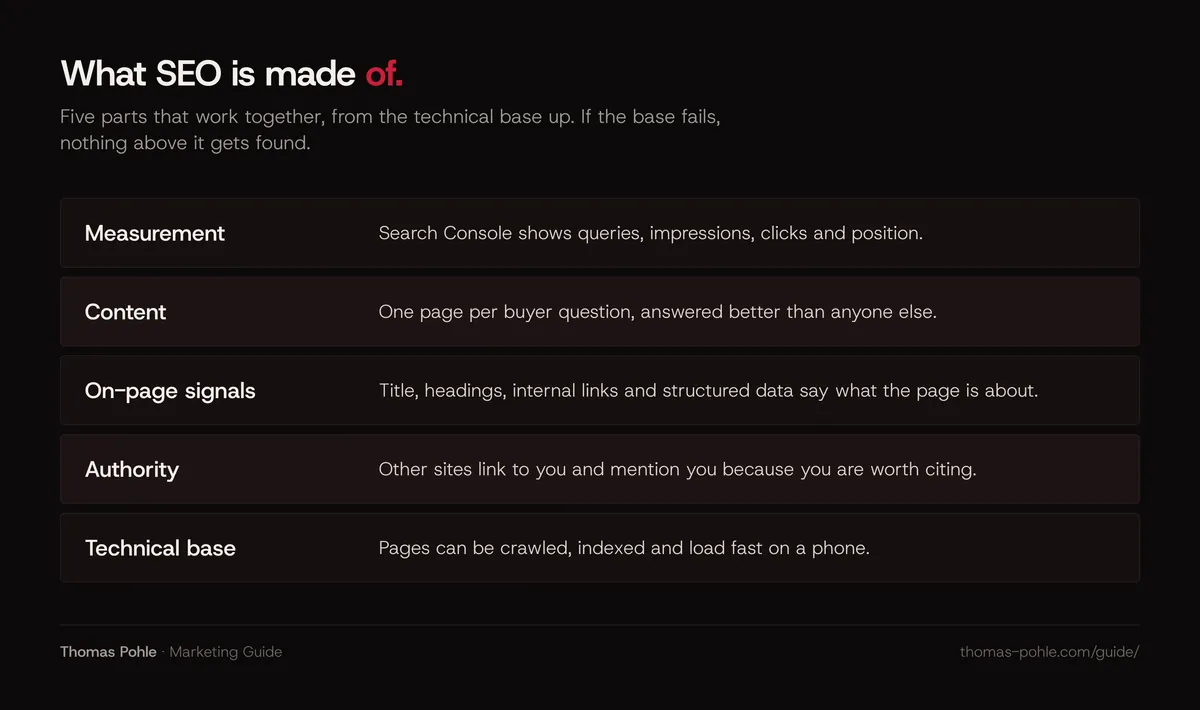
- Technical base. Pages can be crawled and indexed, load fast on a phone, run on HTTPS and, for sites in several languages, tell Google which version is for whom. Google's hreflang documentation says each language version must list itself and the others, and tags that don't point back to each other are ignored. My own site runs in English and German with these pairs. My view: Core Web Vitals are a hygiene factor in B2B. Get them green, then spend your time on content.
- Content. One page per real buyer question, written in the words buyers use. Part of content marketing, connected into topic clusters, which my guide on topic clusters and internal links explains.
- On-page signals. A title that matches the search, headings that follow the reader's questions, descriptive link text and structured data that matches what's visible. The guide on schema markup for B2B websites covers which types you need.
- Authority. Other relevant sites link to you and mention you: trade media, partners, associations, customers. You earn it by being worth citing. Buying links for ranking purposes is link spam under Google's policies.
- Measurement. Google Search Console and Bing Webmaster Tools show which searches you appear for and which pages get clicked.
What can SEO do in a B2B market with small search volumes?
In B2B, SEO pays off even when search volumes are small, because each search can be worth a lot. A term with a few dozen searches a month can matter more than a consumer term with thousands, if the person searching sits in a buying group with a real budget. Count inquiries and pipeline from organic search. Traffic is only a means to that.
Start with the searches real buyers make at each point of a purchase. They rarely type your product category alone.
| Type of search | What a buyer types | The page that answers it |
|---|---|---|
| Problem | "how to cut manual reporting on construction sites" | A guide that explains the problem and the options |
| Category | "construction management software Switzerland" | A solution page for that category and market |
| Comparison | "[your product] vs [competitor]", "alternative to [tool]" | An honest comparison page with criteria |
| Price and process | "cost of implementing [category]" | A page on pricing logic and the implementation process |
| Integration | "[your product] SAP integration" | One page per integration that matters |
| Brand | "[your company] reviews", "[your company] references" | Case studies, about page, customer proof |
Give comparison and integration pages extra care. As I see it, buyers open them late in a purchase, close to the shortlist. Your sales team hears these questions every week. My rule of thumb: that list beats any keyword tool export as a plan.
A worked example with assumed numbers
To judge whether SEO is worth it, run the arithmetic with your own numbers. The figures below are assumptions for illustration. They aren't benchmarks. Replace each one with data from Search Console and your CRM.
- Searches. You find 25 buyer searches with about 40 searches a month each: 1,000 searches a month.
- Clicks. Your pages reach the top results for some of them and win 5% of those searches as clicks: 50 visits a month.
- Inquiries. 2% of those visitors send an inquiry: one a month, 12 a year.
- Deals. Sales qualifies half of them and wins a quarter of the qualified ones: about 1.5 deals a year.
- Value. At an average deal of CHF 40,000 that's about CHF 60,000 a year, from pages that keep working after they're written.
What counts is the order of magnitude and the levers. Double the click share with better titles, or the inquiry rate with a clearer next step on the page, and the result moves as much as if you doubled the search volume. And if your average deal is CHF 2,000, the same arithmetic tells you SEO alone won't fill your pipeline.
How does SEO work with AI answers like Google AI Overviews and ChatGPT?
AI answers sit on top of search indexes, so SEO is the entry ticket. Google says a page must be indexed and eligible to be shown with a snippet to appear as a supporting link in AI Overviews or AI Mode, and that there are no additional requirements beyond that. AI assistants such as ChatGPT search also retrieve web pages through search before they write an answer.
AI answers do change what a ranking is worth. Pew Research Center tracked the browsing of 900 US adults in March 2025. Users who saw an AI summary clicked a traditional search result in 8% of visits, against 15% for visits without one. Links inside the summary got clicked in 1% of visits, and 18% of the Google searches in the study produced an AI summary. Google, for its part, says clicks from pages with AI Overviews are higher quality, meaning people spend more time on the site.
Both can be true at once: fewer clicks, better ones. For a B2B company this shifts the work in three directions:
- Answer first. Every important page states its answer in the first two or three sentences, so a system can lift and attribute it. That's what answer engine optimization (AEO) adds on top of SEO.
- Open access. The crawlers behind AI search can reach your pages. Which bots to allow is in my guide on getting cited by ChatGPT, Perplexity and Google AI Overviews.
- Visible proof. Named authors, sources and consistent company data give a system reasons to prefer your page over a similar one.
I built this guide that way on purpose: question headings, a 40 to 60 word answer first, an FAQ and primary sources. The aim is to be the most citable answer for Google and AI assistants. My take: ten sharp answer-first pages beat a hundred thin ones. What else changes is in my guide on SEO when AI answers the search.
Should a B2B company invest in SEO or Google Ads?
SEO and Google Ads solve different problems. Ads buy visibility today and stop the moment the budget stops. SEO builds pages that keep getting found without paying per click, but it takes months to build. Most B2B companies with real search demand use both: ads to learn which searches bring inquiries, SEO for the searches that will matter for years.
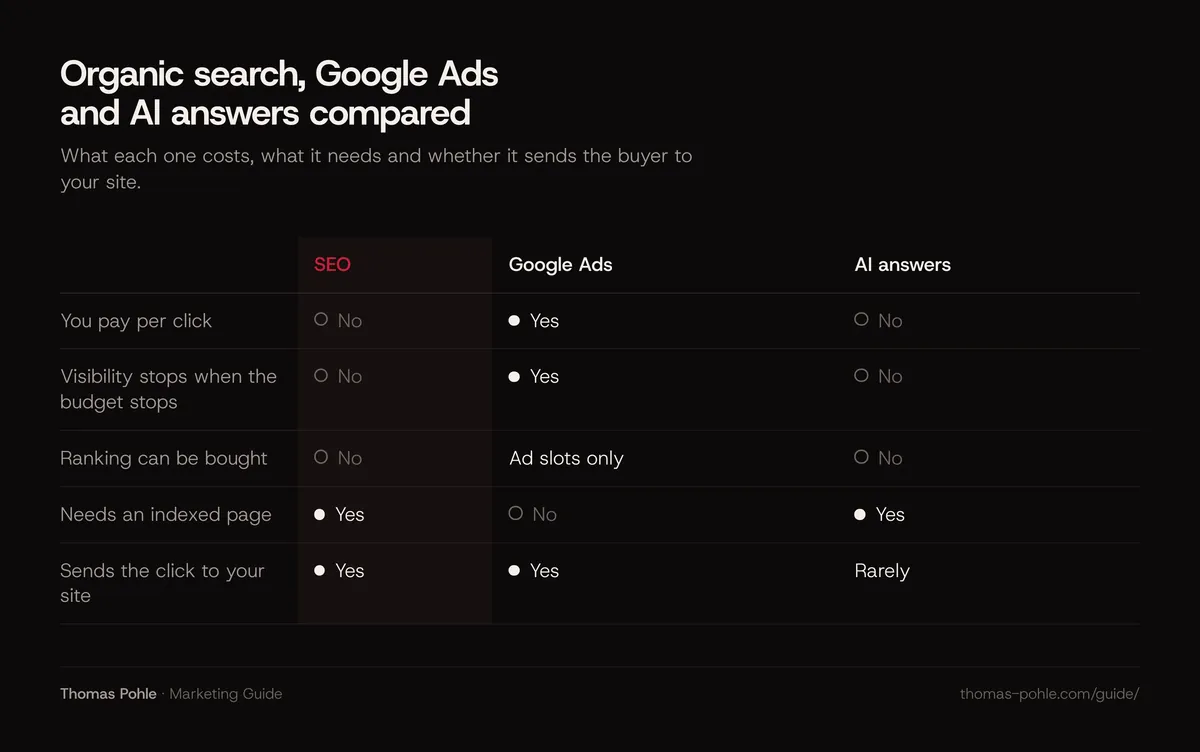
Here's how I'd split the decision:
- Ads first when you launch in a new market or category and need to know within weeks which searches turn into conversations.
- SEO first when the searches are known, your deal sizes are large and you can wait two or three quarters for the payoff.
- Neither first when almost nobody searches for what you sell yet. Then outbound, events and partners create the demand that search later captures.
How long does SEO take, and how do you measure it?
SEO is slow by design. Google's SEO starter guide says some changes take effect in a few hours while others take several months, and it suggests waiting a few weeks before judging the result of a change. For a new page on a young B2B site, plan in quarters. Judge it by queries and inquiries, never by a single ranking screenshot.
The free basis is Google Search Console. Its Performance report shows four numbers per search and per page:
- Impressions. How often your site appeared in results.
- Clicks. How often someone clicked through to your site.
- CTR. Clicks divided by impressions.
- Average position. The average position of your topmost result.
Google counts appearances in AI Overviews and AI Mode in the same Performance report, under the Web search type. Since 31 August 2026 a separate Generative AI performance report shows their impressions, without clicks. Bing Webmaster Tools adds a preview report on how often Microsoft Copilot and AI-generated Bing summaries cite your pages.
For management, three questions each quarter are enough. Do we appear for more of the searches our buyers make? Do more of those appearances turn into visits? How many inquiries came from organic search? The third needs a field in your CRM. How to set all of this up without heavy tracking is in my guide on measuring organic and AI search visibility.
Should you do SEO in-house or hire an agency?
A small B2B team can do most SEO in-house. The hardest part is knowing what buyers ask and answering it better than anyone else, and nobody outside the company knows that as well as you. An agency or freelancer is useful for technical audits, site migrations and extra writing capacity. Google's own advice on hiring an SEO is a good filter either way.
Google's page on whether you need an SEO is blunt. No one can guarantee a number one ranking on Google, and anyone who promises it should be dropped. It also warns about providers who claim a special relationship with Google or won't explain what they plan to do. Among the questions it suggests asking:
- Can you show examples of previous work and share some success stories?
- Do you follow the Google Search Essentials?
- What kind of results do you expect to see, and in what timeframe?
- How do you measure your success?
In-house work can move fast when the basics are right. In a previous in-house role I designed and launched a new website and online funnel that more than tripled organic traffic and doubled conversion rates within weeks.
I'd add one question: who writes the content, and how do they learn what our customers ask? If the answer leaves out your sales team, the pages will sound like everyone else's.
What to do this week
You can check most SEO basics in a few hours, with free tools and one conversation with your sales team. The list starts with the index, because nothing else matters until your important pages are in it. It ends with ownership. As I see it, most B2B companies have a nobody-has-time-to-run-it problem, and SEO is no exception.
- Open Google Search Console and confirm that your ten most important pages are indexed.
- Export the searches from the last three months and mark the ones a buyer would type.
- Ask sales for the ten questions they hear most often. Check whether a page answers each one.
- Search your three most important buyer searches in Google and in ChatGPT. Note who appears.
- Rewrite the title and first paragraph of your most important page so it answers the search in two sentences.
- Fill in the worked example above with your own numbers.
- Verify your site in Bing Webmaster Tools and submit your sitemap there too.
- Decide who owns SEO, with a name and a fixed number of hours per week.
SEO is a compounding asset. For a B2B company it works like building a sales library. Every page that answers a buyer's question keeps working in Google and in AI answers long after it's published.
Want a second pair of eyes on where to start? A one-day Momentum Workshop sets the positioning and the one channel that moves first. Often that's search.
Frequently asked questions
What does SEO stand for?
SEO stands for search engine optimization. It covers everything that helps search engines like Google and Bing crawl your website, understand what each page is about and show it for relevant searches. That includes the technical setup, the content, on-page signals such as titles and headings, links from other sites, and measuring the results in tools like Google Search Console.
Is SEO still worth it when AI answers the search?
Yes, because AI answers are built on search indexes. Google says a page must be indexed and eligible for a snippet to appear as a supporting link in AI Overviews. AI answers reduce clicks on classic results. So the value shifts to being the cited source, and to the searches where buyers still click, such as comparisons, pricing and vendor research.
What is the difference between SEO and SEA?
SEO earns unpaid visibility in organic search results through your website and content. SEA, search engine advertising, buys ad placements, for example with Google Ads, and you pay per click. Ads work from day one and stop when the budget stops. SEO takes months to build but keeps working without a cost per click.
How much does SEO cost for a B2B company?
There's no standard price. The main cost is usually time. Tools are the small part: Search Console and Bing Webmaster Tools are free. The real investment is someone who writes pages that answer buyer questions and keeps the technical base clean. Be careful with fixed-price offers that promise rankings. Google says no one can guarantee a number one ranking.
Can I do SEO myself without an agency?
For most small B2B companies, yes. The core work is checking that pages are indexed, writing one strong page per buyer question and measuring results in Search Console. An agency or freelancer helps with technical audits, migrations or capacity. Use the questions Google suggests, such as asking for examples of previous work and how success will be measured.
Sources
- Google Search Central: In-depth guide to how Google Search works
- Google Search Central: SEO Starter Guide
- Google Search Central: Creating helpful, reliable, people-first content
- Google Search Central: Spam policies for Google web search
- Google Search Central: Do you need an SEO?
- Google Search Central: AI features and your website
- Google Search Central: Tell Google about localized versions of your page
- Search Console Help: Performance report
- Pew Research Center: Google users are less likely to click on links when an AI summary appears in the results (July 2025)
- Bing Webmaster Blog: Introducing AI Performance in Bing Webmaster Tools public preview (February 2026)
- Google Search Central Blog: Introducing Search Generative AI performance reports in Search Console (June 2026, rolled out to all sites 31 August 2026)
- Search Console Help: Generative AI performance report (Search)

Thomas PohleB2B marketing advisor in Zurich. More than ten years in B2B marketing at Link11, Beekeeper and smino, most recently as Head of Marketing. CEO and co-founder of TEISENDA. Researched and drafted with AI tools, checked against the sources listed above. More about Thomas