What is account-based marketing and when does it pay off?

Account-based marketing (ABM) is a B2B approach where marketing and sales pick a short list of named companies and run campaigns for each of them. You stop collecting leads from a whole market. It pays off when deals are large, good-fit accounts are few and several people decide together. For a mid-sized company it usually starts with a CRM and LinkedIn. No new software.
This guide is for founders, CEOs and marketing leads of B2B companies that sell to a few dozen or a few hundred companies. Thousands of buyers? Different game. You get a decision table for whether ABM fits, a 90-day pilot plan, the stack you probably already own and the numbers to watch.
What is account-based marketing?
Account-based marketing treats each target company as a market of its own. Marketing and sales agree on a list of named accounts, find out who decides inside each one, and send messages that fit that company's situation. You measure success per account: meetings, pipeline and revenue. The number of leads collected barely matters.
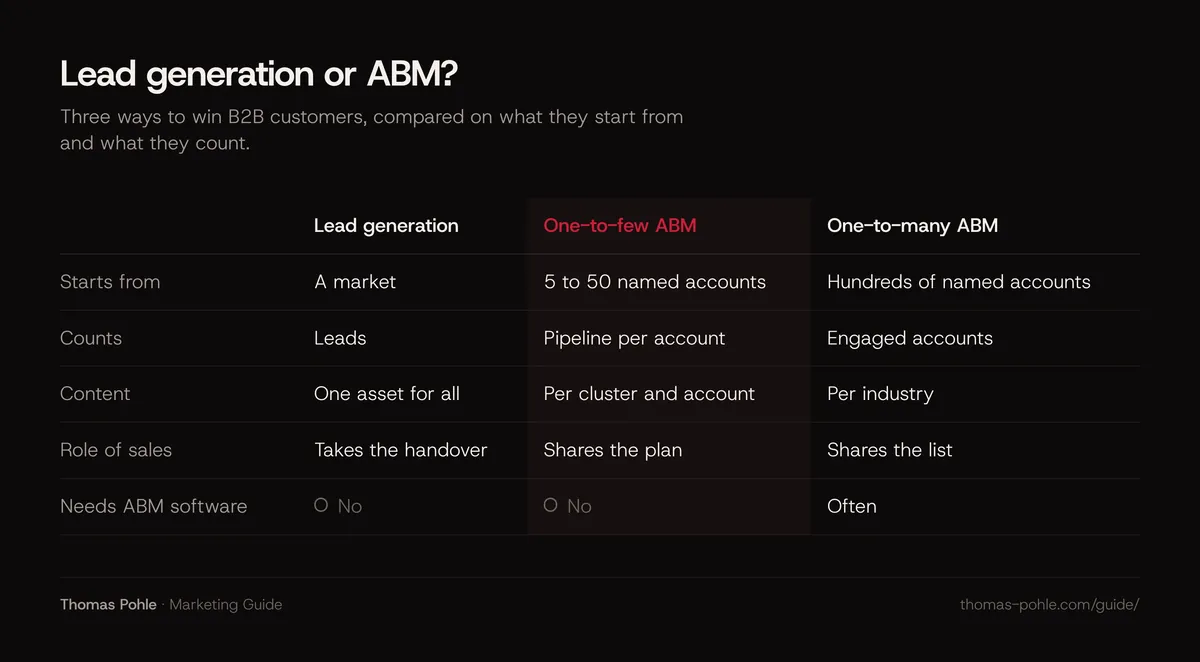
Classic lead generation runs the other way round: campaigns for a whole market, scoring, handover. ABM starts at the end of that funnel. You already know which companies you want.
ABM programs come in three depths:
- One-to-one. One account, one plan. Research, messages and often events or offers built for a single company. Worth it for the few accounts that could change your year.
- One-to-few. Small clusters of similar accounts, say a small group of companies in the same industry with the same problem. One message per cluster, adapted per company.
- One-to-many. Hundreds of named accounts with light personalization by industry or company size, usually run through ad platforms and automation.
For most mid-sized B2B companies the sweet spot is one-to-few, plus a handful of one-to-one accounts. Both run on tools you already pay for.
When does account-based marketing pay off?
ABM pays off when three things are true. A single new customer is worth hours of research and tailored outreach. You can name your best-fit accounts. And several people decide together. If your market has thousands of similar small buyers and deals close in days, skip it. Broad lead generation is cheaper and faster there.
The table below holds my rules of thumb for the decision. They don't come from a study. They're the questions I'd ask before spending a quarter on ABM.
| Question | ABM fits when | Stay with broad lead generation when |
|---|---|---|
| How many companies fit your ideal customer profile? | You can name them, roughly 20 to 500 | Thousands, and you cannot tell them apart |
| What is a new customer worth in year one? | High five figures or more | A few thousand, bought by card or short contract |
| How many people decide? | Several roles across departments | One person decides alone |
| How long is the sales cycle? | Months, with several meetings | Days or a few weeks |
| Can sales work the accounts? | Yes, sales agrees to the list and follows up | Sales has no capacity or does not want the list |
The buying group point matters more than most people think. Forrester's State of Business Buying 2024 reports that on average 13 people inside an organization are involved in a buying decision, and that 89 % of purchases involve two or more departments. A lead form captures one of them. ABM is how you reach the other twelve on purpose.
A warning on the evidence. As far as I could find, the claim that ABM delivers better returns rests mostly on self-reported surveys by associations and software vendors. Don't build your business case on those. Build it on your own deal values and win rates, as in the worked example further down.
How is ABM different from lead generation?
Lead generation asks how many interested people a campaign produced. ABM asks whether the right companies moved closer to a deal. You need both in a B2B marketing plan. Lead generation fills the pipeline from a broad market, ABM puts your effort on the accounts that matter most. Many companies run the two side by side.
The difference shows up in four places:
- The list comes first. You choose target accounts with sales before any campaign starts.
- Content gets narrower. One industry, one problem, sometimes one company.
- Sales is part of the campaign. Both teams touch the same account in the same weeks.
- Measurement moves to the account. Engaged accounts, meetings and pipeline. Form fills don't count for much.
If most of your customers come from inbound requests, keep that engine running. Add ABM for the top accounts. The guide on how B2B companies generate qualified leads covers the broad side of the pipeline.
How do you choose your target accounts?
Start with the customers you already have. List the ones that bought fastest, pay the most and stayed longest. Write down what they share, then use that profile to pick 20 to 30 similar companies you don't serve yet. My rule: sales signs off on every single name. Skip that and the program stalls within weeks.
Four steps:
- Describe the fit. Industry, size, region, the systems they run, the trigger that makes them buy (a new site, a regulation, a merger, a new head of operations).
- Build the long list. From your CRM, lost deals, LinkedIn company search and industry directories.
- Tier the list. Tier 1 gets one-to-one work, Tier 2 one-to-few clusters, Tier 3 light touches. My rule of thumb: five to ten Tier 1 accounts at a time is plenty for a small team.
- Write down why. One sentence per account on why now. If nobody can write that sentence, the account isn't ready for ABM.
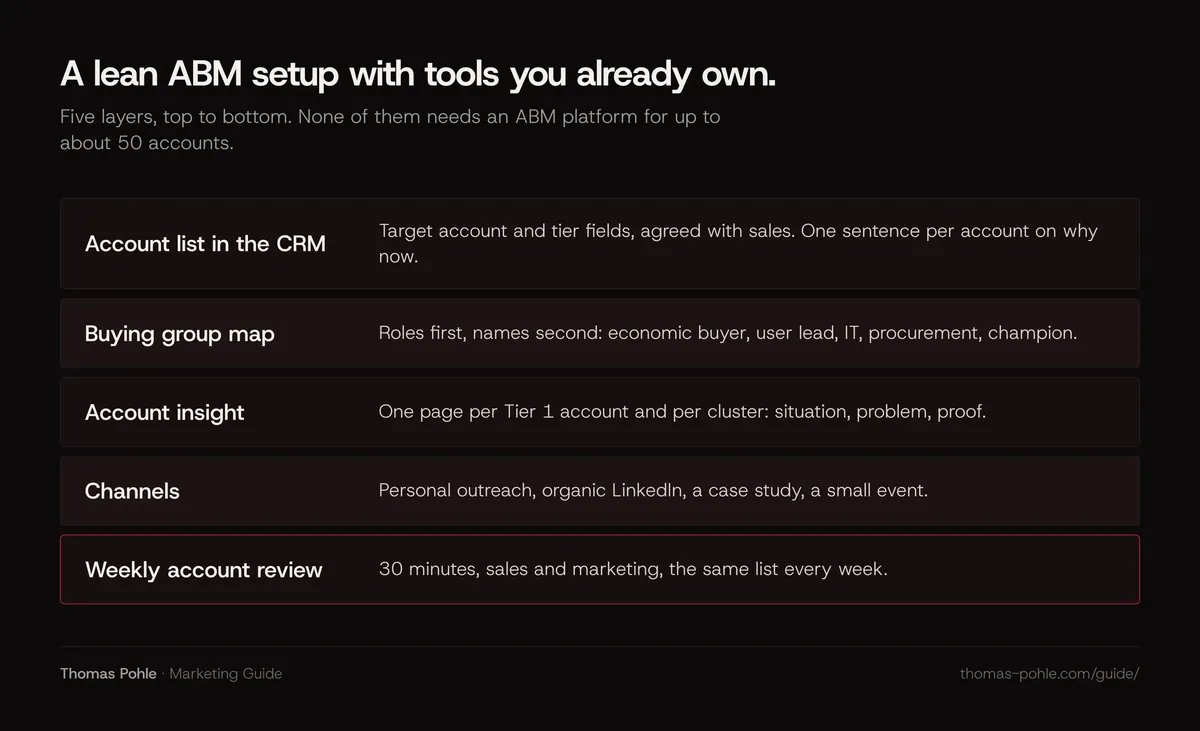
Keep the list in the CRM. A spreadsheet won't do. HubSpot, for example, has a target account checkbox, an ideal customer profile tier field and buying roles on contacts, available in Marketing Hub and Sales Hub Professional and Enterprise. Other CRMs get you the same with a few custom fields.
Who is in the buying group and how do you reach them?
Map the buying group before you write a single message. For each target account, list the roles that decide, pay, use and can block a purchase. Then find the names. The usual roles: the economic buyer, the user lead, IT or security, procurement, and an internal champion who wants the change to happen.
Each role needs its own reason to care. Risk and return for the managing director, integration and security for IT, easier daily work for the user lead. In my experience, buyers in Switzerland and Germany want to get to know you before they buy, more so than in the US or the UK. That's why I think ABM suits DACH well.
Channels that reach a buying group without special software:
- Personal outreach by sales. Email, phone and LinkedIn messages written for the person, based on real research about the company. Check the rules for unsolicited email in each country first. In Germany, section 7 of the UWG requires prior express consent for advertising by email, also toward businesses, with a narrow exception for existing customers.
- LinkedIn. Company list targeting in Campaign Manager plus organic posts from the people who sell. The LinkedIn guide covers the channel in detail.
- Proof content. A case study from a similar company does more in ABM than any ad. The case study guide shows how to build one.
- Small events. A breakfast, a site visit or a round table for five to ten accounts from one cluster.
Can you run ABM without enterprise software?
Yes. For one-to-one and one-to-few ABM with up to about 50 accounts, you need a CRM with a target account field, LinkedIn, your email and a shared account plan. That's it. Dedicated ABM platforms add intent data, account identification on your website and programmatic ads at scale. Those features pay once you work hundreds of accounts.
My take: most companies don't need more software. They need a better system for the tools they already have. When I set up outbound and ABM campaigns, the value proposition comes first, then the setup, then running the campaigns. The tool question comes last.
Know one limit before you plan LinkedIn ads for a small list. LinkedIn's help pages say a company list upload needs at least 300 rows, recommend 1,000 or more companies, and set the minimum audience for an ad set at 300 member accounts. A list of 30 target accounts won't run as an ad audience on its own.
A typical scenario with assumed numbers. An industrial software company has 30 target accounts and maps five roles per account. Targeting only them gives about 150 members, below the 300 an ad set needs. The company list itself would be refused for having fewer than 300 rows. You have three options: put Tier 1 to 3 into one list of 300 or more similar companies and filter by job function, run the 30 accounts through sales outreach and organic LinkedIn only, or do both. For 30 accounts I'd start with the second option. Add ads only for the wider Tier 3 list.
How do you plan a 90-day ABM pilot?
Run ABM as a 90-day pilot with 20 to 30 accounts before you build a program. Twelve weeks are long enough for first meetings in a typical B2B cycle. They're short enough to stop if nothing moves. Agree on the list, the plays and the review date with sales before week one starts.
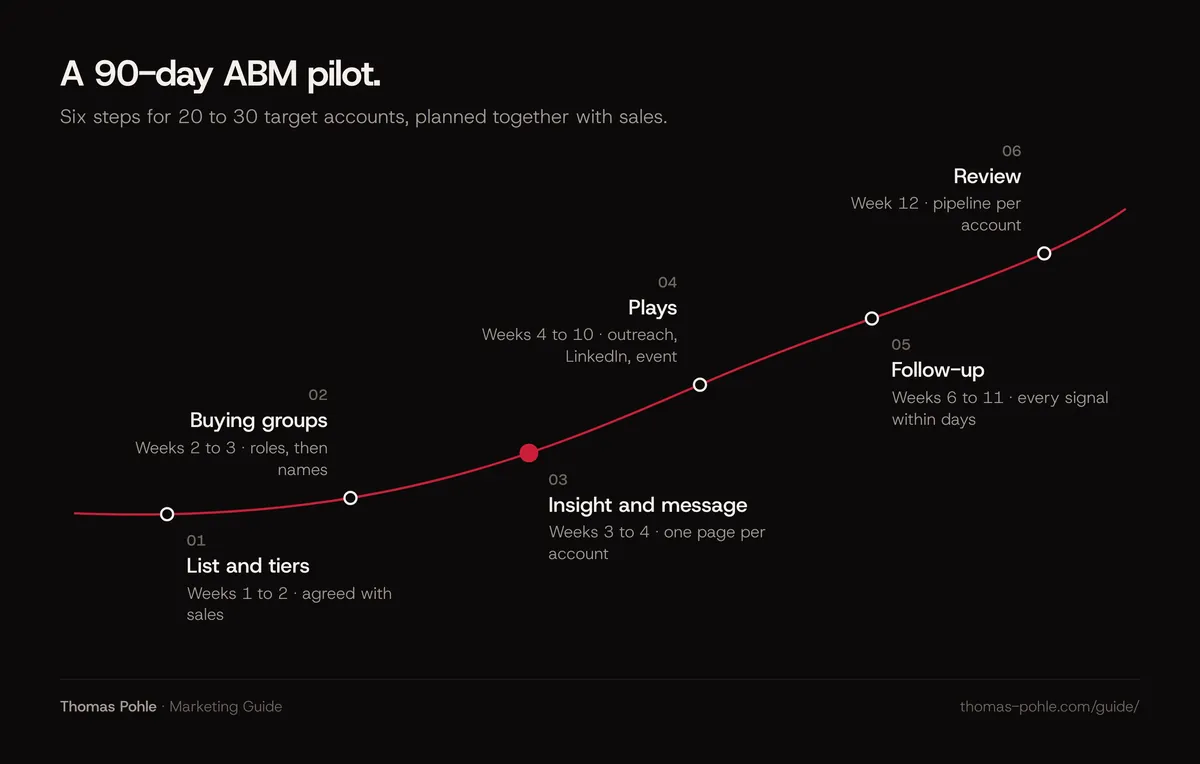
- Weeks 1 to 2: list and tiers. 20 to 30 accounts, agreed with sales, tiered, with one sentence per account on why now.
- Weeks 2 to 3: buying groups. Roles and names for each account. Note the gaps.
- Weeks 3 to 4: account insight and message. One page per Tier 1 account, one page per cluster: their situation, the problem you solve, the proof you have. AI tools speed up the research. A person checks every fact, as described in the guide on where to start with AI in marketing.
- Weeks 4 to 10: plays. Personal outreach, LinkedIn, one small event, all in the same weeks for the same account.
- Weeks 6 to 11: follow-up. Sales follows every signal within days. Marketing feeds the next touch.
- Week 12: review. Meetings, opportunities and pipeline per account, compared with the same accounts' history and with your normal pipeline.
Keep a one-page plan per Tier 1 account: buying group, last touch, next touch, owner. Review the list together every week. 30 minutes.
How do marketing and sales work together in ABM?
In ABM, marketing and sales share one list, one plan per account and one weekly review. Marketing owns research, content and the campaign touches. Sales owns the conversations and the follow-up. Without that shared rhythm, ABM turns into personalized ads that nobody follows up. That's one of the most common reasons pilots fail, in my view.
As Head of Marketing at smino I ran marketing and sales as one team. That's the setup ABM needs. Three agreements make it work:
- Who owns which account. Every Tier 1 account has one name in sales and one in marketing.
- What counts as a signal. A reply, a meeting, a visit to the pricing page from a known contact, a repeat visit to the case study. Agree on the list and on how fast sales reacts.
- What gets reported. Account progress. Marketing activity doesn't belong in the report. "Four of ten Tier 1 accounts in a first meeting" tells leadership more than impressions ever will.
Sales teams that sell this way call it account-based selling, and on LinkedIn, social selling. Research the company, talk to several people, bring something useful to each conversation.
How do you measure account-based marketing?
Measure ABM per account and over a full sales cycle. The core numbers: engaged accounts, meetings with the buying group, opportunities created, pipeline value, win rate and deal size on target accounts, compared with your non-target business. Ignore lead counts and click rates. ABM deliberately talks to few people, so they tell you little.
A worked example with assumed numbers. Your average deal is worth 60,000 in year one and you win one in four qualified opportunities. A 90-day pilot costs you roughly 15 days of internal time plus a few thousand for events and mail. If the pilot creates four qualified opportunities on its 30 accounts, the expected value is one new customer, worth 60,000. Now compare that with what a customer costs you in other channels.
Track in the CRM, by account:
- Coverage. How many buying group roles have a named, reachable contact.
- Engagement. Replies, meetings, event attendance, return visits from known contacts.
- Pipeline. Opportunities and their value on target accounts, by tier.
- Outcome. Win rate, deal size and sales cycle on target accounts versus the rest.
Give the numbers time. The LinkedIn B2B Institute's research on the 95-5 rule says 95 % of potential buyers aren't ready to buy today. So most accounts on your list won't be in market during a single pilot. A quarter shows early movement. A full sales cycle shows whether ABM changes your revenue. For reporting marketing results, see the guide on measuring marketing success in a B2B company.
Which tools do you need for ABM, and when?
From day one you need a CRM, LinkedIn and a way to share account plans. Everything else is optional until the pilot works. Buy an ABM platform when you run hundreds of accounts, when you need intent data or website account identification at scale, or when your team spends more time building lists than talking to buyers.
| Need | Start with | Add later, if needed |
|---|---|---|
| Account list and tiers | CRM fields for target account and tier | Data provider for firmographics |
| Contacts in the buying group | LinkedIn search, company websites, your own network | Sales Navigator or a contact data provider |
| Reach | Personal outreach, organic LinkedIn, events | LinkedIn company list ads, programmatic ABM ads |
| Signals | Replies, meetings, known contacts on key pages | Intent data and account identification on the website |
Check data protection before you add data tools. Bought contact data and visitor tracking are personal data processing. You need a legal basis, and under GDPR Article 14 you must inform people whose data you didn't collect from them. Ask your data protection advisor. This isn't legal advice.
What to do this week
- Pull your ten best customers from the CRM and write down what they have in common.
- Answer the five questions from the decision table. Three or more ABM answers: plan a pilot.
- Draft a list of 20 to 30 target accounts with one sentence each on why now.
- Book 45 minutes with sales to agree on the list and on who owns which account.
- Add a target account field and a tier field to your CRM.
- Map the buying group for your top five accounts. Roles first, names second.
- Put a weekly 30-minute account review into both calendars for the next twelve weeks.
ABM is a habit of focus. The technology is secondary. The companies that get the most out of it pick fewer accounts than they'd like and follow up faster than they planned. Want to set the list, the message and the first plays with your team in one day? That's what a Momentum Workshop is for.
Frequently asked questions
How many accounts should an ABM program start with?
Start with 20 to 30 accounts for a first pilot. Five to ten of them get one-to-one treatment. That's enough to see patterns and few enough that sales can follow up every single signal. Go bigger only once the pilot works.
Is account-based marketing only for large enterprises?
No. ABM fits any B2B company with a small number of valuable target accounts, long sales cycles and several decision makers. A mid-sized company with 30 good-fit prospects can run one-to-few ABM with its CRM, LinkedIn and personal outreach. You only need an enterprise ABM platform once you work hundreds of accounts.
What is the difference between ABM and account-based selling?
ABM is the marketing side: choosing accounts, researching them, creating tailored content and campaign touches. Account-based selling is the sales side: working the same accounts with personal conversations across the buying group. Run them as one program, with a shared list, shared account plans and a weekly review.
How long does ABM take to show results?
First replies and meetings usually show within the first weeks of outreach. Pipeline and revenue follow your normal sales cycle. If deals take six months, judge the program after six months. A 90-day pilot tells you whether accounts engage. It rarely proves the revenue effect on its own.
Can you run LinkedIn ads for a small ABM list?
Only with a workaround. LinkedIn requires at least 300 rows to upload a company list and at least 300 matched member accounts for an ad set, and it recommends lists of 1,000 or more companies. Combine your target accounts with similar companies in one list. Or reach a small list through sales outreach and organic posts instead.
Sources
- Forrester: The State of Business Buying, 2024 (press release)
- LinkedIn Marketing Solutions Help: Company list targeting in Campaign Manager
- LinkedIn Marketing Solutions Help: Matched Audiences best practices
- LinkedIn Marketing Solutions Help: Target audience size best practices
- HubSpot Knowledge Base: Set up account-based marketing in HubSpot
- German Act against Unfair Competition (UWG), section 7: unacceptable nuisance
- GDPR Article 14: Information where personal data have not been obtained from the data subject
- LinkedIn B2B Institute: The 95-5 rule

Thomas PohleB2B marketing advisor in Zurich. More than ten years in B2B marketing at Link11, Beekeeper and smino, most recently as Head of Marketing. CEO and co-founder of TEISENDA. Researched and drafted with AI tools, checked against the sources listed above. More about Thomas