How do B2B companies generate qualified leads?

Qualified B2B leads start with one agreement. Marketing and sales write down what a qualified lead is. Then you pick two or three channels that reach the whole buying group: usually referrals and partners, events, search and LinkedIn content, and tightly targeted outbound. You follow up within hours. You measure pipeline. Form fills are a vanity number.
This guide is for founders, CEOs and marketing leads of B2B companies with long sales cycles and several decision makers per deal. That's typical for the DACH Mittelstand. You get a lead definition you can agree on with sales, a channel table, a 90-day build plan and the math to work back from a revenue target.
What is B2B lead generation?
B2B lead generation means finding companies and people who might buy from you and turning them into sales conversations. A lead is a contact with some fit or interest. A qualified lead is one that marketing and sales agree is worth a sales conversation now, based on fit and a real signal of intent.
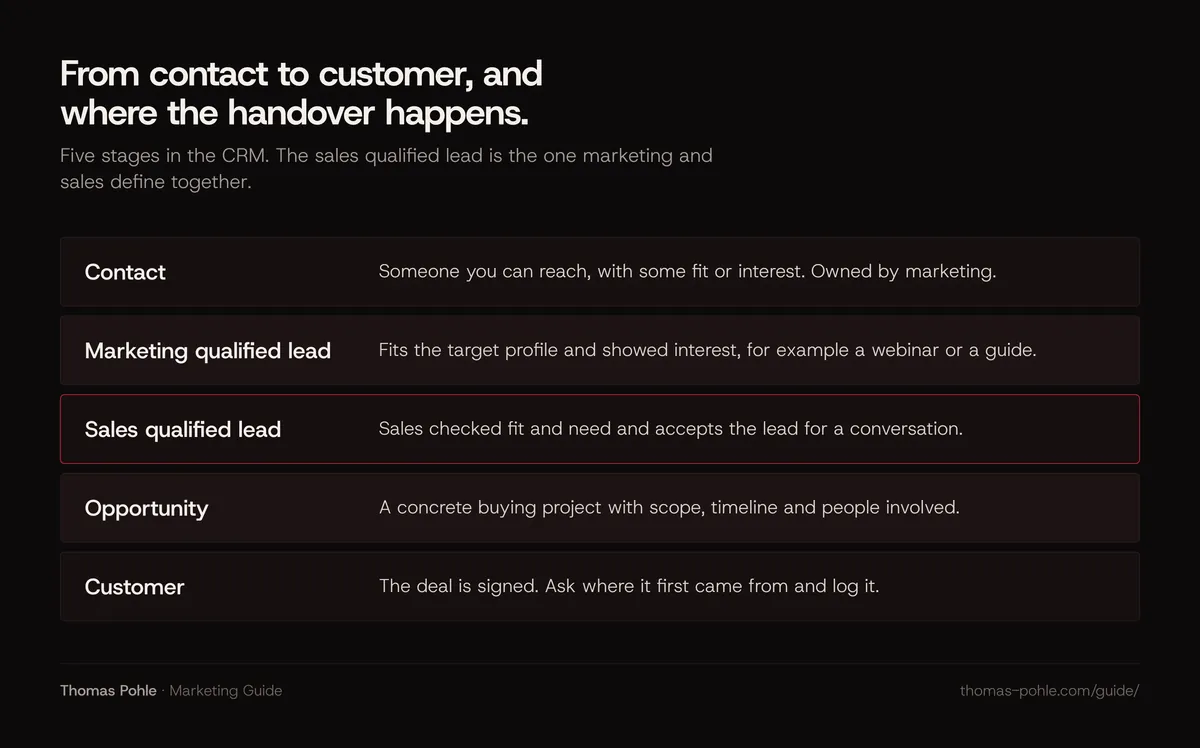
Most teams use four stages. The names vary. The logic doesn't:
| Stage | What it means | Who owns it |
|---|---|---|
| Contact or lead | Someone you can reach, with some fit or interest | Marketing |
| Marketing qualified lead (MQL) | Fits your target profile and showed interest, for example by downloading a guide or attending a webinar | Marketing |
| Sales qualified lead (SQL) | Sales has checked fit and need and accepts it for a conversation | Sales |
| Opportunity | A concrete buying project with a scope, a timeline and people involved | Sales |
The step from MQL to SQL breaks most often. Marketing counts leads. Sales calls them useless. Nobody wrote down what "qualified" means. My take: fixing that definition is worth more than any new channel.
Why is lead generation harder in B2B?
In B2B, several people decide, few of them are buying at any given moment, and the sales cycle runs for months. A lead from one person in one company is a starting point. It's far from a buying decision. Lead generation that ignores the buying group and the timing produces contacts sales can't convert.
Two findings shape how I plan lead generation:
- Buying groups are big. Forrester's State of Business Buying 2024 reports that on average 13 people inside an organization are involved in a buying decision and that 89 % of purchases involve two or more departments.
- Most buyers aren't in market today. The LinkedIn B2B Institute's 95-5 rule says 95 % of your potential buyers aren't ready to buy today. They'll be in market at some point in the future.
That's why aggressive short-term lead campaigns disappoint in B2B. You reach one person in a big buying group, at a moment when the company isn't buying. The fix has two parts. Stay visible to the whole market, so you're remembered when the time comes. And react fast to the few companies that show intent now.
Which channels bring qualified B2B leads in DACH?
In the DACH Mittelstand, qualified leads usually come from four places: referrals and partners, trade fairs and events, search and content, and LinkedIn. Outbound works too. Email outreach is legally tight in Germany and Switzerland, though. Pick two or three channels that fit your buyers and run them properly. Testing ten gets you nowhere.
| Channel | How it creates leads | Time to first results | Fits when |
|---|---|---|---|
| Referrals and partners | Customers, integrators and consultants recommend you | Weeks, if you ask actively | You have happy customers and a partner network |
| Trade fairs and events | Meetings at the booth, talks, small round tables | One event cycle | Your industry meets at a few fixed fairs |
| Search and content | Buyers find your answers on Google and in AI assistants | Months | Buyers research a known problem online |
| Posts from your people, ads and lead gen forms | Weeks for ads, months for organic reach | Your buyers are active there | |
| Outbound | Sales contacts named people at target accounts | Weeks | You can name your target accounts and check the legal basis |
| Webinars | Registrations from a specific, useful topic | Weeks | You have an expert and a question buyers care about |
Here's what I've seen running marketing in several markets. Buyers in Switzerland and Germany want to get to know you first, more than buyers in the US or the UK. Swiss buyers are strongly local. That's one reason referrals, events and personal contact carry so much weight in DACH. A few more notes:
- Search now includes AI answers. Buyers ask ChatGPT, Perplexity and Google's AI Overviews before they talk to sales. The guide on answer engine optimization explains how to become the cited source.
- Case studies convert across channels. One good case study helps sales, LinkedIn and search at the same time. See how to write a B2B case study that gets cited.
- Few, large accounts change the game. If your market is a few dozen companies, account-based marketing usually beats broad lead generation.
Should a B2B company rely on inbound or outbound?
Neither wins alone. Inbound brings buyers who already look for a solution. It takes months to build, and you can't choose who arrives. Outbound lets you choose the companies and starts fast. It needs a sharp message and a legal basis. Most B2B companies with long cycles need a mix, weighted by how well they can name their targets.
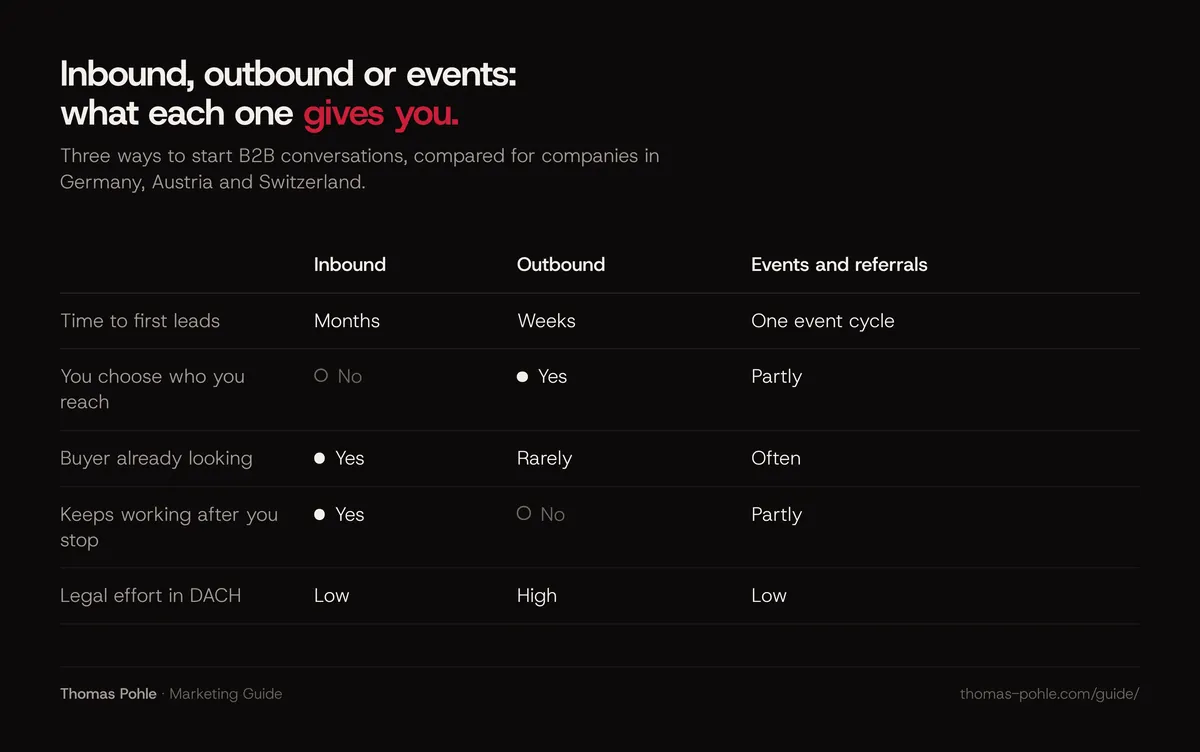
The legal side is a real constraint in DACH. Check it before you plan outbound volume:
- Germany. Section 7 of the Act against Unfair Competition (UWG) treats advertising by email without prior express consent as an unacceptable nuisance, toward businesses too. Phone calls to businesses need at least presumed consent.
- Switzerland. Article 3 (1)(o) of the Swiss UWG covers mass advertising by telecommunication without prior consent. How far it reaches for individual B2B emails is debated.
- Personal data. Contact data of named people falls under the GDPR or the Swiss data protection act, whatever the channel.
This is general information. It isn't legal advice. Ask your counsel before you scale outreach. My take: the safer routes are referrals, events that bring buyers to you, and phone calls where presumed consent is plausible. Don't treat LinkedIn messages as a loophole. German lawyers commonly apply the email rules to advertising messages sent through business networks.
How do marketing and sales define a qualified lead together?
Put marketing and sales in one room for two hours. Write down three things: which companies fit, which signals count as real intent, and how fast sales follows up. Sign it as a short service level agreement and review it every quarter. Without that document, lead quality is just a matter of opinion.
Marketing should sit much closer to revenue than it does in most teams. In my own copy I talk about pipeline, meetings and revenue. Buzzwords don't close deals. In a previous in-house role, marketing's share of the sales pipeline went from under 10 % to over 50 % within two years. A written lead definition is where that link to revenue starts. Here's a checklist with thresholds you can adapt. The numbers are starting points to agree on. They aren't benchmarks:
- Fit. The company matches at least three of your five profile criteria (industry, size, region, systems, trigger).
- Role. The contact is part of the buying group: a decision maker, a budget holder, a user lead or a strong champion.
- Intent. At least one strong signal (a demo request, a pricing question, a reply to outreach) or two medium signals within 30 days (a webinar plus a second visit to a product page).
- Follow-up. Sales responds to hand-raisers within one business hour and to other SQLs within one business day.
- Feedback. Sales marks every rejected lead with a reason within a week, so marketing can adjust.
The follow-up threshold has evidence behind it. A study published in Harvard Business Review in 2011 analyzed 1.25 million sales leads. Firms that contacted a lead within an hour were nearly seven times as likely to have a meaningful conversation with a decision maker as firms that waited even one hour longer. The same authors audited 2,241 US companies with a test web lead. Among those that replied within 30 days, the average response time was 42 hours.
How do you build a lead generation system step by step?
Build lead generation as a system in 90 days: definition first, then one offer worth responding to, two channels, a fast handover and a weekly review. A system beats a campaign because it keeps running after the launch. Plan it with sales from week one, so the leads it produces actually get worked.
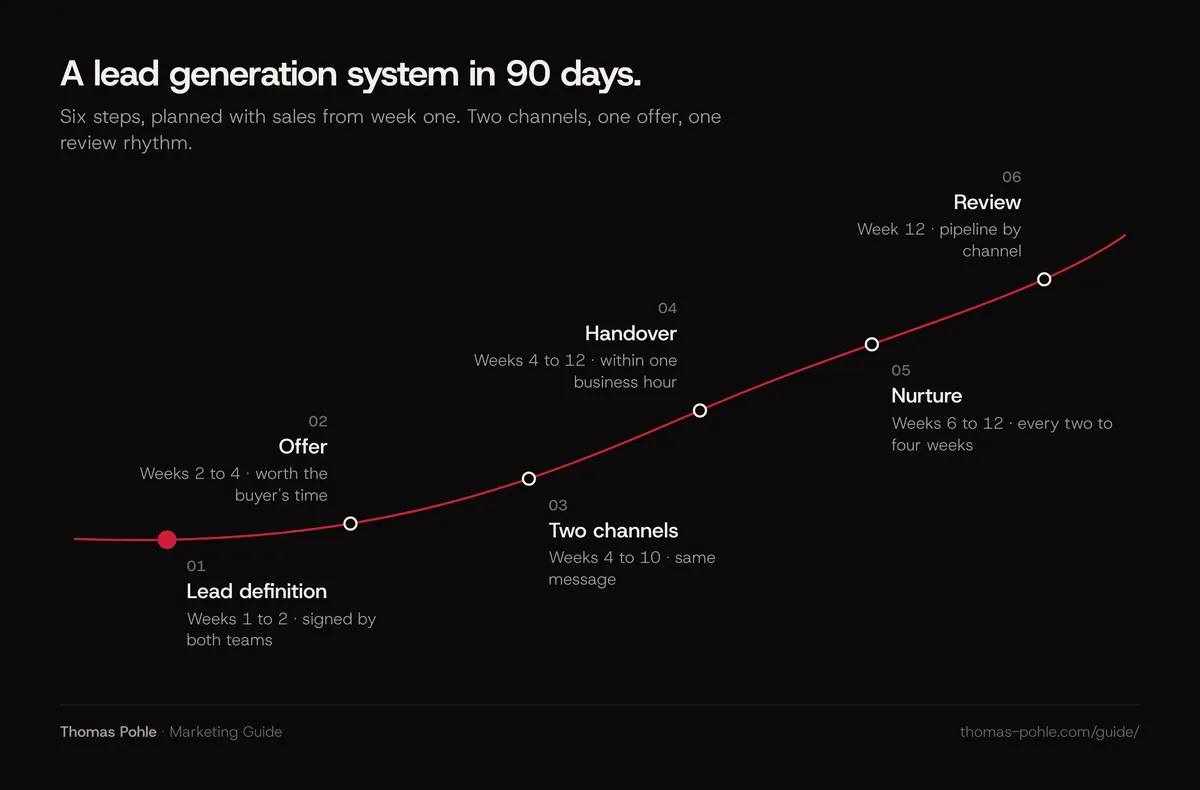
- Weeks 1 to 2: definition. The lead agreement above, signed by both teams. Set up the stages and fields in the CRM.
- Weeks 2 to 4: offer. One reason to respond that's worth the buyer's time: a benchmark, an assessment, a short consultation, a practical guide. A generic "contact us" isn't an offer.
- Weeks 4 to 10: two channels. For example LinkedIn plus an event, or search content plus outbound to named accounts. Same message, same offer.
- Weeks 4 to 12: handover. Every hand-raiser goes to a named person in sales, context attached. Track response times.
- Weeks 6 to 12: nurture. Leads that fit but aren't ready get useful content, roughly every two to four weeks, until they show intent.
- Week 12: review. Leads, SQLs, opportunities and pipeline by channel, plus the reasons sales rejected leads.
One of the three situations that make companies call me: sales is short on pipeline. Good product, good team, empty calendar. Here's my view. B2B marketing rarely fails for lack of a channel. It fails because nobody has the time to run the system that turns attention into meetings.
Should you buy B2B leads?
Rarely. Bought lead lists are contacts. They aren't leads. Nobody on them asked to hear from you, the data ages fast and you take on legal duties. Under GDPR Article 14 you must inform people whose data you got from someone else, at the latest when you first contact them. Buy data to enrich accounts you chose. Never buy demand.
Two exceptions can make sense. Event and media partnerships where attendees agreed to share their details with sponsors. And data providers you use to find the right people at accounts you already picked. In both cases, check what consent was given and for which use, and document it.
How do you manage and nurture leads until they are ready?
Most qualified B2B leads aren't ready to buy the day they arrive. Lead management keeps them in view. Every lead has a stage, an owner and a next step in the CRM. Leads that aren't ready get regular useful content. Sales hears about it when their behavior changes. Skip this and good leads go cold in the inbox.
The basics fit into any CRM:
- Stages and owners. One stage field, one owner per lead, no lead without a next step.
- Recycling. A rejected or stalled lead goes back to marketing with a reason. It never disappears into a black hole.
- Nurture streams. One short sequence per main buyer problem, built from your best guides, case studies and event invitations.
- Signals. An alert to sales when a nurtured contact replies, books, or comes back to a key page.
Marketing automation helps once the volume is too high for manual follow-up. The guide on marketing automation for B2B companies covers when and how.
How do you measure B2B lead generation?
Measure what reaches sales and revenue: SQLs, opportunities, pipeline value and closed deals by channel, plus the conversion rate between each stage and the cost per opportunity. Lead volume alone tells you little. Work back from your revenue target to see how many leads you actually need.
A worked example, with assumed numbers. Replace them with your own:
- Target. 1.2 million in new revenue next year, average first-year deal 60,000, so 20 new customers.
- Win rate. One in four opportunities closes, so you need 80 opportunities.
- SQL to opportunity. Half of SQLs become opportunities, so you need 160 SQLs.
- MQL to SQL. One in three MQLs is accepted by sales, so you need 480 MQLs a year, 40 a month.
Now the plan has a number per month and per stage. If one channel brings MQLs that sales rejects, the stage rates show it within weeks. If the MQL target looks impossible, don't buy more traffic first. My rule of thumb: a better definition that lifts the MQL to SQL rate is usually cheaper.
Attribution in B2B is messy. Many people touch many channels over months. Ask every new opportunity "how did you hear about us?" in a free text field, and compare it with what your tools report. For a broader setup, see the guide on measuring organic and AI search visibility.
What to do this week
- Pull last year's closed deals and note where each one first came from.
- Book two hours with sales and draft the lead agreement: fit, intent signals, follow-up times.
- Check your current response time to inbound requests. Send a test request to yourself.
- Work back from your revenue target to the number of SQLs and MQLs per month.
- Pick two channels from the table. Drop or pause the rest for one quarter.
- Write one offer that's worth a buyer's time and put it on the page your channels point to.
- Ask your counsel which outreach is allowed in your markets before you scale outbound.
B2B lead generation is a slow build with a fast handover. Want to set the definition, the two channels and the first offer with your team in one day? That's what a Momentum Workshop is for.
Frequently asked questions
What is the difference between an MQL and an SQL?
A marketing qualified lead (MQL) fits your target profile and has shown interest, for example by downloading a guide or attending a webinar. A sales qualified lead (SQL) is one that sales has checked and accepted for a conversation, because fit and need are confirmed. Marketing and sales should write both definitions down together.
Which lead generation channel works best in B2B?
There's no single best channel. My take: DACH buyers want to get to know you first, so referrals and events tend to bring the best fit. Search and content compound over time. LinkedIn reaches buying groups well. Outbound gives you control over who you reach. Pick two or three channels that match where your buyers already are, and run them consistently.
Is cold email allowed for B2B lead generation in Germany?
Usually not without consent. Section 7 of the German UWG treats advertising by email without prior express consent as an unacceptable nuisance, and it applies to businesses as well as consumers. There's a narrow exception for existing customers. Phone calls to businesses need at least presumed consent. Ask your counsel. This isn't legal advice.
How many leads does a B2B company need?
Work back from your revenue target. Divide the target by your average deal value to get the number of customers. Then divide by your win rate and by each stage conversion rate. With 20 new customers, a one-in-four win rate and typical stage rates, you quickly end up needing several hundred marketing qualified leads a year.
How fast should sales follow up on a new lead?
As fast as possible. Ideally within an hour for anyone who asks for contact. A study in Harvard Business Review found that firms contacting leads within an hour were nearly seven times as likely to reach a decision maker as firms that waited one hour longer. Put a response time in your lead agreement and track it.
Sources
- Forrester: The State of Business Buying, 2024 (press release)
- LinkedIn B2B Institute: The 95-5 rule
- Harvard Business Review: The Short Life of Online Sales Leads (Oldroyd, McElheran, Elkington, 2011)
- German Act against Unfair Competition (UWG), section 7: unacceptable nuisance
- Swiss Federal Act against Unfair Competition (UWG), Article 3
- GDPR Article 14: Information where personal data have not been obtained from the data subject
- GDPR Recital 47: Overriding legitimate interest

Thomas PohleB2B marketing advisor in Zurich. More than ten years in B2B marketing at Link11, Beekeeper and smino, most recently as Head of Marketing. CEO and co-founder of TEISENDA. Researched and drafted with AI tools, checked against the sources listed above. More about Thomas