What does a head of marketing do in a B2B company?

A head of marketing in a B2B company owns the plan that turns positioning into pipeline. The role sets strategy and budget, leads the team and outside partners, agrees targets with sales and reports results to the CEO. Smaller companies often start with a fractional leader. They hire full-time once budget and team justify it.
This guide is for founders and CEOs deciding whether they need the role, and for marketers who want to know what the job really involves. I worked in-house at Link11, Beekeeper and smino, most recently as Head of Marketing at smino, where marketing and sales ran as one team. Today I advise B2B companies from the other side of the table.
One belief shapes everything below. Most B2B companies don't have a marketing problem. They have a nobody-has-time-to-run-it problem. A head of marketing solves that second problem. The rest of this page shows what that looks like in practice.
What is a head of marketing, and how does the role differ from a CMO?
A head of marketing owns marketing results: strategy, budget, team and reporting. In B2B small and mid-sized companies the title usually sits one level below the executive board. A chief marketing officer (CMO) sits on it. In German the role is called Leiter Marketing, Marketingleitung or Bereichsleiter Marketing.
Titles vary more than tasks. Spencer Stuart reported in January 2026 that 31% of S&P 500 companies have no chief marketing officer, and that the top marketing role has taken on a broader set of responsibilities, sometimes under titles such as chief commercial officer. In a 50-person software company the same job may be called Head of Marketing, Head of Marketing and Communications or just Marketing Lead. The title doesn't matter. What matters is whether one person owns the result.
| Title | Where it usually sits | Typical scope |
|---|---|---|
| Marketing manager | Reports to the head of marketing or the CEO | Runs channels and campaigns |
| Head of marketing (Leiter Marketing) | Reports to the CEO or managing director | Owns plan, budget, team and results |
| Head of marketing and communications | Reports to the CEO | Adds PR, corporate and internal communications |
| Chief marketing officer (CMO) | Executive board | Owns marketing at board level, often brand and product marketing, sometimes revenue |
What are the core tasks of a B2B head of marketing?
A B2B head of marketing has six jobs: sharpen positioning, turn it into a plan and budget, build pipeline with sales, lead the team and outside partners, keep brand and content consistent, and measure what works. The weight shifts with company size. None of the six can be left out for long.
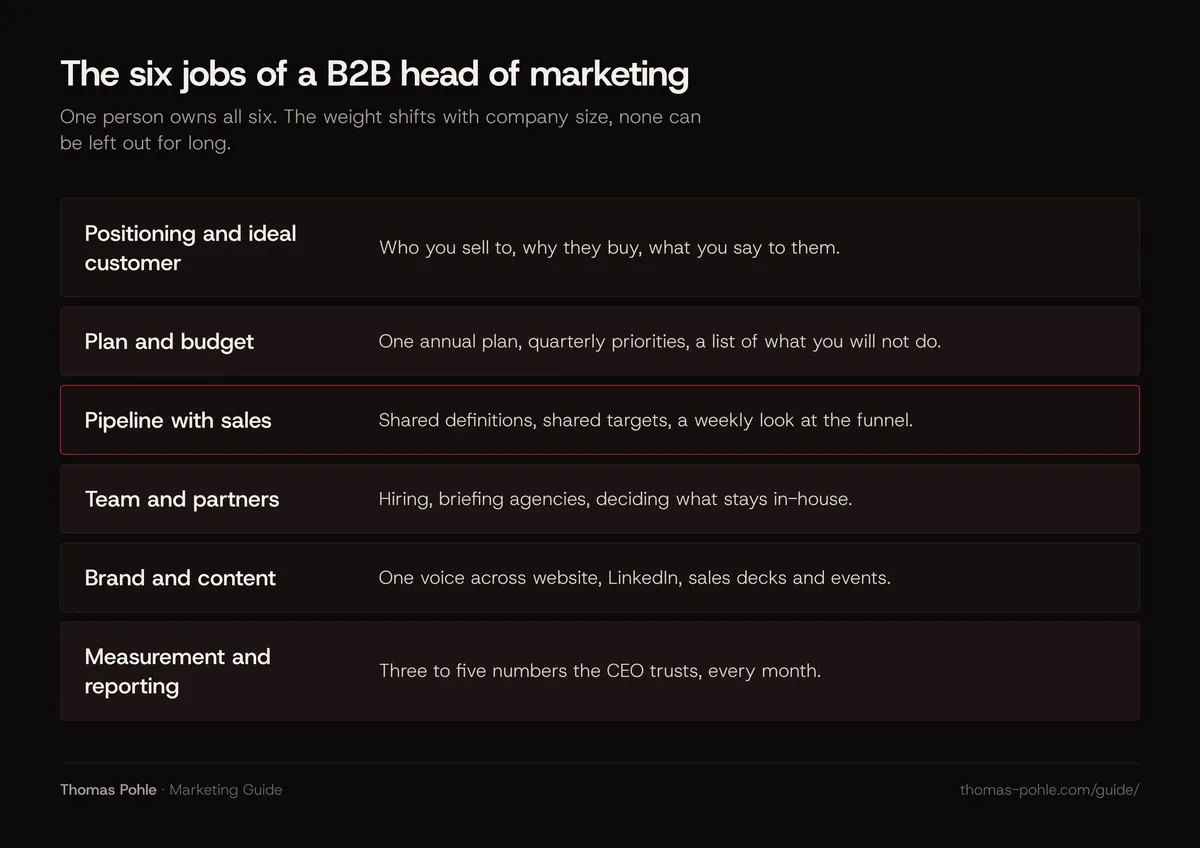
- Positioning and ideal customer. Who you sell to, why they buy and what you tell them. Skip this and every campaign starts from zero.
- Plan and budget. One annual plan with quarterly priorities, a budget, and a written list of what you won't do this year.
- Pipeline with sales. Shared definitions of a lead and an opportunity, shared targets, and a weekly funnel review with the head of sales.
- Team and partners. Hiring, briefing agencies and freelancers, and deciding what stays in-house.
- Brand and content. One voice across website, LinkedIn, sales decks and events. A topic plan instead of random posts. The guide on topic clusters and internal links shows how to build one.
- Measurement and reporting. A small set of numbers the CEO trusts, reported every month.
In a small team the head of marketing also does a lot of the work personally. Writes the positioning paper, briefs the agency, sometimes builds the landing page. That's normal. The mistake is letting execution crowd out the plan until nobody owns the direction anymore.
What goals should a head of marketing be measured on?
Measure a B2B head of marketing on pipeline and revenue contribution first. Then on how efficiently the money is spent. Then on whether buyers who'll be in the market later are getting to know the company. Activity numbers such as posts, clicks and raw leads are early signals at best. They're never the goal.
That last point gets forgotten. LinkedIn's B2B Institute, citing joint research with the Ehrenberg-Bass Institute, states that 95% of potential buyers aren't ready to buy today. A marketing leader who only harvests the few buyers in the market now empties next year's pipeline. Les Binet and Peter Field make the same point for the IPA: balancing brand and activation is one of their five principles of B2B growth.
- Pipeline. Qualified opportunities created or influenced by marketing, against a target agreed with sales.
- Revenue contribution. Won deals that marketing sourced or helped, reviewed every quarter.
- Efficiency. Cost per qualified opportunity and spend against plan.
- Future demand. Branded search, direct traffic and how often your company shows up in search and AI answers for your category. The guide on answer engine optimization covers the second part.
- Team delivery. Whether the quarterly plan shipped on time.
Pipeline is also where the role proves itself fastest. In a previous in-house role I raised marketing's share of the sales pipeline from under 10% to over 50% within two years. Next to pipeline created, marketing's share of pipeline is the number I'd put at the top of the scorecard. It shows whether marketing and sales work as one system.
My take: agree on four to six numbers in the first month, write down how each one is measured, and keep them for a year. A scorecard that changes every quarter makes every leader look good and every result impossible to judge. The guide to marketing measurement goes deeper into the methods.
Who should the head of marketing report to?
In most B2B companies with up to a few hundred employees, the head of marketing should report to the CEO or managing director. That's my clear preference. It keeps marketing tied to company strategy and gives the role the authority to say no. Reporting into sales only works when marketing's sole job is lead generation. It rarely is.
- To the CEO. The default for small and mid-sized B2B companies. Positioning, pricing signals and market entry are CEO topics. Marketing has to sit close to them.
- To the head of sales or a chief revenue officer. Common in sales-led companies. It tightens the pipeline link. My take: brand and long-term demand usually lose out to this quarter's numbers.
- To a chief commercial officer. Marketing, sales and sometimes customer success under one person. Here's my view: it works when that person has run marketing before.
Whatever the line, the CEO owes the role three things. A budget with a clear owner. One person who decides when marketing and sales disagree. And access to customers and sales calls. Without customer access, a head of marketing writes positioning from guesses.
How much budget does a head of marketing manage?
There's no fixed number. Benchmarks give you a reference point. In Gartner's 2025 CMO Spend Survey, marketing budgets averaged 7.7% of company revenue, flat on the year before. That sample is mostly large companies in North America and Europe. Treat it as context. It's no target for a 40-person B2B firm.
The head of marketing owns the logic of the budget more than its size. Five budget questions land on this desk every year:
- Planning. Build the budget bottom-up from the pipeline target. Last year plus ten percent is no plan.
- Allocation. Split it across channels, and between future demand and demand that exists today.
- Tracking. Compare spend with plan every month, so surprises show up in March and not in December.
- Cutting. Know which line items to stop first when the year goes badly, without cutting the ones that feed next quarter's pipeline.
- Outside money. Use market development funds where technology vendors or partners offer them.
A budget close to zero doesn't make the job disappear. It shifts from buying reach to earning it: founder posts on LinkedIn, customer stories, partner webinars. The guide on writing a B2B case study covers one of the cheapest assets with the longest life.
How should the marketing team around a head of marketing look?
The head of marketing designs the team. In most B2B companies that means a few generalists in-house and specialists bought in. Keep in-house whatever touches positioning, customers and data. Buy what needs deep craft and little company knowledge, such as design, paid media management or video production.
Typical first hires, in the order I'd make them:
- A content or product marketer who can write, interview customers and turn product knowledge into pages, posts and sales material.
- A marketing operations or demand generation person who owns the CRM, automation, tracking and the handover to sales.
- A designer, in-house or as a steady external partner, so the brand stays consistent across every piece.
AI changes the math. My take: research, first drafts, repurposing and reporting now take far less time than a few years ago, so a small team covers more ground. The guide on where to start with AI in B2B marketing shows which processes to change first.
When does a full-time head of marketing pay off?
A full-time head of marketing pays off once there's enough budget, team and plan to lead. Before that, a fractional or interim leader one to three days a week often gets more done for the money. You pay for judgment and direction instead of a full calendar. The table below shows the signals I'd check. I work as a fractional advisor myself, so weigh my view accordingly.
| Signal | Fractional or interim first | Full-time hire |
|---|---|---|
| Marketing team without the leader | 0 to 2 people | 3 or more people |
| Leader's full cost as share of the total marketing budget | Above about 25% | Below about 25% |
| Positioning and ideal customer | Not written down yet | Written and agreed |
| Who sells | The founder sells | A sales team needs pipeline every month |
| Markets and products | One market, one product | Several, needing coordination |
Here's a typical scenario, with assumed numbers you should replace with your own. A B2B software company with CHF 12 million revenue plans 5% of revenue for marketing, CHF 600,000 including people. Assume a full-time head of marketing costs CHF 200,000 a year fully loaded. That one person eats a third of the budget before a single campaign runs. Now assume a fractional leader for two days a week at CHF 1,600 a day over 46 working weeks. That's about CHF 147,000, plan and direction covered, more left for execution. At CHF 25 million revenue and the same 5%, the full-time leader is 16% of a CHF 1.25 million budget. Then the hire makes sense.
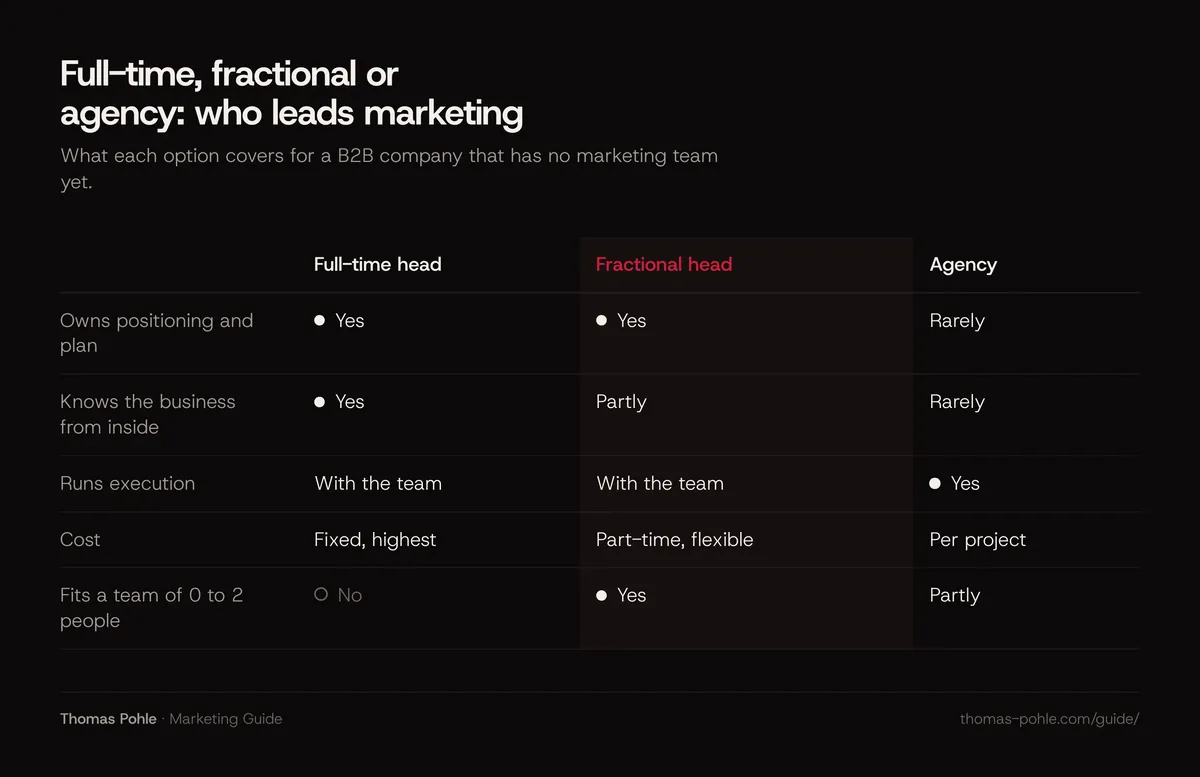
None of these options is wrong. An agency is strong at execution. A freelancer covers one channel well. A full-time leader brings continuity. Each fits a different stage, and the table above tells you which stage you're in.
What should a new head of marketing do in the first 90 days?
In the first 90 days a new head of marketing should listen, decide and ship one thing. Talk to customers and sales, audit what exists, write down positioning and the plan, and agree the scorecard with the CEO. Then run one campaign or channel end to end before building anything bigger. Order beats speed.
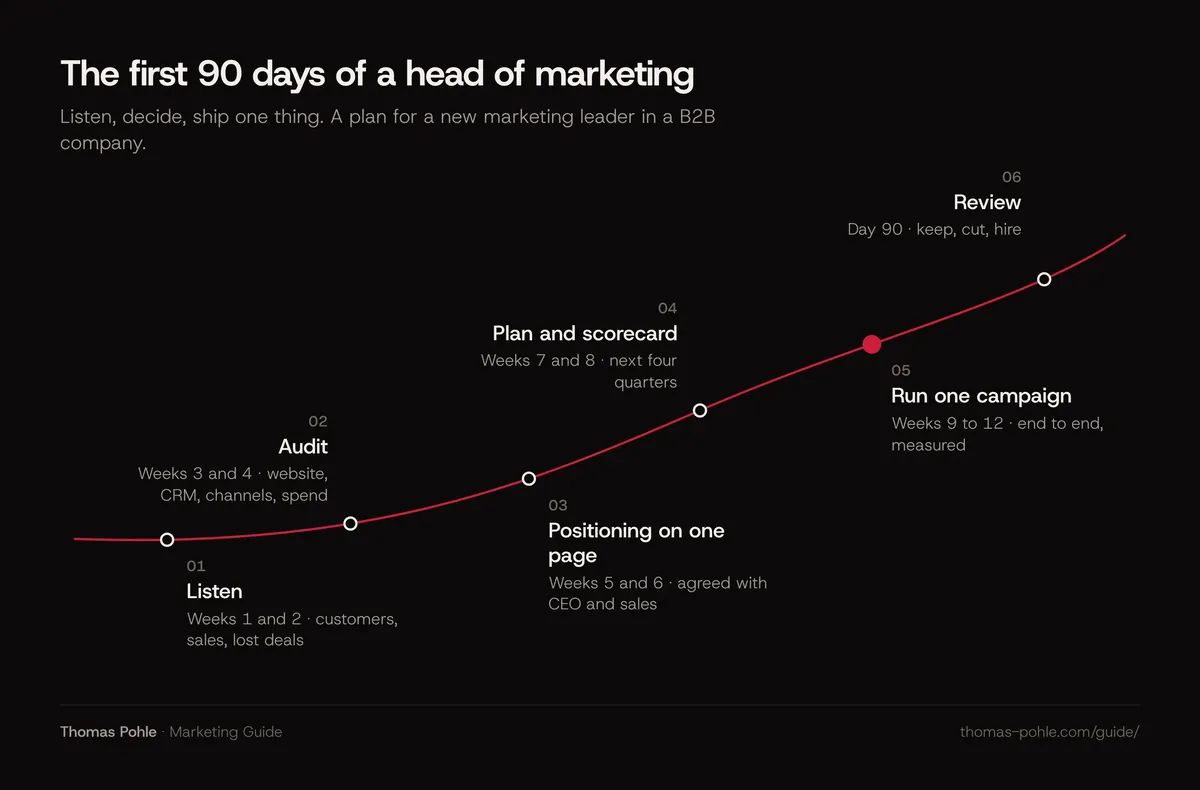
The plan I'd follow:
- Weeks 1 and 2. Listen. Customer calls, sales calls, lost deals. Write down the words buyers use.
- Weeks 3 and 4. Audit. Website, CRM data, channels, agencies, tools and spend.
- Weeks 5 and 6. Positioning and ideal customer, on one page, agreed with the CEO and sales.
- Weeks 7 and 8. Plan, budget and scorecard for the next four quarters.
- Weeks 9 to 12. One campaign or channel run end to end, measured against the scorecard.
- Day 90. Review with the CEO: what to keep, what to cut, whom to hire.
My rule of thumb: a new leader who launches a rebrand in week three spends the rest of the year defending it. One campaign that brings in meetings buys more room than any strategy deck.
What to do this week
Whether you're about to hire a head of marketing or you just became one, these steps take a few hours and make the next decision easier.
- Write down who owns marketing results today, by name. If the answer is "the CEO, on Sunday evenings", you've found the gap.
- List the six jobs from this guide and mark the ones nobody does right now.
- Pick four to six numbers for the scorecard and note how each one is measured.
- Check the reporting line. Does marketing have one decision-maker when it disagrees with sales?
- Add up the full marketing budget, people included, and work out what share a full-time leader would take.
- Use the decision table to choose between a fractional start and a full-time hire.
- Block two hours with sales and listen to three recent calls.
Marketing leadership comes down to ownership. When one person owns the plan, the pipeline and the numbers, the company moves. When nobody does, even a good product waits. For how strategy, channels and measurement fit together, start with the guide to B2B marketing.
Need that ownership before you can justify the hire? Marketing leadership without the hire through Momentum Advisory is one way to get there.
Frequently asked questions
What is the difference between a head of marketing and a marketing manager?
A marketing manager runs channels and campaigns. A head of marketing owns the result: positioning, plan, budget, team and the pipeline target agreed with sales. In small companies one person may do both. The head of marketing is the one who decides what the team won't do and answers to the CEO for the numbers.
Is Leiter Marketing the same as head of marketing?
In most German-speaking companies, yes. Leiter Marketing, Marketingleitung and Head of Marketing describe the same role: the person who owns marketing strategy, budget and team, usually reporting to the managing director. Bereichsleiter Marketing shows up in larger companies where marketing is a division. A CMO usually sits one level higher, on the executive board.
What does a head of marketing and communications do?
Everything a head of marketing does, plus communications: press relations, corporate communications and often internal communications. The combined role is common in mid-sized companies without a separate communications team. It needs someone comfortable with journalists and with pipeline targets. That mix is rarer than it sounds.
How long does a head of marketing usually stay?
There's no reliable figure for heads of marketing in small and mid-sized companies. For large companies, Spencer Stuart reported in January 2026 that chief marketing officers in the S&P 500 stay 4.1 years on average, compared with 5.0 years for all C-suite roles. Build the role so the knowledge stays in the team when a leader leaves.
Can a fractional head of marketing work for a startup?
Yes. My take: at an early stage it often works better than a full-time hire. A fractional leader brings plan, positioning and judgment one to three days a week while the company builds its first team. It works when at least one person in-house executes and the CEO gives the fractional leader real decision rights.
Sources
- Spencer Stuart: CMO Tenure 2026, a snapshot of an expanding role for marketing leaders
- Gartner: 2025 CMO Spend Survey reveals marketing budgets have flatlined at 7.7% of overall company revenue
- LinkedIn B2B Institute: The 95-5 rule
- IPA: Five principles of growth in B2B marketing (Les Binet and Peter Field)

Thomas PohleB2B marketing advisor in Zurich. More than ten years in B2B marketing at Link11, Beekeeper and smino, most recently as Head of Marketing. CEO and co-founder of TEISENDA. Researched and drafted with AI tools, checked against the sources listed above. More about Thomas