What is marketing, and what does it mean for a B2B company?

Marketing decides who you sell to, what you offer them, at what price, through which channels, and how you tell them about it. Advertising and brochures are the visible part. In a B2B company the part that matters sits underneath: a clear position in the market, and the material that helps sales win deals.
This guide is for founders and CEOs of B2B companies who know marketing matters and suspect theirs is too small. You get the textbook definition, what it means in practice in B2B, how marketing supports sales, and a decision table for where to start in your situation.
What is the definition of marketing?
The most cited definition comes from the American Marketing Association (AMA). It describes marketing as the activities, institutions and processes that create, communicate, deliver and exchange offerings with value for customers, clients, partners and society at large. Two words carry the weight: offerings and value. Marketing starts long before the first advertisement.
Three parts of that definition matter most for a B2B company:
- Creating comes first. What you offer, and to whom, is a marketing decision. Design the product first and hand it to marketing later, and you've skipped half the job.
- Delivering and exchanging include price and channel. How a customer buys, through which partner and on which terms belongs to marketing as much as the campaign does.
- Value is judged by the customer. Your feature list counts only as far as a buyer sees it solving a problem that costs them money.
The AMA has its definitions periodically reviewed and updated by a panel of scholars, so older textbooks may quote an earlier wording. My shorter working version for B2B: marketing makes sure the right companies know you, understand why you're the better choice, and find it easy to buy from you. Sales closes the deal. Marketing makes closing easier.
What does marketing include?
Marketing includes four classic decisions, the four Ps: product, price, place and promotion. Most people only see promotion. In B2B the other three often decide the deal: which package you offer, how your pricing works, and how a buyer gets from first contact to a signed contract. Positioning ties all four together. My guide on finding your B2B positioning shows how to get there.
| The P | Textbook meaning | What it means in a B2B company |
|---|---|---|
| Product | What you sell | The problem you solve, the packages, implementation and service level |
| Price | What it costs | Pricing logic, discounts, procurement terms, the cost compared to the alternative |
| Place | Where and how it is sold | Direct sales, partners, marketplaces, the path from inquiry to contract |
| Promotion | How you communicate | Website, search, LinkedIn, events, PR, case studies, sales material |
In practice I look at marketing in six areas, from understanding the market to measuring what it brings. Same four Ps, sorted the way a B2B team actually works on them.
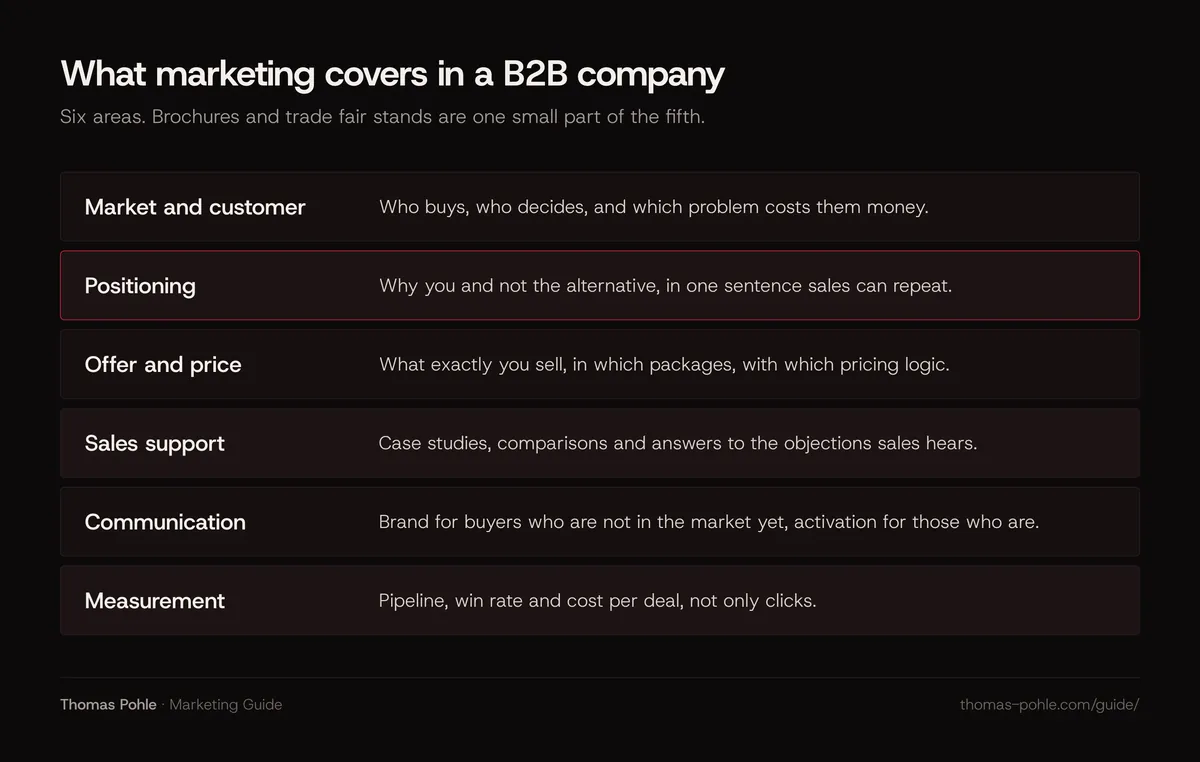
Running these areas over time is what textbooks call marketing management: setting goals, planning the measures, running them and checking the result. The image a market holds of your company, your corporate image, comes from all six areas together. The logo alone doesn't make it.
How is B2B marketing different from consumer marketing?
B2B marketing sells to organizations. Several people decide, purchases are rarer and larger, and buyers research a lot before they talk to a vendor. The basic logic matches consumer marketing. The time horizon changes: at any given moment, most of your future customers aren't buying anything at all.
John Dawes of the Ehrenberg-Bass Institute put a rough number on this in a 2021 report for LinkedIn's B2B Institute. Up to 95% of business buyers aren't in the market for many goods and services at any one time. His reasoning: companies change providers such as their principal bank or law firm about once every five years, so only about 20% of buyers are in the market in a given year and something like 5% in a quarter. Dawes says himself that the 95% isn't meant as a precise rule.
The consequence is practical. Target only the companies ready to buy this quarter and you miss most of next year's pipeline. The rest need to know your name and remember what you stand for when their moment comes. Other differences that shape B2B marketing:
- Several decision makers. A user, a budget owner, IT, procurement and often management all need different answers.
- Long cycles. A purchase can take months, so marketing has to stay present between the first visit and the signature.
- Few, large deals. A handful of customers can make your year. Every lost shortlist hurts.
- Personal risk. The buyer's reputation is tied to the choice, so proof and trust weigh more than a clever ad.
How these differences turn into a working setup is the subject of my guide on how B2B marketing works.
Markets differ too. I've run marketing for eight markets, from Switzerland, Germany and Austria to the UK and the USA. What I've seen: American and British buyers are more direct and decide faster. Buyers in Switzerland and Germany first want to get to know you, and Swiss buyers are strongly local. My take for a DACH company: build trust before the first meeting, through content, references and people they already know.
Why is marketing in many B2B companies reduced to brochures?
Here's my view. Marketing in many mid-sized B2B companies grew out of producing materials: brochures, trade fair stands, the website, a newsletter. Positioning, pricing and sales arguments stayed with management and sales, often undocumented. You end up with a marketing team that executes requests, and a company whose story changes depending on who tells it.
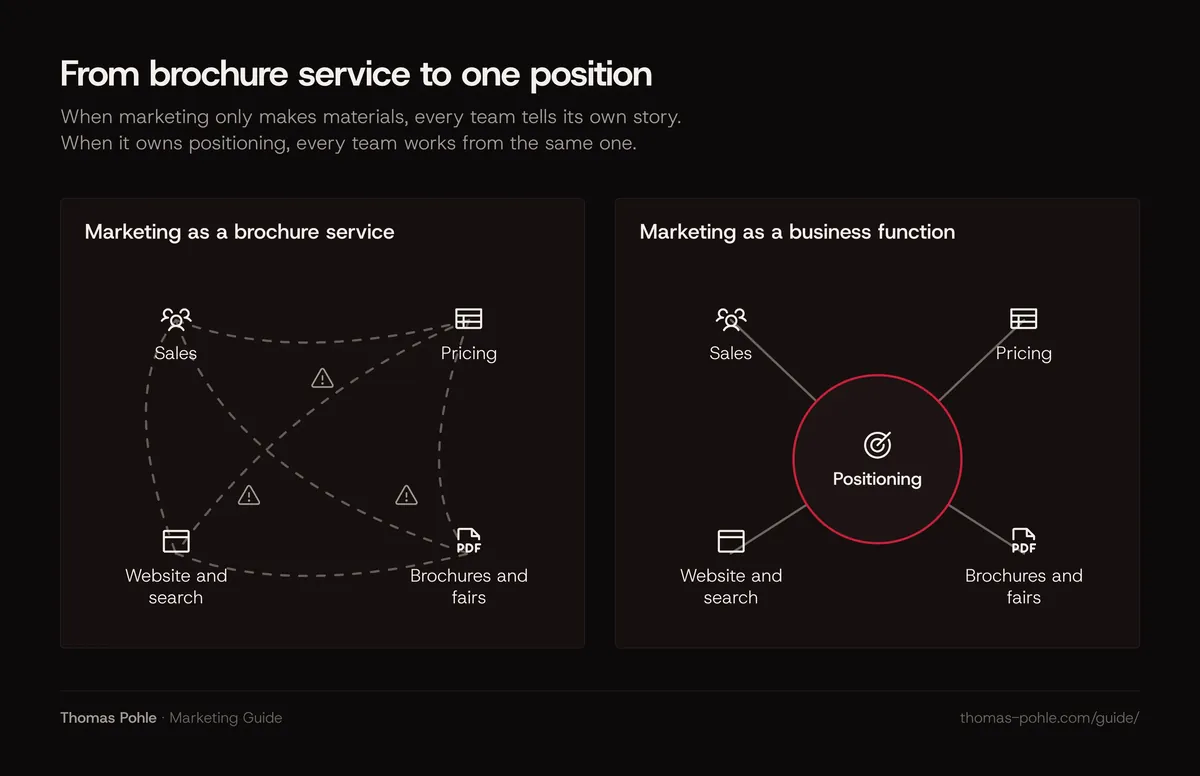
B2B marketing rarely fails outright. It just never gets going, because nobody has the time and the mandate to run it. The symptoms are easy to spot:
- Every salesperson pitches differently. There's no single sentence on why a customer should choose you.
- Price is set without marketing. Nobody has checked how your pricing compares with what buyers consider the alternative.
- The website describes the company. The customer's problem is missing. It answers questions nobody searches for.
- Marketing measures output. Number of posts, newsletters and fairs, with no line to inquiries or revenue.
A bigger brochure budget won't fix this. Give marketing a seat in the decisions the AMA definition starts with: what you offer, to whom, and at what price.
How does marketing support sales?
Marketing supports sales in two ways that need separate budgets. Brand building makes buyers know and trust you before they need you. Activation turns existing demand into inquiries and meetings. Les Binet and Peter Field found in the IPA Databank that B2B marketing works most efficiently with roughly 46% of the budget on brand and 54% on activation.
Binet and Field call that ratio a guiding principle. They don't offer it as a formula. Their B2B sample was small, under 50 cases, all of them entries to the IPA Effectiveness Awards, which tend to have relatively big budgets. Brand building in B2B has its own guide on brand management. The direction still holds up against the 95% figure above. You need activity that reaches buyers long before they're in the market, and activity that converts the few who are.
On the activation side, the most useful sales support in B2B is often unglamorous:
- One positioning sentence sales can repeat, tested against real objections.
- A steady flow of qualified inquiries, the subject of my guide on how B2B companies generate qualified leads.
- Case studies that show a result for a customer like the prospect. My guide on writing a B2B case study that gets cited covers the format.
- Comparison and pricing pages that answer what buyers ask shortly before a shortlist.
- Answers to the five most common objections, written once and used everywhere.
- Clear rules for handing leads to sales: what counts as a qualified inquiry and who follows up how fast.
You can measure this, for example as marketing's share of the sales pipeline.
Push your message through outbound and ads, or pull buyers in through search and content? That depends on how many of them are already looking. Most B2B companies need both. My take: marketing belongs much closer to revenue than most org charts allow.
What does marketing look like online today?
Online marketing is the same discipline, applied to the channels where B2B buyers now research: search engines, AI assistants, LinkedIn, email and your own website. The website sits at the center. Almost every other channel sends people there, and search engines and AI assistants read it before they decide whether to show or recommend you.
- Website. One clear sentence on what you do and for whom, pages for the questions buyers ask, and an easy next step.
- Search. Being found by buyers who already have the problem. My guide on what SEO does for a B2B company explains how it works with small search volumes.
- AI answers. Being the source ChatGPT, Perplexity or Google AI Overviews quote. That's what answer engine optimization covers.
- Content. A connected set of pages around the topics you want to own. See content marketing in B2B and topic clusters and internal links.
- LinkedIn and email. Reach among buyers who aren't in the market yet, and a direct line to those who are. More in my guide on LinkedIn for B2B marketing.
- Data. Measuring what each channel brings in inquiries and pipeline, covered in my guides on measuring marketing success and organic and AI search visibility.
Digitalization also changes how marketing work gets done. Every process I touch starts with one question: can AI do this faster, or do it for us? Research, first drafts, reporting and personalization usually qualify. Where a B2B team should begin is in my guide on AI in B2B marketing.
How should a B2B company organize its marketing?
A small B2B company needs one marketing owner, one plan and a few measures before it needs more channels or tools. The owner can be a founder, a marketing lead or an outside senior operator. What counts is that someone has the time and the mandate to decide. The plan answers three questions: who you sell to, why you, and which channel goes first.
Where you start depends on your situation. The first three rows below are the three situations that make B2B companies call me. The fourth is the brochure trap from above.
| Your situation | First move | Leave out for now |
|---|---|---|
| Nobody owns marketing. The CEO does it on Sunday evenings, or not at all. | Name one owner with fixed weekly hours and the mandate to decide | New tools and agencies for single channels |
| Nobody knows where to start. Ten channels, five tools, no plan. | Write the positioning and pick the one channel that moves first | Running every channel at half strength |
| Sales is short on pipeline. Good product, good team, empty calendar. | Activation: a defined account list for outbound, pages for the questions buyers search | Brand campaigns without a sales follow-up |
| Marketing exists, but only produces material. | Give marketing ownership of positioning and sales material, with sales as co-owner | More brochures |
For the owner, each option has a trade-off as I see it. An agency executes but rarely understands your business deeply. A classic consultant delivers slides and leaves the execution to you. A freelancer covers one channel. A full-time hire is slow to find and expensive. What the role involves is in my guide on what a head of marketing does. Whoever it is, keep the plan to one page and turn it into a list of actions with names and dates, as described in building a B2B marketing strategy.
What to do this week
You can test the state of your marketing in a few hours. No new tool, no agency. The steps below go from your position in the market to the one number that connects marketing to revenue. Each one ends with a decision or a written answer you can show your team.
- Write down in one sentence who you sell to and why they should choose you. Ask three people in sales to do the same and compare the answers.
- Go through the four Ps for your main offer and mark where marketing is involved today.
- Name the owner of marketing and the hours per week they have for it.
- Find your situation in the decision table above and commit to its first move.
- Ask sales for the five objections they hear most often. Check whether you have material that answers each one.
- Read your homepage as a buyer: does the first screen say what you do and for whom?
- Pick one number tied to revenue to review every month, such as qualified inquiries or first meetings.
Good B2B marketing is clear before it's loud. Clear on who you serve, why you, and what the buyer should do next. Companies that get this right get more out of every channel, because each one tells the same story.
Want that clarity in one day? A Momentum Workshop covers positioning, the ideal customer and the one channel that moves first. You leave with a plan your team can run on Monday.
Frequently asked questions
What is the simplest definition of marketing?
Marketing is deciding who you sell to and what you offer them, then making sure they know about it, understand why it's the better choice and find it easy to buy. The American Marketing Association describes it as creating, communicating, delivering and exchanging offerings that have value for customers, partners and society.
What are the four Ps of marketing?
The four Ps are product, price, place and promotion. Product is what you sell and the problem it solves. Price covers the pricing logic and terms. Place is how and where customers buy, directly or through partners. Promotion is how you communicate. In B2B, product, price and place often decide a deal more than promotion does.
What is the difference between marketing and sales?
Marketing works on the whole market. It decides the offer and positioning, builds awareness among buyers who aren't ready yet and creates demand. Sales works on individual deals. It qualifies, advises and closes. In a B2B company the two overlap in sales support, such as case studies, comparison pages and answers to objections.
How much should a B2B company spend on marketing?
No universal figure fits every company. The split has better evidence. Les Binet and Peter Field found in IPA data that B2B marketing works most efficiently with about 46% on brand building and 54% on activation. They call that a guiding principle and warn against treating it as a rule. Start from your sales goal and work backwards.
Does a small B2B company need a marketing department?
Not necessarily. It needs one person who owns marketing, has fixed time for it and the mandate to decide, plus a plan that fits on one page. That can be a founder, a marketing lead or an outside senior operator. A department without an owner and a plan produces material. It won't produce pipeline.
Sources
- American Marketing Association: Definitions of Marketing
- Ehrenberg-Bass Institute, John Dawes: Advertising effectiveness and the 95-5 rule (B2B Institute report, May 2021)
- Les Binet and Peter Field: The 5 Principles of Growth in B2B Marketing (LinkedIn B2B Institute and IPA, 2019, PDF)
- LinkedIn Marketing Blog: How B2B marketing really drives growth (October 2019)
- IPA: Five Principles of Growth in B2B Marketing

Thomas PohleB2B marketing advisor in Zurich. More than ten years in B2B marketing at Link11, Beekeeper and smino, most recently as Head of Marketing. CEO and co-founder of TEISENDA. Researched and drafted with AI tools, checked against the sources listed above. More about Thomas