What is performance marketing and when does it work in B2B?

Performance marketing is paid marketing you buy, steer and judge by measurable actions: clicks, leads, sign-ups or sales. You pay per click, per thousand impressions or per result, and you shift budget to what converts. In B2B it works when demand already exists and you track results past the lead, into pipeline and revenue.
This guide is for founders and marketing leads in B2B companies who spend money on Google or LinkedIn ads, or are about to, and want to know if it's working. The short version: the dashboard in your ad account usually tells you the least important part of the story.
You get a definition, the channels and pricing models, a decision table for when performance marketing fits, the limits in long sales cycles, how it works with brand building, and a worked example that shows why the cheapest lead is often the most expensive one.
What is performance marketing?
Performance marketing is the part of marketing where every euro or franc is tied to a measurable action. You run paid ads on search engines, social networks or partner sites, track what people do after they see or click, and move budget toward the ads, audiences and keywords that produce the action you defined as success.
The term describes a way of working more than a channel. The feedback loop sets it apart from classic advertising. You set a target, measure every campaign against it and change bids, audiences and messages based on the result, often weekly. Online marketing and performance marketing overlap heavily. Still, plenty of online marketing is unpaid, and plenty of paid marketing is never managed for performance.
| Pricing model | You pay for | Typical B2B use |
|---|---|---|
| CPC (cost per click) | Each click on the ad | Search ads, most LinkedIn campaigns |
| CPM (cost per mille) | Each thousand impressions | Reach and awareness among a defined audience |
| CPL (cost per lead) | Each form submission or sign-up | Lead generation forms, content syndication |
| CPA (cost per acquisition) | Each defined result, such as a sale | Affiliate and partner programs, smart bidding targets |
Which channels belong to performance marketing in B2B?
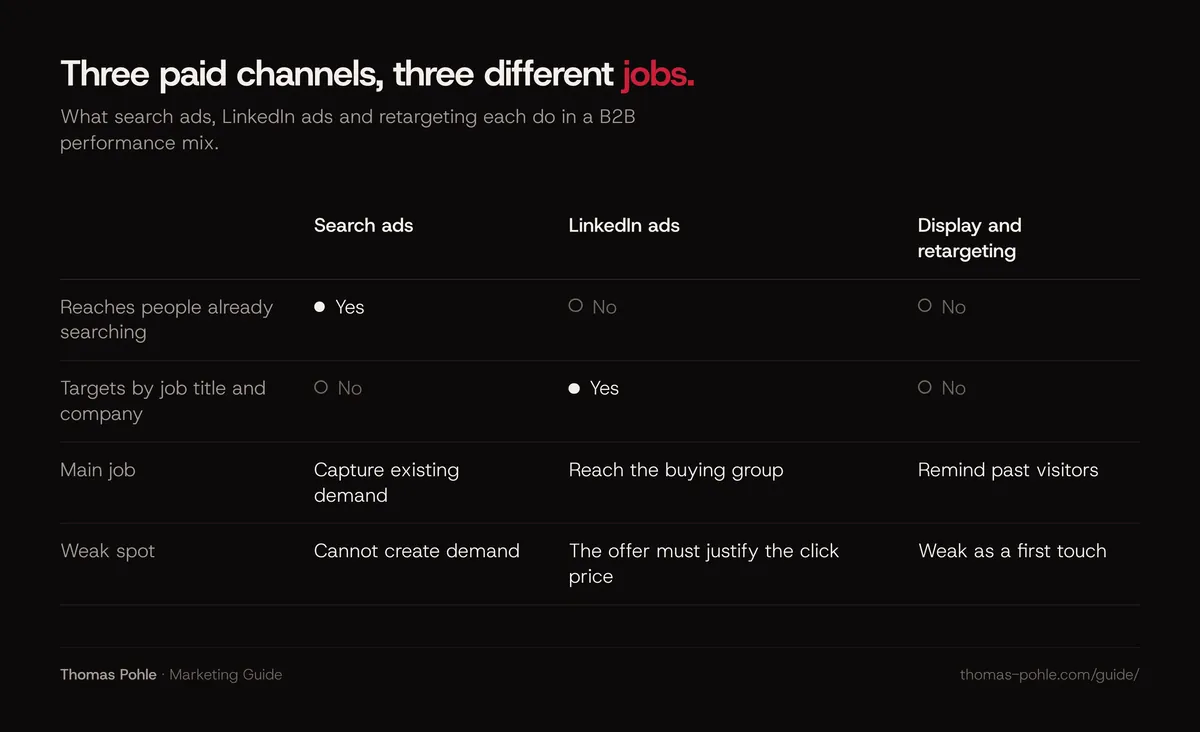
Three paid channels carry most B2B performance budgets. Search ads reach people already looking for a solution. LinkedIn ads target people by job title, company or industry. Display and retargeting remind past visitors. Affiliate and partner programs, which pay per result, play a smaller role in most B2B markets.
- Search ads (SEA). Google Ads and Microsoft Ads place your ad next to search results for the keywords you bid on. Together with search engine optimization they make up search engine marketing (SEM). My take: search mostly captures demand that exists. It does little to create it. The organic side of search is explained in what SEO does for a B2B company.
- LinkedIn ads. LinkedIn lets advertisers target by job title, company name, industry and seniority. That fits buying groups better than any keyword. The offer has to justify the click price, so test it on a small budget before you scale. More on the channel in how B2B companies use LinkedIn for marketing.
- Display and retargeting. Banner ads on partner sites, mostly shown to people who visited your site before. Useful as a reminder, weak as a first touch.
- Affiliate and partner programs. You pay a partner per lead or sale. This works for simple, standardized B2B products. It rarely works for complex solutions with a long sales process.
Don't ignore the organic counterpart. Paid search stops the moment you stop paying. Pages that rank and get cited by AI assistants keep working. The guide on answer engine optimization covers that side.
When does performance marketing work in B2B?
Performance marketing works in B2B when five conditions hold. Buyers already search for the problem you solve. Your deal size carries the cost of a qualified lead. Your CRM shows which leads became pipeline. Your offer makes a stranger act. Results arrive within the platforms' conversion windows. If two or more fail, fix those first.
| Condition | Works when | Struggles when |
|---|---|---|
| Existing demand | Buyers search for the category or the problem in words you can bid on | The category is new and nobody searches for it yet |
| Deal size | One won deal pays for many months of ads | Small deals with long sales cycles |
| Feedback from sales | The CRM records which ad leads became opportunities and deals | Marketing only sees leads, sales keeps its own list |
| Offer | A demo, assessment or tool a buyer actually wants now | Only a generic "contact us" or a brochure |
| Sales cycle | Most deals close within weeks of the first click | Deals take many months, so ad platforms never see the result |
The table is my own decision frame. It isn't a study. I use it because each row points to one fix: build demand, raise the deal size threshold, connect the CRM, sharpen the offer, or measure differently.
Why does performance marketing hit limits with long sales cycles?
Performance marketing optimizes what it can measure, and in B2B the measurable part is short. Ad platforms count conversions within a window of days or weeks. A B2B deal often takes months and involves several people. Optimize only for clicks and leads, and the algorithm learns to find people who fill in forms. Buyers are a different crowd.
Three facts make this concrete:
- Most buyers aren't in market. Professor John Dawes of the Ehrenberg-Bass Institute estimates that up to 95 % of business clients aren't in the market for many goods and services at any one time, and stresses that the figure isn't meant as a precise rule. He notes that corporations change providers such as their main bank or law firm about once every five years on average. Performance campaigns only reach the small in-market share.
- Conversion windows end. In Google Ads, the click-through conversion window can be set from 1 to 30, 60 or 90 days depending on the conversion source, with 30 days as the default. A deal that closes in month five is invisible to the campaign that started it, unless you import it.
- Attribution is a model. Google Ads now offers only last click and data-driven attribution; first click, linear, time decay and position-based models are no longer supported. Data-driven is the default for most conversion actions. Neither model knows what happened in a sales meeting.
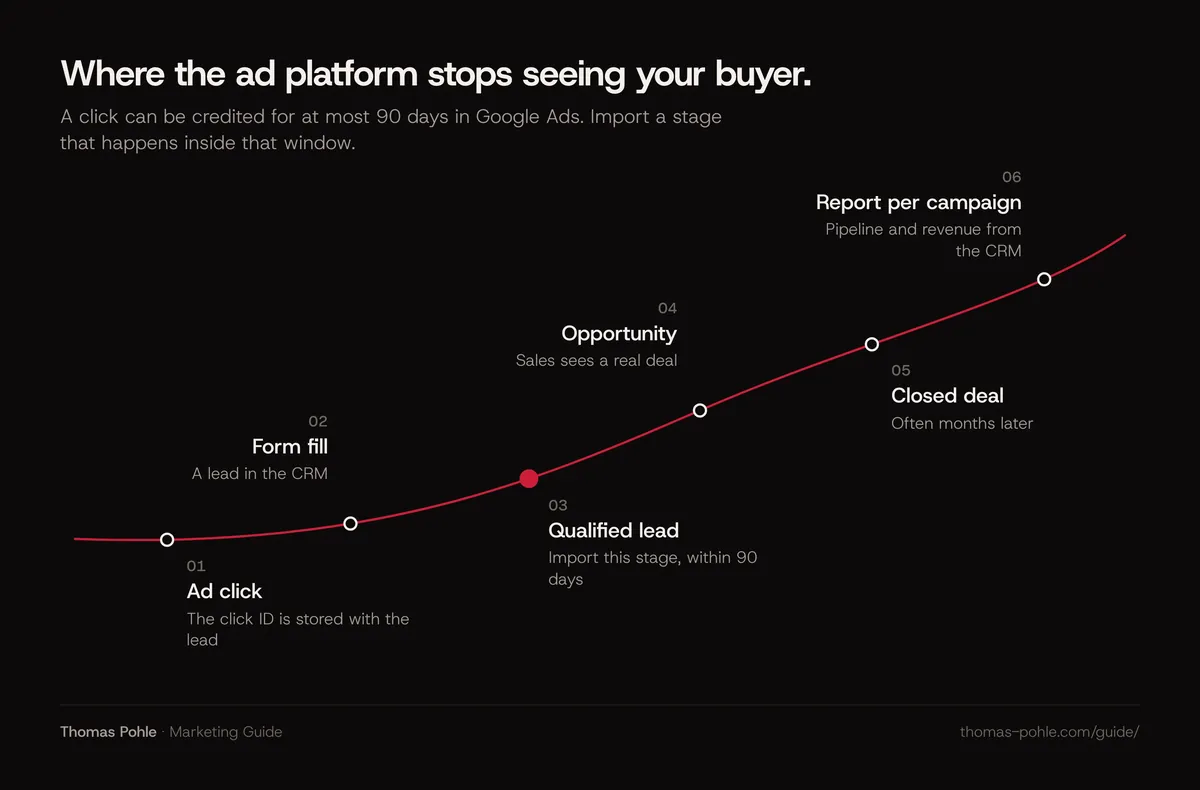
The fix: feed real outcomes back. Google's offline conversion import lets you see what happens offline after someone clicks your ads. You store the click ID with the lead and upload the sales outcome later. Google keeps that click ID for 90 days. So import an earlier stage, such as a qualified lead or an opportunity. Don't wait for the signed contract.
How do performance marketing and brand building work together?
Brand building makes buyers think of you when they enter the market. Performance marketing converts the ones who are ready now. In B2B you need both. The LinkedIn B2B Institute, based on research by Les Binet and Peter Field, recommends balancing budget between long-term brand building and short-term sales activation at roughly 50/50.
Treat that split as a starting point. It's no law. A young company with a clear search category may spend more on activation early, a company in a new category more on brand. What matters is that someone decides it on purpose. Otherwise the channel with the nicest dashboard wins the budget every quarter. The brand side is covered in how brand management works in B2B.
The two also feed each other. Branded search volume, people searching for your company by name, is one of the few signals that show brand work paying off. Those searches are where paid and organic results meet the buyer who already knows you. Consistent naming and profiles help here, as described in connecting your website and profiles into one recognizable brand. My view: marketing belongs much closer to revenue, and that's exactly why brand belongs in the plan. It decides how many buyers think of you before they search.
Which KPIs show whether paid marketing works?
Judge paid marketing by cost per opportunity and pipeline created. Cost per click and cost per lead won't tell you enough. Clicks and leads are inputs. The numbers that matter for a B2B company are how many qualified opportunities a campaign produced, what each one cost, and how much of the sales pipeline came from marketing.
That last number is the one I'd put in front of a CEO. It only means something when marketing and sales look at the same pipeline.
A worked example
The numbers below are assumptions for illustration. They aren't results. Two campaigns get CHF 10,000 a month each. Campaign A offers an e-book: CHF 80 per lead buys 125 leads, and 4 % become opportunities, which is 5 opportunities at CHF 2,000 each. Campaign B offers a short assessment call: CHF 400 per lead buys 25 leads, and 40 % become opportunities, which is 10 opportunities at CHF 1,000 each.
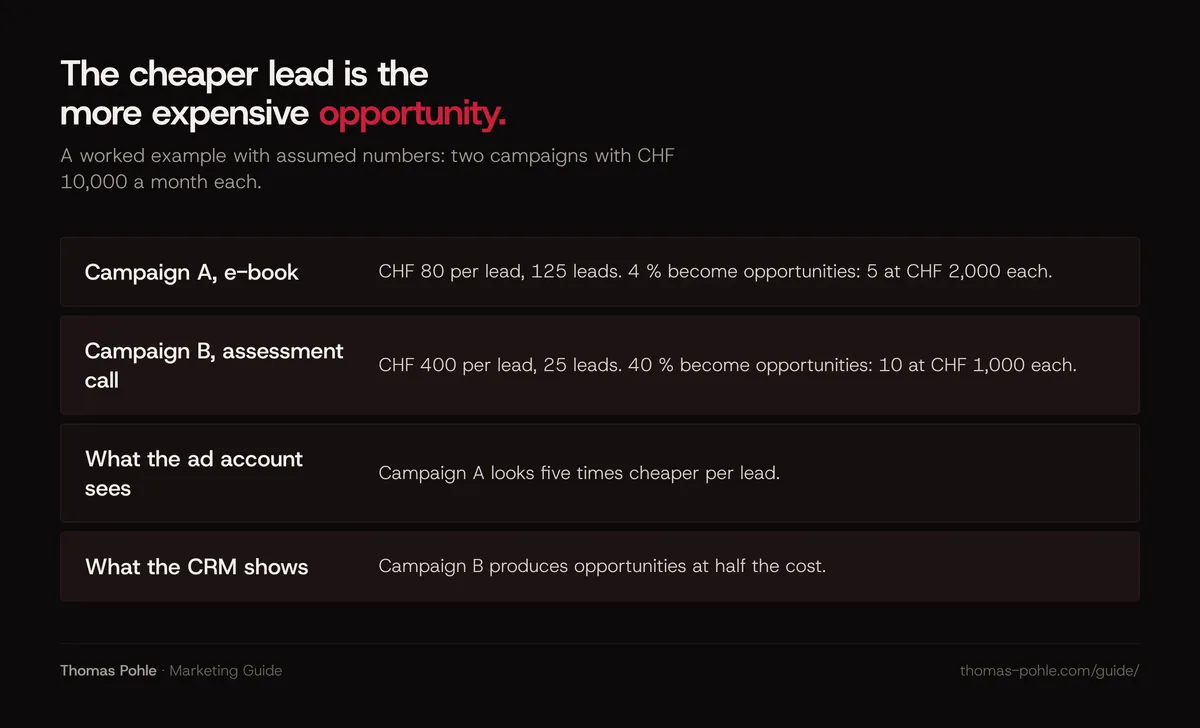
An ad account that optimizes for cost per lead would push budget to Campaign A. The CRM shows the opposite. That's why every B2B performance setup needs the lead-to-opportunity rate per campaign. And it's why reporting should follow the approach in measuring visibility without heavy tracking: few numbers, collected the same way every month.
- Input metrics. Impressions, click-through rate, cost per click. Useful to tune ads, useless to judge success.
- Lead metrics. Leads, cost per lead, share of leads sales accepts.
- Pipeline metrics. Opportunities, cost per opportunity, pipeline value, marketing's share of pipeline.
- Revenue metrics. Won deals and revenue from paid sources. Read them over months. Weeks are too short.
The full measurement picture beyond paid channels is in how to measure marketing success in a B2B company.
How do you set up a performance marketing campaign in B2B?
Start with the offer and the measurement. The ads come last. Define one audience, one offer a buyer wants now, and the stage in your CRM that counts as success. Connect ad clicks to CRM records before you spend, launch with a test budget, and judge once enough leads have reached sales. The first week tells you nothing.
- Pick one audience and one problem. A role, a company size, a trigger. One campaign per audience keeps the data readable.
- Build an offer worth a click. An assessment, a benchmark, a calculator or a demo with a clear agenda. Proof such as a case study buyers can find and quote lifts conversion on the landing page.
- Set up tracking end to end. Store the click ID with every lead in the CRM and plan the offline conversion import for a stage that happens within 90 days.
- Handle consent. Google's EU user consent policy requires consent from users in the EEA, the UK and Switzerland for cookies where legally required and for ads personalization. Google's consent mode passes your users' consent status to Google, and conversion modeling then fills part of the gap for users who decline.
- Launch, wait, then cut. Change one thing at a time and give each test enough leads to judge the lead-to-opportunity rate.
Do you need a performance marketing agency or manager?
You need someone who owns the numbers end to end, from ad click to opportunity. Agency, freelancer or in-house performance marketing manager matters less. What matters is that this person sees CRM data and is measured on pipeline. An agency judged on cost per lead will deliver cheap leads.
When you choose an agency, ask three questions. Which CRM stage will you report on? How do you get our sales outcomes back into the ad platforms? What would make you recommend we spend less? A good answer to the last one tells you more than a case study deck. Hire in-house when paid media becomes a large, stable share of your budget and the learning should stay in the company.
What to do this week
- Pull last quarter's paid leads from the CRM and count how many became opportunities, per campaign.
- Calculate cost per opportunity for each campaign and compare it with cost per lead.
- Check that the click ID is stored with every lead and set up an offline conversion import for qualified leads.
- Review the conversion window of every conversion action and match it to a stage that happens within it.
- Run the five rows of the decision table against your business and write down the weakest one.
- Decide on purpose how your budget splits between brand building and activation for the next two quarters.
- Agree with sales on one shared pipeline report that marketing and sales both use.
Paid campaigns get easier once the basics are in place: a clear audience, an offer worth a click and a CRM that tells you the truth. Want that set up with your team? A one-day Momentum Workshop covers the audience, the offer and the first channel.
Frequently asked questions
What is the difference between performance marketing and online marketing?
Online marketing covers all marketing on digital channels, paid and unpaid: SEO, content, email, social media and ads. Performance marketing is the paid part you steer by measurable results such as clicks, leads or sales, and adjust continuously based on those results. You can measure SEO and content too. You just don't buy each result the way you buy a click.
Is performance marketing the same as SEA?
No. Search engine advertising, ads on Google or Bing results, is one channel of performance marketing. In B2B it's often the strongest one, because it reaches people who are already searching. Performance marketing also includes LinkedIn and other social ads, display and retargeting, and affiliate or partner programs paid per result.
How much budget does B2B performance marketing need?
There's no reliable public benchmark. Click costs vary widely by country, industry and keyword. Work backwards instead: estimate your cost per lead, your lead-to-opportunity rate and the number of opportunities you need. Then test with a budget that can produce enough leads for sales to judge. A budget that buys only a handful of leads a month tells you nothing.
Does performance marketing work for companies with long sales cycles?
Yes, if you measure an earlier stage than the signed contract. Import qualified leads or opportunities from your CRM into the ad platforms, because conversion windows and click IDs expire after at most 90 days in Google Ads. And combine it with brand building, since most buyers aren't in the market at any given moment.
Which KPI matters most in B2B performance marketing?
Cost per opportunity, read together with marketing's share of the sales pipeline. Cost per click and cost per lead help you tune ads, but they reward campaigns that attract form fillers. Cost per opportunity shows which campaigns bring buyers that sales actually wants to talk to.
Sources
- Google Ads Help: About conversion windows
- Google Ads Help: About attribution models
- Google Ads Help: Set up offline conversion imports using Google Click ID (GCLID)
- Google Ads Help: Offline conversion imports FAQs
- Google Ads Help: About consent mode
- LinkedIn B2B Institute: Marketing as growth (Les Binet and Peter Field)
- Ehrenberg-Bass Institute, John Dawes: Advertising effectiveness and the 95-5 rule
- LinkedIn Marketing Solutions: Ad targeting
- Google: EU user consent policy

Thomas PohleB2B marketing advisor in Zurich. More than ten years in B2B marketing at Link11, Beekeeper and smino, most recently as Head of Marketing. CEO and co-founder of TEISENDA. Researched and drafted with AI tools, checked against the sources listed above. More about Thomas