How should you split the marketing budget across channels?

Split the marketing budget by the job the money has to do in the buying process. Fund people, tools and website first. Then put money into reaching buyers who are not in the market yet, into being found when they search, and into converting them at events and webinars. Keep about 10% as a reserve and move money by marginal cost per opportunity.
This guide is for founders, CEOs and marketing leads who already have a budget number and now have to decide where it goes. How large the budget should be is covered in the guide on how much marketing budget a B2B company needs. The planning process is in the guide on planning a marketing budget step by step. The person who usually owns the split is described in the guide on what a head of marketing does in a B2B company.
Here you get the split itself: which jobs the money has to do, how much goes to people versus media, a worked example in Swiss francs and the rule for moving money during the year.
Why should the split follow the buying process instead of last year's budget?
Last year's split tells you what your team was used to funding. It doesn't tell you where your buyers make up their minds. In B2B most of the decision forms before a buyer ever talks to you, so a split that puts almost everything into lead capture and sales meetings pays for the last step and starves the first ones.
Two findings make the point. In 6sense's 2025 B2B Buyer Experience Report, based on just under 4,000 respondents, buyers made first contact with sellers 61% of the way through their journey. And they chose a vendor from their day-one shortlist 95% of the time. LinkedIn's B2B Institute adds the 95-5 rule: 95% of your potential buyers aren't ready to buy today.
So the question for every line is simple. Which part of the buying process does this money work in? If the answer is "the last 40%" for nearly every franc, you're competing for buyers whose shortlist is already written.
Which jobs does the money have to do along the buying process?
A B2B marketing budget has five jobs. The fixed base keeps the team and the website running. Reach puts your name in front of buyers who aren't in the market yet. Capture makes sure you're found when they start searching. Convert turns interest into meetings. The reserve pays for tests and surprises.
| Job | Typical channels | When it works | How you judge it |
|---|---|---|---|
| Fixed base | People, tools, website | All year, before any campaign | Output per person, uptime, conversion rate of the site |
| Reach | LinkedIn, content, PR, founder posts | Before the shortlist forms | Reach in the buying group, branded search, direct traffic |
| Capture | Paid search, SEO, comparison pages | During independent research | Cost per qualified opportunity |
| Convert | Events, trade fairs, webinars, case studies | From first contact to decision | Meetings, opportunities, win rate |
| Reserve | Tests, a new channel, a fair that comes up | Released by decision | Whether the test met its planned cost per opportunity |
The table also explains why one channel can sit in two rows. LinkedIn ads can build reach in the buying group and collect leads. Label each line by its main job, so you can see the balance at a glance.
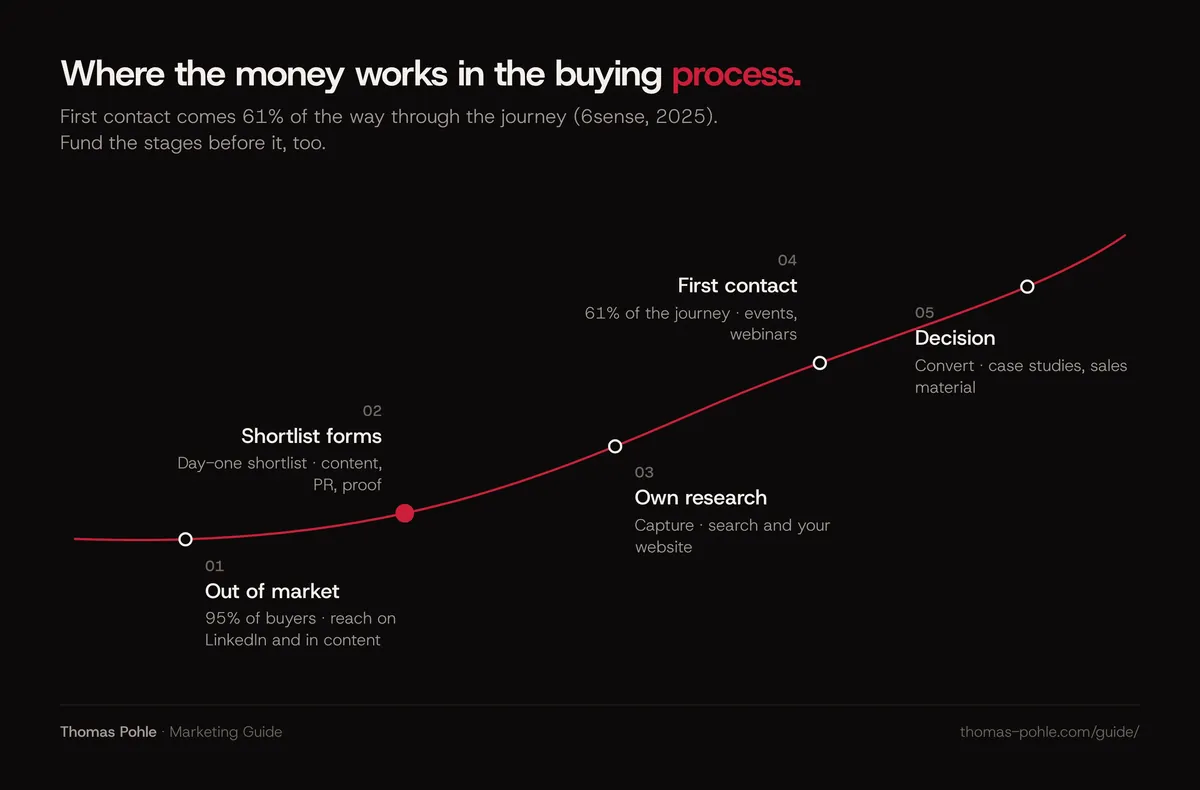
On brand versus activation, the guide on planning the budget already covers Binet and Field's finding that B2B businesses grow best with 46% of budget in brand building and 54% in activation. In the split here, reach is roughly the brand side and capture plus convert the activation side.
How much should go to people, tools and media?
Fund people and tools first, because no campaign runs without them. In Gartner's 2025 CMO Spend Survey of large companies, paid media took 30.6% of the marketing budget, martech 22.4%, labor 21.9% and agencies 20.7%. Smaller B2B companies usually spend a larger share on people, because one person covers several channels.
That last sentence is my view, and the Gartner sample explains why it matters: it's dominated by companies with more than $1 billion in revenue. For a company with 50 employees and a team of two, salaries can easily be half of the total. That's fine, as long as those people produce the content, campaigns and follow-up the program budget relies on.
My rule of thumb for people versus agencies:
- In-house for everything that runs every week: content, LinkedIn, campaign operations, CRM hygiene. Knowledge that builds up should stay in the company.
- Agency or freelancer for peaks and specialist craft: a trade fair stand, video, the first setup of a paid search account, a website rebuild.
- Tools only when a person uses them every week. A license nobody opens is budget that could buy opportunities.
Gartner's 2026 survey reports that CMOs now put 15.3% of the marketing budget into AI. In a small team I'd count that money where it does its job: in tools when it's a license, in people when it frees up their time.
How do you split CHF 550,000 across channels?
Take the scenario from the guide on how much budget you need: a Swiss B2B software company with CHF 10 million in revenue needs 100 qualified opportunities from marketing. Its budget is CHF 550,000. CHF 300,000 go to the fixed base, CHF 250,000 to programs. Within the programs, each channel gets the opportunities it can deliver at its own cost.
All inputs are assumed numbers for a typical scenario. Replace them with your own CRM data. The cost per opportunity of each channel comes from last year's spend divided by the qualified opportunities that channel produced.
| Line | Budget (CHF) | Qualified opportunities | Cost per opportunity (CHF) |
|---|---|---|---|
| Paid search (capture) | 45,000 | 30 | 1,500 |
| LinkedIn ads (reach) | 70,000 | 25 | 2,800 |
| Content and SEO (reach) | 25,000 | 20 | 1,250 |
| Events and one trade fair (convert) | 70,000 | 20 | 3,500 |
| Partner webinars (convert) | 15,000 | 5 | 3,000 |
| Reserve, 10% of programs | 25,000 | 0 | n/a |
| Programs total | 250,000 | 100 | 2,500 on average |
Three things are worth reading out of this table:
- The average hides the spread. CHF 2,500 per opportunity on average sits on top of channels between CHF 1,250 and CHF 3,500. You can only steer with the channel numbers.
- The balance by job. Of the CHF 225,000 in active programs, reach gets CHF 95,000 (42%), capture CHF 45,000 (20%) and convert CHF 85,000 (38%). That's close to Binet and Field's direction for brand versus activation without forcing it.
- People are the largest line. The two marketers at CHF 260,000 are 47% of the CHF 550,000. Media and programs are 41%, tools and website 7%, the reserve 5%.
Content looks cheapest per opportunity here, partly because its production cost is low and the writing happens in-house. That's exactly why the people line and the program lines have to be read together.
How should the split change with your company's situation?
The split follows the situation more than the industry. A founder-led company with no pipeline history funds reach and one capture channel. A company growing in a known market splits by measured cost per opportunity. A company entering a new country has no cost data yet and spends more on reach and local proof before it captures anything.
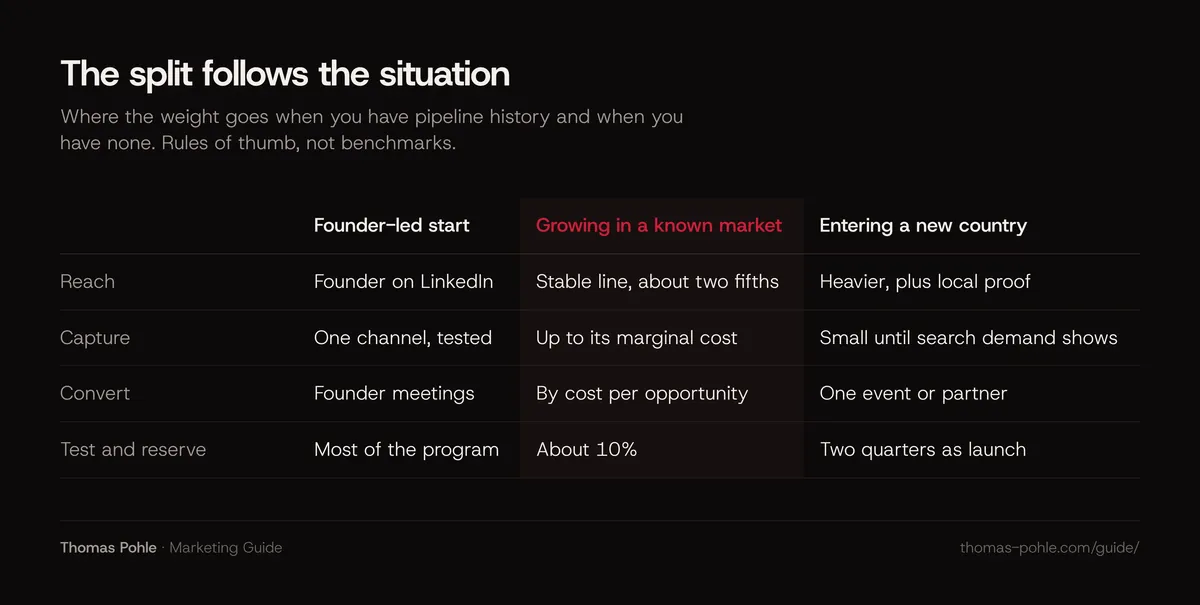
These weights are my rules of thumb, not research findings. What they share: a channel only gets serious money once you can measure what it delivers. For entering a new market, the guide on market entry strategies covers the order of markets. The budget table in the guide on how much budget you need covers the size.
What should LinkedIn, search, content and events each get?
Each channel earns its share by the job it does and the cost per opportunity it reaches. LinkedIn carries reach in the buying group. Search captures buyers who already look for a solution. Content serves both and gets cheaper over time. Events convert, but only when follow-up is funded along with the stand.
- LinkedIn. Judge it on two numbers: reach in your target accounts and qualified opportunities. My own goal on LinkedIn is reach, credibility and a network, not short-term leads. For a company page with paid budget, I'd still expect opportunities after a quarter. The guide on LinkedIn for B2B marketing covers formats and targeting.
- Paid search. Fund it up to the point where the next franc gets expensive. Search volume in a B2B niche is limited, so this line usually caps out early. The guide on performance marketing in B2B covers how to lower its cost per opportunity.
- Content and SEO. Mostly a people cost. The program line pays for design, video and freelance writing. Pages keep working after they're paid for, so this line gets cheaper per opportunity every year it runs.
- Events and trade fairs. Budget the stand, travel and the follow-up as one line. In AUMA's outlook for 2026 and 2027, a survey of 404 German exhibitors from October and November 2025, 40.4% planned higher trade fair budgets and about 20% planned cuts. I've run online and offline events, the largest a flagship event with close to 1,000 attendees. My view: an event pays when the meetings are booked before the doors open.
When do you move money from one channel to another?
Move money when the next franc in one channel buys less than the next franc in another. That's the marginal cost per opportunity, and it rises as you push a channel past its natural audience. The average cost from last year looks fine long after the extra spend has stopped paying. Check the marginal cost every quarter.
Back to the scenario. Say the company raises paid search from CHF 45,000 to CHF 60,000 and gets 36 opportunities instead of 30. The average is still about CHF 1,670 per opportunity. But the extra CHF 15,000 bought 6 opportunities, so the marginal cost was CHF 2,500. That's still cheaper than LinkedIn at CHF 2,800, so the move holds. If the next CHF 15,000 bring only 3 more, the marginal cost is CHF 5,000 and the money goes back.
My working rules for shifting:
- Compare marginal cost, never only the average.
- Move in steps of 10 to 20% of a channel's budget, so you can see the effect.
- Give a channel a year before you judge it for good, and look at first signals after a quarter.
- Keep reach stable unless the whole budget is cut. Its effect shows up in next year's pipeline.
The monthly tracking and the cap rule for channels that run over plan are in the guide on planning a marketing budget. How to count opportunities per channel without heavy tracking is in the guide on measuring marketing success.
What to do this week
You can redo the split of an existing budget in a few hours, with last year's spend and the CRM. These steps give you a split you can explain by job and by channel, and a rule for changing it during the year.
- List every line of this year's budget and label its main job: fixed base, reach, capture, convert or reserve.
- Add up the shares per job. If reach is close to zero, write down where next year's shortlists will come from.
- Pull the qualified opportunities per channel from the CRM and calculate each channel's cost per opportunity.
- Check the people line against the work it carries. Move recurring work in-house, peaks to agencies.
- Set a 10% reserve and name who releases it.
- For the two biggest channels, estimate what the last CHF 10,000 bought. That's your marginal cost.
- Put a quarterly review in the calendar where money moves by marginal cost.
A split built this way changes every year, because each quarter's numbers become next year's inputs. That's the point. A budget that's split the same way three years in a row is usually following habit.
Want to go through your split with someone who has done it in-house? A one-day Momentum Workshop is one way to get there.
Frequently asked questions
What percentage of the marketing budget should go to digital marketing?
There's no reliable B2B benchmark for a digital share, and the line between digital and offline is blurry when events run on LinkedIn invitations and webinars. Split by job instead: reach, capture, convert. In Gartner's 2025 survey of large companies, paid media alone took 30.6% of the budget. Use your own cost per opportunity per channel to decide how much of it goes online.
How much should a B2B company spend on LinkedIn?
Enough to reach your buying group often and to measure opportunities within a quarter. In the scenario in this guide, LinkedIn gets CHF 70,000 of a CHF 250,000 program budget. That's an assumption, not a benchmark. LinkedIn's own minimums are technical floors. They don't tell you what it takes to reach the accounts you need.
How much of the budget should go to content marketing?
Content is mostly a people cost, so look at the people line and the content program line together. In the scenario, the program line is only CHF 25,000 because writing happens in-house. My view: content gets cheaper per opportunity every year it runs, so it deserves a stable line even when results take a few quarters to show.
How do you split a performance marketing budget between search and LinkedIn?
By marginal cost per qualified opportunity. Fund search until the next franc gets more expensive than the next franc on LinkedIn, then fund LinkedIn. Search volume in B2B niches is limited, so search usually caps out first. Recheck the split every quarter, because both channels get more expensive as you push past their natural audience.
Should the split change during the year?
Yes, but by rule and by quarter. Move money in steps of 10 to 20% of a channel's budget when its marginal cost per opportunity rises above another channel's. Keep reach stable unless the whole budget is cut, and release the reserve only by a named decision. A split that never moves usually means nobody measures it.
Sources
- 6sense: 2025 B2B Buyer Experience Report
- LinkedIn B2B Institute: The 95-5 rule
- LinkedIn: How B2B marketing really drives growth (Binet and Field, October 2019)
- Gartner: 2025 CMO Spend Survey reveals marketing budgets have flatlined at 7.7% of overall company revenue (May 2025)
- Decision Marketing: Agencies firmly in the firing line as CMOs plot cutbacks (Gartner 2025 CMO Spend Survey shares for martech, labor and agencies, May 2025)
- Gartner: 2026 CMO Spend Survey finds CMOs allocate 15.3% of marketing budgets to AI (May 2026)
- AUMA: AUMA-Aussteller-Ausblick 2026/2027 (survey of 404 exhibitors, October and November 2025)

Thomas PohleB2B marketing advisor in Zurich. More than ten years in B2B marketing at Link11, Beekeeper and smino, most recently as Head of Marketing. CEO and co-founder of TEISENDA. Researched and drafted with AI tools, checked against the sources listed above. More about Thomas