Which market entry strategies are there, and how do you choose one?

Every market entry strategy answers three questions: when you enter (as pioneer or follower), how many markets you open at once (waterfall, one after another, or sprinkler, several in parallel) and in which form (direct sales, partner, branch, subsidiary or acquisition). Pick by budget, team capacity and how fast competitors can copy you.
Textbooks list the strategies. Few tell you what they cost. This guide is for founders and marketing leads of B2B companies planning a new country or segment. You get the four classic strategies, the entry forms, a worked budget example and a checklist with thresholds.
The wider plan around an entry, from segment to pipeline math and local outreach rules, is in the guide on how to build a go-to-market strategy. This article covers the step before it.
What is a market entry strategy?
A market entry strategy is the decision on how a company brings an offer into a market where it doesn't sell yet. It combines three choices: timing compared with competitors, the order in which you open several markets, and the legal and operational form of your presence. Each choice moves budget, team size and the kind of marketing you need.
Most overviews treat timing, sequence and form as separate topics. In practice you answer all three at once, because they constrain each other. A sprinkler entry into four countries rarely works with a subsidiary in each.
- Timing. Pioneer, the first to offer this kind of product in the market, or follower, entering once the category exists.
- Sequence. Waterfall, one market after the other, or sprinkler, several markets at the same time.
- Form. Direct sales from home, a partner, a branch office, a local company, or a joint venture or acquisition.
Should you enter as a pioneer or as a follower?
Enter as a pioneer only if you can afford to teach buyers a new category and protect what you build: technology, scarce partners or customer loyalty. Research on first movers shows their advantage is far less reliable than the textbook story. Well-timed followers often end up leading. My take: for most mid-sized B2B companies, a sharp follower is the safer bet.
Marvin Lieberman and David Montgomery's 1988 review in the Strategic Management Journal described what can help first movers. The UCLA Anderson Review sums it up as technology leadership, locking competitors out of prime real estate, distribution channels or other scarce resources, and capturing customer loyalty. The same summary names the downsides: far higher startup costs than followers, and the risk of obsolescence as technology advances. In a 1998 follow-up the authors rejected findings based solely on market share.
Peter Golder and Gerard Tellis tested the pioneer story with a historical analysis of about 500 brands in 50 product categories, published in the Journal of Marketing Research in 1993. The results are blunt. Almost half of market pioneers failed. Their mean market share was much lower than earlier studies had found. And the early market leaders entered on average 13 years after the pioneers.
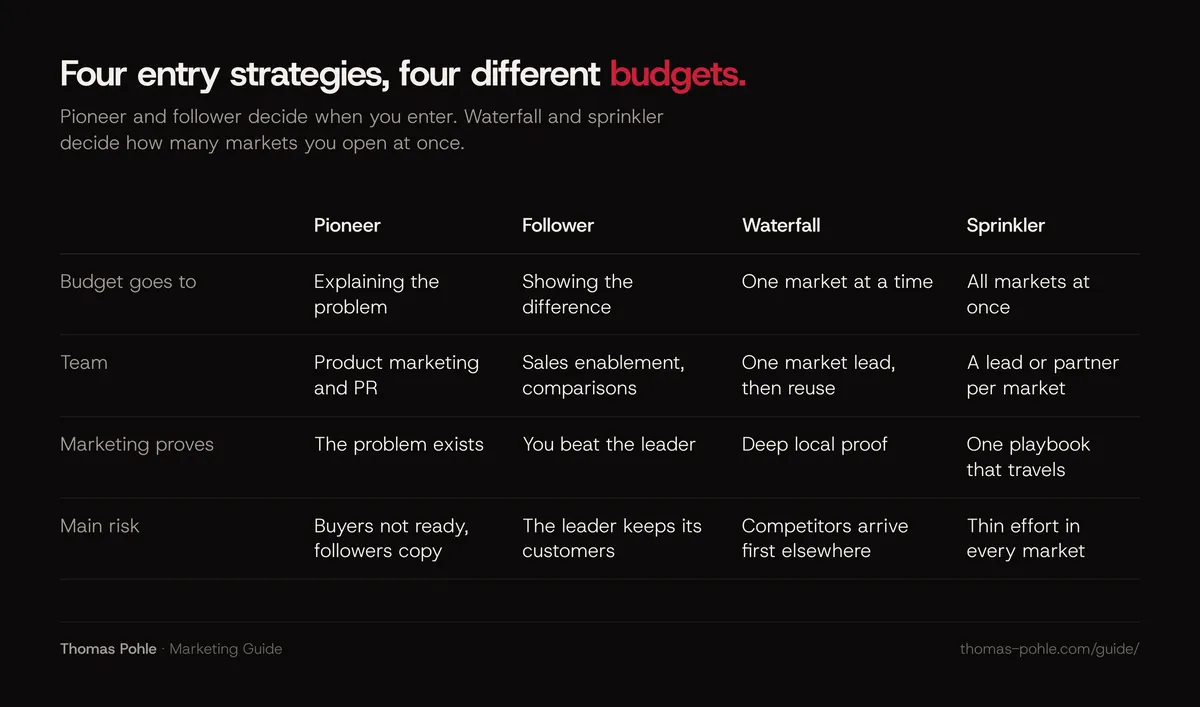
For marketing, the choice changes the job. A pioneer spends its budget explaining the problem, because buyers don't search for a solution they've never heard of. That means PR, content that names the problem, patient sales cycles. A follower spends it on difference: comparison pages, a clear position against the leader, proof from customers who switched. The guide on B2B positioning shows how to find that position.
You can be a follower at home and a pioneer abroad. A category that's common in the US may be unknown to buyers in Austria. Check what buyers there actually search for before you budget as a follower.
Should you open one market at a time or several at once?
A waterfall strategy opens markets one after the other and moves on only when the current one works. A sprinkler strategy opens several markets at the same time. Waterfall needs less money at once and lets you learn from each market. Sprinkler reaches more buyers before competitors do. The price: budget and attention spread across every market.
Igal Ayal and Jewel Zif, in the Journal of Marketing in 1979, framed it as market concentration against market diversification. Their two levers: the rate of entry into new markets and the allocation of effort among them. Shlomo Kalish, Vijay Mahajan and Eitan Muller later modeled waterfall and sprinkler launches with innovation diffusion and game theory. Their results generally suggested that strong global competition pushes a company toward the sprinkler strategy.
That's a model of competitive pressure. It's no rule for a company with twenty salespeople. My reading: sprinkler makes sense when competitors can copy you quickly and the markets are similar enough to share one playbook. Waterfall makes sense when each market needs its own language, references and sales effort. That's the normal case for B2B companies entering German-speaking Europe and then the UK.
What do the strategies mean for budget, team and marketing?
The budget gap between waterfall and sprinkler is mostly multiplication. Every market you open needs its own sales capacity, local material and marketing program from day one. So opening three markets in parallel costs roughly three times the first year of one market. And that's before any of them has proven the offer sells there.
Here's a typical scenario. Replace the assumptions with your own. A Swiss B2B software company plans Germany, Austria and the United Kingdom. Per market and year it assumes one local salesperson at CHF 130,000 fully loaded, CHF 25,000 one-off for localizing website, material and contracts, CHF 60,000 for marketing programs and CHF 15,000 for travel and events.
| Line item, first year | Waterfall (Germany first) | Sprinkler (three markets) |
|---|---|---|
| Markets opened | 1 | 3 |
| Local sales | CHF 130,000 | CHF 390,000 |
| Localization | CHF 25,000 | CHF 75,000 |
| Marketing programs | CHF 60,000 | CHF 180,000 |
| Travel and events | CHF 15,000 | CHF 45,000 |
| Total first year | CHF 230,000 | CHF 690,000 |
| Management attention | One market | Split across three |
The numbers are invented. The logic holds. The sprinkler entry costs three times as much in year one and needs three people who can run a market. The waterfall entry costs a third, but the UK opens more than a year later. In the waterfall, Austria can later reuse German material, references and partners. In the sprinkler version that reuse doesn't exist yet.
The team follows the same logic. A waterfall entry needs one market lead who builds a playbook the next market can copy. A sprinkler entry needs a lead or partner per market, plus someone central who keeps message and pricing consistent.
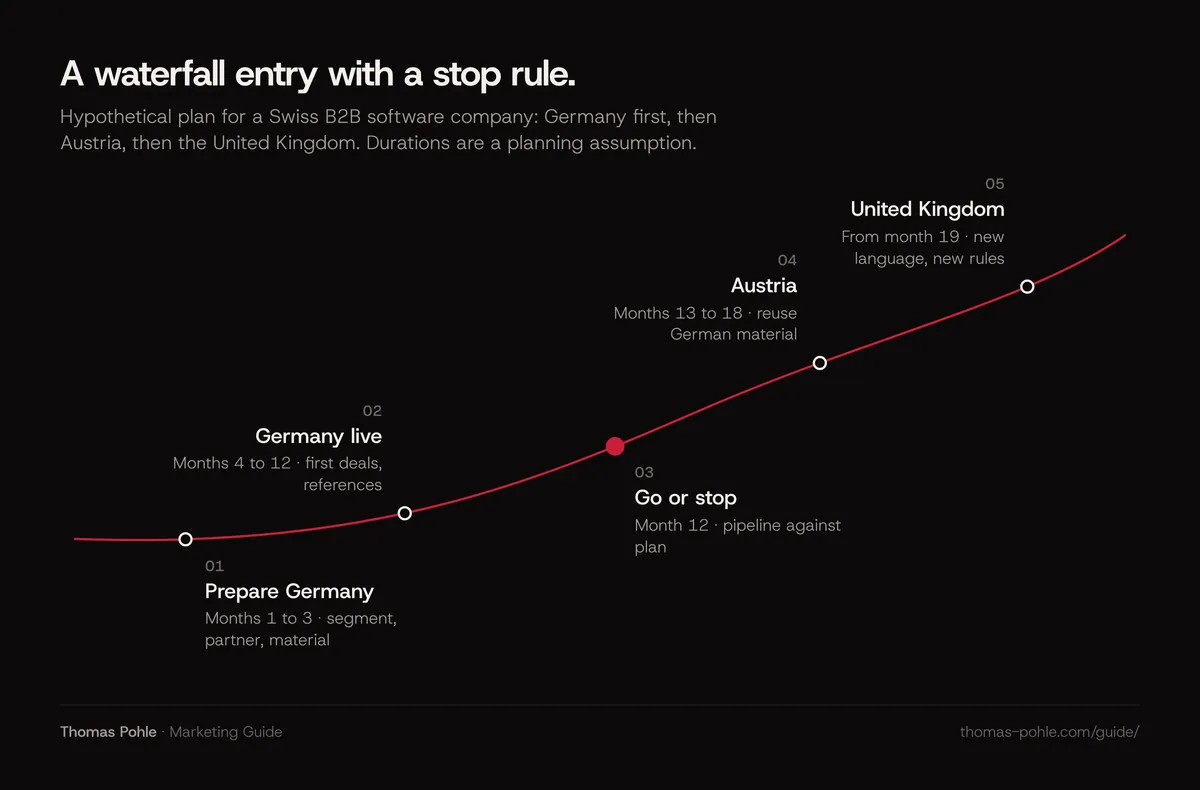
The plan above follows the scenario: Germany prepared in months 1 to 3 and live in months 4 to 12, go or stop at month 12, Austria in months 13 to 18, the UK from month 19. The durations are my planning assumption for a sales cycle of several months.
Which entry modes are there, from export to subsidiary?
Entry modes run from selling directly from your home country, through a partner or distributor, to a branch office, a local subsidiary, a joint venture or an acquisition. The further down that list, the more control you gain. You also commit more capital, liability and time. My take: most B2B companies should start with direct sales or a partner.
| Entry mode | Commitment | Fits when |
|---|---|---|
| Direct sales from home | Low | Buyers accept a foreign supplier and deals can be closed remotely |
| Partner or distributor | Low to medium | Someone already owns the customer relationship you need |
| Branch office | Medium | You want a local presence without founding a new company |
| Subsidiary | High | You need a local entity for contracts, hiring and trust |
| Joint venture or acquisition | Very high | Speed matters more than control, and capital is available |
Two legal facts matter early if Germany or Switzerland is the target. Germany Trade & Invest (GTAI), Germany's federal agency for foreign trade and inward investment, explains that with an autonomous branch office the foreign head office is liable for the business the branch concludes. A subsidiary such as a GmbH offers separate limited liability. Under Section 5 of the German Limited Liability Companies Act, a GmbH needs share capital of at least EUR 25,000. Under Section 7, at least EUR 12,500 must be paid in before registration. In Switzerland, the federal SME portal names a minimum share capital of CHF 20,000 for a GmbH, under Article 773 of the Code of Obligations.
This is general information. It isn't legal or tax advice, so have a local lawyer and tax advisor check the form.
How do you choose the right market entry strategy?
Answer five questions in order. Can you fund a full sales cycle in each market? How fast can competitors copy you? Do you have someone who can run each market in its language? Do you have references at home? Do buyers in the target market already know the category? The answers point to waterfall or sprinkler, follower or pioneer, partner or own team.
The thresholds below are my rules of thumb. They aren't research results:
- Funding. If you can't fund at least one full sales cycle plus three months of ramp-up in every market you want to open, open one market.
- Copy speed. If a competitor could match your offer within about a year and the markets are similar, consider opening them in parallel, ideally through partners.
- People. If nobody on your side speaks the language and can run sales there, start with a partner. Your own team comes later.
- References. If you have fewer than a handful of customers at home who'd take a call from a prospect, fix that before you expand.
- Category. If buyers in the target market don't search for your category, plan as a pioneer there, with a longer runway and a budget for explaining the problem.
Write the answers down. Then pick one combination, for example "follower, waterfall, partner first in Germany". The most common trap I see is the opposite: several markets opened because it looks ambitious, none of them funded through a full sales cycle.
How does marketing change with each entry strategy?
Marketing changes most in what it has to prove. As a pioneer it proves the problem exists. As a follower it proves you're different from the leader. In a waterfall it builds deep local proof in one market at a time. In a sprinkler it builds one central playbook that partners and local teams can run in parallel.
I've run marketing for eight markets, among them Germany, Switzerland, Austria, the UK, France, Sweden, Poland and the USA. Here's my view: the most underplanned part of an entry is language. I speak German, English and Polish, and I took a Swiss German business course in Zurich, so I take that cost seriously. Translation is the small part. Local references and a sales conversation in the buyer's language are the big one.
A named target account list per market, as in account-based marketing, keeps a waterfall entry focused. The channels that bring first meetings in DACH are in the guide on B2B lead generation.
What to do this week
- Write your current plan in one line: timing, sequence and form, for example "follower, waterfall, partner first".
- Run the budget table above with your own salaries, localization and program costs, for one market and for all markets at once.
- Check whether you can fund one full sales cycle plus three months of ramp-up per market. If you can't, cut to one market.
- Ask three prospects in the target market what they use today. That tells you whether you're pioneer or follower there.
- Name one person per market who can run it in the local language, or list two possible partners.
- Put a go or stop review in the calendar twelve months after launch, with the pipeline number that decides it.
No entry strategy survives the first year unchanged. You choose one so you know what you're testing. If you want to set the first market, the entry form and the first channel with your team in one day, book a Momentum Workshop.
Frequently asked questions
What is the difference between a waterfall and a sprinkler strategy?
A waterfall strategy enters markets one after another and opens the next only when the current one works. A sprinkler strategy enters several markets at the same time. Waterfall needs less money at once and lets you reuse what you learned. Sprinkler reaches more buyers before competitors do, but splits budget and attention across every market from the start.
What are the advantages and disadvantages of a pioneer strategy?
A pioneer can gain technology leadership, lock up scarce partners or channels and win early customer loyalty. The costs: higher startup spending than followers, the work of teaching buyers a new category, and the risk that technology moves on. Golder and Tellis found that almost half of the market pioneers in their sample failed.
Which market entry strategy suits a small B2B company?
My take: most small and mid-sized B2B companies do best as a follower with a waterfall sequence. One market at a time, entered through direct sales or a partner, with a dated review before the next market opens. That keeps first-year cost to one market and lets the second reuse what the first taught you.
Do I need a local company to sell in Germany or Switzerland?
Not to start. Many B2B companies first sell directly or through a partner. A branch or subsidiary pays off once you hire locally or need a local entity for contracts and trust. In Germany a GmbH needs at least EUR 25,000 share capital, in Switzerland CHF 20,000. Check the details with a local lawyer and tax advisor.
How long should you give a new market before deciding?
At least one full sales cycle after the first qualified meetings, plus time to ramp up. For a B2B offer with a sales cycle of several months, that usually means about a year. Decide against a pipeline number you wrote down before launch. And set the review date before you spend the first euro.
Sources
- Golder and Tellis: Pioneer Advantage: Marketing Logic or Marketing Legend?, Journal of Marketing Research (1993)
- Lieberman and Montgomery: First-mover advantages, Strategic Management Journal (1988)
- UCLA Anderson Review: How first-mover advantage lost its grip on entrepreneurs and business researchers
- Ayal and Zif: Market Expansion Strategies in Multinational Marketing, Journal of Marketing (1979)
- Kalish, Mahajan and Muller: Waterfall and sprinkler new-product strategies in competitive global markets, International Journal of Research in Marketing (1995)
- Germany Trade & Invest: Company set-up in Germany
- German Limited Liability Companies Act (GmbHG), Section 5: Share capital
- German Limited Liability Companies Act (GmbHG), Section 7: Registration
- Swiss federal SME portal: GmbH, liability, share capital, formation

Thomas PohleB2B marketing advisor in Zurich. More than ten years in B2B marketing at Link11, Beekeeper and smino, most recently as Head of Marketing. CEO and co-founder of TEISENDA. Researched and drafted with AI tools, checked against the sources listed above. More about Thomas