How do you build a go-to-market strategy?

Build your go-to-market strategy as one plan that product, marketing and sales share. It decides which market and buyer you serve first, why they should choose you, what you sell at what price, how buyers find and buy it, how much pipeline that takes, and which numbers tell you within a quarter whether it works.
This guide is for founders, CEOs and marketing leads of mid-sized B2B companies and scale-ups, many of them in the DACH region. Most go-to-market templates come from venture-funded software companies and assume a far bigger team. A family-owned machine builder entering a new segment, or a Swiss software company expanding to Germany, needs the same decisions with fewer people. Below you get the building blocks, a decision on the motion, a worked pipeline example with numbers, a plan for doing it together, and what changes when you cross a border.
What is a go-to-market strategy?
A go-to-market strategy (GTM strategy) is the plan for how a specific offer reaches a specific group of buyers and turns into revenue. It covers the target market, the buyer's problem, positioning, offer and price, the sales motion, channels, the pipeline you need and the metrics you watch. It's narrower than a business strategy and more concrete than a marketing plan.
You need one whenever something new meets the market: a new product, a new segment, a new country, or a relaunch after growth has stalled. A company with three products in two countries can have six go-to-market plans and one marketing strategy.
The test of a good GTM strategy is simple. Every person in sales, marketing and product can say in two sentences who the first customer is, why that customer buys and how the first deal happens. If the answers differ by department, you have documents. You don't have a strategy.
How is go-to-market different from a marketing strategy?
A marketing strategy describes how a company builds demand and brand across all its offers over years. A go-to-market strategy covers one offer in one market, usually over the next two to four quarters. It also includes the sales and product decisions a marketing strategy leaves out: pricing, packaging, sales process and who closes the deal.
| Question | Go-to-market strategy | Marketing strategy |
|---|---|---|
| Scope | One offer, one market or segment | The whole company and brand |
| Time frame | Launch and the next two to four quarters | Several years |
| Owners | Product, marketing and sales together | Mainly marketing |
| Main output | Who to sell to first, how, and the pipeline it takes | Positioning, brand, channel mix and budget across offers |
The two depend on each other. Your positioning comes from the marketing side and has to hold in every go-to-market plan. That's why B2B positioning sits underneath both. How demand, brand and budget fit together is in the guide on building a B2B marketing strategy.
Which building blocks does a go-to-market strategy need?
A complete go-to-market strategy has six building blocks: target market and ideal customer, the problem and your positioning, the offer and price, the go-to-market motion and channels, the pipeline target with its math, and the metrics and review rhythm. Skip one and the others drift. The usual gaps are pricing and the pipeline math.
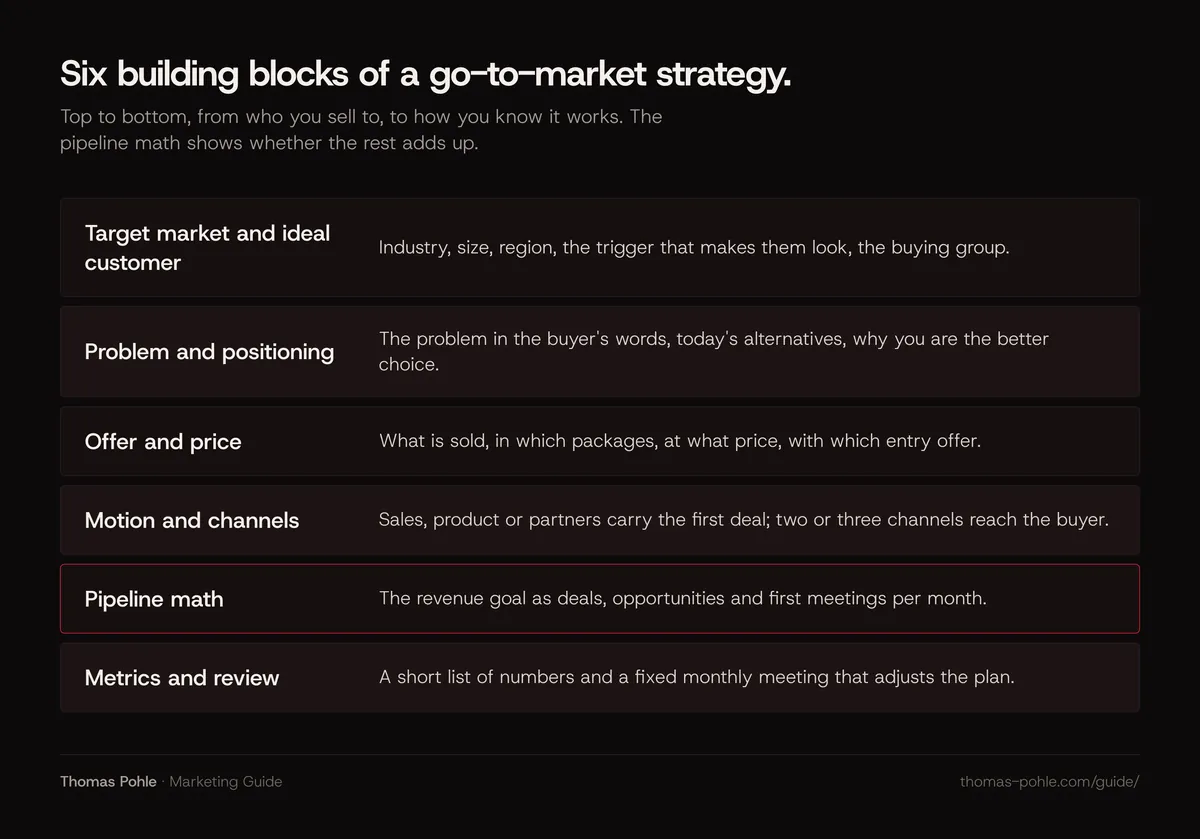
- Target market and ideal customer. Industry, company size, region, the trigger that makes them look, and the people in the buying group.
- Problem and positioning. The problem in the buyer's words, the alternatives they use today, and why you're the better choice for this group.
- Offer and price. What exactly is sold, in which packages, at what price, with which entry offer.
- Motion and channels. Whether sales, the product or partners carry the first deal, and the two or three channels that reach the buyer.
- Pipeline math. The revenue goal translated into deals, opportunities and first meetings per month.
- Metrics and review. A short list of numbers and a fixed monthly meeting where you adjust the plan.
How do you choose the target market and ideal customer?
Pick the first target market where your offer solves an urgent, expensive problem, where you can reach buyers with the people and channels you already have, and where you can win references fast. My take: narrow beats big. A segment of a few hundred to about a thousand companies you can name is a better start than a market of fifty thousand you can't.
Work from evidence you already have. Look at your last ten deals and your last ten losses. Which industries, sizes and triggers repeat? Talk to five customers and ask what they used before and why they switched. Founders should stay close to customers and sales in this phase. That's my view. The best segment definitions come from someone who was in the calls.
Then size the segment from the bottom up. Count the companies that fit. Ignore the market reports. If you can list a few hundred to about 1,000 target accounts by name, you can plan outbound, account-based marketing and events against a real list. Can't list them? Then the segment is still too vague.
Keep one number in mind while you size it. Research by LinkedIn's B2B Institute with the Ehrenberg-Bass Institute estimates that about 95 % of potential B2B buyers aren't ready to buy at any given moment. So a segment of 800 accounts has only a few dozen buying right now. That's why your go-to-market plan needs reach beyond the in-market few. Lead generation alone rarely fills the plan.
Which go-to-market motion fits your company?
The motion is how the first deal happens. In a sales-led motion a salesperson runs the deal from first meeting to contract. In a product-led motion buyers try the product themselves and buy or upgrade without much sales contact. In a partner-led motion resellers, integrators or consultants sell your offer to customers they already serve.
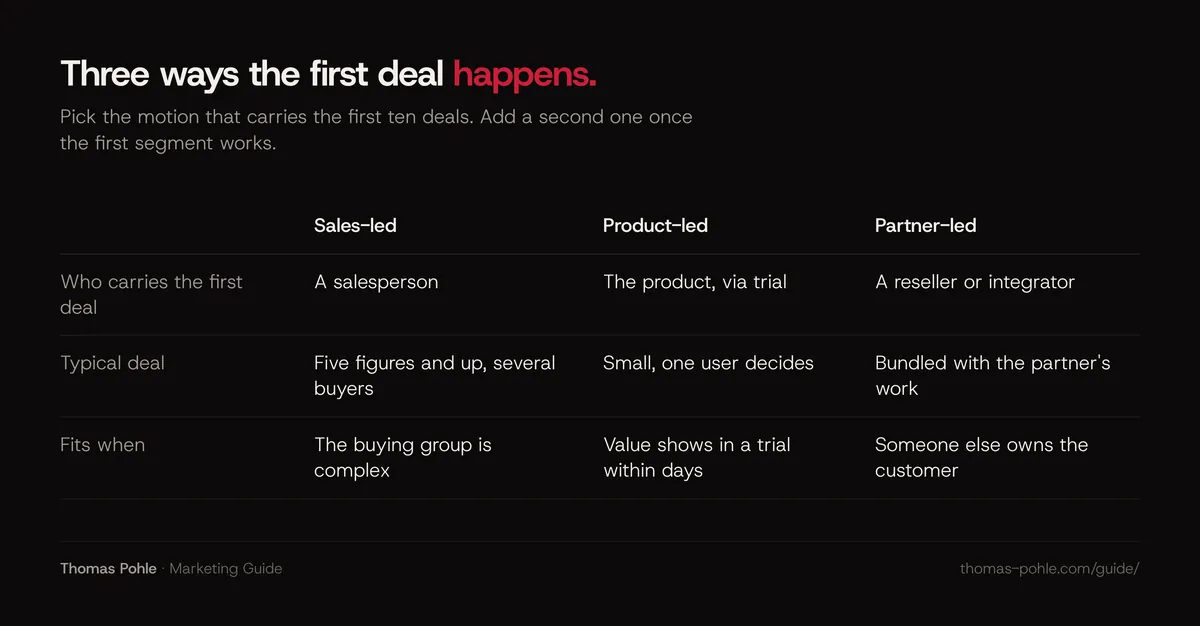
My rule of thumb: B2B companies with five-figure deals and buying groups of several people should start sales-led. Product-led works when a single user can see the value in a trial within days. That's rare outside software. Partner-led makes sense when someone else already owns the customer relationship, for example an integrator in a market you don't know yet.
You can combine motions. Just don't do it on day one. Pick the one that carries the first ten deals, build it until it works, then add the second. In my view, a plan that runs three motions at once usually runs none of them properly.
How much pipeline does your go-to-market have to produce?
Work backwards from the revenue goal. Divide it by the average deal size to get the number of deals. Divide that by your win rate to get the qualified opportunities. Divide again by the share of first meetings that become opportunities. The result is the number of first meetings per month your channels have to deliver.
A typical scenario, with assumptions you replace with your own numbers:
| Step | Assumption | Result |
|---|---|---|
| New revenue goal for 12 months | CHF 600,000 from the new segment | CHF 600,000 |
| Deals needed | Average first-year deal of CHF 30,000 | 20 deals |
| Qualified opportunities | Win rate of 25 % | 80 opportunities |
| First meetings | Half of first meetings become opportunities | 160 meetings, about 13 to 14 per month |
The numbers are invented for the example. The method is real. Run it with your own deal size and win rate from the CRM. No history yet? Use conservative assumptions and replace them after the first quarter.
Now check the result against reality. Thirteen first meetings a month from a segment of 800 accounts means meeting about one in five of them within a year. Can your channels do that? If not, change the goal, the deal size, the segment or the channel plan before you launch. Afterwards is too late. This is also when you put sales cycle length into the plan. If deals take six months, revenue from meetings in month eight lands next year. The guide on B2B lead generation covers the channels that produce first meetings.
How do product, marketing and sales build the plan together?
Build the plan in one shared working rhythm. Three separate documents won't get you there. Product brings what the offer can do and what it costs to deliver. Marketing brings the segment, positioning and channels. Sales brings what buyers say in calls and what closes deals. One person owns the plan and the final decisions.
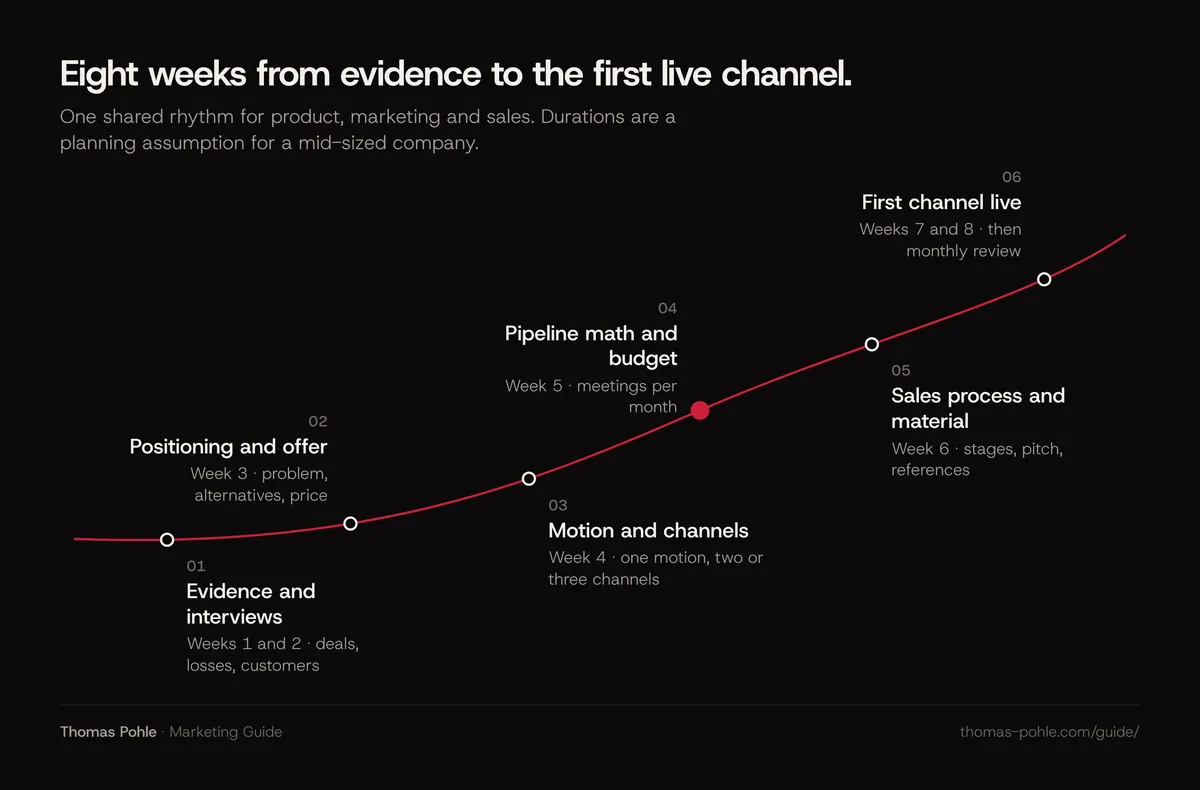
Here's how I'd run it for a mid-sized company. Evidence and customer interviews in weeks one and two. Positioning and offer in week three. Motion and channels in week four. Pipeline math and budget in week five. Sales process and material in week six. The first channel live in weeks seven and eight. The durations are my planning assumption. They aren't a benchmark.
Three rules keep it practical. Write the plan on a few pages. Skip the deck nobody runs. Give marketing a pipeline number on top of the lead number, because marketing should sit much closer to revenue than most companies allow. In a previous in-house role I raised marketing's share of the sales pipeline from under 10 % to over 50 % within two years, so I take that number seriously. And meet monthly with product, marketing and sales to look at the same numbers and change one thing.
Where does product marketing fit? In larger companies a product marketer owns positioning, launch material and sales enablement for each offer. In a mid-sized company the head of marketing and a product lead often split that role. That works as long as one name stands on the plan.
What changes when you enter a new country?
A new country changes three things more than founders expect: the law that governs outreach, the language buyers expect, and the trust signals that count locally. The rest of the plan stays. Each of these three can break it, though. Check them before you budget the channels.
- Outreach rules. Germany's Act against Unfair Competition (UWG, Section 7) treats advertising by email without the recipient's prior express consent as an unacceptable nuisance, with a narrow exception for existing customers. Phone calls to businesses need at least presumed consent. In the US, the FTC's CAN-SPAM guide says the law makes no exception for business-to-business email, and opt-out requests must be honored within 10 business days. An outbound plan that works in the US can be unlawful in Germany. Treat this as general information. It isn't legal advice.
- Language. In CSA Research's 2020 survey of 8,709 consumers in 29 countries, 76 % preferred to buy products with information in their own language, and 40 % said they never buy from websites in other languages. The survey covers consumers. For B2B, read it as a direction. It isn't a measurement. Switzerland alone has four national languages.
- Local proof. References from the target country, a local address or partner, local events and press. Buyers in a new market don't know your logos from home.
On the website side, separate language versions need hreflang annotations so Google shows the right one, as described in Google's documentation on localized versions and in the technical SEO checklist. I've run marketing for eight markets, among them Germany, Switzerland, Austria, the UK and the USA. Here's my view: the difference between markets is rarely the product. It's the channel rules, the language and who vouches for you. My observation on buying habits: American and British buyers are more direct and decide faster. Buyers in Switzerland and Germany first want to get to know you. Swiss buyers are very locally oriented, German buyers somewhat more open. In DACH, plan time for that first phase of getting to know each other.
Which KPIs show whether your go-to-market works?
Track a short chain of numbers from first touch to revenue: first meetings in the target segment, the rate at which they become qualified opportunities, win rate, average deal size, sales cycle length and pipeline coverage. Judge them monthly against the pipeline math. Give a new market at least one full sales cycle before you call it.
- Leading. First meetings per month in the target segment, share of meetings that match the ideal customer profile, replies per channel.
- Middle. Meeting to opportunity rate, pipeline value created, pipeline coverage against the revenue goal.
- Lagging. Win rate, average deal size, sales cycle length, revenue from the segment, first referenceable customers.
Name one owner per number. Keep the list short enough to discuss in thirty minutes. The guide on marketing measurement shows how to set up reporting without heavy tracking. If AI search is one of your channels, the guide on how SEO changes when AI answers the search explains what to measure there.
What to do this week
- Write down in two sentences who your first customer is and why they buy. Ask sales, marketing and product to do the same. Compare.
- Pull your last ten won and ten lost deals from the CRM. Note industry, size and trigger.
- Book three customer calls. Ask what they used before and why they switched.
- List your target accounts by name. If you can't name them, or the list runs into many thousands, narrow the segment. If you only find a few dozen, check whether account-based marketing fits better.
- Run the pipeline math with your own deal size and win rate. Compare the meetings per month with what your channels deliver today.
- Pick one motion for the first ten deals.
- Planning a new country? Check outreach rules, language and local proof before you budget channels.
- Put a monthly go-to-market review with product, marketing and sales in the calendar.
A go-to-market strategy is never finished. The first quarter will prove half your assumptions wrong. That's the point of writing them down. Want to set the segment, positioning and the first channel with your team in one day? That's what a Momentum Workshop is for.
Frequently asked questions
How long does it take to build a go-to-market strategy?
For a mid-sized B2B company I'd plan about eight weeks from the first customer interviews to the first channel going live. That assumes one person owns it and product, marketing and sales each give it a few hours a week. You can get a first version in a one-day workshop. Collecting the evidence from interviews and the CRM takes longer.
What is the difference between a go-to-market strategy and a business plan?
A business plan describes the whole company: model, finances, team and long-term goals, often for investors or banks. A go-to-market strategy takes one offer and one market and plans how it reaches buyers and turns into revenue: segment, positioning, price, motion, channels, pipeline and metrics. One business plan can contain several go-to-market plans.
Who should own the go-to-market strategy?
One person with authority across product, marketing and sales. In a scale-up that's often the CEO or a chief revenue officer. In a mid-sized company it can be the head of marketing or a business unit lead. Shared ownership without one name usually means nobody changes the plan when the numbers say it isn't working.
Do we need a separate go-to-market strategy for each country?
You need a separate plan for each country where the buyer, the language, the outreach rules or the channels differ. The positioning and offer can stay largely the same. Germany, Austria and Switzerland share a language but differ in law, buying habits and trust signals. The US differs again, for example in email outreach rules.
What is a go-to-market template?
A template is a fixed list of questions for the six building blocks: target market, positioning, offer and price, motion and channels, pipeline math, and metrics. It helps you avoid gaps. The template itself is worth little. The value comes from filling it with evidence from your own deals and customer calls.
Sources
- LinkedIn B2B Institute and Ehrenberg-Bass Institute: The 95-5 rule
- German Act against Unfair Competition (UWG), Section 7: Unacceptable nuisance
- US Federal Trade Commission: CAN-SPAM Act, a compliance guide for business
- CSA Research: Survey of 8,709 consumers in 29 countries finds that 76% prefer purchasing products with information in their own language (2020)
- Google Search Central: Tell Google about localized versions of your page
- Google Search Central: Managing multi-regional and multilingual sites

Thomas PohleB2B marketing advisor in Zurich. More than ten years in B2B marketing at Link11, Beekeeper and smino, most recently as Head of Marketing. CEO and co-founder of TEISENDA. Researched and drafted with AI tools, checked against the sources listed above. More about Thomas