How do you plan a marketing budget step by step?

Plan a marketing budget backward from the revenue target. Work out the new revenue you need, the deals and qualified opportunities behind it and what each opportunity costs per channel. Add people, tools, brand and a reserve. Phase the money by quarter. Then present three scenarios, so leadership sees what each line buys.
This guide is for marketing leads and CEOs who have to turn a revenue target into a budget the leadership team will sign. If your question is how large the budget should be in the first place, the guide on how much marketing budget a B2B company needs covers sizing and benchmarks. This one is about the process: seven steps, one worked example and the questions a CFO will ask.
The budget usually belongs to the head of marketing. The guide on what a head of marketing does in a B2B company explains the role around it.
What goes into a marketing budget plan?
A marketing budget plan lists every cost marketing causes over the year, grouped so leadership sees what's fixed, what buys pipeline now and what builds demand for later. Typical lines are people, tools and website, agencies and freelancers, paid media, content and events, and a reserve. Every line needs an owner and a reason.
| Line | What it contains | How it is planned |
|---|---|---|
| People | Salaries, social costs, training | Fixed, from the team plan |
| Tools and website | CRM, automation, analytics, hosting, licenses | Fixed, from contracts |
| Agencies and freelancers | Design, paid media management, video, PR | Per project or retainer |
| Paid media | Search, LinkedIn, display, sponsored content | From the cost per opportunity of each channel |
| Content and events | Production, trade fairs, webinars, customer events | From the content and event calendar |
| Reserve | Money held back for tests and surprises | A fixed share of the program budget |
For orientation: in Gartner's 2025 CMO Spend Survey, paid media was the largest block at 30.6% of the marketing budget, with martech, labor and agencies as the other main blocks. That sample is mostly companies with more than $1 billion in revenue. My take: smaller B2B companies tend to spend a larger share on people, because one person covers several channels.
The plan comes together in seven steps. Each one builds on the one before.
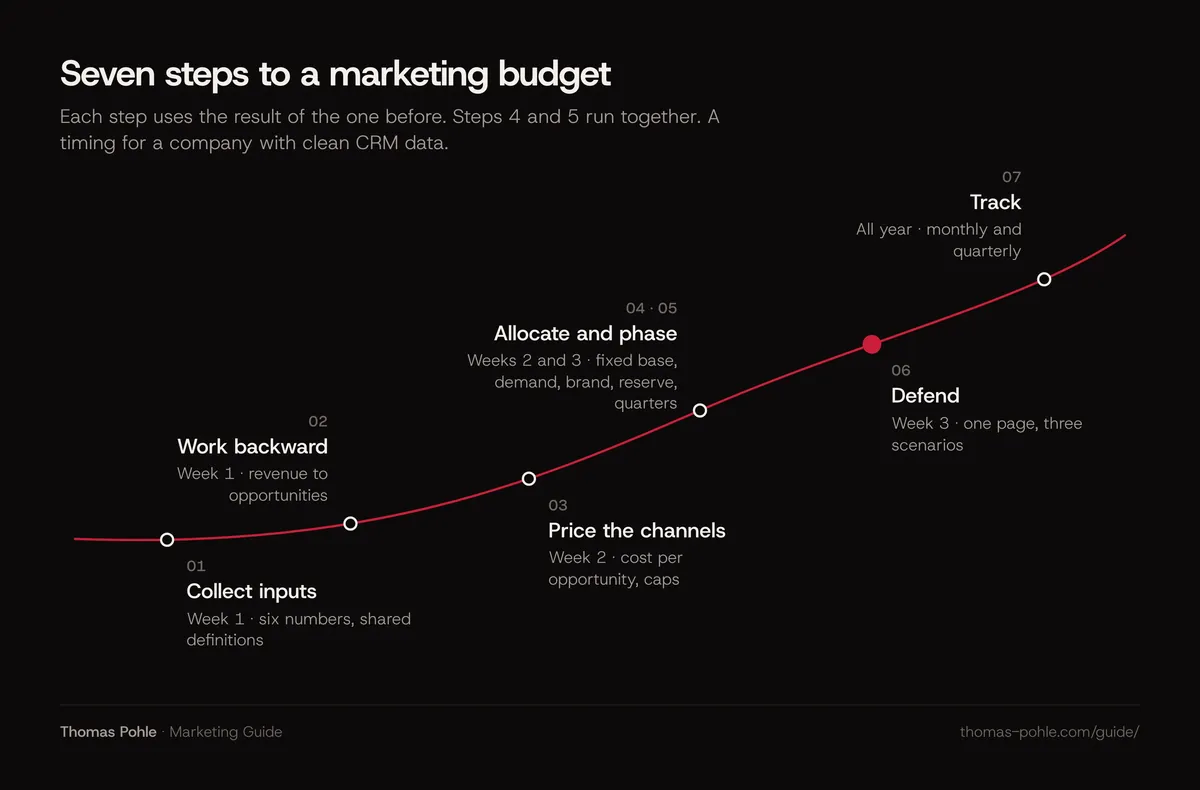
Step 1. Which numbers do you need before you start?
Before you plan, collect six numbers: the revenue target, the revenue existing customers will bring, the average first-year deal size, the win rate on qualified opportunities, the length of the sales cycle, and last year's spend and qualified opportunities per channel. They come from finance and the CRM. Your plan is only as good as they are.
- Revenue target. From the company plan, agreed with the CEO and finance.
- Revenue from existing customers. Renewals and expansion minus expected churn, from finance or customer success.
- Average first-year deal size. From closed deals in the last 12 months.
- Win rate. Won deals divided by qualified opportunities, over the same period.
- Sales cycle. Median days from qualified opportunity to signed contract.
- Spend and opportunities per channel. What each channel cost and how many qualified opportunities it produced.
If the CRM can't give you these numbers, fix that first. In a previous in-house role I moved a company's CRM from Pipedrive to HubSpot to get full-funnel targets and reliable forecast reporting. A budget built on guessed win rates gets challenged in the first meeting. Rightly so.
Agree the definitions with sales before you count. What makes an opportunity qualified? When does it count as marketing-sourced? The guide to measuring marketing success in B2B covers both definitions.
Step 2. How do you work backward from revenue to pipeline?
Working backward turns the revenue target into the number of qualified opportunities you need. New revenue divided by average deal size gives deals. Deals divided by the win rate gives opportunities. Then shift the timing back by the sales cycle, because an opportunity created in November rarely closes in the same year.
Here's a typical scenario with assumed numbers. Replace them with your own. A German B2B software company has EUR 20 million in revenue and a target of EUR 23 million. Existing customers are expected to bring EUR 19 million after churn and expansion. Marketing is expected to source 40% of new deals.
| Step | Calculation | Result |
|---|---|---|
| New revenue needed | EUR 23 million minus EUR 19 million | EUR 4,000,000 |
| New deals | EUR 4,000,000 divided by EUR 50,000 average deal | 80 deals |
| Marketing-sourced deals | 40% of 80 | 32 deals |
| Qualified opportunities from marketing | 32 divided by a 25% win rate | 128 opportunities |
| Timing | Six-month sales cycle | Most of the 128 must exist by the end of June |
Most plans skip the timing row. With a six-month cycle, opportunities created in the second half mainly feed next year. Spending in autumn still matters. It just pays into next year's target. This year's pipeline work belongs in the first half.
Step 3. How do you turn opportunities into a budget?
Multiply the opportunities each channel should deliver by that channel's cost per qualified opportunity. Spread the total across the channels that worked last year, cap each channel at the volume it can realistically deliver, and fund one small test for a new channel. The sum is your demand program budget.
In the scenario, last year's CRM data gives these assumed costs per qualified opportunity:
- Paid search. 40 opportunities at EUR 1,800: EUR 72,000.
- LinkedIn ads. 30 opportunities at EUR 3,000: EUR 90,000.
- Events and trade fairs. 30 opportunities at EUR 4,000: EUR 120,000.
- Webinars and content. 28 opportunities at EUR 1,500: EUR 42,000.
Together that's 128 opportunities for EUR 324,000 in demand programs. The caps matter. A channel usually gets more expensive per opportunity once you push it past its natural audience. My take: a plan that assumes last year's cost per opportunity at twice last year's volume is the easiest mistake in budget planning. And the hardest to explain in October.
Step 4. How do you split the budget between brand, demand and fixed costs?
Fund the fixed base first, then the demand programs from the opportunity math, then brand, then a reserve. For the balance between brand and demand, Les Binet and Peter Field found that B2B businesses grow best when they allocate 46% of budget to brand building and 54% to activation, in research LinkedIn published in 2019.
The 95-5 rule from LinkedIn's B2B Institute helps explain the split: 95% of potential buyers aren't ready to buy today. Demand programs reach the few who are in the market now. Brand reaches the ones who'll be in the market later, and makes sure they already know your name.
Applied to the scenario: if EUR 324,000 of demand programs is 54%, brand gets about EUR 276,000, for a program budget of EUR 600,000. Here's my view: treat 46:54 as a direction for established companies. A young company without pipeline usually starts heavier on demand and moves toward the balance as the pipeline stabilizes.
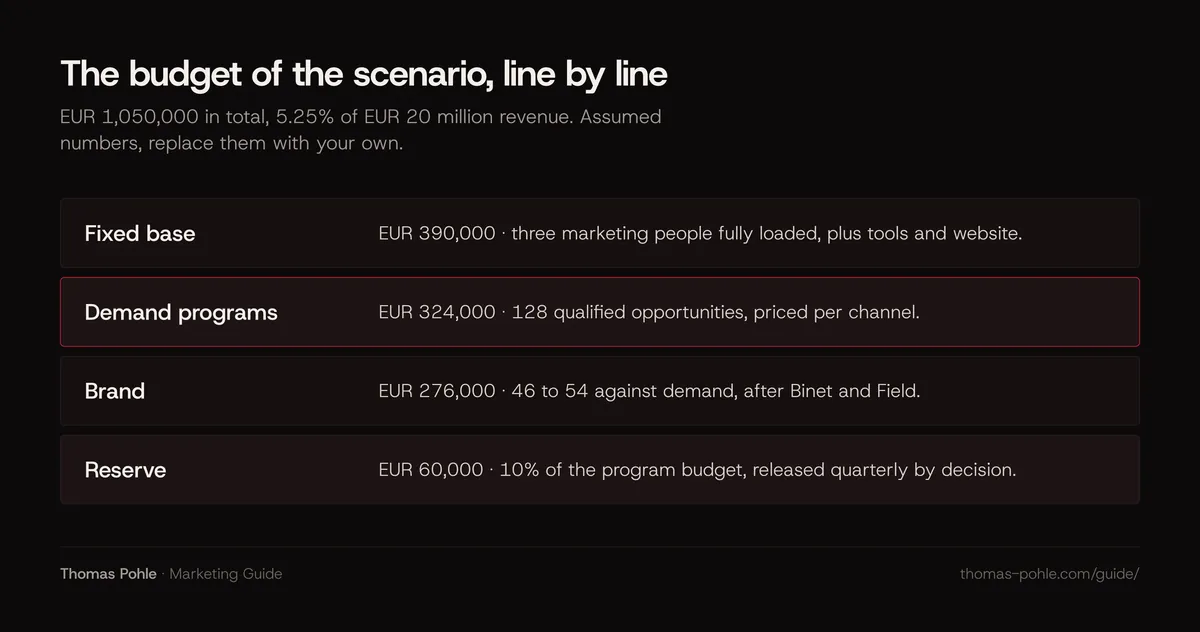
Then add the rest. Three marketing people at an assumed EUR 110,000 each, fully loaded, make EUR 330,000, plus EUR 60,000 for tools and website. A reserve of 10% of the program budget, EUR 60,000, covers tests and surprises. That share is my rule of thumb. The total is EUR 1,050,000, or 5.25% of revenue. That's below the 7.8% average Gartner reported for 2026 for a sample of mostly large companies.
Step 5. How do you phase the budget across the year?
Phase the budget by quarter, following when opportunities have to be created. Don't spread the money evenly. With a long sales cycle, put more of the demand programs into the first half, keep brand spending steady all year, and place event costs in the quarters the events actually happen. Then set monthly limits per channel that finance can track.
- Demand programs follow the timing from step 2, so the first two quarters carry more.
- Brand runs continuously. My take: brand works through continuity, and switching it on and off wastes most of what you spend.
- Events sit where the trade fairs are. Book stands and hotels early, because those costs land months before the event.
- Ad platforms pace spend themselves. Google Ads may spend up to twice the average daily budget on a single day, but no more than 30.4 times the daily budget in a month. A LinkedIn campaign with a daily budget and no end date won't spend more than seven times that daily budget in a week. Plan monthly limits with these rules in mind.
- The reserve is released once a quarter, by a named decision with a written reason.
Step 6. How do you defend the budget in front of leadership?
Defend a marketing budget with the chain from money to revenue. An activity plan won't do it. Show the target, the opportunities it needs, the cost per opportunity behind each channel, and three scenarios with what each one buys and what it gives up. A leadership team that sees the trade-offs decides faster and argues less.
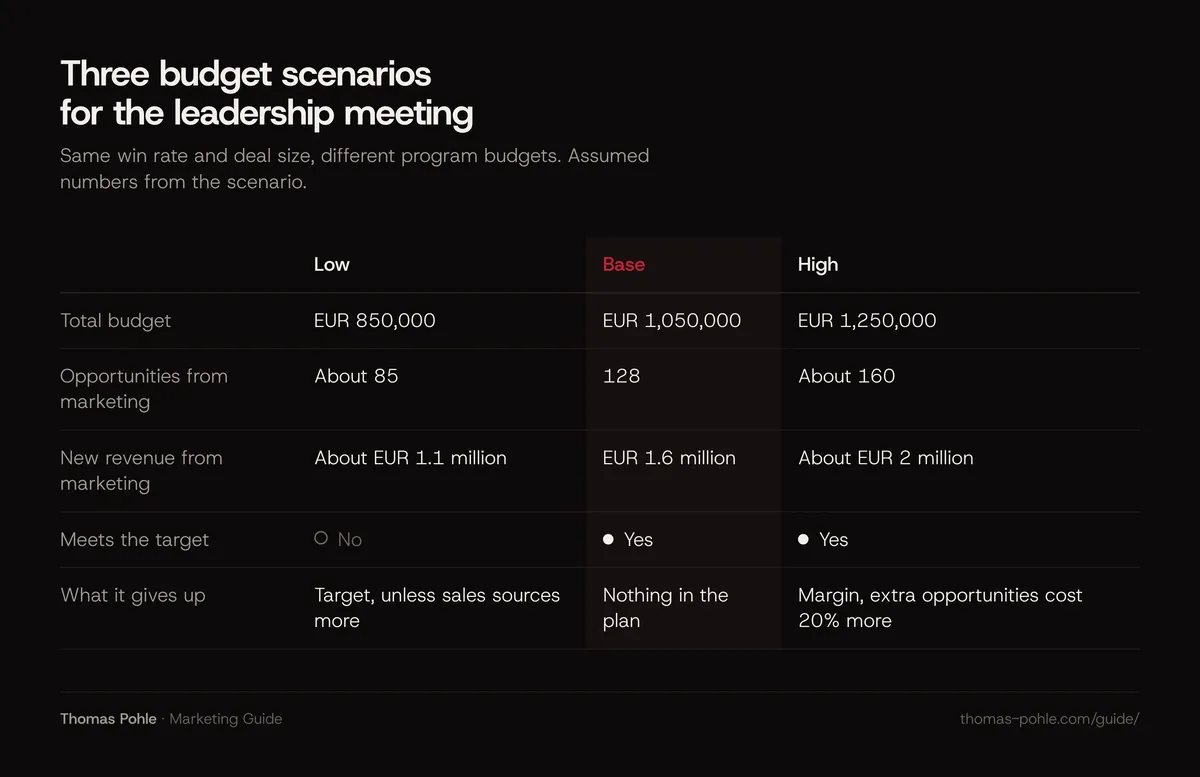
In the scenario, the low case takes EUR 200,000 out of the program budget, EUR 108,000 of it from demand programs. At the average cost of about EUR 2,500 per opportunity, marketing then delivers about 85 opportunities and roughly EUR 1.1 million of new revenue, against EUR 1.6 million in the base case. The high case adds the same EUR 200,000 and assumes the extra opportunities cost 20% more each, for about 160 opportunities and roughly EUR 2 million. Both are assumptions.
You won't be the only one asking for more. In Gartner's 2026 survey, 56% of CMOs said their marketing organization lacked the budget to deliver its strategy. Scenarios turn that complaint into a decision.
Keep it to one page. I'm allergic to slide decks that nobody runs, and a leadership meeting doesn't need forty slides of activities. It needs the chain, the scenarios and your cut order.
Step 7. How do you track and adjust the budget during the year?
Track spend against plan every month and cost per qualified opportunity per channel every quarter. Move money from channels whose cost per opportunity rises to channels that still deliver at plan. Release the reserve by decision. Re-plan only when the revenue target or the sales team changes. My working rules:
- Monthly. Spend against plan per line. Anything more than 10% off gets a sentence of explanation.
- Quarterly. Opportunities and cost per opportunity per channel, against plan.
- Shift rule. A channel that runs 30% above its planned cost per opportunity for two months in a row gets capped, and its money moves.
- Test rule. A new channel gets one quarter and a fixed budget. It continues only if its cost per opportunity is within plan.
- Brand. Stays stable unless the whole budget is cut.
The guide on what performance marketing can do in B2B covers how to improve cost per opportunity inside a channel.
What to do this week
Most of the groundwork fits into a few days, long before anyone asks for the final number. These steps give you a plan that holds up in the leadership meeting and a routine that keeps it honest for the rest of the year.
- Collect the six inputs from finance and the CRM.
- Agree with sales what a qualified opportunity is and when it counts as marketing-sourced.
- Run the backward calculation and shift it by the sales cycle.
- Price each channel with its cost per opportunity and set a cap.
- Add the fixed base, the brand share and a 10% reserve.
- Build three scenarios on one page, with what each gives up.
- Put the monthly and quarterly review dates in the calendar now.
A budget built this way gets signed faster, because leadership sees what each line buys. And it gets better every year, because this year's actual cost per opportunity becomes next year's input.
Want to build the first version with someone who has done it in-house? A one-day Momentum Workshop is one way to get there.
Frequently asked questions
How do you calculate a marketing budget?
Start with the new revenue you need and divide it by the average deal size to get deals. Divide by the win rate to get qualified opportunities. Take marketing's share and multiply by the cost per opportunity of each channel. Add people, tools, a brand share and a reserve. Compare the total with revenue only as a final sanity check.
How long does marketing budget planning take?
My rule of thumb: two to three weeks of elapsed time for a company with clean CRM data. One week for the inputs and definitions, one for the calculation and allocation, and a few days for scenarios and the leadership meeting. No reliable CRM data? Plan extra time to reconstruct win rates and channel results, or run a test quarter instead.
What should you do if leadership cuts the marketing budget?
Cut in the order your plan already defines, and say what each cut costs in opportunities. My take: cut the reserve and the weakest channel first, then lower-performing events, and brand last, because brand cuts show up in next year's pipeline. Keep the fixed base unless the team itself changes. A written cut order makes the conversation shorter.
Should a marketing budget include a reserve?
Yes. My rule of thumb is about 10% of the program budget. It pays for tests, a channel that suddenly performs, or a trade fair that comes up during the year. It only works if it's released by a named decision with a written reason. Otherwise it quietly becomes part of the regular spend.
How do you plan a marketing budget without historical data?
Plan the first quarter as a test. Pick one or two channels, give each a fixed budget and measure the cost per qualified opportunity they produce. Use those numbers for the backward calculation from the second quarter on. Until then, keep the fixed base lean and avoid long commitments such as annual event contracts.
Sources
- Gartner: 2026 CMO Spend Survey finds CMOs allocate 15.3% of marketing budgets to AI (May 2026)
- Gartner: 2025 CMO Spend Survey reveals marketing budgets have flatlined at 7.7% of overall company revenue (May 2025)
- LinkedIn: How B2B marketing really drives growth (Binet and Field, October 2019)
- LinkedIn B2B Institute: The 95-5 rule
- Google Ads Help: About overdelivery and your average daily budget
- LinkedIn Marketing Solutions Help: Campaign and ad set budgets

Thomas PohleB2B marketing advisor in Zurich. More than ten years in B2B marketing at Link11, Beekeeper and smino, most recently as Head of Marketing. CEO and co-founder of TEISENDA. Researched and drafted with AI tools, checked against the sources listed above. More about Thomas