What makes a good B2B website?

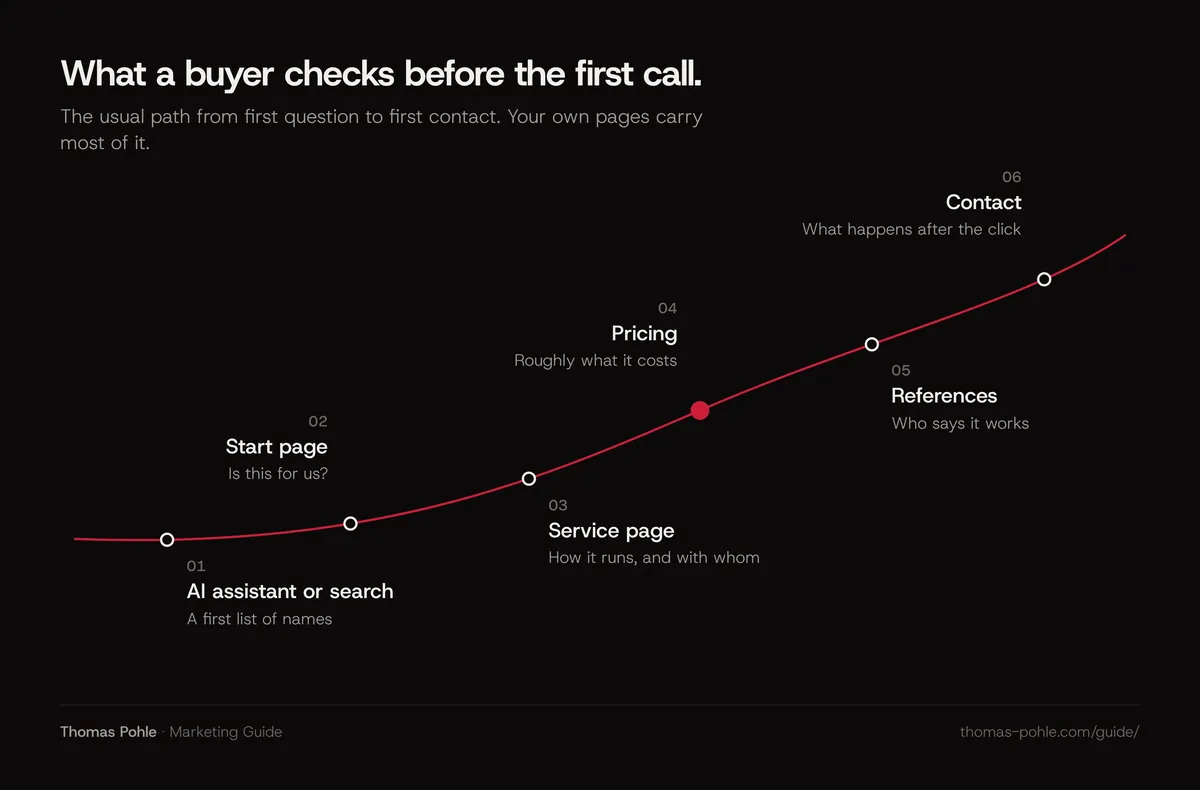
A good B2B website answers the questions a buyer has before the first call: roughly what it costs, who else trusts you, how the work runs, who they will work with and how to start. Buyers form a shortlist before they talk to anyone. A site that hides these answers drops out without ever hearing why.
This guide is for founders, CEOs and marketing leads who own a B2B website and suspect it looks fine but sells nothing. The guide to B2B marketing shows where the website sits in the whole system. Here you look at your site through one pair of eyes: a buyer who wants answers before the first call. At the end you get a scored checklist per page type, with thresholds.
What makes a good B2B website?
A good B2B website lets a buyer decide, without talking to you, whether you belong on the shortlist. It answers five questions in plain words: what does it cost, who says you deliver, how does the work run, who will I deal with, and what is the first step. Design, CMS and copy style only matter as far as they help those answers land.
Most B2B sites answer a different question: what the company wants to say about itself. The buyer's questions stay open.
| Buyer question | Page that answers it | What it must show |
|---|---|---|
| Is this for us? | Start page | Who you serve and what changes for them |
| What does it cost? | Pricing or service page | Price logic and a starting point |
| Who says it works? | References | Named customers with a result |
| How does it run, and with whom? | Service page | Steps, durations, named people |
| How do we start? | Contact | What happens after the first click |
What do B2B buyers check before the first call?
B2B buyers check price, proof and fit before they contact a vendor, and most already have a favorite by then. In 6sense's 2025 Buyer Experience Report, a survey of about 4,000 B2B buyers published in November 2025, 94 percent of buying groups had ranked their preferred vendors before first contact, and they bought from that early favorite 77 percent of the time.
Three more data points show what that means for your website:
- Research comes first. 6sense reports that the split between independent research and seller engagement moved from 70/30 to 60/40. 6sense sells buyer-intent software, so read its numbers as vendor research.
- Buyers prefer to go without a rep. Gartner's survey of 646 B2B buyers, fielded in August and September 2025 and published in March 2026, found that 67 percent prefer a rep-free experience. A year earlier, Gartner's survey had found 61 percent.
- Pricing tops the wish list. TrustRadius's 2026 B2B Buying Disconnect report (1,862 technology buyers, surveyed in January 2026) says transparent pricing has been buyers' number one wish from vendors four years running.
One more finding should worry anyone whose site was written years ago. In that earlier survey of 632 buyers, published in June 2025, 69 percent saw inconsistencies between a supplier's website and what its sellers told them. A website that says something different from your sales deck costs trust twice.
Should a B2B website show prices?
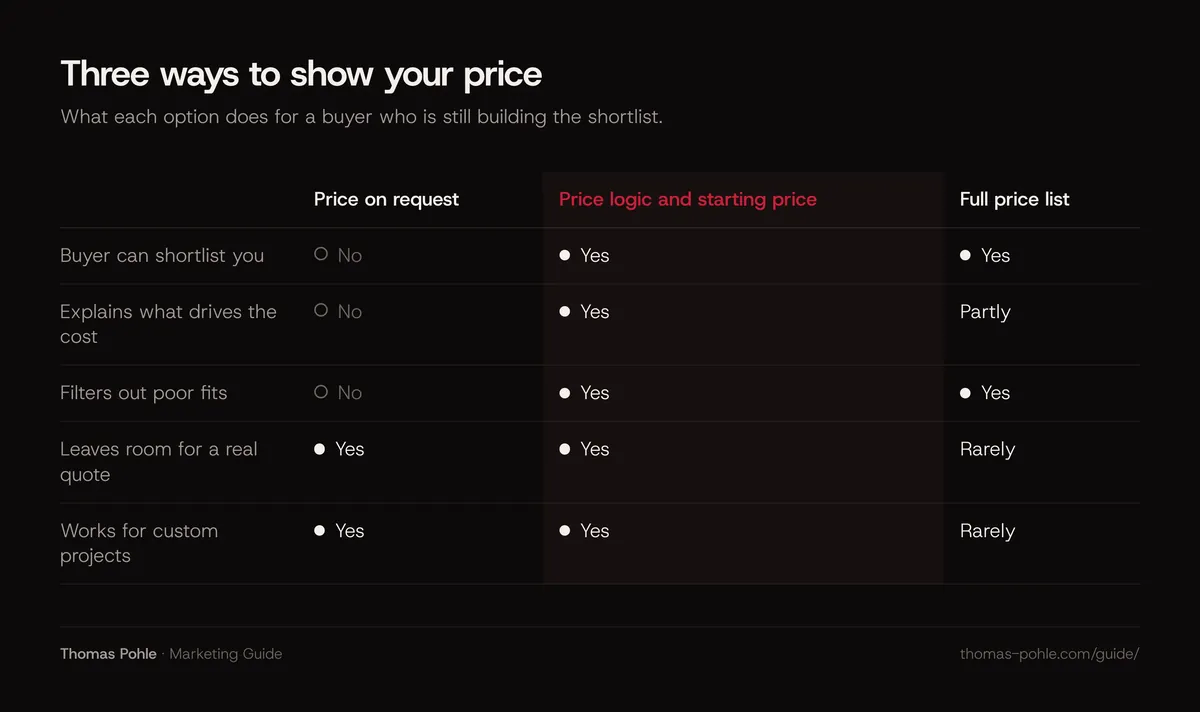
Yes, at least the price logic and a starting point. Buyers use price to cut a long list down to a shortlist, and in my view a site without any price signal is often the first to go. You don't need a full price list. A "from" price, a range, or the price of two or three typical scenarios is enough for that first filter.
This is old knowledge. Jakob Nielsen of Nielsen Norman Group called missing prices "the most user-hostile element of most B2B sites" in 2006, after testing 179 B2B websites, and recommended showing representative cases with their prices. TrustRadius's 2026 data says buyers still ask for it.
The usual objection: every project is different. That's why scenario prices work. Show what drives the price (scope, users, markets, duration), then two or three typical cases with their cost. The buyer sees where they land. You keep room to quote the real project. The guide to price positioning covers where your price should sit; this is about showing it.
What proof belongs on a B2B website?
Proof that a buyer can check: named customers, a specific result with a date, and the voice of a real person who approved what they said. Anonymous praise and walls of small logos convince almost nobody. Every proof element should answer the buyer's real worry, which is whether you have solved this problem before for a company like theirs.
Rank your proof by how hard it is to fake:
- Case studies with names and numbers. Customer, starting point, what changed, by how much, approved quotes. The guide to case studies that get cited shows how to build one.
- Named testimonials. A person, a role, a company, a sentence about a concrete change.
- Independent reviews. TrustRadius's 2026 report says 74 percent of buyers use reviews to inform their purchase decisions.
- Logos. Only with permission, and only when the buyer recognizes them.
I apply the same standard to my own site. I planned a "What clients say" section, then removed it until a client approves a real quote. An empty section with a placeholder, or a quote nobody said, does more damage than no section at all. If you don't have approved proof yet, show the method and the people, and go and get the first case study.
How do you show the process and the people?
Describe the work as steps with durations and name the people who do it. B2B buyers are buying risk reduction as much as a result. A page that says "week one: workshop with your team, week two: draft, week four: launch" and shows who leads each step answers the question a buying group asks in every internal meeting: what happens after we sign?
The service page is where this belongs. Keep it concrete:
- Who it is for, and who it is not for. One sentence each. The second one builds more trust than the first.
- The steps. Three to six, each with a duration and what the customer has to provide.
- The result. What the customer holds at the end, in nouns: a plan, a campaign, a working process.
- The people. Names, roles, faces, a line on experience. Not a stock team photo.
Named people also help search engines and AI assistants; the guide on showing expertise to Google and AI goes into author pages and bylines.
How should the path to the first call work?
The first step should be small, clear and described before the click. Tell the buyer what happens after they get in touch: who answers, how fast, how long the first call takes and what they get from it. A form that just says "Contact us" leaves all of that open, and an open question is a reason to wait.
Here is how I describe my own first step: a 30-minute intro call where you tell me where it's stuck and I tell you what I'd do first, then a few days of analysis with my honest take in writing, then one decision on the format. Write yours with the same level of detail.
Keep the path light: a direct email address and a short form. The buyer is still deciding whether to talk to you at all.
A legal note, short and without legal advice. In Germany, § 5 of the Digital Services Act (DDG) requires providers of commercial digital services to keep their name and address (for legal entities also the legal form and representatives), contact details including an email address, and, where registered, the register and register number easy to recognize, directly reachable and always available. In Switzerland, Art. 3 para. 1 lit. s of the Unfair Competition Act (UWG) requires clear and complete information on identity and contact address, including email, from anyone offering goods, works or services in electronic commerce. Check your own case with a lawyer.
How do you score your B2B website?
Score each of the five page types against three checks, with 0 points for missing, 1 for partly there and 2 for clear. That gives a maximum of 30 points. The thresholds below are my rule of thumb, not an industry standard. They tell you whether to fix the site first or start sending traffic to it.
| Page | Check | 2 points when |
|---|---|---|
| Start page | Who and what | A stranger can repeat it after 10 seconds |
| Start page | Proof | Named customer or result on the first two screens |
| Start page | Next step | One clear action, visible early |
| Service page | Fit | Says who it is for and who not |
| Service page | Process | Steps with durations |
| Service page | People | Named people who do the work |
| Pricing | Price logic | Names what drives the cost |
| Pricing | Number | A starting price, range or scenario price |
| Pricing | Scope | Says what is included and what is not |
| References | Names | Three or more named customers with results |
| References | Match | Proof from the buyer's industry or size |
| References | Detail | Dated numbers, approved quotes |
| Contact | What happens | Who replies, how fast, how long the call |
| Contact | Effort | Email address plus a form of five fields or fewer |
| Contact | Identity | Complete legal notice and a real address |
Then read the total:
- 24 to 30 points. The site answers the buyer. Spend your time on traffic and on keeping it current.
- 15 to 23 points. Fix the weakest page first, usually pricing or references, before you redesign anything.
- Under 15 points. Fix the content before you pay for more visitors. Ads and outbound only send buyers to a site that drops them.
- Any page at 2 points or fewer. That page blocks the rest, whatever the total says.
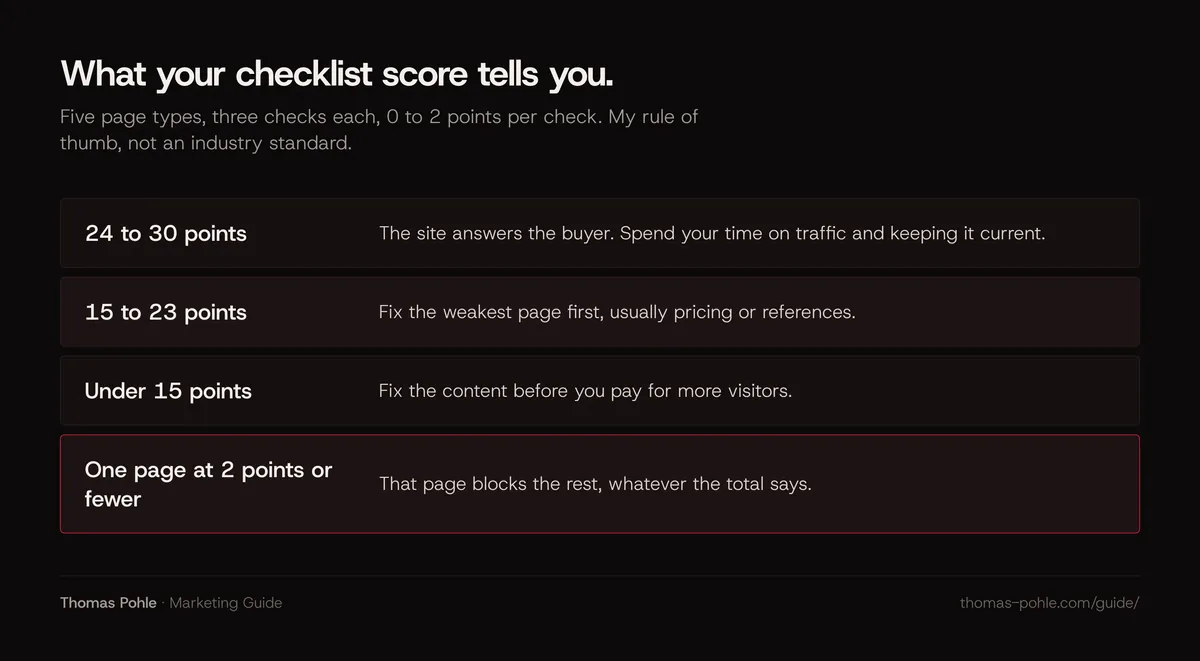
A typical scenario: an engineering services firm scores 2 on its start page, 4 on its service page, 0 on pricing, 3 on references and 3 on contact. Total 12. A redesign won't move that number. A pricing section with three scenario prices and two named case studies will, and both are a few weeks of content work.
What about design, the CMS and technical SEO?
Design and the CMS serve the content. Pick a CMS your team can update without a developer, because pricing, references and team pages change several times a year. A site that needs an agency ticket for a new case study stays out of date, and outdated proof is weak proof.
For B2B web design, three points are enough to brief a designer: readable on a phone, fast, and every page answering one question. The technical side has its own guides, so I won't repeat them here:
- Crawling, indexing, Core Web Vitals, hreflang. The technical SEO checklist.
- Structured data for company, people and articles. The guide to schema markup for B2B.
- Getting quoted by AI assistants. How to optimize your website for AI search.
What to do this week
You can score your own site this week in about two hours, with a spreadsheet and one colleague from sales. The goal is a total score, the one page that blocks the rest, and a list of the content you need to write. Work through these steps in order:
- Ask sales for the five questions buyers ask most often in the first call.
- Check for each question whether your site answers it, and on which page.
- Score the five page types with the checklist above and add up the total.
- Write down what drives your price and draft two or three scenario prices.
- List the customers you could ask for a named case study and send the first request.
- Rewrite the contact page so it says who replies, how fast and what the first call is for.
- Compare your service page with your current sales deck and remove every contradiction.
A website rarely loses deals in a way you can see. It loses them before the first call, on a shortlist you never knew existed. If you want a second pair of eyes on the score and the order of fixes, a one-day Momentum Workshop is a good place to start.
Frequently asked questions
How many pages does a B2B website need?
Fewer than most companies think. A start page, one page per service, a pricing section, a references page with case studies, an about page with the people, and a contact page cover the buyer's questions. Add guides or articles once those basics answer the five questions well. More pages with thin content make the important answers harder to find.
What if we can't publish prices because every project is custom?
Publish the price logic instead of a price list: what drives the cost, then two or three typical scenarios with their price or a range. Nielsen Norman Group recommended representative cases for exactly this situation. The buyer can see whether you fit the budget, and you still quote the real project after the first conversation.
Which CMS is best for a B2B website?
The one your marketing team can update on its own. Pricing, case studies and team pages change several times a year, and a site that needs a developer for each change falls behind. Check three things before you choose: editing without code, clean HTML output for search engines, and the ability to add structured data.
Should a B2B website gate its content behind forms?
Gate as little as possible. Nielsen Norman Group found that users are very reluctant to register and recommended moving more information outside the barrier. Buyers are still deciding whether you belong on the shortlist, so hidden answers usually cost you more than the email addresses are worth. Keep the decision information open.
How often should we review our B2B website?
Score it once a quarter with the checklist and update proof and prices whenever they change. Compare it with the current sales deck at the same time, because Gartner found that 69 percent of buyers saw inconsistencies between supplier websites and what sellers told them. A quarterly check keeps both stories the same.
Sources
- 6sense via Business Wire: The Timeline for Influencing B2B Buyers Is Shrinking, 2025 Buyer Experience Report (November 2025)
- Gartner: Sales Survey Finds 67% of B2B Buyers Prefer a Rep-Free Experience (March 2026)
- Gartner: Sales Survey Finds 61% of B2B Buyers Prefer a Rep-Free Buying Experience (June 2025)
- HG Insights: TrustRadius 2026 B2B Buying Disconnect Report (July 2026)
- Nielsen Norman Group: B2B Usability (Jakob Nielsen, 2006)
- Nielsen Norman Group: Show Prices for Common Scenarios (Jakob Nielsen, 2006)
- Digitale-Dienste-Gesetz (DDG) § 5 Allgemeine Informationspflichten
- Bundesgesetz gegen den unlauteren Wettbewerb (UWG, SR 241), Art. 3

Thomas PohleB2B marketing advisor in Zurich. More than ten years in B2B marketing at Link11, Beekeeper and smino, most recently as Head of Marketing. CEO and co-founder of TEISENDA. Researched and drafted with AI tools, checked against the sources listed above. More about Thomas