How do you position your prices, and when does premium work?

Position your price relative to the alternatives your buyers actually compare: low, mid or premium. Premium works in B2B only when you can prove the result, take risk off the buyer, back it with service and keep a sales team that holds the price. Discounts break that position faster than any competitor, because every one teaches buyers to wait.
This guide is for founders, CEOs and marketing leads who set prices or watch sales give them away. The bigger picture of positioning sits in the guide on positioning for B2B companies, and the classic strategies, including cost leadership, are in positioning strategies. Here you get the price side: the three positions, the price-quality matrix, what premium demands, the margin math behind discounts, approval thresholds and how to raise prices.
What is price positioning?
Price positioning is the decision where your price sits compared with the alternatives a buyer weighs: below them, level with them or above them. It's a promise about value. A low price says "good enough for less". A mid price says "safe choice". A premium price says "worth more, and we can prove it". The price has to match everything else the buyer sees.
The reference point is the buyer's shortlist. That's often a competitor, but in B2B it's just as often an internal team, a spreadsheet or doing nothing. If you don't know what buyers compare you with, your price position is a guess. The positioning map helps you see where you stand on the axes buyers care about.
| Position | What the buyer believes | What you need | Where it breaks |
|---|---|---|---|
| Low | Good enough, and cheaper | A lower cost base than rivals | A bigger rival undercuts you |
| Mid | The safe, normal choice | Clear reasons to pick you within the pack | Every deal turns into a price fight |
| Premium | Worth more, with less risk | Proof, risk reduction, service, price discipline | Discounts and proof you can't show |
What does the price-quality matrix show?
The price-quality matrix sets three price levels against three quality levels and gives nine strategies. It's usually credited to Philip Kotler and his textbook Marketing Management. The diagonal from premium to economy is consistent. Cells where quality beats price are value strategies. Cells where price beats quality are overpricing, and buyers punish them once they notice.
The labels vary between editions and the many summaries online, so treat them as a vocabulary. Mindtools, for example, describes the three overpriced cells as unsustainable. In a common version, the high-quality row reads premium, high value and superb value. The medium row reads overcharging, medium value (Toolshero calls it average) and good value. The low row reads rip-off, false economy and economy.
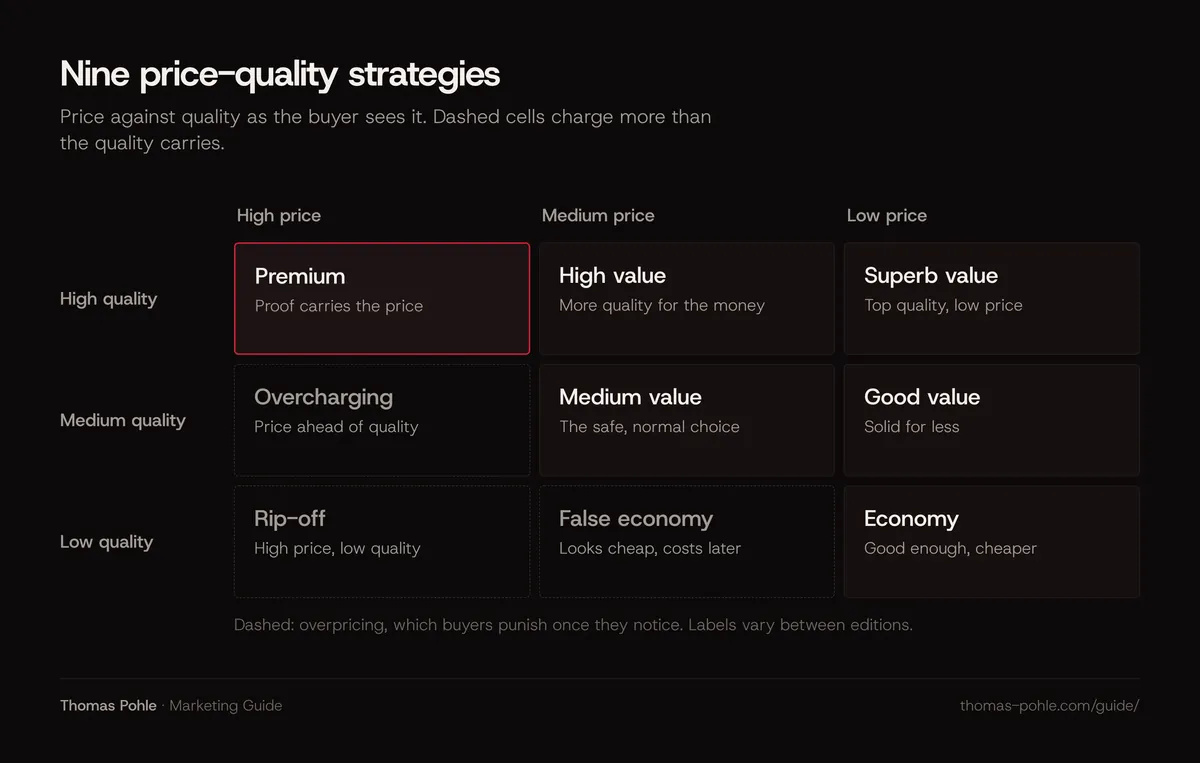
For B2B the useful question is about perception. Who decides what counts as quality? The buyer does, with what they can see before signing. A product that's better but looks the same to the buying group lands in the overcharging cell, whatever your engineers think.
When does a premium position work in B2B?
A premium position works in B2B when four things are in place: proof the buyer can check, less risk for the buyer than with the alternatives, service that shows up after the contract, and a sales team that holds the price. Missing one of them, the premium turns into a gap that buyers close with a discount request.
- Proof. Case studies with numbers, named references, test results. Proof from other people beats any claim you make about yourself. The guide on B2B differentiation goes deeper on building it.
- Risk reduction. Pilots, clear implementation plans, guarantees you can afford. Bain's B2B Elements of Value research (Almquist, Cleghorn and Sherer, Harvard Business Review, 2018) notes that whether a product can enhance the buyer's reputation or reduce anxiety plays a large role in B2B purchases.
- Service. Faster answers, a named contact, onboarding that works. Premium buyers pay for the year after the signature.
- A sales team that holds price. Salespeople who can explain value, have the authority to say no and aren't paid only on volume.
Premium also means fewer buyers. That's the trade. My own plan works this way: as TEISENDA grows, my advisory narrows to high-priced work with few hours. The price model belongs to the position as well. I bill per project, per hour or as a monthly retainer, and each model tells the buyer something different about what they're paying for.
Why do discounts destroy a premium position faster than competitors?
Discounts destroy a premium position from the inside because they cut profit far more than they lift volume, and they teach buyers that the list price is a starting offer. A McKinsey Quarterly analysis of the average income statement of an S&P 1500 company found that a 1 percent price rise at stable volume would lift operating profit by 8 percent.
The same lever works in reverse. Marn, Roegner and Zawada wrote in "The power of pricing" (McKinsey Quarterly, 2003) that a 1 percent price cut brings operating profit down by the same 8 percent, and that volumes would have to rise by 18.7 percent just to offset the profit impact of a 5 percent price cut. They call demand that sensitive to price cuts extremely rare.
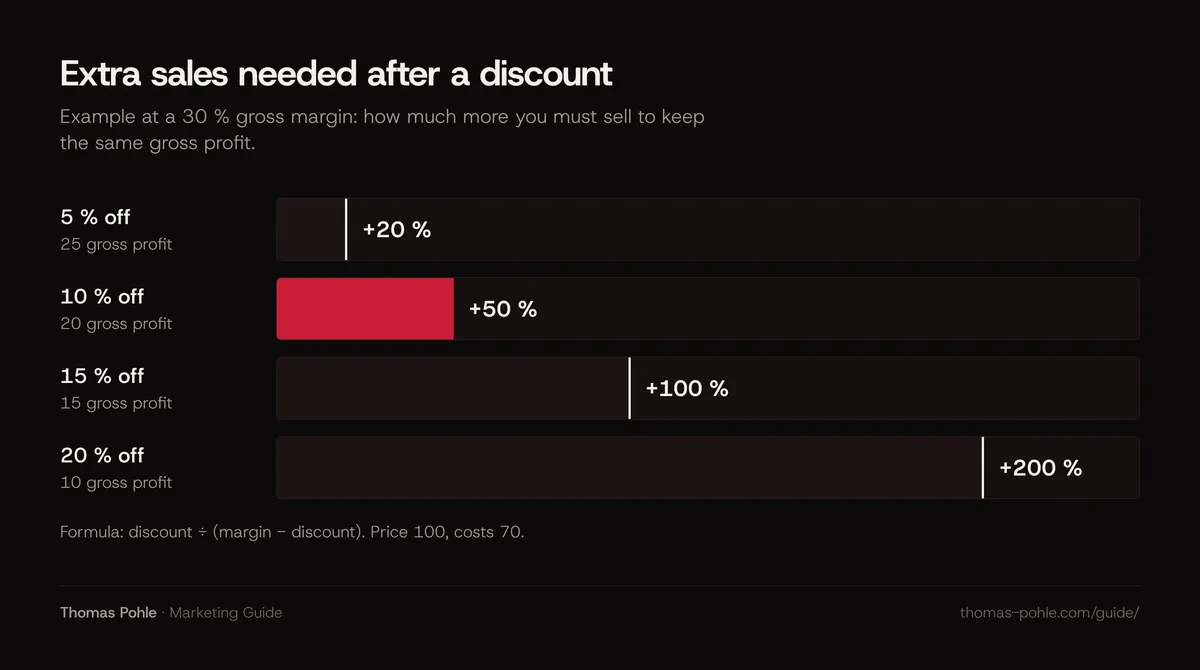
A worked example, labelled as an example. You sell a service at 100 with a gross margin of 30 percent, so each sale leaves 30 in gross profit. Give 10 percent off and the price drops to 90 while costs stay at 70. Gross profit per sale falls to 20. To earn the same 30 in total you now need 1.5 sales for every one before: 50 percent more volume. The formula is discount divided by margin minus discount.
| Discount | Gross profit per sale | Extra volume needed |
|---|---|---|
| 5 % | 25 instead of 30 | +20 % |
| 10 % | 20 instead of 30 | +50 % |
| 15 % | 15 instead of 30 | +100 % |
| 20 % | 10 instead of 30 | +200 % |
The second damage is slower. Most discounts never appear in the list price. McKinsey describes a lighting supplier whose on-invoice discounts pushed average invoice prices 32.8 percent below list, and whose pocket price, after off-invoice items such as cash discounts, rebates and freight, was about half the list price. Marn and Rosiello described this as the pocket price waterfall in Harvard Business Review in 1992. In my view, buyers who learn the waterfall come back for it every year.
Which discount rules and approval thresholds should you set?
Set discount rules before the next negotiation starts. Every discount needs a give in return, a written reason in the CRM and an approval level that rises with its size. Above a hard ceiling, change the scope instead of the price. That keeps the list price credible and makes every discount visible to the person who carries the margin.
The thresholds below are my rule of thumb for a company with about 30 percent gross margin. Adjust them to your own margin with the formula above. At 30 percent, each step at least doubles the extra volume you'd need.
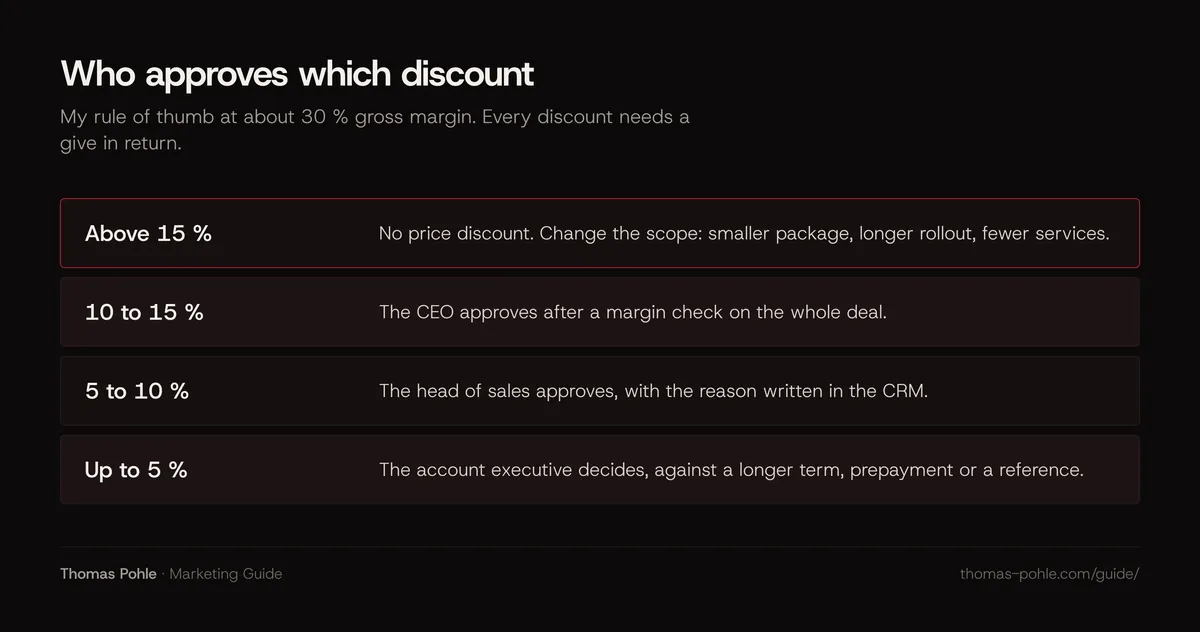
- Up to 5 percent. The account executive decides, but only against a give: a longer term, prepayment, a reference call, a case study or a larger scope.
- 5 to 10 percent. The head of sales approves, with the reason written in the CRM.
- 10 to 15 percent. The CEO approves after a margin check on the whole deal.
- Above 15 percent. No price discount. Offer a smaller package, a longer rollout or fewer services instead.
- Never. Unconditional end-of-quarter discounts. They train buyers to wait for the last week.
Pay sales on gross profit or realized price as well as on volume. If a salesperson earns the same commission at 15 percent off, the rules are decoration. A note on law: agreements on prices with competitors or resellers are a competition-law question. Ask a lawyer before you act; this guide isn't legal advice.
How do you raise prices without losing your best customers?
Raise prices with the same math in reverse: at 30 percent gross margin, a 5 percent increase keeps gross profit level even if you lose up to 14.3 percent of volume. Start with new customers, give existing customers notice and a reason, tie the increase to value they've seen, and train sales to hold the line before the first letter goes out.
The break-even loss is the price increase divided by margin plus increase. At 30 percent margin, a 3 percent increase tolerates about 9.1 percent less volume, a 5 percent increase 14.3 percent, a 10 percent increase 25 percent. That's arithmetic, labelled as an example. In my view, most B2B companies lose far less than that after a well-prepared increase, which is why it usually pays.
- New customers first. Change the list price for new deals. That tests the market without touching existing contracts.
- Segment existing customers. Those on old, heavily discounted contracts move first. The best-fit customers get the most notice and the clearest reason.
- Give notice in writing. State the date, the new price and what they got in the past year. Check your contracts for notice periods.
- Prepare sales. A one-page script with the reason, the answer to "can we keep the old price", and who approves exceptions.
- Measure. Track churn, downgrades and win rate by segment for six months.
How do you check whether your price position holds?
Check your price position with four numbers each quarter: the average realized price as a share of list, the share of deals closed with a discount, the win rate in your best-fit segment and the deals lost with price as the stated reason. If realized price slides while win rate stays flat, sales is buying deals the product would have won anyway.
Look at the spread, too. McKinsey found pocket prices at the lighting supplier ranging from under 30 percent to 90 percent or more of list, with many small customers getting bigger discounts than their size justified. Sort your own deals by realized price. Start with the bottom fifth: that's where you see who works your waterfall.
Before you move the whole price list, test a new price position with 20 to 30 named accounts over one quarter, with the new price and the new proof in the first call. If buyers repeat the value story back to you and the win rate holds, roll it out. If you want help setting the position and the rules with your leadership, a one-day Momentum Workshop is where I'd start.
What to do this week
You can check your price position this week with your CRM export and one meeting. The goal: know your realized price, know who gives discounts, and have rules on paper before the next big negotiation. These steps get you there, in this order:
- Export the deals of the past twelve months with list price, final price and discount reason.
- Calculate the average realized price as a share of list, by salesperson and by segment.
- Run the discount formula with your own gross margin for 5, 10 and 15 percent.
- Write down the alternatives buyers compared you with in the last ten deals you won and lost.
- Draft the four approval levels and the list of gives sales may ask for.
- Check how sales commission treats discounted deals.
- Pick 20 to 30 accounts for a price test next quarter.
Price is the part of positioning buyers feel most directly. Keep the list price honest, make discounts rare and visible, and review the numbers every quarter. The position you hold on paper only counts if it holds in the last week of the quarter too.
Frequently asked questions
What is the difference between price positioning and a pricing strategy?
Price positioning is where your price sits relative to the alternatives buyers compare: low, mid or premium. A pricing strategy covers how you get there and run it: the price model, list prices, discounts, increases and the rules sales follows. The position comes first. The strategy has to fit it, or buyers notice the mismatch.
Can a small B2B company charge premium prices?
Yes, if it can prove results, take risk off the buyer and serve customers well after the contract. Small companies often win on specialization and access to senior people, which buyers value. The trap is copying a premium price without the proof. Then buyers ask for discounts, and the position erodes within a few deals.
How much discount is too much?
It depends on your gross margin. Divide the discount by your margin minus the discount to see how much more you must sell. At 30 percent margin, 10 percent off needs 50 percent more volume, 15 percent off needs double. My rule of thumb: above that level, change the scope of the deal and keep the price.
How often should a B2B company raise its prices?
There is no fixed rule. Many companies review prices once a year, together with the budget, and adjust when costs, value delivered or the competitive set have changed. I would rather raise in small, regular steps with a clear reason than wait years and then ask for a large jump that forces customers to run a new tender.
Is the price-quality matrix from Kotler?
It is usually credited to Philip Kotler and his textbook Marketing Management, and later authors such as Peter Doyle extended it. The cell names differ between editions and summaries, for example medium value or average for the middle cell. Use it as a vocabulary for discussing where your price and your perceived quality sit.
Sources
- Michael V. Marn, Eric V. Roegner and Craig C. Zawada: The power of pricing, McKinsey Quarterly, 2003 Number 1
- Michael V. Marn and Robert L. Rosiello: Managing Price, Gaining Profit, Harvard Business Review, September to October 1992 (HBR Store)
- Eric Almquist, Jamie Cleghorn and Lori Sherer: The B2B Elements of Value, Harvard Business Review, March to April 2018 (Bain & Company)
- Mindtools: Kotler's Pricing Strategies
- Toolshero: Kotler Pricing Strategies

Thomas PohleB2B marketing advisor in Zurich. More than ten years in B2B marketing at Link11, Beekeeper and smino, most recently as Head of Marketing. CEO and co-founder of TEISENDA. Researched and drafted with AI tools, checked against the sources listed above. More about Thomas