How do you differentiate in a B2B market where everyone sounds the same?

When features are interchangeable, B2B companies differentiate through what buyers can check: proof from customers, a specialization in one industry or problem, and a way of working competitors won't copy. Start with a logo swap test on your own homepage. Cut every sentence a competitor could sign and replace it with one claim a buyer can verify.
This guide is for founders and marketing leads in markets where three or four suppliers offer nearly the same product. The pillar on how a B2B company finds its positioning covers the strategic choice. This one covers the problem that comes after it: the choice is made, and your website still reads like everyone else's.
Why do B2B companies all sound the same?
B2B companies sound the same because they all describe business value: efficiency, quality, good service. Every competitor can promise that too, and buyers know it. A 2013 report by CEB with Google cites an earlier CEB survey of 9,000 customers: only 14 % saw a real difference between suppliers and valued it enough to pay for it.
The report, From Promotion to Emotion, rests on its own survey of 3,000 B2B buyers across 36 brands in seven categories. Its authors call business value table stakes: it gets a supplier onto the shortlist, and doesn't make it stand out there. They also found that personal value, such as confidence or fitting in with colleagues, had about twice the impact of business value across 14 commercial outcomes. The surveys date from 2009 and 2013 and Google was a research partner, so treat the numbers as a signal.
Three forces make the sameness worse, in my view:
- Features travel fast. What you launch this year sits on a competitor's roadmap next year. A claim built on a feature expires with it.
- Everyone copies the leader. Teams study the category leader's homepage and borrow its words. After a few years the whole category shares one vocabulary.
- Drafts start from the average. Copy assembled from competitor pages lands in the middle of the category, whether a person or an AI tool assembles it. Writing it yourself, from your own customer calls, is still the best way out. If you draft with AI, feed it your own interview notes and your own judgment.
Is differentiation still worth it, or is distinctiveness enough?
Both matter, for different jobs. Distinctiveness makes buyers recognize and remember you: a name, a color, a phrase you repeat for years. Differentiation gives the buying group a reason to pick you that survives an internal meeting. Research from the Ehrenberg-Bass Institute suggests the first is underrated. My view: B2B buying groups still need the second.
The evidence: Jenni Romaniuk, Byron Sharp and Andrew Ehrenberg published data in the Australasian Marketing Journal in 2007, spanning many categories and two countries, that showed a low level of perceived differentiation between competing brands. Customers kept buying those brands anyway. The authors proposed putting distinctiveness at the center of brand strategy. The Ehrenberg-Bass report How B2B Brands Grow (2023, with the LinkedIn B2B Institute) carries the same thinking into B2B: buyers choose brands that are easy to mind and easy to find.
Two cautions before you drop differentiation. The 2007 paper measured how customers perceive brands across many categories; it doesn't study how a six-person buying group decides on a three-year contract. And the authors never call differentiation worthless. They argue it plays a more limited role than the textbooks assume. I read the research as a division of labor:
| Concept | What it does | What buyers do with it | Example |
|---|---|---|---|
| Distinctiveness | Makes you recognizable | Notice and remember you | One name, one color, one recurring phrase |
| Differentiation | Gives a reason to choose | Argue for you internally | A reference from their industry, a guarantee |
| Positioning | Decides where you compete | Put you on the right shortlist | A named customer group and its alternatives |
Positioning decides which buyers you serve and which alternatives you beat. A positioning map shows where you stand against those alternatives. Differentiation is the evidence that makes the position believable.
How do you test whether you sound like everyone else?
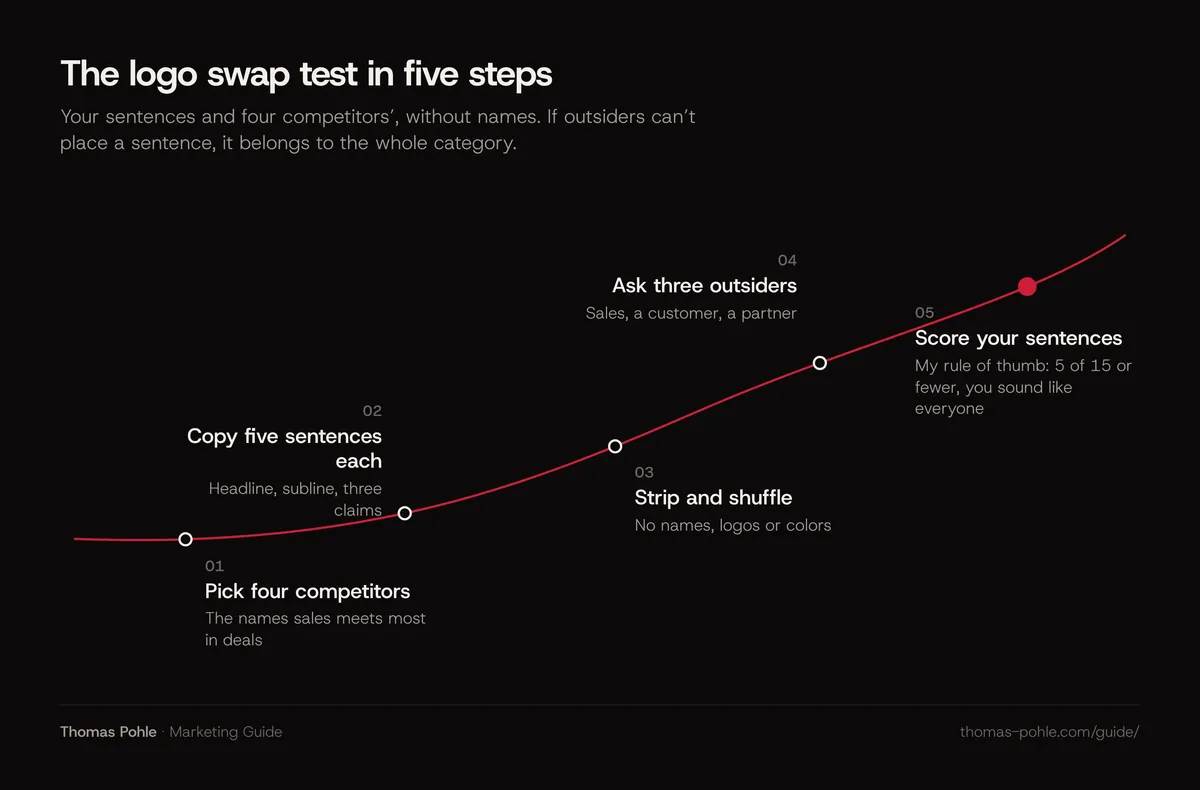
Run a logo swap test. Copy five sentences from your homepage and from four competitors, remove every name and logo, and ask three people outside your marketing team to match each sentence to its company. A sentence nobody can place belongs to the whole category. It does nothing for you.
- Pick the competitors. Take the four names your sales team meets most often in deals, from the CRM or from lost-deal notes.
- Copy five sentences each. Headline, subline and the first three claims. That gives you 25 sentences.
- Strip and shuffle. Remove company names, product names, logos and colors. Mix the sentences on one sheet.
- Ask three outsiders. People who know the market and don't write your copy: a salesperson, a customer you trust, a partner.
- Score your five sentences. One point for each person who places a sentence correctly. The maximum is 15.
My rule of thumb for reading the score: 11 to 15 points, buyers can tell you apart. 6 to 10, one or two sentences carry you and the rest is category noise. 5 or fewer, you sound like everyone. These thresholds are my own working guide. No study backs them.
For a single sentence there's a faster version. Ask whether your strongest competitor could publish it unchanged and it would still be true. If yes, it isn't a differentiator.
How do you differentiate through proof?
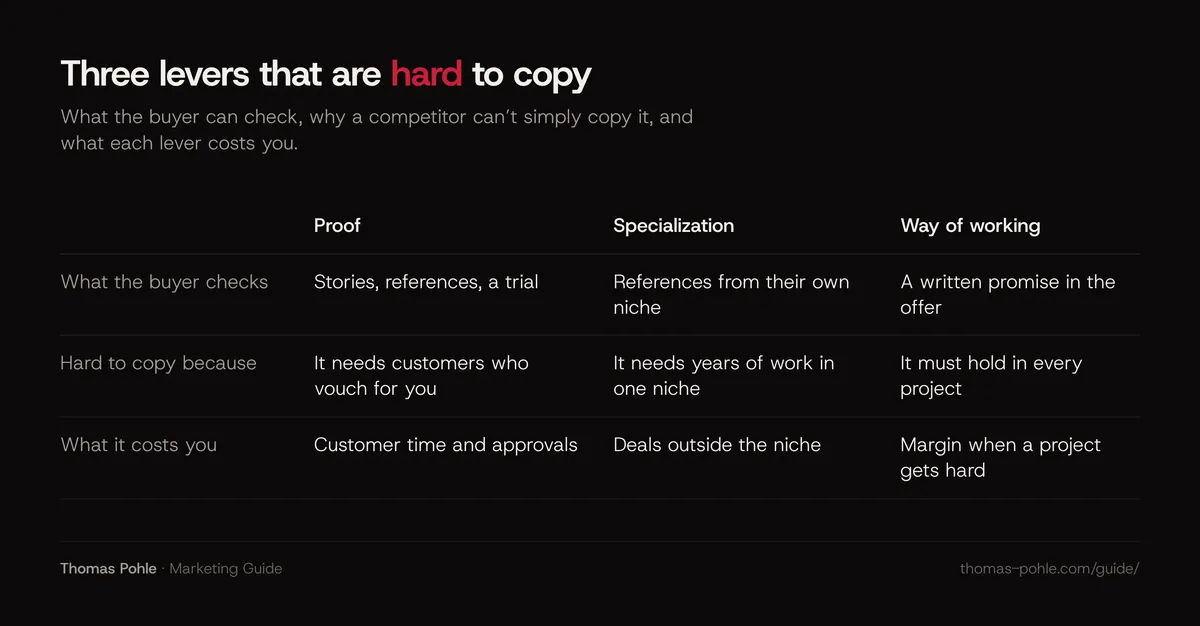
Proof differentiates when competitors make the same promise and only you can show it. Replace adjectives with things a buyer can check: a named customer in their industry, a number with its date and method, a reference call, a trial on their own data. Two suppliers can both claim to be reliable. Only one can show who relies on them.
Proof has a ladder. The lower rungs are cheap to copy. The upper rungs take customer time and approval, which is why competitors can't fake them.
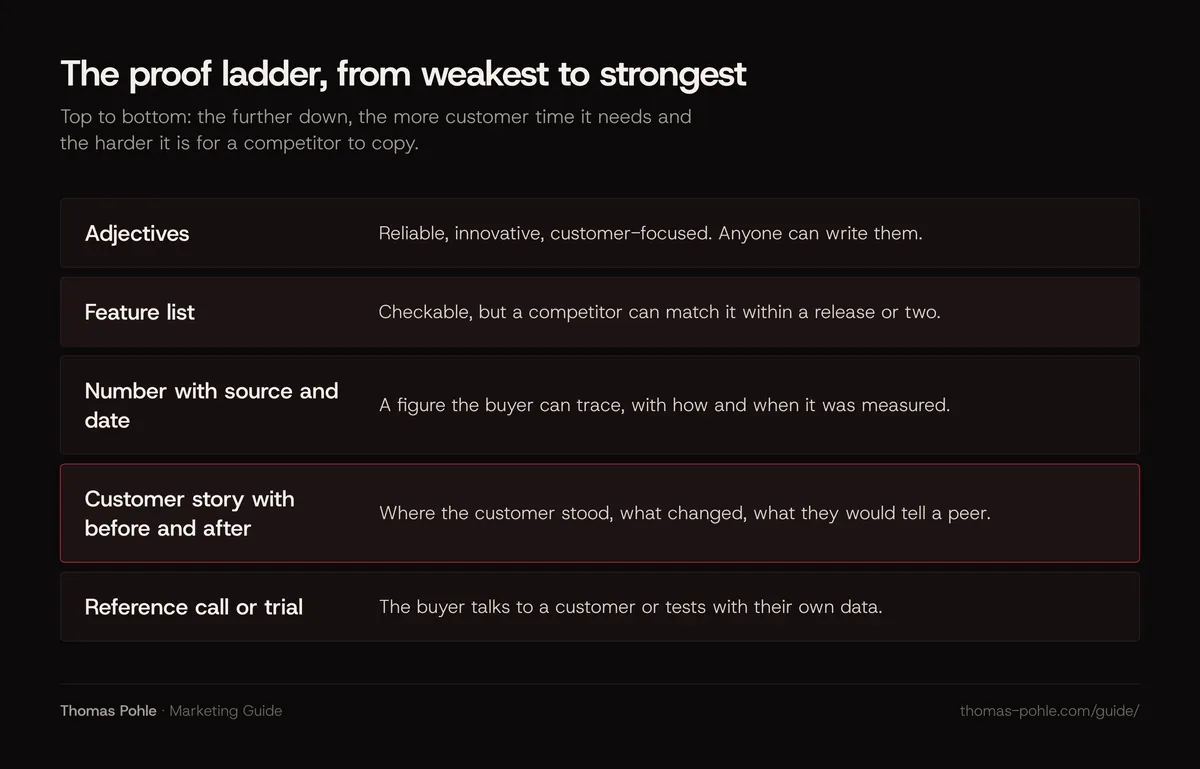
A customer story only works when it tells a story. My rule for testimonials: ask the customer where they stood before, what concretely changed and what they'd tell another business owner. Those three answers give the next buyer a situation to recognize. Praise alone gives them nothing to check.
Weak proof can also cost you. I removed the logo strip from my own homepage: I had no client approval to show the names, a strip mixing employers and clients confused readers, and small unknown logos weakened the page more than they helped. Three strong, approved pieces of proof beat a wall of logos.
Proof also has to be true in the legal sense. In Germany, section 5 of the Act against Unfair Competition (UWG) treats untrue statements about the essential features or benefits of a service as misleading. A claim like “the only” or “number one” needs evidence on file before it goes live. This is general information, not legal advice; the guide to the USP covers the Swiss side as well.
How do you differentiate through specialization?
Specialization makes a common strength unique for one group. Pick an industry, a problem or a technical environment, and become the obvious choice there. A generalist competes with everyone on the same claims. A specialist competes with fewer suppliers, and its references, language and examples match the buyer's world from the first sentence.
- By industry. Maintenance software for packaging machine builders instead of maintenance software for manufacturing.
- By problem. The audit deadline, the migration off a legacy system, the first hire in a new country. Buyers search for the problem long before they search for a supplier.
- By environment. Companies running a particular ERP system, or companies with strict data residency rules. The environment does the filtering for you.
Specialization costs something: you turn away deals outside the niche, and some months that hurts. What the specialist strategy demands you give up is covered in the guide to positioning strategies. My test before committing: can you name 20 to 30 target accounts in the niche by company name, and do you have at least one customer there who would take a reference call? If you can't name 20, the niche is too vague or too small.
How do you differentiate through your way of working?
When products and proof look alike, the way you work can decide the deal: who does the work, how fast, how you price, what you guarantee and how a project starts. It only counts when the buyer can see it before signing. Write it down as a concrete promise with a number, a step or a condition.
- Who does the work. The senior person who sells the project also delivers it.
- Speed. A first working version within a fixed number of days, written into the offer.
- Pricing. A fixed price per phase instead of open hourly billing.
- Risk. A short paid pilot with a clear exit point before the large contract.
- Start. A one-day session that ends with a decision, before anyone signs a retainer.
My test for a way of working: would you lose the customer if you broke the promise? If nothing would happen, it's a slogan. And it has to hold in every project, including the difficult ones, because buyers check it in reference calls. Keeping it costs you margin when a project gets hard, and that cost makes it believable.
Which lever fits your company?
Pick the lever that matches what you already have. Proof fits when customers are happy and nobody tells their story. Specialization fits when your wins cluster in one industry or problem. Way of working fits when your product equals the competition and the experience of working with you does not. Most companies start with one lever and add a second later.
| Your situation | Start with | First step | Watch out |
|---|---|---|---|
| Product equals competitors, customers are happy | Proof | Ask three customers for a before and after story | Approvals take weeks |
| Wins cluster in one industry or problem | Specialization | List 20 to 30 target accounts in that niche | You turn deals away |
| Product and references alike, service differs | Way of working | Write down three promises you already keep | Must hold in every project |
| Good offer, but nobody remembers the name | Distinctiveness | Fix one name, one color, one phrase | Needs years of repetition |
What does a rewrite look like in practice?
A rewrite replaces every category sentence with a sentence only you can sign. Each new sentence draws on one lever: a niche that filters, a promise that binds you, a proof the buyer can check. The example below is a constructed scenario. The company and its numbers are invented to show the method.
A typical scenario: a provider of maintenance software opens its homepage with “Innovative software solutions for efficient maintenance. Reliable, flexible, customer-focused.” In a logo swap test nobody places it, because four competitors say the same.
The rewrite: “Maintenance planning for packaging machine builders. Live in 60 days, with a fixed price per phase. Ask our customers in the packaging industry.” The first sentence is specialization, the second is way of working, the third is proof. Each can be checked, and a generalist can't copy any of them without changing its business.
Write the new sentences yourself, from what customers said in calls. Their words are more specific than anything a workshop invents.
What to do this week
You can find out this week how interchangeable you sound and pick your first lever. You end with a scored list of your sentences, one chosen lever and one rewritten headline to test with sales.
- Copy five sentences from your homepage and from the four competitors you meet most often.
- Run the logo swap test with three people outside your marketing team and score your sentences.
- Mark every sentence a competitor could publish unchanged.
- Ask three happy customers where they stood before, what changed and what they'd tell a peer.
- List the industries and problems of your last 20 wins and look for a cluster.
- Write down three promises about how you work that you already keep in every project.
- Pick one lever from the decision table and rewrite your homepage headline with it.
Differentiation is rarely one big idea. It's a set of small, checkable sentences that a buyer can repeat in a meeting you're not invited to. If you want to work out your lever and your proof with the leadership team in one room, that's a typical topic for a one-day Momentum Workshop.
Frequently asked questions
What is the difference between differentiation and positioning?
Positioning is the choice of which customers you serve and which alternatives you compete against. Differentiation is the evidence that makes that choice believable: proof, a specialization and a way of working the buyer can check. You can have a clear position and still sound like everyone if your website only uses category words. Positioning comes first, differentiation makes it visible.
Can a small B2B company differentiate on price?
It can, but price is the easiest lever to copy and the hardest to defend, because a larger competitor can always undercut you for a few quarters. For a small company I'd rather use the pricing model as a way of working, such as a fixed price per phase, than the price level itself. A model shows how you work. A low price only shows that you're cheaper today.
Is B2B differentiation about emotion or about facts?
Both. The CEB study with Google from 2013 found that personal value, such as confidence and fitting in with colleagues, had about twice the impact of business value on outcomes like purchase and premium payment. Facts still matter, because the buying group must justify the decision. My take: use facts as proof and make the buyer look good for choosing you.
What if a competitor copies our differentiation?
Then it was probably a claim rather than a difference. Features and adjectives are copied quickly. Customer stories with approval, references in a niche and promises you keep in every project are much harder to copy, because they need years of work and customers who vouch for you. If a competitor copies your words, add proof they can't produce.
Sources
- Think with Google: From Promotion to Emotion. Connecting B2B Customers to Brands (CEB Marketing Leadership Council, Google and Motista, 2013)
- CEB Marketing Leadership Council with Google and Motista: From Promotion to Emotion, full whitepaper (2013, third-party copy)
- Romaniuk, Sharp and Ehrenberg: Evidence concerning the Importance of Perceived Brand Differentiation, Australasian Marketing Journal 15(2), 2007
- Ehrenberg-Bass Institute with the LinkedIn B2B Institute: How B2B Brands Grow (November 2023)
- Gesetz gegen den unlauteren Wettbewerb (UWG), § 5 Irreführende geschäftliche Handlungen

Thomas PohleB2B marketing advisor in Zurich. More than ten years in B2B marketing at Link11, Beekeeper and smino, most recently as Head of Marketing. CEO and co-founder of TEISENDA. Researched and drafted with AI tools, checked against the sources listed above. More about Thomas