What is a USP, and does your B2B company have one?
A USP, or unique selling proposition, is the one benefit you offer that competitors can't or don't, and that is strong enough to win buyers. In B2B marketing it only counts when buyers name it without prompting, can verify it and would pay for it. Many B2B firms have a strength. Fewer have a USP.
This page is for founders and marketing leads who have a sentence on their website that starts with "the only" or "the leading", and a quiet doubt whether buyers care. It defines the term and gives you a five-part test: do buyers reward your USP, or does it only make the team proud?
What does USP mean in marketing?
USP stands for unique selling proposition, in German Alleinstellungsmerkmal. Advertising executive Rosser Reeves defined it in his 1961 book Reality in Advertising with three requirements: a concrete benefit promised to the buyer, a benefit competitors can't or don't offer, and a promise strong enough to pull new customers over.
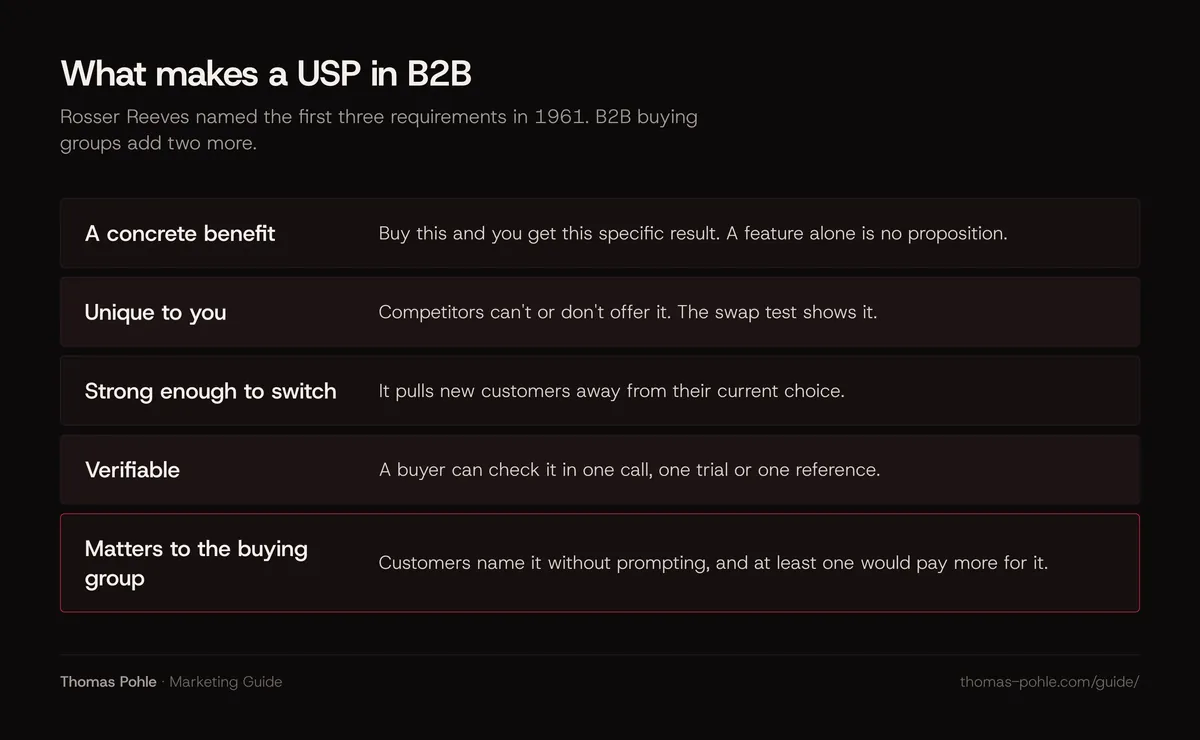
Reeves wrote for mass consumer advertising. In my view, B2B adds two checks his definition doesn't need. Buyers have to be able to verify the claim, because a buying group asks for proof. And the benefit has to matter to the people who decide, which in B2B are several, with different concerns.
How is a USP different from positioning and a value proposition?
Positioning is the overall choice of which customers you serve, which alternatives you beat and why. A value proposition describes the value a customer gets from your offer. A USP is narrower: the single part of that value nobody else delivers. Every company has a positioning and a value proposition. Not every company has a USP.
| Term | Answers | Every company has one? |
|---|---|---|
| Positioning | Whom do we serve, against which alternatives, why do we win? | Yes, chosen or by accident |
| Value proposition | What does the customer get from us? | Yes |
| USP | What do we offer that nobody else does, and buyers want? | No |
| Claim or tagline | How do we say it in a few words? | Usually |
A USP sits inside a positioning. Find the positioning first, as described in the guide on what positioning is and how a B2B company finds its own. The USP is then what April Dunford, in her book Obviously Awesome, calls a unique attribute: something you have that the alternatives lack.
Does a B2B company really need a USP?
A B2B company needs a reason to be chosen, and that reason doesn't have to be unique in Reeves' strict sense. Research suggests buyers see few real differences between suppliers. A clear choice of customer, strong proof and being easy to remember often win more deals than a claimed uniqueness that buyers don't believe.
A 2013 report by CEB (now part of Gartner) with Google and Motista, built on a survey of 3,000 B2B buyers, cites an earlier CEB survey of 9,000 customers: only 14 % saw a real difference between suppliers and valued it enough to pay for it. The 2013 survey itself found personal value, such as confidence or career advancement, had twice the impact of business value on outcomes like purchase and premium payment.
Researchers at the Ehrenberg-Bass Institute go further. In their view brands compete less through meaningful differentiation and more through distinctiveness, such as logos and colors that make a brand easy to recognize and bring to mind.
My take: hunt for a USP, but don't fake one. A real one is worth a lot, because it shortens every sales conversation. A fake one costs you. Buyers stop believing the rest of the page too.
How do you test whether your USP counts for customers?
A USP counts when customers name it without prompting, when your strongest competitor can't honestly say the same sentence, when a buyer can check it in one call or trial, when it shows up in your won deals and when at least one buyer would pay more for it. Five checks test this with data you already have.
The pass marks are my suggested thresholds for a B2B company with 10 to 50 customers. They aren't research benchmarks.
| Check | How to run it | Pass mark |
|---|---|---|
| Unprompted | Ask 5 customers why they chose you, without suggesting answers | At least 3 name it in substance |
| Swap | Put your strongest competitor's name in front of the sentence | The sentence becomes false |
| Proof | Find what a buyer could check: a demo, a reference, a number | Checkable in one call or one trial |
| Deal | Read the win notes of your last 10 deals | It appears in at least 3 |
| Price | Ask 3 customers whether they'd pay more for it | At least 1 says yes and says why |
Pass all five and you have a USP. Pass the first three and you have a strong point of difference: use it, and keep collecting proof. Fail the unprompted check and the claim is internal pride. Buyers haven't noticed it, however true it is.
What does a worked example look like?
In this hypothetical example, the company and all results are invented for illustration. A German software firm with 35 employees sells planning software to mid-sized construction companies. It tests three USP candidates with all five checks.
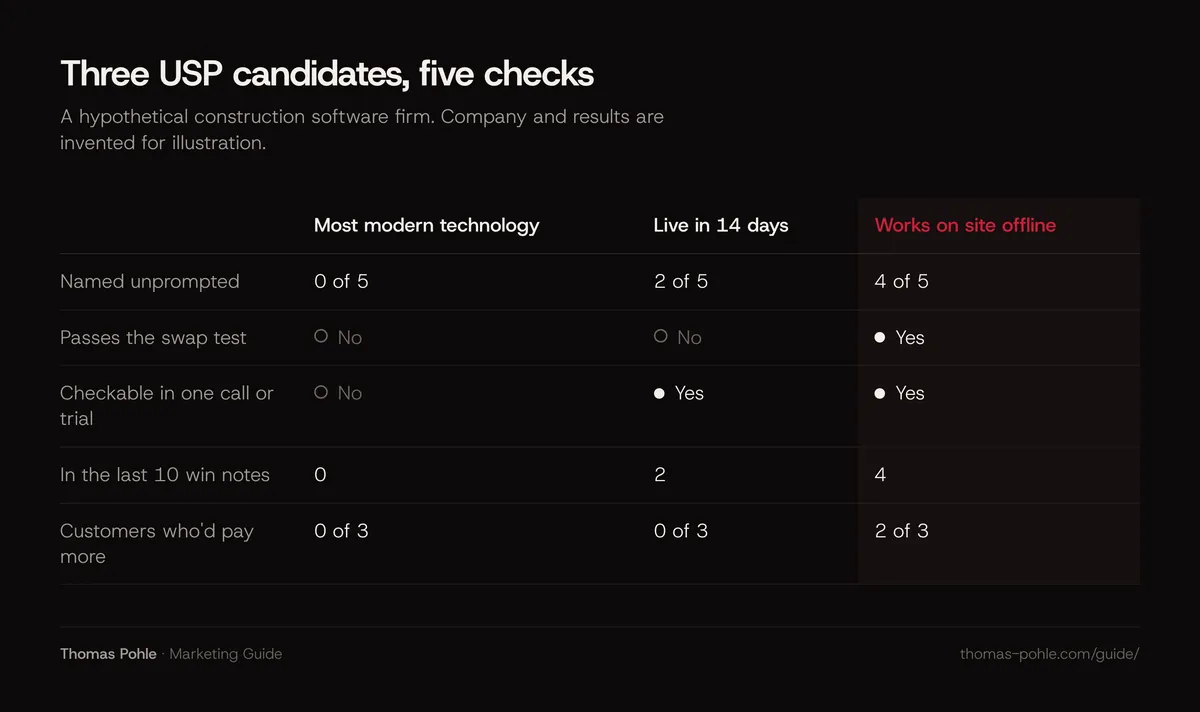
- "The most modern technology in the industry." No customer named it unprompted, every competitor claims the same, nobody can check it in a call and it shows up in no win note. Fails every check.
- "Live in 14 days." Two of five customers mentioned it, one competitor promises the same and it appears in two of ten win notes. A trial proves it. A real strength. Still not unique.
- "Works on site without a connection." Four of five named it, no competitor offers it, a trial shows it, it appears in four of the last ten win notes and two of three customers would pay more because it saves rework. Passes all five.
The team liked the first candidate best. Customers had already chosen the third. A positioning map built from buyer evidence is the next step when you want to see where that difference puts you among the alternatives.
What if your company has no USP?
In my view, most B2B companies don't have a USP in the strict sense, and that's workable. Narrow the target group until a strength becomes unique for that group, make an existing strength provable and let customers say it. Then repeat it consistently, so buyers remember you.
- Narrow the group. "Fast onboarding" is common. "Fast onboarding for dental laboratories" may be unique, if you're the only one built for them.
- Make it provable. A claim with a published reference or a free trial beats a better claim nobody can check.
- Let others say it. I think proof should come from other people. A customer quote that names your difference carries more weight than your own superlative.
For my own brand I took the route of one word repeated everywhere. My claim is "Momentum for B2B marketing", and I deliberately turn down labels like growth hacker or marketing AI expert. I wanted one promise tied to me as a person. How that becomes a memory is covered in the guide to defining brand positioning.
What can you legally claim as unique?
A uniqueness claim like "the only provider" or "number one" reads as a statement of fact, so it has to be true. In Germany, section 5 of the Act against Unfair Competition (UWG) bans misleading statements, including untrue claims about the essential features of goods or services. Switzerland's UWG, article 3, paragraph 1, letter b, also bans incorrect or misleading statements about your offer.
Keep the evidence for every superlative on file before it goes live: market data, date, comparison. This is general information, not legal advice. For a claim that names competitors or says "the only", ask a lawyer in your market.
What to do this week
You can test your USP this week with five customer calls and your last ten deal records. Write down your current claim, run the five checks, and decide whether it stays, gets narrowed or gets replaced by a strength buyers already name. The output is one sentence your team can prove.
- Write down the sentence you currently use as your USP.
- Run the swap test with your two strongest competitors.
- Ask five customers why they chose you, without hinting.
- Read the win notes of your last ten deals and count what comes up.
- Collect one checkable proof for the strongest candidate.
- Remove any superlative you can't document.
The test shows that your positioning itself is unclear? A one-day Momentum Workshop settles positioning, ideal customer and the first channel with your team.
Frequently asked questions
What is the difference between a USP and a value proposition?
A value proposition describes everything a customer gets from your offer, including benefits competitors also provide. A USP is the one part of that value nobody else offers and buyers want. Every company has a value proposition. Many have no USP.
What is a good USP example in B2B?
A good B2B USP is specific, checkable and tied to a buyer problem, such as software that works on a construction site without a connection when no rival does. Weak examples are "highest quality", "customer focus" or "innovative solutions", because every competitor can say them and no buyer can verify them.
Can a service company have a USP?
Yes, though it rarely sits in the service itself. Service firms usually find their USP in a defined customer group, a method with published results, a delivery model such as a fixed price or a guaranteed timeline, or the specific experience of the team. It has to pass the same checks: named by customers, checkable, rare among rivals.
How often should you review your USP?
Review it once a year and whenever a competitor launches something similar. A USP erodes when rivals copy it or the market stops caring. My rule of thumb: rerun the unprompted check with five customers every twelve months. If fewer than three name it, it is turning into a point of parity.
Sources
- Bob Bly: Reality in Advertising, on Rosser Reeves' three USP requirements
- CEB Marketing Leadership Council with Google and Motista: From Promotion to Emotion. Connecting B2B Customers to Brands (2013)
- Ehrenberg-Bass Institute: How B2B brands grow
- April Dunford: Positioning (homepage definition)
- April Dunford: Obviously Awesome, publisher page (Page Two)
- Gesetz gegen den unlauteren Wettbewerb (UWG), § 5 Irreführende geschäftliche Handlungen
- Bundesgesetz gegen den unlauteren Wettbewerb (UWG), SR 241, Art. 3
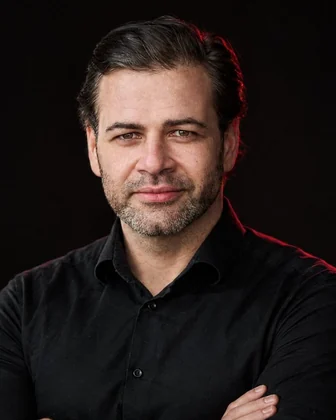
Thomas PohleB2B marketing advisor in Zurich. More than ten years in B2B marketing at Link11, Beekeeper and smino, most recently as Head of Marketing. CEO and co-founder of TEISENDA. Researched and drafted with AI tools, checked against the sources listed above. More about Thomas