What does brand positioning mean, and how do you define it?

Brand positioning is the part of your brand identity you actively communicate to show buyers why they should choose you over the alternatives. To define it, name the category buyers put you in, the points where you must match competitors, the one or two points where you differ, and the buying situations in which buyers should think of you.
This guide is for founders and marketing leads of B2B companies who have a logo, a website and a pitch, and still no shared answer to one question: what should the brand mean to buyers? It separates brand positioning from brand identity, shows the models that help in B2B, walks through the definition step by step and ends with a test you can run on your own statement.
Brand positioning builds on a business decision you make first: which customers you serve and which alternatives you beat. That decision is covered in the guide on what positioning is and how a B2B company finds its own. This article covers the next layer: the memory you want that decision to leave.
What is brand positioning?
Brand positioning is the deliberate choice of what buyers should associate with your brand compared with the alternatives, plus the part of your identity you put forward to build that association. David Aaker describes brand position as the part of the brand identity that is to be actively communicated. Positioning is selective by design.
Kevin Lane Keller, Brian Sternthal and Alice Tybout added a point that matters for B2B in their 2002 Harvard Business Review article. Positioning has traditionally focused on points of difference, the benefits that set a brand apart. Their argument: points of difference alone aren't enough. Managers also need to understand the frame of reference the brand competes in and the points of parity it shares with competitors.
Put plainly, a brand positioning answers four questions:
- Frame of reference. Which category do buyers put you in when they compare you?
- Points of parity. Where do you have to be as good as the alternatives to be considered at all?
- Points of difference. Which one or two things do buyers credit you with that the alternatives lack?
- Buying situations. In which moments should a buyer think of you first?
The fourth question comes from more recent research on memory, covered further down. All four answers fit on one page.
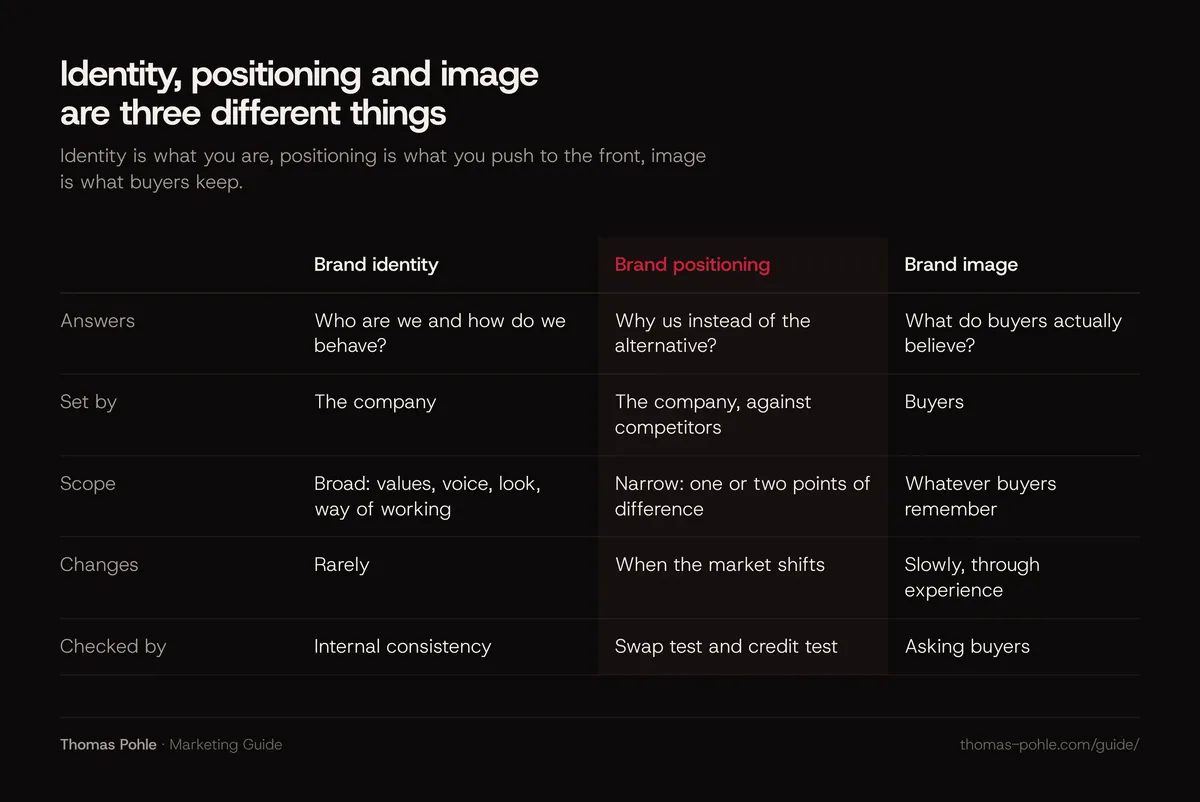
How is brand positioning different from brand identity?
Brand identity is everything a company wants its brand to stand for: values, personality, look, voice, way of working. Brand positioning is the slice of that identity you push to the front because it wins against alternatives. Aaker frames identity as the image strategists aspire to create or maintain. Image is what buyers actually hold in their heads.
The difference gets practical when two brands share values. When I built my personal brand, it overlapped with my TEISENDA co-founder's personal brand. Both sat close to the idea that clients should own their marketing. I resolved it by splitting the promises: ownership became hers, momentum became mine. Client control stayed part of my identity as the way I work. It's no longer what I promise.
That's the general pattern. A value can sit firmly in your identity and still make a poor positioning. Maybe someone near you claims it more strongly. Maybe buyers don't choose on it. Positioning picks what wins. Identity keeps everything else consistent in the background.
How does brand positioning relate to company positioning?
Company positioning decides the market: which customers, which alternatives, which reason to win. Brand positioning decides the memory: which category, which associations and which buying situations buyers connect with your name. The first comes from strategy. The second turns it into something buyers can recall months later, when they're back in the market.
In small B2B companies the same people often do both in the same meeting. That's fine. April Dunford's components of positioning, from competitive alternatives to market category, belong to the first decision. The order still matters. Write a brand promise before you know which alternatives you beat, and you end up with a word every competitor could use too. A positioning map built from buyer evidence bridges the two. It shows which differences buyers already credit you with.
The brand positioning then feeds the work described in the guide to B2B brand management: name, voice, visual identity and proof, kept consistent over years.
Which brand positioning models actually help in B2B?
Four models carry most of the practical weight in B2B: Keller's frame of reference with points of parity and difference, Geoffrey Moore's positioning statement, Jenni Romaniuk's category entry points and the Ehrenberg-Bass idea of distinctive brand assets. Each answers a different question. So pick the model by the question you need answered now.
| Model | Question it answers | Use it when |
|---|---|---|
| Frame, parity and difference (Keller, Sternthal, Tybout) | Against whom and on what do we compete? | Buyers struggle to place you or compare you with the wrong players |
| Positioning statement (Moore) | Can we say the decision in one paragraph? | Teams describe the company differently |
| Category entry points (Romaniuk) | In which situations should buyers think of us? | Buyers like you but do not remember you when the need comes up |
| Distinctive assets (Ehrenberg-Bass) | How do buyers recognize us at a glance? | Your ads and posts could come from any competitor |
My take: big brand frameworks such as pyramids, wheels and multi-layer houses suit consumer brand portfolios. Small B2B teams don't need them. They cost weeks and produce a document nobody opens. The four models above fit on one page together.
Category entry points deserve a closer look, because fewer people know them. In her 2022 report for the LinkedIn B2B Institute, Romaniuk defines them as the cues category buyers use to access their memories when faced with a buying situation. In data from 606 US business insurance customers, the bigger brand had more decision-makers linking six or more entry points to it than the smaller brands did. In 16 of the 17 insurance products analyzed, buyers who linked fewer entry points to their provider stated a significantly higher probability of switching.
How do you define your brand positioning step by step?
Six steps. Name the frame of reference buyers use. List the points of parity you must meet. Choose one or two points of difference buyers already credit you with. Pick the buying situations to own. Write the positioning statement. Translate it into signals buyers can recognize. Every step runs on evidence from customers. Internal opinion alone won't do.
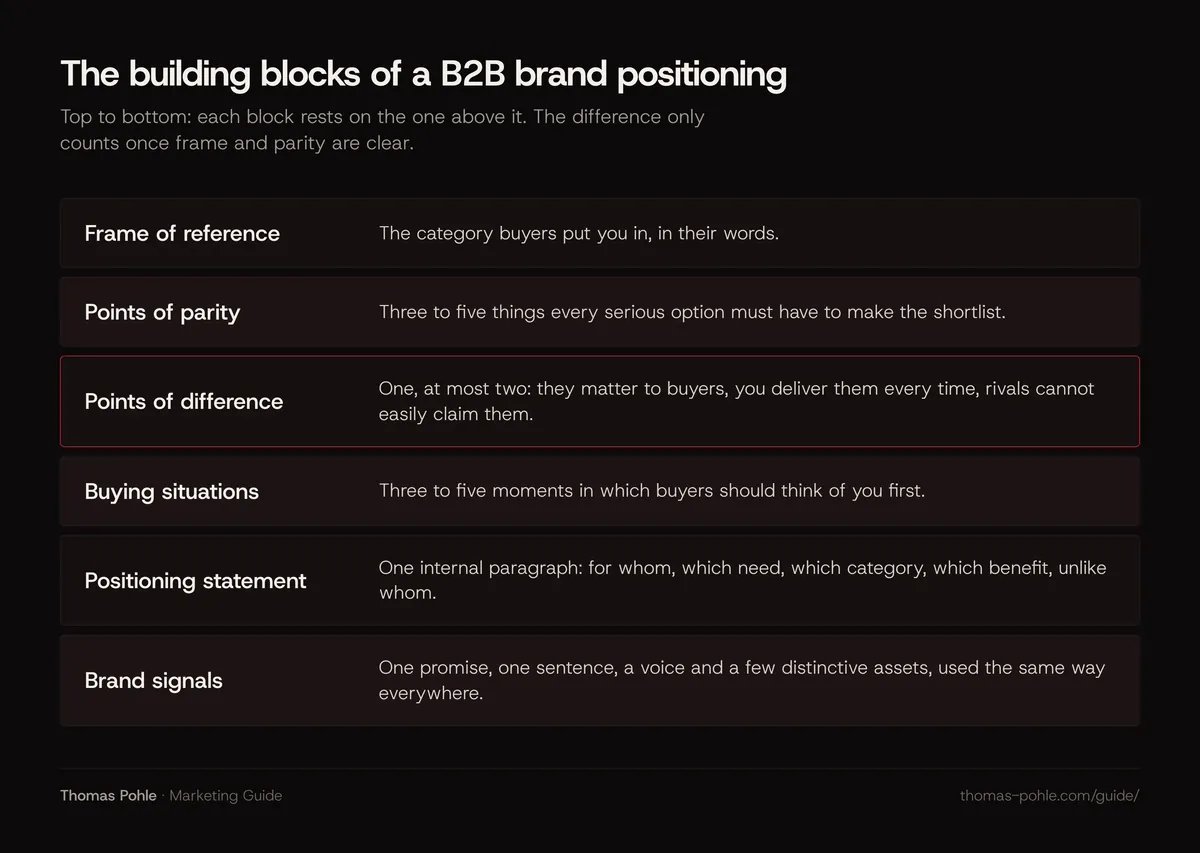
- Name the frame of reference. Ask five customers what they'd call your category and what they compared you with. Use their term, even if you prefer another one.
- List the points of parity. These are the three to five things every serious option must have to make the shortlist, such as certifications, integrations or local support. Miss one and you lose deals, whatever your difference.
- Choose the points of difference. One, two at most. They must matter to buyers, you must be able to deliver them every time, and the alternatives must not be able to claim them easily.
- Pick the buying situations. Romaniuk's report suggests prompts such as when, where, why and with whom the need comes up. Choose three to five situations in which you want to be the first name that comes to mind.
- Write the positioning statement. The template usually attributed to Moore's Crossing the Chasm works well: for whom, which need, which category, which key benefit, and unlike which main alternative.
- Translate it into signals. One promise, one sentence that says what you do, a voice and a few distinctive assets such as a color, a phrase or an image style. Use them the same way everywhere.
For my own brand, the promise is tied to the person. It isn't tied to an offer. The brand had to sell advisory today and support TEISENDA later, so it promises momentum, which survives a change of offers. A company brand needs the same check. Does the promise still hold if the product line changes?
What does a brand positioning statement look like in practice?
A positioning statement is an internal paragraph. Don't use it as customer copy. It names the target customer, the need, the category, the key benefit and the main alternative you beat. Here's a hypothetical example for a fictional company, followed by the parts it rests on. All details are invented to show the structure.
For IT leads at Swiss companies with 50 to 250 employees who must prove their security to auditors and customers, Example Secure is a managed security service that keeps them audit-ready all year. Unlike an in-house hire, it covers monitoring, documentation and audit preparation from one team for a fixed monthly fee.
- Frame of reference. Managed security service. That's the term customers used. The founders preferred cyber resilience platform.
- Points of parity. ISO 27001 certified team, data hosted in Switzerland, German-speaking support.
- Point of difference. Audit-ready all year, with documentation done for the customer.
- Buying situations. A customer sends a security questionnaire; an auditor announces a visit; the only IT security person resigns.
- Signals. The phrase "audit-ready" in every headline, one accent color, a monthly audit status report as a recognizable artifact.
Look at what's missing. No values, no history, no list of services. Those belong to the identity and the website. The statement only holds what the brand pushes to the front.
How do you test whether your brand positioning is clear?
Your brand positioning is clear when nobody else could sign it, when buyers already credit you with the difference, and when your team can name the buying situations without notes. Five checks show this in a week. The pass marks are my suggested thresholds for a small B2B team. They aren't research benchmarks.
- Swap test. Replace your name in the statement with your strongest competitor's. Pass: at least one sentence becomes false.
- Credit test. Ask five customers what you do better than the alternatives, without prompting. Pass: at least three name your point of difference in substance.
- Parity test. Check your last ten lost deals. Pass: no more than two were lost on a point of parity you thought you met.
- Situation test. Ask three people in sales to name the situations in which buyers should think of you. Pass: all three name at least two of your chosen situations.
- Proof test. For each point of difference, find the evidence a buyer can check. Pass: at least one case study, number or demo per point.
Here's my view: three mistakes explain most failed tests. A difference buyers don't care about, often a technical feature. A missing point of parity that kills deals before the difference ever counts. And a statement full of words like quality, partnership and innovation, which fails every swap test.
What to do this week
A week is enough to draft a brand positioning, with five customer conversations and one leadership meeting. Start from what buyers say, write the four answers on one page, run the swap test and decide which identity elements stay in the background. The output is one paragraph that leadership signs off and every channel uses.
- Ask five customers what they'd call your category and what they compared you with.
- List the three to five points of parity buyers expect. Mark any you don't meet yet.
- Choose one point of difference and find one proof for it.
- Write down three buying situations in which you want to come to mind first.
- Draft the positioning statement with the template above, in under 60 words.
- Run the swap test with your two strongest competitors.
- Sort your brand values into two lists: what you promise and how you work.
Leadership can't agree on the point of difference? A one-day Momentum Workshop settles positioning, ideal customer and the first channel with your team.
A brand positioning rarely needs a new logo. It needs a decision about what goes to the front, and the patience to repeat it until buyers repeat it back.
Frequently asked questions
What is the difference between brand positioning and a value proposition?
A value proposition describes what a customer gets from a specific offer, often per segment or product. Brand positioning describes what buyers should associate with the brand as a whole compared with the alternatives. You can run several value propositions under one brand positioning. They should all support the same point of difference.
How long does it take for a new brand positioning to show results?
Nobody has a reliable general number. You can write the statement in a week. Buyers form associations slowly, and according to John Dawes of the Ehrenberg-Bass Institute, up to 95 % of business buyers aren't in the market for many goods and services at any one time. My rule of thumb: judge it first by internal signals, such as whether sales uses the same words. Judge it later by how buyers describe you.
Can a small B2B company afford brand positioning work?
Yes. The core work costs time, and very little money: customer conversations, one leadership decision and one page of text. Agencies and big frameworks add cost. They don't necessarily add clarity. My take: small companies often gain the most. They can't outspend larger competitors, so they need buyers to remember one clear reason to choose them.
Should brand positioning be different in each country?
The point of difference usually stays the same. The frame of reference and the points of parity can change by market. A local certification, a language or a data hosting requirement may be parity in one country and irrelevant in another. Check the frame and the parity list with customers in each market before you translate the statement.
How do AI assistants pick up a brand positioning?
They draw on what public, crawlable sources say about you: your website, profiles, articles and third-party mentions. If those sources use the same category term and the same point of difference, an assistant is more likely to describe you that way. If they contradict each other, the description tends to go vague. That's my reading. No provider documents it as a rule.
Sources
- Kevin Lane Keller, Brian Sternthal and Alice Tybout: Three Questions You Need to Ask About Your Brand, Harvard Business Review, September 2002
- David A. Aaker: Building Strong Brands (publisher description)
- Jenni Romaniuk: Category Entry Points in a B2B World, LinkedIn B2B Institute (2022)
- Ehrenberg-Bass Institute: How B2B Brands Grow (2023)
- TechTarget: What is a positioning statement? (Geoffrey Moore's template from Crossing the Chasm)
- April Dunford: Positioning (homepage definition)
- Gainsight: Lessons from April Dunford on product positioning (session recap listing the components of her positioning process)
- John Dawes, Ehrenberg-Bass Institute: Advertising effectiveness and the 95-5 rule

Thomas PohleB2B marketing advisor in Zurich. More than ten years in B2B marketing at Link11, Beekeeper and smino, most recently as Head of Marketing. CEO and co-founder of TEISENDA. Researched and drafted with AI tools, checked against the sources listed above. More about Thomas