Which positioning strategies are there, and which fits you?

B2B companies usually pick one of four positioning strategies: specialist, quality leader, price leader or niche provider. Each wins on one thing and costs you another. The right one is the strategy whose sacrifice you can live with for years, because your best customers already reward it and your costs and team can carry it.
This guide is for founders and CEOs who know they need a clear position and keep circling between options. The basics of what positioning is and how to find it from your best customers are in the guide on what positioning is and how a B2B company finds its own. This article goes one step further. It compares the four strategies by what each one makes you give up in daily business, and it ends with a decision table.
Which positioning strategies are there?
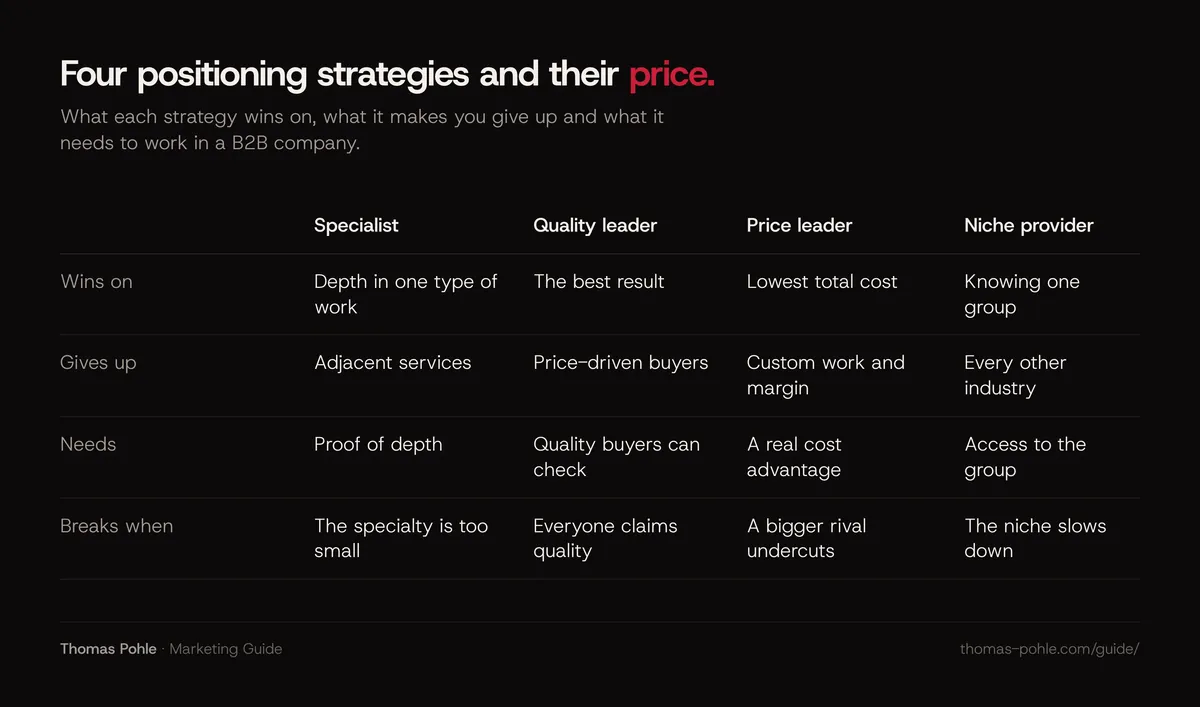
Four positioning strategies cover most B2B companies: the specialist, who does one kind of work better than anyone; the quality leader, who offers the best result at a higher price; the price leader, who wins on lowest cost; and the niche provider, who serves one customer group completely. They go back to two classic strategy models.
Michael Porter's book Competitive Strategy (1980) describes three generic strategies: cost leadership, differentiation and focus. Michael Treacy and Fred Wiersema described three value disciplines in Harvard Business Review in 1993: operational excellence, product leadership and customer intimacy. The four strategies below are my practical translation of both for small and mid-sized B2B firms.
| Strategy | You win on | You give up | Classic root |
|---|---|---|---|
| Specialist | Depth in one type of work | Everything outside that work, even when a client asks | Focus, variety-based |
| Quality leader | The best result in the category | Price-driven buyers and fast, cheap projects | Differentiation, product leadership |
| Price leader | Lowest total cost for the buyer | Custom work, premium margins, most extras | Cost leadership, operational excellence |
| Niche provider | Knowing one customer group inside out | Every buyer outside that group | Focus, needs-based, customer intimacy |
The third column decides. Most teams like the second column of every row. Only one row's third column is something you'll accept every week.
What does a specialist strategy demand you give up?
A specialist wins because buyers trust deep expertise in one type of work, such as ERP migrations, pricing projects or security audits. The cost is saying no to everything next to it. A specialist who also takes the website project, the trade fair and the CRM setup is a generalist with a sharp tagline.
Porter calls this logic variety-based positioning in his 1996 Harvard Business Review essay "What Is Strategy?": a company serves a subset of an industry's products or services. The buyers can come from many industries. What they share is the job they need done.
- What it costs you. Revenue from adjacent work, often from your favorite clients. Cross-selling stops being a growth plan.
- What it needs. Proof of depth that a generalist can't fake: method, case studies, references in the same type of project.
- Where it breaks. When the specialty is too narrow to fill the pipeline, or a platform makes the work a commodity.
I made a small version of this choice myself. I work with B2B companies only, never with consumer brands. That rules out work I could do. It also makes every page, every post and every first call simpler.
What does quality leadership cost you?
A quality leader wins on the best result in its category and charges for it. In B2B that can mean the most reliable machine, the strongest consulting team or the most complete software. The cost is the buyer who decides on price, and the discipline to keep investing before the market pays for it.
Treacy and Wiersema call the matching discipline product leadership: competing with the best and most innovative offer in the market. That's expensive. Research, senior people, longer testing and the patience to walk away from a deal at the wrong price all go on the bill.
- What it costs you. Price-sensitive segments, fast discount deals and the comfort of matching a cheaper competitor.
- What it needs. Quality buyers can check: certifications, measurable outcomes, references that name the result.
- Where it breaks. When "quality" is a claim every competitor makes. Buyers then hear a price premium without a reason.
My take: quality leadership is the strategy most often claimed and least often lived. If your sales team discounts to win against a cheaper rival, you're not a quality leader yet.
When does price leadership work in B2B?
Price leadership works in B2B when you can deliver the same result at structurally lower cost than anyone else, and keep it that way. It needs standardized offers, high volume and processes others can't copy quickly. Without a cost advantage, a low price is a discount. The margin disappears, the position doesn't stick.
Porter's term is cost leadership, and the emphasis is on cost. Treacy and Wiersema describe operational excellence as reliable products or services at competitive prices, delivered with minimal difficulty or inconvenience. In B2B services the price leader usually sells a fixed package, onboards customers without meetings and says no to anything custom.
- What it costs you. Custom work, premium margins and the extras sales likes to promise.
- What it needs. A cost structure you can explain in one slide: automation, scale, a cheaper delivery model.
- Where it breaks. When a bigger rival or a platform undercuts you. In a small market there's room for very few cost leaders.
How is a niche provider different from a specialist?
A niche provider serves one customer group with most of what that group needs, while a specialist does one type of work for many groups. The niche provider knows the buyers. The specialist knows the job. Both narrow the market, but the sacrifice differs: the niche provider gives up other industries, the specialist gives up other services.
Porter calls the first logic needs-based positioning: serving most or all of the needs of a particular group of customers. Treacy and Wiersema's customer intimacy fits it too: value comes from tailoring the offer closely to specific customers. A software firm for dental laboratories, an advisor only for family-owned machine builders and a recruiting firm only for nurses are niche providers.
- What it costs you. Every buyer outside the group, and the comfort of a market that grows by itself.
- What it needs. Real access to the group: its events, its associations, its language, its references.
- Where it breaks. When the niche is too small to grow in, or a downturn hits the whole group at once.
Why does trying to be all four fail?
Trying to be all four fails because each strategy needs different costs, people and processes, and they contradict each other. You can't run the cheapest delivery and the most senior team at once. Porter calls the attempt straddling. Treacy and Wiersema found market leaders excel in one discipline and meet the industry standard in the others.
Porter's example in "What Is Strategy?" is Continental Lite. Continental Airlines tried to copy the low-cost model of Southwest while keeping its full-service position. According to Porter, the airline lost hundreds of millions of dollars, and the CEO lost his job. The lesson for a 40-person B2B company is the same at a smaller scale. A sales team that pitches "premium quality at the best price" ends up discounting its premium.
Matching the industry standard is not optional, though. Treacy and Wiersema describe leaders that became champions in one discipline while meeting industry standards in the other two. A price leader still has to deliver work that's good enough, and a quality leader can't be so slow that buyers leave. You choose where to lead. Everywhere else you stay at par.
I saw the same pattern in my own offer. It started as four packages shown as a timeline from workshop to advisory. That timeline described a sequence real engagements never follow. I cut it to three formats chosen by the client's situation. Fewer options, and no promised sequence.
Which positioning strategy fits your company?
The positioning strategy that fits is the one your best customers already reward and your cost structure can carry. Check four signals: why you win deals, what your margins allow, how varied your best customers are, and what your team does best. Then choose the strategy whose sacrifice you can accept for years. My rule of thumb is at least three.
The thresholds in this table are my rules of thumb for a B2B company with 10 to 200 employees. They aren't research benchmarks. Count from your last 10 won deals and your current customer list.
| If this is true for you | Lean toward | Watch out for |
|---|---|---|
| At least 6 of your last 10 wins came from one type of project, across different industries | Specialist | A specialty too small to fill the pipeline |
| At least 6 of your best 10 customers come from one industry or one buyer type | Niche provider | The whole niche slowing down at once |
| You win against cheaper offers at least half the time, without discounting | Quality leader | "Quality" that buyers can't verify |
| Your delivery cost is clearly lower than rivals' for the same result, and buyers buy on price | Price leader | Price without a cost advantage |
| None of the rows is true | Go back to the customer list first | Choosing the strategy you'd like to have |
A typical scenario, invented to show the logic: a Swiss IT services firm with 60 employees looks at its last 10 wins. Seven were Microsoft 365 migrations, spread over law firms, schools and manufacturers. Only two came from the same industry. The data points to a specialist strategy for migrations. The sacrifice is clear too: the firm stops pitching managed services as its headline and keeps them for migration clients only.
Two signals point the same way? Then pick the one with the clearer sacrifice. A position you can't explain in terms of what you no longer do won't survive the next big deal that doesn't fit.
How do you test the choice before you commit?
Test a positioning strategy before you announce it. Write down what you'll stop doing, check it against your pipeline, try the new story in five sales calls and see whether buyers repeat it. If losing the work you'd give up would sink the quarter, the strategy is right but the timing isn't yet. Plan the transition.
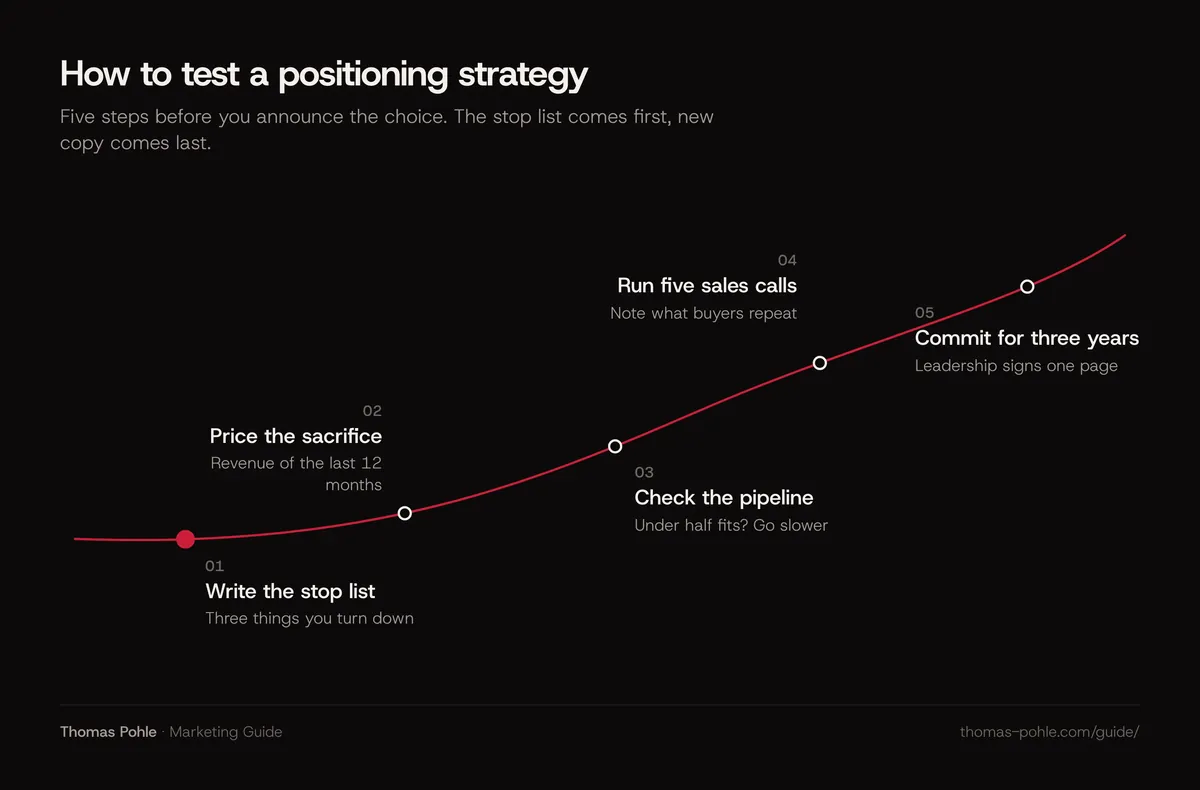
- Write the stop list. Three services, segments or deal types you'll turn down from now on.
- Price the sacrifice. How much revenue of the last twelve months sat in those three items?
- Check the pipeline. How many current opportunities fit the new position? My threshold: if it's under half, move more slowly.
- Run five sales calls. Use the new story with buyers in your chosen focus. Note which sentences they repeat.
- Commit for three years. Write the choice down, with the stop list, and let leadership sign it.
Once the strategy stands, you can draw it. A positioning map built from buyer evidence shows whether buyers see you where you want to be. The guide to defining brand positioning turns the choice into a memory buyers carry. And the B2B marketing strategy guide shows how the choice steers channels and budget.
What to do this week
You can make the strategy decision this week with data you already have. Look at your wins, your customers and your margins, pick the row in the decision table that is true, and write down the sacrifice. Leadership then signs a one-page choice that includes the stop list.
- List your last 10 won deals with type of project, industry and whether you discounted.
- Mark your 10 best customers by industry and by type of work.
- Check which row of the decision table is true for you.
- Write a stop list of three things you'll no longer sell or pitch.
- Calculate the revenue share of those three things over the last twelve months.
- Rewrite your first homepage screen so it names either the industry or the type of work.
- Test the new story in five sales calls and note what buyers repeat.
Leadership can't agree on the sacrifice? That disagreement is the real positioning work. A one-day Momentum Workshop settles positioning, ideal customer and the first channel with your team.
No strategy is permanent. Markets shift, and so can you. Switch strategy on purpose, though, and only after a real change in your customers or costs. A bad quarter is not a reason.
Frequently asked questions
What is the difference between a positioning strategy and a positioning statement?
A positioning strategy is the basic choice of how you win: as specialist, quality leader, price leader or niche provider. A positioning statement writes down the result for one offer: target customer, need, category, key benefit and main alternative. The strategy comes first. The statement describes it in one paragraph your team can use.
Can a small B2B company be a price leader?
Rarely, and only with a real cost advantage. A small firm can be cheapest in a narrow segment when it standardizes one offer and automates delivery. Without lower costs than its rivals, a low price is a discount that shrinks the margin. Most small B2B firms do better as specialists or niche providers.
Is a niche strategy risky?
It concentrates risk. When the whole niche slows down, so does your pipeline. It also makes marketing cheaper and sales easier, because you know where buyers meet and what they need. My rule of thumb: check that the niche has enough buyers to fill your pipeline for three years before you commit, and keep one adjacent niche in view.
How often should a company change its positioning strategy?
As seldom as possible. A position needs years of consistent repetition before buyers connect it with you. Change it when your customers or your cost structure have changed for good, for example after a new product, an acquisition or a shift in the market. One weak quarter is not a reason to switch.
Sources
- Michael E. Porter: What Is Strategy? Harvard Business Review, November to December 1996
- Michael E. Porter: Competitive Strategy. Techniques for Analyzing Industries and Competitors (Free Press, 1980), library record (CiNii)
- Michael Treacy and Fred Wiersema: Customer Intimacy and Other Value Disciplines, Harvard Business Review, January to February 1993
- April Dunford: Positioning (homepage definition)

Thomas PohleB2B marketing advisor in Zurich. More than ten years in B2B marketing at Link11, Beekeeper and smino, most recently as Head of Marketing. CEO and co-founder of TEISENDA. Researched and drafted with AI tools, checked against the sources listed above. More about Thomas