Do you need AEO instead of SEO, or both?
You need both, and you should run them as one program. AEO (answer engine optimization) sits on the same base as SEO: crawlable, indexed pages with clear, sourced answers. Google says optimizing for its AI features is still SEO. AEO adds a citation goal, a few crawler and opt-in settings, and new reports. So budget by task.
This is for founders and marketing leads who already pay for SEO and now get offers for AEO, GEO or "AI SEO" on top. The terms are defined in what answer engine optimization is and what generative engine optimization is. The big picture is in the pillar on how SEO changes when AI answers the search. Here it's about the decision: where the work is identical, where AEO really adds something, and how to split the money.
Can AEO replace SEO?
AEO can't replace SEO, because every answer engine that cites web pages has to find, crawl and index them first. Google shows a page as a supporting link in AI Overviews or AI Mode only if it's indexed and eligible for a snippet in normal Search. Without the SEO base, AEO has nothing to stand on.
Google says so in plain words. Its guide on optimizing for generative AI features on Google Search, published in May 2026, says this work "is optimizing for the search experience, and thus still SEO." The features run on Google's core ranking and quality systems.
The other platforms point the same way through their crawlers. OpenAI says sites opted out of OAI-SearchBot won't be shown in ChatGPT search answers. Perplexity says PerplexityBot surfaces and links websites in its results. Microsoft counts citations in Copilot through Bing Webmaster Tools. Each of them needs your pages crawled first.
The reverse question is the real one: can you do SEO and ignore AEO? Less and less. Pew Research Center tracked the browsing of 900 US adults in March 2025. With an AI summary on the page, users clicked a traditional result in 8 % of visits; without one, in 15 %. They clicked a link inside the summary in 1 % of visits with a summary. Where your buyers' searches show summaries, ranking alone pays less than it used to.
What does AEO add on top of SEO?
AEO adds a goal, a few settings and a measurement layer. The goal is being the cited source inside an answer, which often brings no click. The settings are robots.txt rules for AI search crawlers and Google's generative AI control in Search Console. The measurement comes from two reports that Google and Microsoft launched in 2026.
- A citation goal. You judge a page by whether an answer can lift a passage and name you as the source, in addition to rank and clicks.
- More crawlers. OAI-SearchBot and PerplexityBot fetch pages for search answers. Training crawlers such as GPTBot are a separate decision. The full list is in how to get cited by ChatGPT, Perplexity and Google AI.
- One setting in Search Console. Google's Search generative AI control includes every site in AI Overviews, AI Mode and Discover's AI features by default. Opting out removes your links and content there and doesn't change your ranking in regular Search.
- Two new reports. Search Console's generative AI report shows impressions in AI Overviews and AI Mode by page, for all sites since 31 August 2026. Bing's AI Performance report, in public preview since 10 February 2026, counts citations in Copilot and Bing's AI summaries.
What AEO doesn't add, according to Google's May 2026 guide: no llms.txt for Google Search, no special schema.org markup, no need to chop content into tiny pieces, no ideal page length and no special writing style for AI. Other services may read llms.txt. For Google it neither helps nor hurts.
How do SEO and AEO compare task by task?
Task by task, SEO and AEO share most of the work. Crawl access and indexing are the same jobs. Content structure and company data are the same jobs with stricter rules. Only citations and the reports that count them are new. The table shows where an AEO offer adds work and where it relabels work you already pay for.
| Task | SEO | What AEO adds | Verdict |
|---|---|---|---|
| Crawl access | Googlebot and Bingbot reach every key page, main text in the HTML | Search crawlers of AI assistants allowed too | Mostly the same |
| Indexing | Key pages indexed in Google and Bing, sitemaps, canonicals | Nothing extra for Google; fresh Bing index for Copilot | Same |
| Content structure | Clear headings, matched search intent, helpful pages | A short answer at the top of each section, sourced numbers, tables, FAQ | Same, stricter |
| Company data | Organization data, one company name, author pages | The same facts on every profile, so answers name you correctly | Same, stricter |
| Citations | Links and mentions from other sites | Being the cited source inside an AI answer | New |
| Measurement | Rankings, clicks, conversions | Google's generative AI report, Bing AI Performance, AI referrers | New reports |
The stricter rules have a source. Bing's AI Performance announcement says clear headings, tables and FAQ sections help surface key information, and that examples, data and cited sources help build trust. It also points to IndexNow to keep information fresh in search and AI answers.
My take: four of the six rows are work you should already be paying for. If they aren't done, money labelled AEO is wasted. In a previous in-house role, a new website and online funnel I designed more than tripled organic traffic and doubled conversion rates within weeks. Nobody called it AEO. It was the base that answer engines read today.
In which order should you do SEO and AEO work?
Do the shared base first, sharpen it second and add the AEO-only parts last. Open access for the search crawlers, get the key pages indexed, rewrite them answer-first with your own data, align your company data, then open the AI reports. Only then decide how much goes into AEO-only work. A rewritten page no crawler can fetch earns nothing.
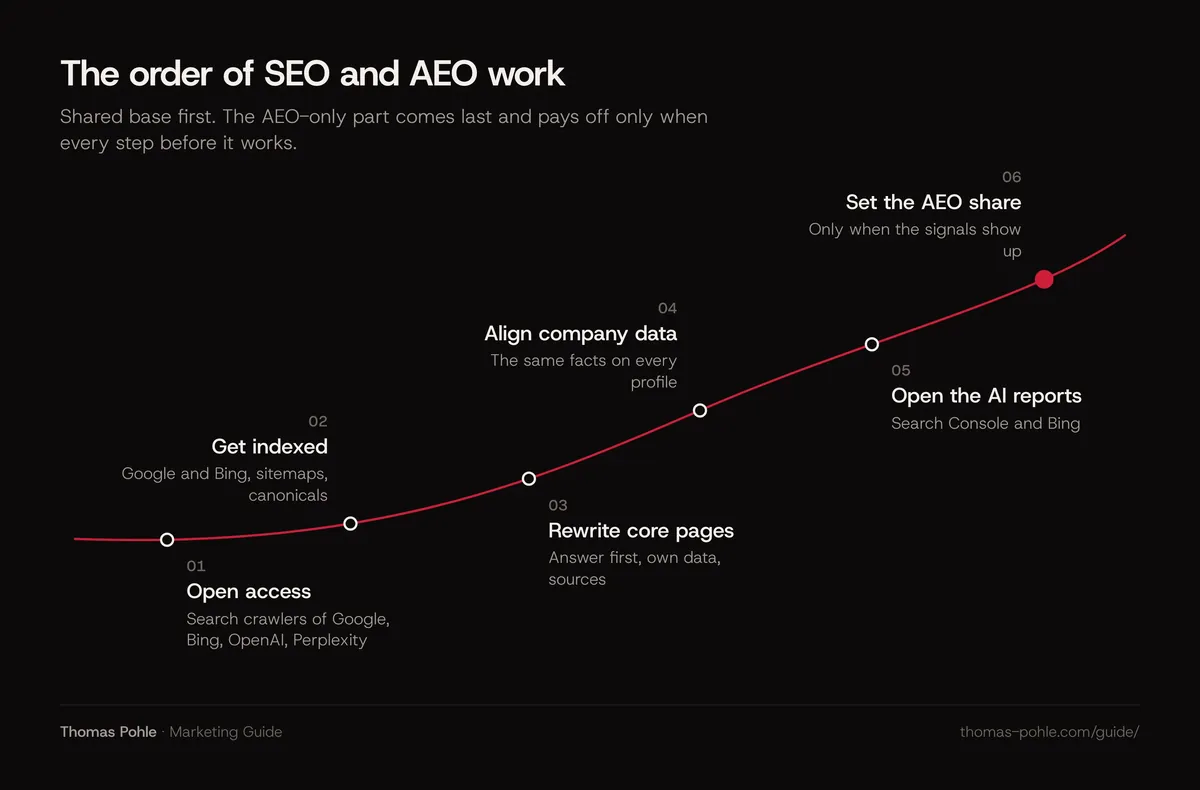
My rule of thumb: on a healthy site, access and indexing take days. If they take months, you have an SEO project and AEO waits. The checks are in the technical SEO checklist for B2B websites, and the rewrite method is in how to rewrite existing content for AI search.
When does AEO deserve its own share of the budget?
AEO deserves its own share once the shared base works and AI answers show up for your buyers' questions. The signals are in your own data: impressions in Google's generative AI report on your key pages, citations in Bing's AI Performance report, and new leads who say an AI assistant named you. Before those signals, every euro goes into the base. The share is a row in one search budget, not a separate line.
- Base broken. Key pages not indexed, crawlers blocked, main text only after JavaScript. AEO-only share: 0 %. Fix SEO first.
- Base fine, few AI impressions. Make answer-first writing the standard for every new page. AEO-only share: about 5 %, for measurement.
- AI impressions rising on key pages, clicks flat. Rewrite those pages' answers and track citations. AEO-only share: 10 to 15 %.
- Leads name ChatGPT, Perplexity or Copilot. Hold that share, ask every lead and check which pages they found.
These thresholds are my rules of thumb. No study I know of sets a right AEO share. My view: AI changes marketing fundamentally, and the fundamentals still decide who gets found. In search that means the base gets paid first.
How do you split the budget by task instead of by label?
List every search task, assign it once, and give each one a budget and an owner. Separate lines for SEO, AEO and a GEO tool pay for the same crawl audit and the same page rewrites more than once, and nobody owns the result. A task budget pays once and shows honestly how much is really AEO-only.
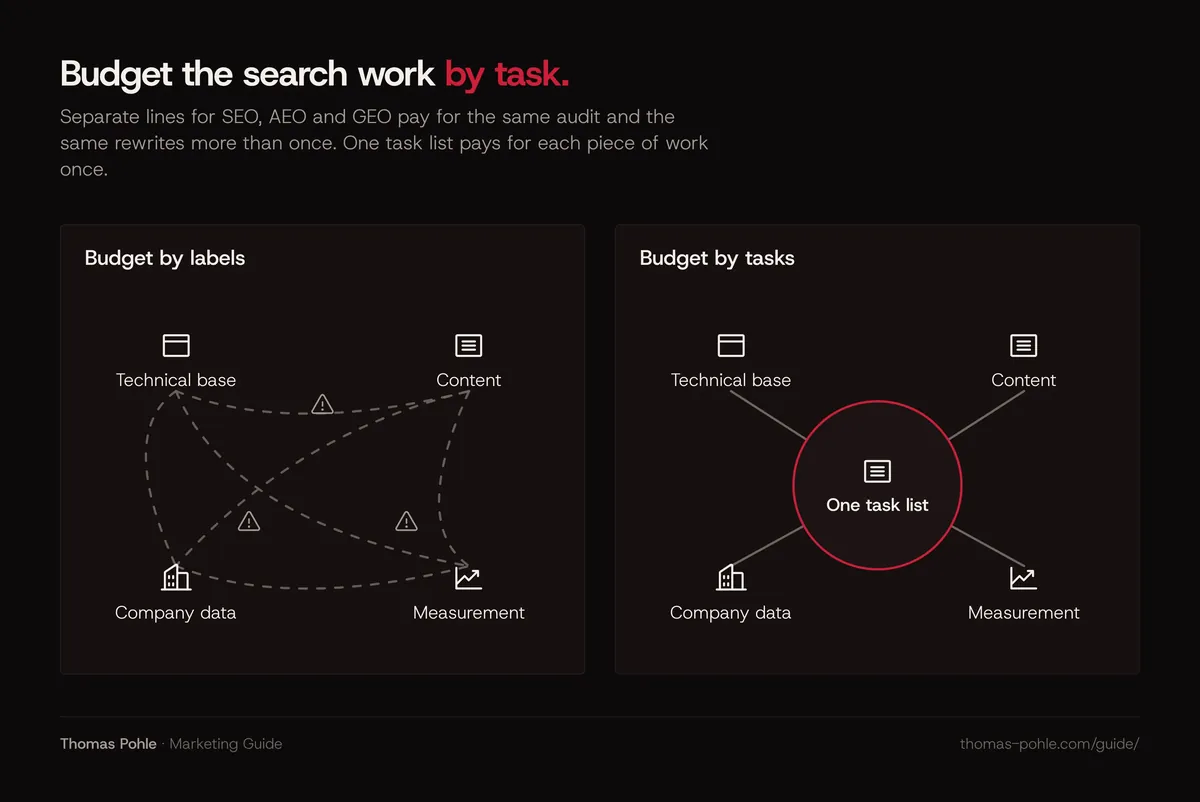
A worked example with round numbers, for a fictional company: a B2B software firm with 60 employees spends EUR 40,000 a year on search, outside paid ads. Its base works, and Google's generative AI report shows rising impressions on its product and comparison pages.
| Task | Share | Example per year | Needed without AI answers? |
|---|---|---|---|
| Technical base for Google and Bing | 15 % | EUR 6,000 | Yes |
| Content: rewrites and new pages with own data | 45 % | EUR 18,000 | Yes |
| Company data and earned mentions | 15 % | EUR 6,000 | Yes |
| Measurement and the lead-source question | 10 % | EUR 4,000 | Yes |
| AEO only: citation tracking, answer tests | 15 % | EUR 6,000 | No |
Read the last column. EUR 34,000, or 85 %, buys work you'd need without a single AI answer. EUR 6,000 is AEO-only. If an agency quotes AEO as a second budget the size of your SEO budget, ask which rows it covers that your SEO budget doesn't.
The content row is the biggest, and the one where AI drafting is most tempting. Google's May 2026 guide advises: "Create the content yourself based on what you know about the topic." I agree. Write it yourself, or at least put your own cases, numbers and opinions into every draft. That's what makes a page worth citing over the hundred others that say the same thing.
Which AEO offers are SEO under a new name?
An AEO offer is SEO under a new name when its task list matches your existing SEO work: technical audit, structured data, content rewrites, link building. That's fine if nobody covers those tasks today. It's double spending if your SEO provider already does. Ask for the task list and mark every line against the table above.
- llms.txt as the main deliverable. Google says its Search doesn't use the file.
- Special AI markup. Google says there's no special schema.org markup for its AI features.
- Bought or seeded mentions. Google says seeking inauthentic mentions isn't as helpful as it might seem.
- A proprietary AI visibility score. Google says no third-party tool has access to its internal ranking or AI systems. Tools sample prompts, so read their numbers as a trend.
The full agency check, with first-call questions and red flags, is in how to choose an AI SEO agency.
How do you measure SEO and AEO in one report?
Use one monthly report with two layers on the same pages. The SEO layer shows indexing, impressions, clicks and conversions per page. The AEO layer shows impressions in Google's generative AI report, citations in Bing's AI Performance report, visits from chatgpt.com and perplexity.ai, and what new leads say about how they found you.
Keep the limits in view. Google's generative AI report shows impressions and no clicks, and Bing's announcement doesn't mention clicks either. Neither OpenAI's nor Perplexity's crawler documentation describes a comparable citation report for site owners (checked November 2026). So the lead-source question in your form or first call carries more weight than any dashboard. In my estimate the setup takes an afternoon; see how to measure organic and AI search visibility.
What to do this week
You don't need a new AEO project to decide this. You need a clear picture of what you pay for today and whether your base holds. These steps fit into one week next to normal work.
- List your search spend by task. Use the five rows of the example table, with real numbers.
- Mark every AEO or GEO offer. Each line gets "same", "stricter" or "new".
- Check robots.txt. Googlebot, Bingbot, OAI-SearchBot and PerplexityBot must get through to your key pages.
- Check the Search Console setting. Confirm your site is included in Search generative AI features, then open the generative AI report.
- Open Bing Webmaster Tools. Verify the site and look at AI Performance.
- Rewrite five key pages. Start each section with a 40 to 60 word answer that contains your own numbers.
- Ask every new lead. "Where did you first hear about us?" Log each answer that names an AI assistant.
Give the split a quarter, then look at the two AI reports again. If you want a second opinion on where your search money should go, that's what we work out in a one-day Momentum Workshop.
Frequently asked questions
Is AEO the same as SEO?
Mostly. AEO uses the same base as SEO: crawlable, indexed pages with clear, sourced content. Google says optimizing for its generative AI features is still SEO. The difference is the goal and the measurement. SEO counts rankings and clicks. AEO counts how often AI answers show or cite your page. Google (impressions) and Microsoft (citations) started to report this in 2026.
Should you do AEO instead of SEO?
No. AEO instead of SEO doesn't work, because AI answer engines cite pages they can crawl and index. Google needs a page to be indexed and eligible for a snippet before it can appear as a link in AI Overviews or AI Mode. Treat AEO as a goal and a few extra tasks inside your SEO program.
How much of the search budget should go to AEO?
Only the part that would be unnecessary without AI answers: citation tracking and answer tests on key pages. In my rule of thumb that's 0 % while the base is broken, about 5 % once it works, and 10 to 15 % when AI impressions rise on your key pages. No study sets a right share.
Do you need a separate AEO agency?
Usually not. Google treats generative AI optimization as SEO, and most AEO tasks are SEO tasks with stricter rules. Two agencies on one website tend to mean two reports and no clear owner. A specialist makes sense when your SEO provider can't explain AI crawlers, the generative AI report and Bing's AI Performance report.
Does AEO need llms.txt or special schema?
Not for Google. Its May 2026 guide says Google Search doesn't use llms.txt and that there's no special schema.org markup for its AI features. Structured data still helps with rich results as part of normal SEO. Google notes the file may be useful for other services that use it; for Google Search it neither helps nor hurts.
Sources
- Google Search Central: Optimizing your website for generative AI features on Google Search (May 2026)
- Google Search Central: AI features and your website
- Search Console Help: Search generative AI control
- Google Search Central Blog: Introducing Search Generative AI performance reports in Search Console (June 2026, rolled out to all sites 31 August 2026)
- OpenAI: Overview of OpenAI crawlers
- Perplexity: Perplexity crawlers
- Bing Webmaster Blog: Introducing AI Performance in Bing Webmaster Tools public preview (February 2026)
- Pew Research Center: Google users are less likely to click on links when an AI summary appears in the results (July 2025)
Thomas PohleB2B marketing advisor in Zurich. More than ten years in B2B marketing at Link11, Beekeeper and smino, most recently as Head of Marketing. CEO and co-founder of TEISENDA. Researched and drafted with AI tools, checked against the sources listed above. More about Thomas