How do you rewrite existing content so AI search can use it?
Rewrite one section at a time on pages you already have. Turn the heading into the buyer's question, open with a 40 to 60 word answer that names who, what and how much, put the evidence and its source on the page, and add a visible date where facts change. Keep the URL. Google says no special AI format is needed.
This is for B2B teams that already have a website full of service pages, product pages and old blog posts, and keep hearing they need "content for AI search". Most of them don't need more content. They need the content they have to answer a question in a sentence someone can quote.
Below you get what Google and OpenAI actually say in 2026, a decision table for which sections to touch, and one real before and after: a section of my own homepage, rewritten edit by edit. For the bigger picture of how search changes, start with the pillar on how SEO changes when AI answers the search.
Why rewrite an existing page instead of writing a new one?
An existing page already has a URL, an index entry and links pointing to it. A rewrite keeps all of that and fixes the one thing AI answers need: a passage that answers a question on its own. Google warns that creating separate pages for every query variation, mainly to manipulate AI responses, violates its scaled content abuse policy.
Google's guide to generative AI features on Search, updated in July 2026, says it in plain words: a high quantity of pages doesn't make a website higher quality or more relevant. The same guide says its systems understand synonyms, so you don't need a page for every long-tail phrasing.
My take: in B2B, the facts buyers ask about already sit somewhere on your site. Prices on one page, the process on another, the team on a third. The work is pulling the answer into the section where the question is asked. My own guide shows the order. It started on 23 October 2026 with ten articles, and the structured format you see here, answer first with tables, figures, FAQ and sources, followed a day later.
What do Google and OpenAI actually say about content for AI search?
Google says AI Overviews and AI Mode rest on its core ranking systems, so regular SEO best practices apply. Its July 2026 guide says you don't need to chunk content, rewrite it in a special way for AI, add llms.txt or add special schema markup. OpenAI documents its crawlers but publishes nothing about how ChatGPT search picks sources.
The gaps matter as much as the rules. Anyone who sells you a ranking formula for AI answers is guessing.
| Company | What it publishes | What it does not publish |
|---|---|---|
| No special optimization needed; page must be indexed and eligible for a snippet; write non-commodity content; structured data must match visible text | Which passages get picked, how query fan-out weighs sources, any citation formula | |
| Bing | Clear headings, tables and FAQ sections help; examples, data and cited sources build trust; regular updates keep answers current | How citation share is calculated, ranking inside an answer |
| OpenAI | OAI-SearchBot surfaces sites in ChatGPT search; allow it in robots.txt; changes take about 24 hours | How ChatGPT search ranks or selects sources |
One research result points the same way. In the GEO study by Aggarwal and colleagues, presented at KDD 2024, adding citations, quotations and statistics to a page improved its visibility in generated answers by about 30 to 40 % in their simulated engine, while keyword stuffing did not help. A smaller test on Perplexity showed smaller gains, so treat it as a direction.
Which sections of a page should you rewrite first?
Rewrite the sections that sit where a buyer question is asked and the answer is missing, scattered or out of date. Leave brand copy, hero lines and stories alone; they have a different job. Merge sections that answer the same question twice, and delete facts you can no longer stand behind.
My four signals per section: Does a buyer ask this question before a purchase? Is the answer in this section, or only somewhere else on the site? Does it contain a fact that can go stale, such as a price, a date or a team size? Does the section say who is speaking, or only "we"?
| Section type | Signal | Decision |
|---|---|---|
| Offer, price, process | Buyers ask it, answer sits on another page | Rewrite first |
| Comparison or "which option" | Answer is a feature list without a verdict | Rewrite with a table and your criteria |
| Two sections, same question | More than half the content overlaps | Merge into one, redirect the weaker URL if it is a page |
| Hero line, brand story, manifesto | Nobody searches for it | Leave as it is |
| Outdated number or claim | No source, or older than 12 months | Update with a source or delete |
The 12 months and the "more than half" overlap are my rules of thumb, not Google thresholds. For which whole pages deserve the work first, see the guide on optimizing your website for AI search.
What does a real section look like before the rewrite?
Here is a real section from the homepage of thomas-pohle.com, quoted as it was live on 9 November 2026. It reads well as brand copy. As an answer it fails: three questions without answers, no prices, no name and no date. A model asked what working with Thomas Pohle costs finds nothing to quote here.
Three ways to work together. Entering DACH? Scaling in a market you’re already in? Starting from zero? The first question is always the same: what moves first. The format depends on how much of it you want me to carry.
Below that come the three formats with their duration. The prices exist, but on the consulting page, one click away. A human reader clicks. A passage pulled into an AI answer can't.
I picked my own page on purpose: I can quote it in full and I know which facts are true.
How do you rewrite one section, step by step?
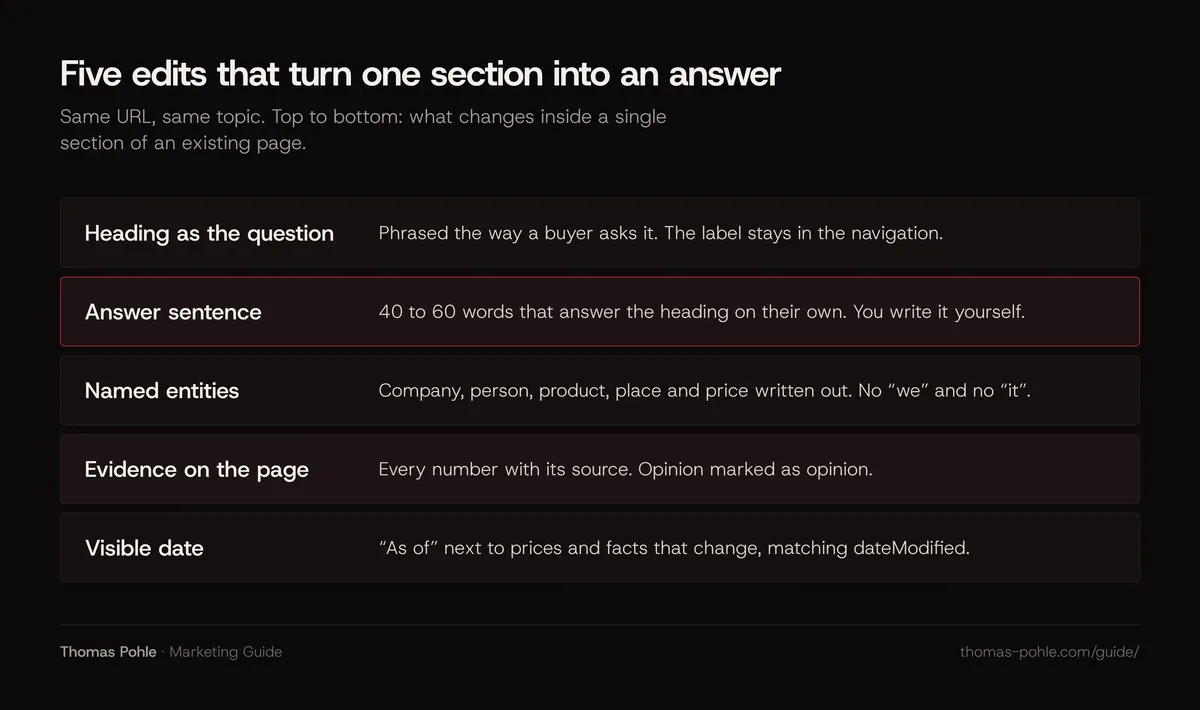
Make five edits, in this order: phrase the heading as the buyer's question, write a 40 to 60 word answer sentence, name every entity, put the evidence on the page and add a visible date. Each edit is small. Together they turn a section that needs context into a passage that works on its own.
Heading as the question
"Three ways to work together" becomes "How can you work with Thomas Pohle, and what does it cost?" That is the question a buyer types into ChatGPT or Google. The short label can stay in the navigation.
Answer sentence
The first paragraph answers the heading completely: who, what, for how long, at what price. My rule of thumb is 40 to 60 words. In my view, this is the sentence that decides whether the section gets quoted. My rule: you write it yourself, or at least feed the tool your own facts and wording. An AI tool can shorten your sentence. It can't know your prices, your process or what your buyers ask, and buyers notice when the experience behind a page is missing.
Named entities
Replace "we", "it" and "our solution" with names: the company, the person, the product, the city, the currency. A passage lifted out of the page loses everything around it, so the names have to travel with it.
Evidence on the page
Every number gets its source in the same sentence or the next. Results from your own work get a time frame. Opinions get marked as opinions. Facts remain facts, opinions remain opinions; that's the line I draw.
Visible date
Put "as of" next to anything that changes: prices, team size, availability. Then set the page's dateModified to the day of the real change, not the day you fixed a typo.
What does the rewritten section look like?
After the rewrite, the section answers the buyer's question in its first sentence, with the name, the three formats, their length and their guide prices. The facts come from the existing consulting page, so nothing new had to be invented. The brand voice stays; the vagueness goes.
How can you work with Thomas Pohle, and what does it cost? Thomas Pohle, a B2B marketing advisor in Zurich, works in three formats: a one-day Momentum Workshop from CHF 4,200, a Momentum Project of four to twelve weeks from CHF 7,800, and Momentum Advisory from CHF 3,500 a month. Guide prices as of November 2026; the final price is fixed before the start. Same amounts in EUR for Germany and Austria. Work usually starts within two weeks of the first call.
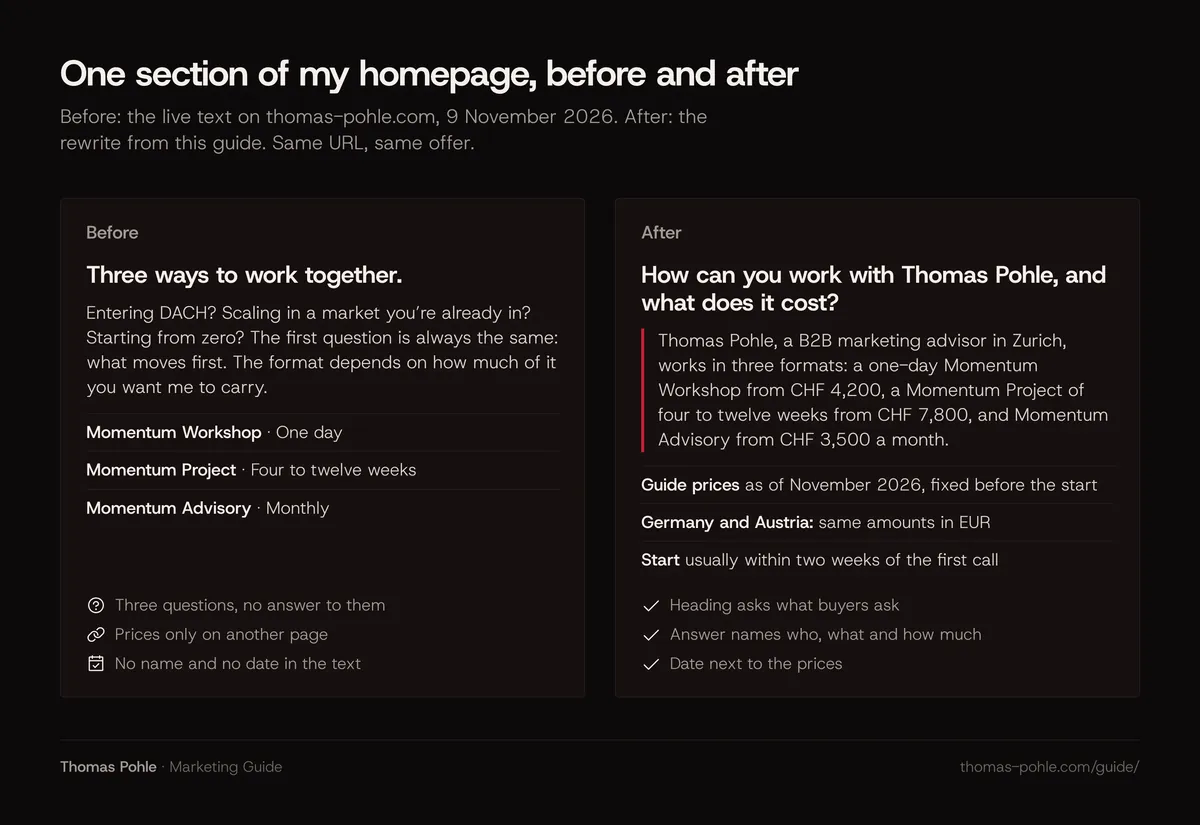
Three things did not change: the URL, the offer and the tone. The rhetorical questions went, because they asked the reader something instead of answering. The live homepage hasn't been changed; the rewrite here demonstrates the method.
The same five edits work on product pages, case studies and old blog posts. For case studies, see the guide on writing a B2B case study that gets cited.
How do you keep dates and facts honest after a rewrite?
Change the date only when the content changed substantially, and show it on the page with a label such as "Updated". Google asks site owners not to change dates to make pages seem fresh, and its byline date guide says visible dates and structured data dates must match. A fake update date costs trust and gains nothing.
Google's documentation on byline dates recommends a visible date labelled "Published" or "Last updated", plus datePublished and dateModified in structured data, and warns against future dates. Its helpful content guide adds that adding or removing a lot of content just to seem fresh won't help.
- Keep a fact list. One line per changing fact on the page: price, team size, market count, with the date you checked it.
- Check it on a schedule. Prices and availability quarterly, everything else when you touch the page.
- One source of truth. If the price lives on three pages, update all three the same day, or link two of them to the third.
- Author on the page. Google strongly encourages accurate bylines; see the guide on E-E-A-T for B2B for how to show authorship.
How do you know whether the rewrite worked?
Compare the rewritten page before and after in Google Search Console's Generative AI performance report and in Bing Webmaster Tools' AI Performance report. Google shows impressions in AI Overviews and AI Mode by page. Bing shows citations and grounding queries. OpenAI's crawler documentation describes no comparable report, so you check ChatGPT by hand.
Google's report counts how often links to your site were shown in a generative AI feature, grouped by page, country, date and device. Bing's report, in public preview since February 2026, counts how often your content is cited as a source and samples the phrases its AI used to retrieve it. Neither tells you where in the answer you appeared.
Give it several weeks before you judge. Google has to recrawl the page first, and Search Console only shows the report once a site has enough impressions in generative AI features. For a full measurement setup, see the guide on getting into Google AI Overviews, which covers recrawl requests and tracking.
What to do this week
- Pick one page. The one buyers land on most before they contact you, usually the offer or pricing page.
- List its sections. Run each through the decision table: rewrite, merge, leave or delete.
- Rewrite one section. Question heading, a 40 to 60 word answer sentence you write yourself, names instead of "we".
- Pull the facts in. Prices, duration, location from wherever they sit on the site, with "as of" and the month.
- Check the dates. Visible "Updated" date and dateModified match, and both show the real change.
- Write the fact list. Every changing fact on the page, with the date you checked it.
- Note the baseline. Impressions in the Search Console Generative AI report and citations in Bing for that page today.
One section a week adds up: after a quarter, a dozen sections answer in their first sentence, without a single new URL.
If you'd rather have someone go through your pages with your team and decide what to rewrite first, that's what a one-day Momentum Workshop is for.
Frequently asked questions
Do I need to rewrite my whole website for AI search?
No. Start with the pages buyers visit before they contact you, and within them, the sections that answer a buying question. Google's 2026 guide says no special format is needed for its AI features, so the goal is clearer answers for people. Brand copy, stories and hero lines can stay as they are.
Should I add an FAQ section to every page?
Only where buyers really ask follow-up questions. Bing says FAQ sections help surface key information, and Google says structured data isn't required for its AI features. An FAQ that repeats the page adds length without adding answers. Better: fix the main sections first, then add three to five real questions.
Can I use AI to rewrite my existing content?
You can use it to shorten, restructure and check your text. Write the answer sentences and the evidence yourself, or at least give the tool your own facts and wording. Google asks for content based on what you know and the experience you bring, and an AI tool can't know your prices, process or buyers.
Does updating the date help my page get cited?
Not on its own. Google asks site owners not to change dates to make pages seem fresh when the content has not substantially changed. Update the visible date and dateModified when you change facts, prices or answers. Bing says regular updates help AI systems reference the current version of your content.
How long should a rewritten section be?
As long as the question needs. Google says there is no ideal page length and no need to break content into tiny pieces. My rule of thumb: a section that answers one buyer question opens with a 40 to 60 word answer and rarely needs more than a few short paragraphs or one table after it.
Sources
- Google Search Central: Optimizing your website for generative AI features on Google Search (updated July 2026)
- Google Search Central Blog: A new resource for optimizing for generative AI in Google Search (May 2026)
- Google Search Central: AI features and your website
- Google Search Central: Creating helpful, reliable, people-first content (updated October 2026)
- Google Search Central: Influence your byline dates in Google Search
- Search Console Help: Generative AI performance report (Search)
- Bing Webmaster Blog: Introducing AI Performance in Bing Webmaster Tools public preview (February 2026)
- OpenAI: Overview of OpenAI crawlers
- Aggarwal et al.: GEO, Generative Engine Optimization (arXiv 2311.09735, KDD 2024)

Thomas PohleB2B marketing advisor in Zurich. More than ten years in B2B marketing at Link11, Beekeeper and smino, most recently as Head of Marketing. CEO and co-founder of TEISENDA. Researched and drafted with AI tools, checked against the sources listed above. More about Thomas