How do you choose an AI SEO agency?

Test every claim an AI SEO agency makes against what Google, Bing and OpenAI publish. A good agency starts with your technical base and your best pages, separates proven work from experiments and reports with your own Search Console and Bing data. Walk away from guaranteed citations, mass-produced pages and secret tricks.
This guide is for founders and marketing leads with two or three proposals on the table who can't tell substance from buzzwords. You get the warning signs with their primary sources, the questions for the first call with what a good answer sounds like, a scorecard with thresholds, and a clear line between what an agency can do and what stays in your company. For the bigger picture, start with the pillar guide on how SEO changes when AI answers the search.
What should an AI SEO agency actually do for you?
An AI SEO agency should make your site eligible, readable and worth citing in AI answers. That's mostly SEO done thoroughly. Google states that from its perspective optimizing for generative AI search is still SEO. Its own page on hiring an SEO lists optimizing for generative AI among the services a good provider may offer.
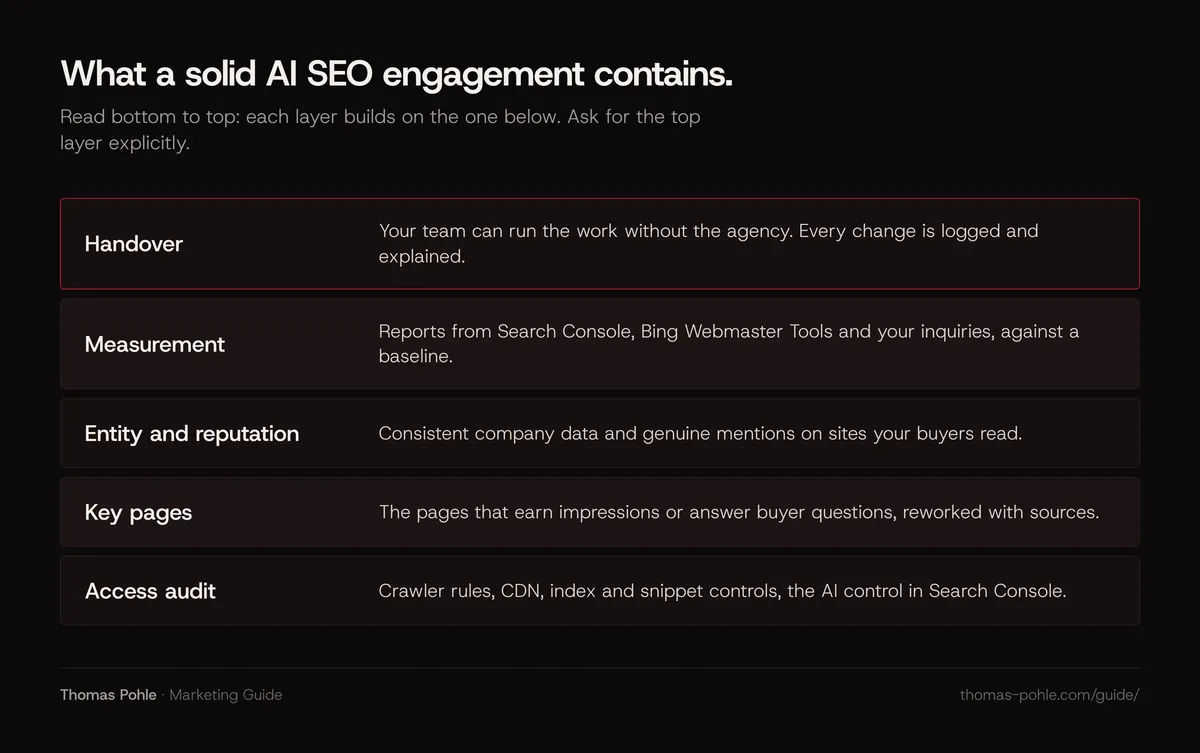
In practice the useful scope is narrow and concrete:
- Access and eligibility. Crawler rules, CDN settings, index and snippet controls, the AI control in Search Console.
- Your best pages. Restructuring the pages that already earn impressions or answer what buyers ask, with sources and a clear answer per section.
- Entity and reputation. Consistent company data and genuine mentions on sites your buyers read.
- Measurement. Reports built on Search Console, Bing Webmaster Tools and your inquiry data.
Does a proposal spend most of its budget elsewhere? Ask why. What to fix first is in the checklist on how to optimize your website for AI search.
Which promises should make you walk away?
Walk away from any agency that guarantees rankings or AI citations, claims special access to Google, sells placement inside ChatGPT answers or plans hundreds of AI-written pages. Each of these contradicts what Google or OpenAI has published. You can check the claim yourself in a few minutes. No need to trust a sales deck.
- Guaranteed positions or citations. Google says no one can guarantee a number one ranking, and that you should find someone else if an SEO promises first place.
- "Approved by Google" or "internal Google data". Google says it doesn't evaluate third-party services, and that no third-party tool has access to its internal ranking or AI systems.
- Paid placement in ChatGPT answers. OpenAI says answers are shaped by what is objectively useful, never by advertising, and that ads are labeled and kept separate from the answer.
- Pages for every query variation. Google says creating content for every fan-out query mainly to manipulate AI responses violates its scaled content abuse policy.
- llms.txt as the main lever. Google Search ignores llms.txt. It neither helps nor harms there. Fine as an extra. As a strategy, it's wrong.
- Bought or seeded mentions. Google calls inauthentic mentions less helpful than they seem, and buying links for ranking is link spam.
- Secrecy. Google warns against companies that are secretive or won't explain what they intend to do.
One claim needs context. Don't reject it outright. Agencies often quote the GEO study by Aggarwal and colleagues, accepted at KDD 2024, which reported visibility gains of up to 40 % in generative engine responses. That's a result on a research benchmark. It shows content changes can matter. It promises nothing for your site.
Which questions should you ask in the first call?
Ask questions that force the agency to separate documented facts from its own experience and to show how it would spot failure. Google publishes a list for hiring any SEO, including what results to expect in what timeframe, whether all changes are shared and the reasoning behind recommendations. Add four questions specific to AI search.
| Question | A good answer | A warning answer |
|---|---|---|
| What will you check first? | Crawler access, index status, the pages that earn impressions | A content calendar with 50 new articles |
| Which of your methods are documented by Google, Bing or OpenAI, and which are your experience? | Names sources, labels opinions as opinions | "Our proprietary GEO framework" |
| How would we know in 90 days that it is not working? | A baseline from Search Console and Bing, agreed thresholds | "AI visibility takes time, trust the process" |
| Will you share every change you make to the site? | Yes, with a change log and the reasoning | "We handle the technical side for you" |
| Who writes, and who checks facts? | A named person; AI drafts are reviewed before publishing | Volume targets, no review step |
| Which tool data do you report? | First-party data, plus tool trends with their prompt sample | One "AI visibility score" from their own tool |
Google also suggests checking whether the provider is interested in you. A good SEO asks what makes your business unique, who your competitors are and how your customers find you. Is the first call a pitch without questions? Then you know how the project will run.
How do you score competing proposals?
Score each proposal on eight criteria from 0 to 2 points, for a maximum of 16. My rule of thumb: any red flag from the list above disqualifies, whatever the points. 12 or more makes the shortlist. Below 10 is out. The scorecard turns impressions from sales calls into a comparison your team can defend.
- Starts with access and existing pages before new content.
- Cites primary sources for claims about how AI search works.
- Labels experiments as experiments.
- Reports first-party data from Search Console, Bing and your CRM.
- Shares every change with reasoning.
- Understands your buyers and asked about them in the first call.
- Leaves you in control of accounts, content and data.
- Plans a handover so your team can continue without them.
A typical scenario: three proposals. The first offers 40 AI-written articles a month and a dashboard score. It scores 6 and guarantees "AI top placement", so the red flag alone kills it. The second starts with an audit of the ten key pages and reports from Search Console. It scores 13. The third scores 11 but brings stronger industry experience. Here I'd invite the third back on the questions it answered weakly before deciding. 11 is close enough to the line to justify one more conversation.
What should stay in-house?
Keep everything in-house that defines what's true about your company: positioning, the topics that matter to buyers, final fact approval and ownership of every account. An agency can audit, draft and implement. It can't know what your sales team hears every week. And it should never hold the keys to your Search Console or your domain.
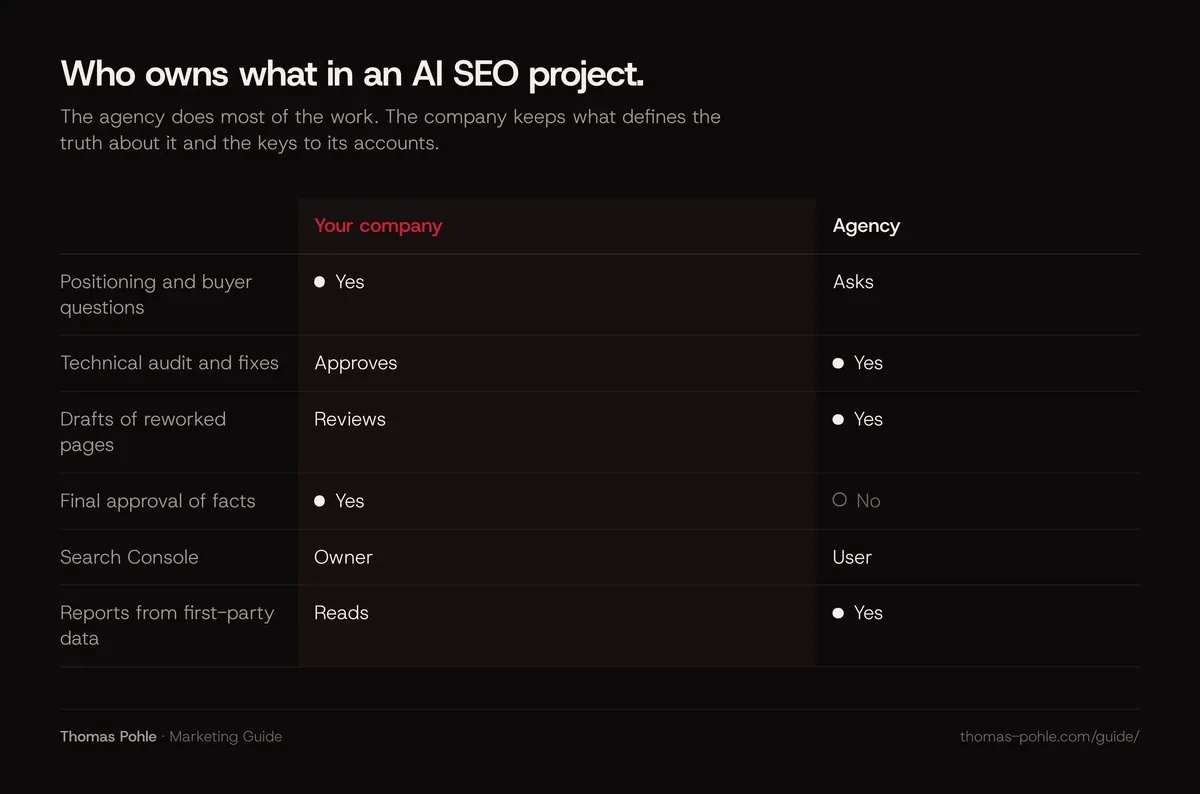
Account ownership is concrete. Search Console has owners, full users and restricted users, and only owners can add or remove users. For the audit stage, Google advises granting read access only. No write access. Make sure a person in your company is the verified owner and the agency is a user you can remove. Google also reminds site owners that they're responsible for the actions of any company they hire.
The other reason is knowledge. Here's how I see the alternatives. An agency executes but often doesn't understand the business. A consultant delivers slides and nobody runs them. Whatever you choose, build it with your team, so the knowledge stays with you when the external help is gone. In AI search that matters more than usual. Google, Bing and OpenAI have changed their documentation and reports several times in 2026 alone, and someone inside has to notice.
How should the first 90 days be set up?
Start with a paid, fixed-scope phase of about 90 days. Skip the open-ended retainer. The phase should deliver an access audit, the reworked key pages and a baseline report, with a decision point at the end. If the agency pushes back on a short first phase with measurable outputs, treat that as information.
- Weeks 1 to 2. Access audit and baseline: AI impressions per page from Search Console, citations from Bing, inquiries that name an assistant.
- Weeks 3 to 8. Rework of the agreed key pages, every change logged, every fact approved by your side.
- Weeks 9 to 12. Entity and mentions work, first comparison against the baseline, written recommendation for the next phase.
Treat this as a planning frame. It isn't a benchmark. Content changes need recrawling, so the 90-day report shows direction. The final result comes later. The decision point asks two things: did the agency do what it said, and did its reasoning hold up?
How do you check whether the agency is working?
Check the agency against first-party data you can open yourself. Search Console's generative AI report shows impressions in AI Overviews and AI Mode by page, country and date. Bing's AI Performance report shows citations, cited pages and sample grounding queries across Copilot and Bing's AI-generated summaries. Your CRM shows whether inquiries mention AI assistants.
Third-party AI visibility tools sample prompts, and their numbers depend on which prompts they run. Google says no third-party tool has access to its internal ranking data and that any predictions are their own. Use such tools for trends. Ask the agency to show the prompt list behind every chart. The full reporting setup is in the guide on measuring organic and AI search visibility.
Do you need a separate GEO agency at all?
My take: most B2B companies don't need a separate GEO agency next to their SEO provider. Google treats generative AI optimization as part of SEO, and the work overlaps almost completely: access, page quality, reputation and measurement. Two agencies on one website usually means two reports and nobody responsible for the result.
A specialist makes sense in two cases. Your current SEO provider can't answer the first-call questions above. Or you have no SEO provider and want one partner who covers search and AI answers together. For the terms themselves, see what answer engine optimization is.
What to do this week
- Check who's the verified owner of your Search Console property. If nobody in the company is, add yourself.
- Export a baseline: AI impressions per page from Search Console and citations from Bing Webmaster Tools.
- Write down the five questions your buyers ask most, so you can test every agency on them.
- Send the six first-call questions to each agency before the meeting.
- Score every proposal on the eight criteria and drop anything with a red flag.
- Ask the shortlisted agency for a fixed-scope first phase of about 90 days with a decision point.
- Name the person in your company who approves facts before anything goes live.
The market for AI SEO services is young, and the vocabulary moves faster than the evidence. Your protection is simple. Ask for sources, keep the accounts and judge by your own data. Want a second opinion on proposals before you sign? A Momentum Workshop is one day to sort it out with your team.
Frequently asked questions
What does an AI SEO agency cost?
Nobody publishes a reliable price benchmark for AI SEO services. So compare scope, and ignore the rates at first. Ask what exactly the first 90 days deliver: an access audit, how many reworked pages, which reports. A proposal that lists deliverables and a decision point is far easier to judge than a monthly retainer with an AI visibility score.
Is GEO different from SEO?
Google says that from its perspective optimizing for generative AI search is still SEO. The term GEO comes from a 2023 research paper on generative engines. In practice both rest on the same base of crawlable, indexed, trustworthy pages. If an agency sells GEO as a completely separate discipline, make it explain what it does that good SEO doesn't.
Can an agency get my company into ChatGPT answers?
An agency can make sure OpenAI's search crawler reaches your pages and that those pages answer buyer questions clearly. It can't guarantee a citation. OpenAI says ChatGPT answers are shaped by what is objectively useful and never by advertising, and that ads are labeled and separated from the answer.
Should I give the agency owner access to Search Console?
No. Keep a person from your company as the verified owner and add the agency as a full or restricted user. You can remove that user at any time. Google advises granting read access only during an audit. Owners can add and remove users, so owner rights would let the agency control access to your own data.
How long until an AI SEO agency shows results?
Access fixes can show within days. OpenAI says robots.txt changes reach its systems in about 24 hours. Reworked pages need recrawling, so my estimate for content effects is weeks to months. Judge the first 90 days on two things: did the agency deliver what it promised, and did the baseline move in the right direction?
Sources
- Google Search Central: Do you need an SEO?
- Google Search Central: Guidance on using third-party SEO tools, services, and advice
- Google Search Central: Optimizing your website for generative AI features on Google Search
- Google Search Central: Spam policies for Google web search
- Search Console Help: Manage users, owners, and permissions
- OpenAI: Our approach to advertising and expanding access to ChatGPT (January 2026)
- OpenAI: Overview of OpenAI crawlers
- Google Search Central Blog: Introducing Search Generative AI performance reports in Search Console (June 2026)
- Bing Webmaster Blog: Introducing AI Performance in Bing Webmaster Tools Public Preview (February 2026)
- Aggarwal et al.: GEO, Generative Engine Optimization (arXiv 2311.09735, KDD 2024)

Thomas PohleB2B marketing advisor in Zurich. More than ten years in B2B marketing at Link11, Beekeeper and smino, most recently as Head of Marketing. CEO and co-founder of TEISENDA. Researched and drafted with AI tools, checked against the sources listed above. More about Thomas