What is generative engine optimization (GEO)?

Generative engine optimization (GEO) is the work of getting your content named, quoted and linked inside answers written by AI systems such as ChatGPT, Perplexity, Microsoft Copilot and Google's AI Overviews. The term comes from a 2023 research paper. Most of the work is good SEO with a new label. Measuring citations in AI answers is the new part.
This entry is for founders and marketing leads who hear GEO, AEO, AI SEO and LLMO in the same meeting. What changes for your SEO program as a whole is in the pillar on how SEO changes when AI answers the search.
Where does the term generative engine optimization come from?
The term comes from a paper by Pranjal Aggarwal and five co-authors from IIT Delhi, Princeton University and two independent researchers. It went up on arXiv on 16 November 2023 and appeared at KDD 2024. The authors presented GEO as the first approach to help content creators gain visibility in generative engine responses.
A generative engine, in the paper's sense, retrieves sources and has a language model write one answer from them, with citations. Its examples: Bing Chat, Google's Search Generative Experience and Perplexity. Marketing picked up the acronym fast and now uses it for almost any work on AI visibility.
What did the GEO paper actually measure?
The paper measured how much of an AI-written answer cited one source after that source was rewritten. The authors built a test engine on 10,000 queries, fed it the top five Google results per query, rewrote one of the five pages with one of nine methods, and compared the share of the answer citing it before and after.
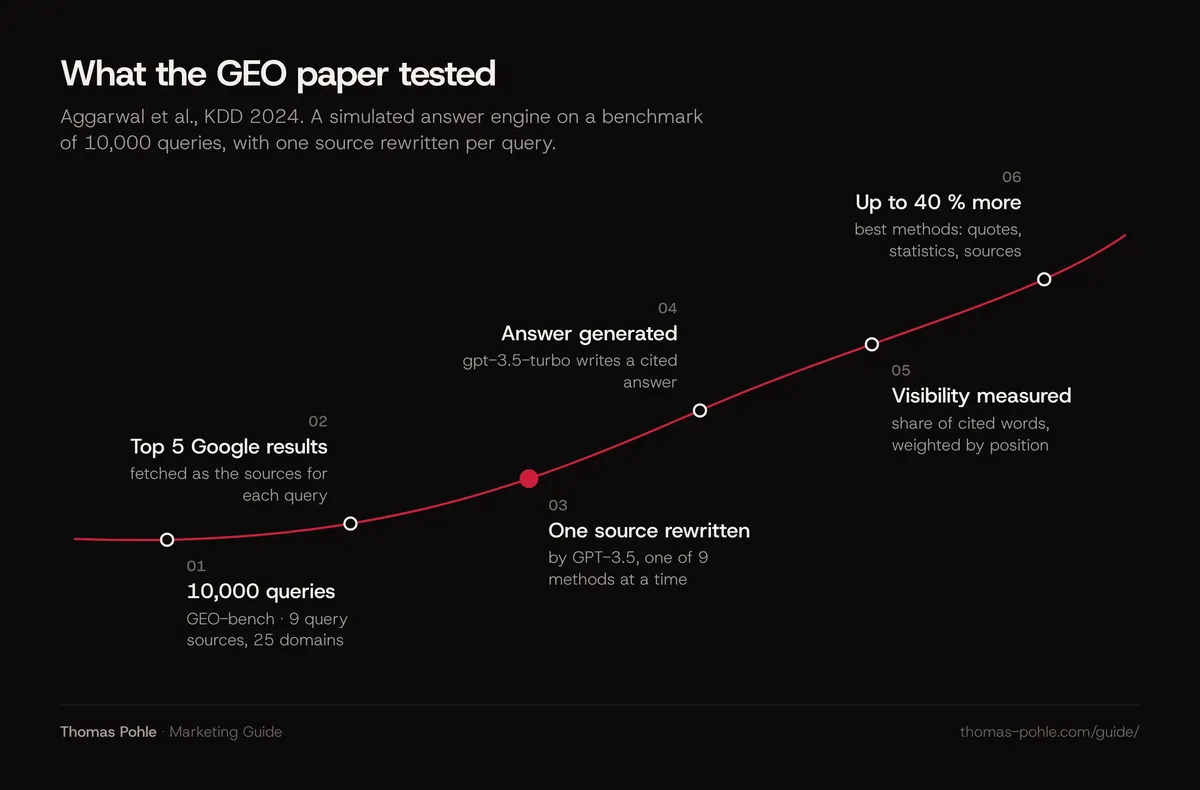
- Benchmark. GEO-bench: 10,000 queries from nine sources such as MS MARCO, Natural Questions and Perplexity's Discover feed, across 25 domains. About 80 % are informational.
- Engine. gpt-3.5-turbo wrote the answers; GPT-3.5 also did the rewrites.
- Score. Words in answer sentences that cite the page, weighted higher for earlier positions.
| Method | What the rewrite did | Score |
|---|---|---|
| No change | Baseline | 19.3 |
| Quotation addition | Added quotes from relevant sources | 27.2 |
| Statistics addition | Replaced vague claims with numbers | 25.2 |
| Cite sources | Added citations to credible sources | 24.6 |
| Keyword stuffing | Added more query keywords | 17.7 |
The abstract says GEO can boost visibility by up to 40 %. In table 1 the best method, quotation addition, beats the unchanged page by 41 % (27.2 against 19.3) in that lab setup. Keyword stuffing scored below the unchanged page. Pages ranked fifth gained most: adding citations raised the visibility of rank-5 sources by 115.1 % and lowered it for rank-1 sources by 30.3 %.
What are the limits of the GEO study?
The GEO study is a lab result. It used a simulated engine on gpt-3.5-turbo, rewrote one page while four competing pages stayed unchanged, and scored visibility with a formula and a language model as judge. It didn't test ChatGPT, Google AI Overviews or Microsoft Copilot as they work in 2026, and it didn't check search rankings.
- One live check. Perplexity was tested on 200 queries with the sources uploaded as files. Quotation addition raised the score from 24.1 to 29.1.
- No rankings. A rewrite that wins inside the answer could cost the page its top-five place.
My take: the paper is good evidence that quotes, numbers and named sources make a text more useful to a system that summarizes. It's no evidence that a GEO package will lift your citations in ChatGPT by 40 %.
How is GEO different from SEO, AEO, AI SEO and LLMO?
SEO aims at rankings in search results. AEO aims at being the quoted source of a direct answer. GEO aims at visibility inside AI-generated answers. AI SEO and LLMO are industry labels without a defining study. In practice the terms describe one overlapping body of work.
| Term | Origin | What it aims at | How precise |
|---|---|---|---|
| SEO | Search industry | Rankings and clicks in search results | Precise |
| AEO | Industry term | Being the quoted answer in snippets and AI answers | Fairly precise |
| GEO | Aggarwal et al., 2023 | Share of an AI answer that cites you | Precise in the paper, loose in marketing |
| AI SEO, LLMO | Agencies and tool vendors | SEO for AI search, or SEO done with AI | Vague |
AI SEO is the slipperiest: some mean optimizing for AI search, others doing SEO with AI tools. Ask before you sign. I use AEO as the umbrella term in this guide because it keeps the focus on the buyer's question; the full definition is in what answer engine optimization is.
What do Google, Microsoft, OpenAI and Perplexity say about GEO?
Google says GEO is still SEO. Its guide for generative AI features, published on 15 May 2026, states that optimizing for generative AI search is optimizing for the search experience, and thus still SEO. Microsoft uses the term itself and calls its citation report in Bing Webmaster Tools an early step toward GEO tooling.
- Google, May 2026. No special files, Markdown or schema needed, no ideal page length, and chasing inauthentic mentions isn't as helpful as it seems.
- Microsoft, February 2026. Bing's AI Performance report shows citations in Copilot, Bing's AI summaries and select partners, plus grounding queries. The announcement doesn't mention clicks.
- OpenAI. Sites opted out of OAI-SearchBot won't be shown in ChatGPT search answers, except as navigational links.
- Perplexity. PerplexityBot surfaces and links websites in its results and, Perplexity says, isn't used to crawl content for AI foundation models.
None publishes how it picks the page it cites. The crawler setup is in how to get cited by ChatGPT, Perplexity and Google AI.
Which part of GEO is just good SEO with a new label?
Most of it. Crawler access, a page in the index, a clear answer early in each section, evidence with sources, and a company described the same way everywhere were good practice before any AI answer existed. If a GEO offer is mostly this list, you're buying SEO.
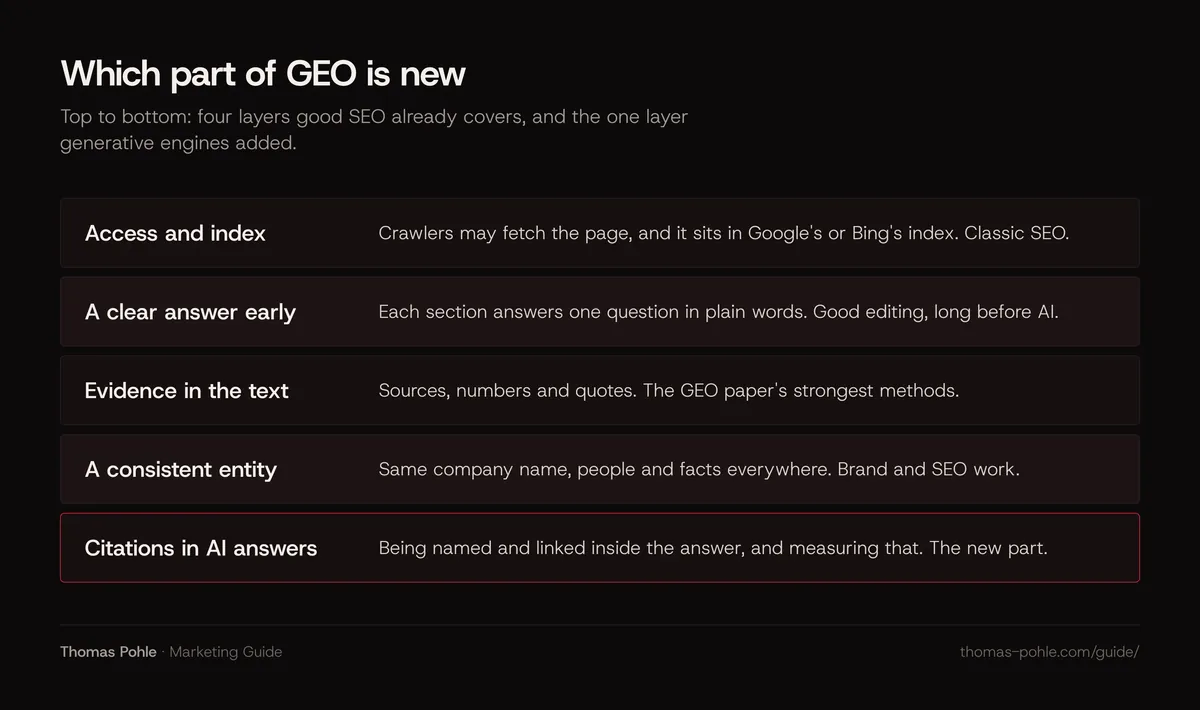
Even the paper's best methods are old editorial virtues: quote people who know, put a number where you'd write "many", name your source. My own guide is built that way, with a question headline, a 40 to 60 word answer first, an FAQ and primary sources. On my own profiles I keep one role line, one claim and company names written exactly as the companies write them. That's brand hygiene, covered in one brand everywhere.
In my view, writing the content yourself, or at least feeding your own experience and numbers into every draft, is still the best way to get cited. A page that repeats a hundred others gives an answer engine no reason to pick yours.
What is really new about GEO?
Two things are new. Success is now a citation inside an answer, which often brings no click. And you can measure that citation only partly, through reports Google and Microsoft introduced in 2026.
- Google. Search Console's generative AI report (all sites since 31 August 2026) shows impressions in AI Overviews and AI Mode by page. No clicks.
- Microsoft. Bing's AI Performance report (public preview since 10 February 2026) counts citations.
- The gaps. OpenAI and Perplexity document no comparable citation report open to every site owner. Third-party tools sample prompts. Read their numbers as a trend.
Here's my view: create no separate GEO budget line. Add AI citations as a goal to the SEO and content work you already pay for, and track it as described in how to measure organic and AI search visibility.
What to do this week
You don't need a GEO project. You need a few checks that show whether your existing pages can be retrieved, cited and measured. All of them fit into one week next to normal work.
- Ask what GEO means. If an agency offers it, get the task list and mark each item as SEO, content or measurement.
- Check crawler access. robots.txt for Googlebot, Bingbot, OAI-SearchBot and PerplexityBot.
- Open two reports. Google's generative AI report and Bing's AI Performance report.
- Fix five pages. A 40 to 60 word answer at the top of each section, one vague claim per page replaced with a sourced number or quote.
- Add your own experience. One paragraph per page that only your company could write.
- Ask new leads. "Where did you first hear about us?" Log every answer that names an AI assistant.
If you want help deciding which pages to fix first, that's what we settle in a one-day Momentum Workshop.
Frequently asked questions
What is SEO for AI called?
There's no single official name. The most common terms are GEO (generative engine optimization), from a 2023 research paper, and AEO (answer engine optimization). Agencies also say AI SEO or LLMO (large language model optimization). Google's May 2026 guide names AEO and GEO and treats both as SEO.
Is GEO the same as SEO?
Mostly. GEO rests on the same base: crawlable, indexed pages with clear, sourced content. Google says optimizing for its generative AI features is still SEO. The difference is the goal and the measurement: GEO counts citations inside AI answers, which often bring no click, so you track them in separate reports.
Does GEO really increase visibility by 40 %?
Only in the original study's setup: a test engine built on gpt-3.5-turbo and the top five Google results, with one page rewritten. The authors didn't test live ChatGPT or Google AI Overviews and didn't check search rankings. Treat 40 % as a lab result, never as a forecast for your site.
Do I need an llms.txt file or special schema for GEO?
Not for Google. Its May 2026 guide says you don't need new machine readable files, AI text files, Markdown or special schema.org markup to appear in its generative AI features. Regular structured data still helps with rich results. Google Search ignores llms.txt, so treat it as an optional extra for other services at best.
Sources
- Aggarwal et al.: GEO: Generative Engine Optimization (arXiv 2311.09735, v3 June 2024, KDD 2024)
- Aggarwal et al.: GEO: Generative Engine Optimization, full text (methods, GEO-bench, results, limitations)
- Google Search Central: Optimizing your website for generative AI features on Google Search (May 2026)
- Google Search Central Blog: A new resource for optimizing for generative AI in Google Search (15 May 2026)
- Google Search Central: AI features and your website
- Google Search Central Blog: Introducing Search Generative AI performance reports in Search Console (June 2026, rolled out to all sites 31 August 2026)
- Bing Webmaster Blog: Introducing AI Performance in Bing Webmaster Tools public preview (February 2026)
- OpenAI: Overview of OpenAI crawlers
- Perplexity: Perplexity crawlers

Thomas PohleB2B marketing advisor in Zurich. More than ten years in B2B marketing at Link11, Beekeeper and smino, most recently as Head of Marketing. CEO and co-founder of TEISENDA. Researched and drafted with AI tools, checked against the sources listed above. More about Thomas