What does B2B mean?
B2B stands for business-to-business. It means you sell to other companies, public bodies or professionals instead of private consumers. A machine builder selling to factories, a tax advisor working for firms and a software company selling to construction contractors are all B2B. The buyer spends the organization's money. Their own wallet stays closed.
Below you get the definition, examples from the Mittelstand in Germany, Austria and Switzerland, and what the term changes in marketing, sales and contracts. For the whole marketing system, read the guide to what B2B marketing is and how it works.
What does B2B stand for?
B2B is short for business-to-business. Both sides of the deal act as businesses: the seller is a company, and the buyer acts for a company, a public authority or a professional practice. The opposite is B2C, business-to-consumer, where a private person buys for personal use. The B2B sector, or B2B market, is the sum of all such trade.
German law draws the same line. Section 14 of the Civil Code (BGB) defines an entrepreneur as a person or company acting in its commercial or independent professional activity. Section 13 defines a consumer as a natural person buying for purposes mostly outside that activity. The purpose decides. The product doesn't. A freelance architect buying a laptop for her office buys B2B. The same laptop for her children is B2C. Orientation only, no legal advice.
What are typical B2B business models?
Most B2B companies run one of five models. They make goods for other companies, trade them, provide professional services, sell software, or run operational services such as maintenance and logistics. Many Mittelstand firms in Germany, Austria and Switzerland combine two. A machine builder that also earns money from service contracts is the classic case.
| Model | What is sold | Typical buyer |
|---|---|---|
| Manufacturing and components | Machines, parts, materials | Production, engineering and purchasing |
| Wholesale and distribution | Goods in volume, with logistics | Retailers, trades, workshops |
| Professional services | Advice, legal, tax, engineering, IT projects | Management, finance, specialist teams |
| Software and SaaS | Licences or subscriptions for business processes | The department that uses it, plus IT |
| Operational services | Maintenance, logistics, facility services | Operations and facility management |
All three companies I worked for in-house were B2B, each in a different shape. Link11 sells DDoS protection. Beekeeper built an employee app for frontline teams. smino makes construction management software. The buyer was always a team inside an organization.
Today I work only with B2B companies, mostly founders and CEOs of firms with 1 to 200 employees in the DACH region. I don't take B2C work.
How does B2B show up along a value chain?
Most products pass through several B2B sales before a consumer ever sees them. Take a coffee machine in a café. A steel supplier sells to a pump maker, the pump maker to a machine builder, the machine builder to a distributor, the distributor to the café. That's four sales between companies. Only the cup of coffee goes to a consumer.
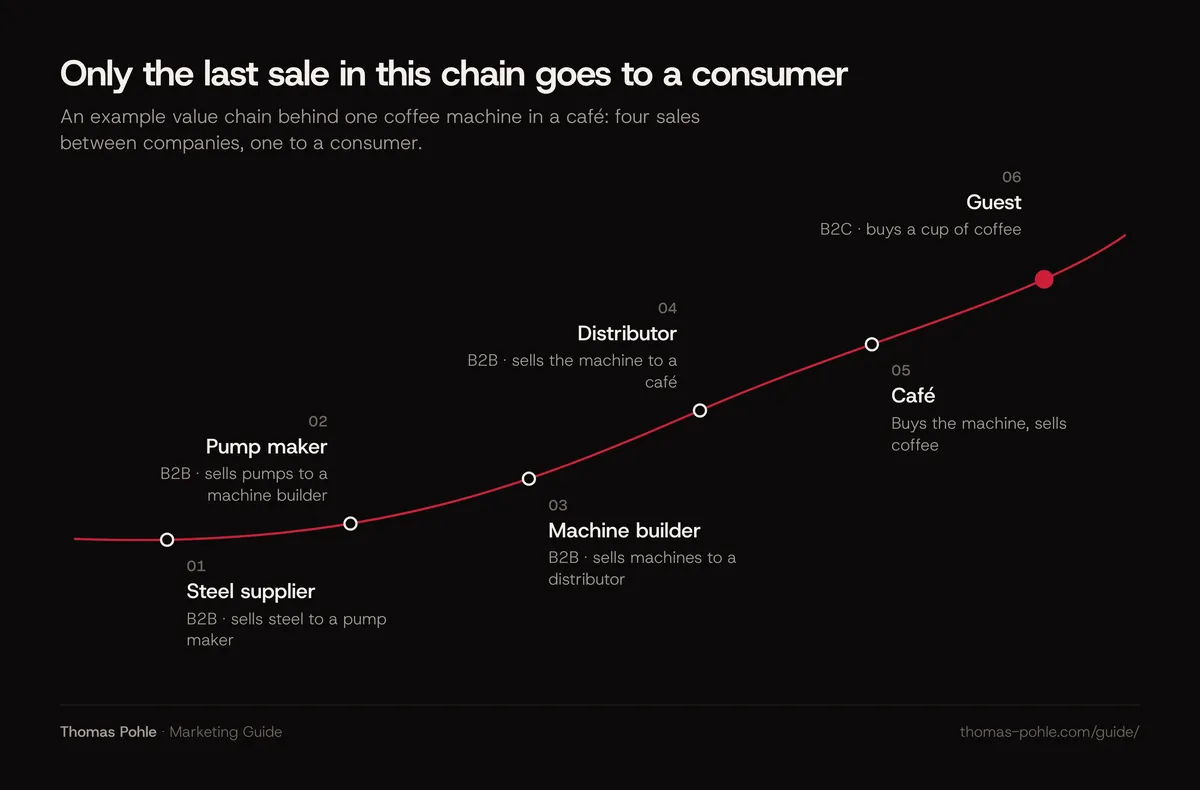
That's why so many B2B companies are unknown to the public, even when their parts sit in everyday products. For your marketing, that's good news. You don't need fame with everyone. You need it with the organizations that can buy from you.
How big is the B2B market?
Nobody publishes "the B2B market" as a single official number. The data that does exist shows its weight. Eurostat reports that in 2024, web sales to other businesses and public authorities made up 4.34 % of the turnover of EU enterprises with ten or more employees. That's slightly more than the 4.04 % from web sales to consumers.
- Online sales. Eurostat counts sales to businesses and to public authorities together. Deals closed by sales teams, tenders or EDI connections aren't in the web sales figure.
- Public buyers. EU public authorities spend around 2.6 trillion euros, about 15 % of EU GDP, on services, works and supplies, according to the European Commission. Selling to them is called B2G.
- Size of the buyers. In Germany, 99.3 % of companies were small or medium-sized in 2024, yet they generated only 27 % of turnover, according to Destatis. Most B2B customers are small. Most of the money sits with a few large ones.
Act on the last point first. Decide whether you're after many small companies or a few large ones. That choice changes your price, your sales process and your channels.
What does B2B mean for marketing?
In B2B marketing, the customer is one organization, but many people decide. Forrester's State of Business Buying 2024 found an average of 13 people involved in a buying decision, and 89 % of purchases spanned two or more departments. So your marketing has to reach a whole buying group and stay known between purchases, which can be years apart.
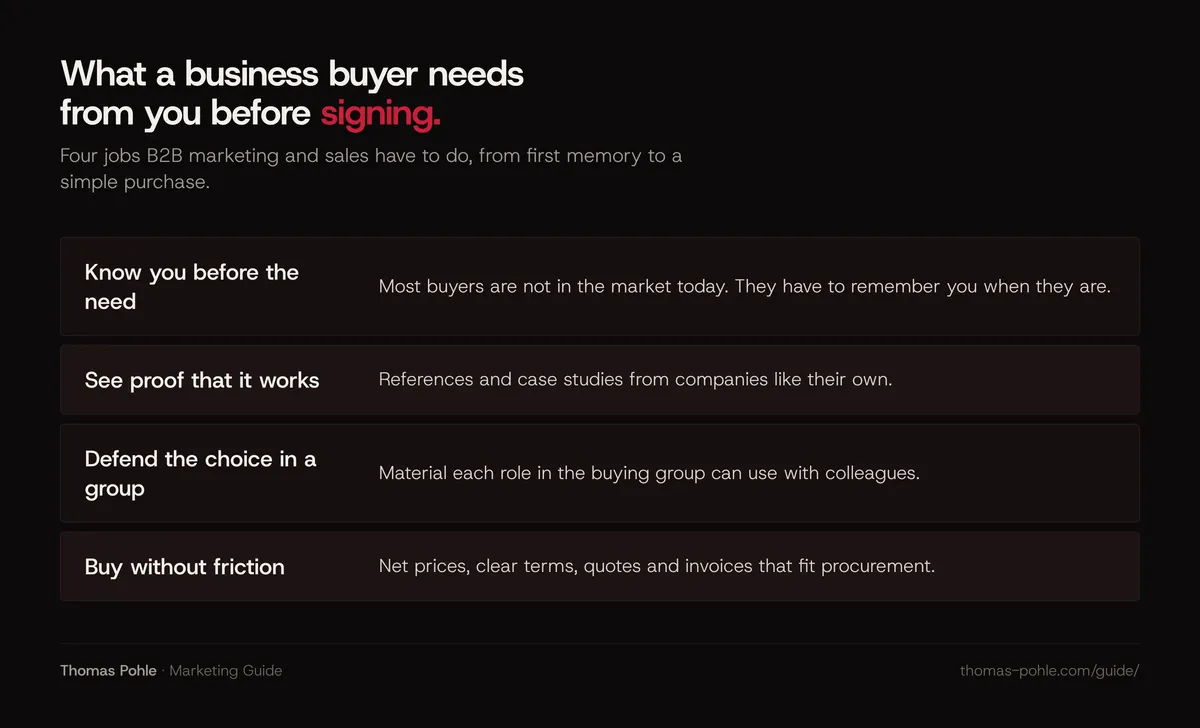
- Know you before the need. Most organizations aren't shopping for what you sell this quarter. They have to remember you when they are.
- See proof. Evidence from companies like their own, for example a B2B case study that gets cited.
- Defend the choice. Finance wants cost, IT wants security, the user wants less work.
- Buy without friction. Quotes, terms and invoices that fit procurement.
So you target on two levels: first the company, then the roles inside it. That's the idea behind account-based marketing. It's also why clear B2B positioning comes before any channel.
What does B2B mean for prices, contracts and law?
B2B changes the commercial and legal frame too. Prices are usually quoted without VAT, deals run on negotiated contracts and terms, and many consumer protection rules don't apply. In Germany, the Price Indication Ordinance (PAngV) requires total prices when a business offers goods or services to consumers. That's why B2B offers are often quoted net.
- Prices. Section 3 PAngV requires total prices from businesses that offer to consumers.
- Right of withdrawal. Under section 312g BGB, consumers have a right of withdrawal for distance and off-premises contracts; section 355 sets the period at 14 days. Switzerland has no statutory right to return online purchases, according to the federal SME portal.
- VAT across EU borders. According to the EU's Your Europe portal, goods sold to a business with a valid EU VAT number are usually invoiced without VAT, and services are usually taxed in the customer's country via reverse charge.
This is orientation. It isn't legal or tax advice. If you sell to both groups, have a lawyer and a tax advisor check your setup.
Is your company B2B, B2C or both?
You're B2B when your buyers act for an organization, whatever your product looks like. Five questions settle it: who signs, who pays, who uses it, how many people decide, and how long the relationship lasts. My rule of thumb: if at least three of the five answers point to a company, plan your marketing with B2B logic.
| Question | Points to B2B | Points to B2C |
|---|---|---|
| Who signs the order? | A company, authority or practice | A private person |
| Who pays, and how? | Invoice to a company, often with a VAT number | Card or private account |
| Who uses it? | Employees, at work | The buyer or their household |
| How many people decide? | Two or more, from different roles | One person or a couple |
| How long is the relationship? | Ongoing: contract, service, renewal | Often one purchase |
If the answers split, you probably run two businesses under one roof. The details, including mixed forms such as B2B2C and B2G, are in the difference between B2B and B2C.
What to do this week
A week is enough to turn the definition into decisions. Classify your business with the five questions. Write down which model you run and which buyer you serve. Check that your website, prices and terms speak to that buyer. Then decide how many companies you're really after.
- Answer the five questions above for your three most recent customers.
- Write one sentence: "We sell [what] to [which kind of organization], and the decision is made by [which roles]."
- List the roles that took part in your last three deals.
- Check your website: does the first screen say which kind of company you serve?
- Decide: many small firms or a few large ones? Write the number down.
If nobody owns these decisions, a one-day Momentum Workshop sets positioning, ideal customer and the first channel. Your team leaves with a plan it can run on Monday.
Once you know who really buys from you, most marketing choices get easier. You stop writing for everyone.
Frequently asked questions
What is the difference between B2B and B2C?
B2B means a company sells to other organizations. B2C means it sells to private consumers. In B2B a group usually decides, prices are often quoted net and contracts get negotiated. In B2C one person or a household decides, often faster, and consumer protection law applies. The full comparison, with mixed forms, is in the guide on the difference between B2B and B2C.
What does B2G mean?
B2G stands for business-to-government: a company sells to public authorities such as cities, cantons, ministries or public hospitals. It's a special form of B2B. Public buyers usually purchase through procurement procedures and tenders with fixed rules and deadlines. Expect a sales process that looks very different from selling to a private company.
Is a freelancer or a small practice a B2B customer?
Usually yes, when they buy for their work. German law counts a natural person as an entrepreneur when acting in a commercial or independent professional activity. A freelance designer buying software for client projects buys B2B. In practice, small practices often buy like consumers, alone and fast. They still need business invoices.
Can a company be B2B and B2C at the same time?
Yes. Many companies sell to both, for example a manufacturer that supplies retailers and runs its own online shop. Treat them as two audiences with separate messages, prices and legal setups, because consumer protection rules apply only to the consumer side. Have a lawyer check the setup.
Sources
- German Civil Code (BGB), section 13: Verbraucher
- German Civil Code (BGB), section 14: Unternehmer
- German Civil Code (BGB), section 312g: Widerrufsrecht
- German Civil Code (BGB), section 355: Widerrufsrecht bei Verbraucherverträgen
- Preisangabenverordnung (PAngV), section 3: Pflicht zur Angabe des Gesamtpreises
- KMU-Portal (Swiss Confederation): Widerrufsrecht in der Schweiz und der EU
- Your Europe: Cross-border VAT
- Eurostat: E-commerce statistics
- European Commission: Public procurement
- Destatis: Kleine und mittlere Unternehmen
- Forrester: The State of Business Buying, 2024 (press release)
Thomas PohleB2B marketing advisor in Zurich. More than ten years in B2B marketing at Link11, Beekeeper and smino, most recently as Head of Marketing. CEO and co-founder of TEISENDA. Researched and drafted with AI tools, checked against the sources listed above. More about Thomas