What is the difference between B2B and B2C?

B2B and B2C differ in who buys. In B2B a company buys, usually through a group of people, on negotiated terms, for a relationship that lasts years. In B2C a private person buys for personal use, often alone and fast, protected by consumer law. Marketing, sales, pricing and contracts all follow from that one difference.
Below you'll find the differences side by side: the buying decision, the target group and the relationship, plus the mixed forms such as B2B2C that sit in between. At the end there's a decision table for companies that sell to both. For the term itself, see what B2B means. For how a B2B marketing system works as a whole, see the guide to B2B marketing.
What do B2B and B2C mean?
B2B means business-to-business: a company sells to other companies, public authorities or professionals who buy for their work. B2C means business-to-consumer: a company sells to private people who buy for themselves or their household. The product can be identical. The buyer, the purpose of the purchase and the rules that apply are what change.
German law draws the same line. Section 13 of the Civil Code (BGB) defines a consumer as a natural person who buys for purposes mostly outside their trade or profession. Section 14 defines an entrepreneur as someone acting in their commercial or independent professional activity. Many consumer protection rules hang on that split. That's why it matters well beyond marketing.
What are the main differences between B2B and B2C?
B2B and B2C differ in three places: the buying decision, the target group and the relationship. In B2B a group decides, the audience is a countable list of organizations, and the sale opens a relationship with contracts and renewals. In B2C one person decides, the audience is large and anonymous, and many purchases end at the checkout.
| Aspect | B2B | B2C |
|---|---|---|
| Who buys | An organization, through people in roles | A private person or household |
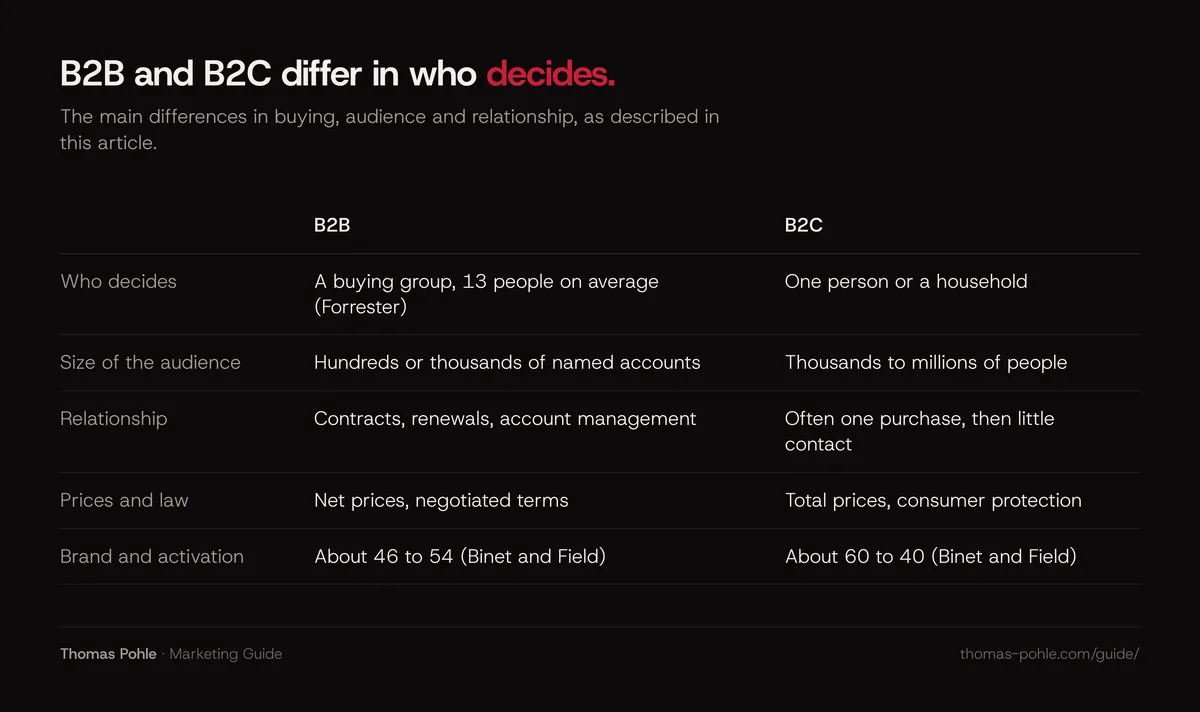
| Who decides | A buying group, 13 people on average according to Forrester | One person, sometimes a couple |
| Target group | Hundreds or thousands of companies you can name | Thousands to millions of people you cannot name |
| Purchase | Rare, larger, often planned with a budget | Frequent or spontaneous, mostly smaller |
| Risk for the buyer | Budget, projects, own reputation | Own money and satisfaction |
| Relationship | Contracts, service, renewals, account management | Often one purchase, then little contact |
| Prices and law | Usually net, negotiated terms | Total prices, consumer protection |
| Typical channels | Website, search, LinkedIn, direct outreach, events, partners | Search, social media, retail, marketplaces, mass media |
Read the table as tendencies. A one-person agency paying for software by card buys B2B but behaves like a consumer. A family buying a house behaves like a buying group. The mixed forms below cover those cases.
How does the buying decision differ?
In B2C one person usually decides, weighs price against desire and can buy within minutes. In B2B a group decides on behalf of an organization, and each member carries part of the risk. Forrester's State of Business Buying 2024 reports an average of 13 people in a buying decision, and 89 % of purchases involve two or more departments.
The same study shows what that does to the process: 86 % of B2B purchases stall at some point. Every extra person adds a question, a meeting and a veto. So your content has to answer the finance lead, the IT lead and the future user. One persona won't cover it.
The classic mistake is to conclude that B2B buyers are purely rational. They aren't. Les Binet and Peter Field analyzed B2B cases from the IPA Databank for the LinkedIn B2B Institute. They found that emotions play a much larger role in B2B than many would believe, even though rational messages come a little more to the fore than in consumer markets. Their example is the old line about IBM: nobody ever got fired for buying it. That's emotional advertising aimed at business buyers.
My take: proof has to come from other people. A buying group trusts what a peer company says about you far more than what you say about yourself. Customer voices, references and case studies carry more weight in B2B than in most consumer markets.
How does the target group differ?
A B2C company addresses a large, anonymous audience and wins people one by one. A B2B company addresses a limited number of organizations it can write down in a list, and several people inside each one. That changes how you plan. B2B marketing counts accounts and roles. B2C marketing counts reach and conversion rates.
Here's a typical scenario, with the arithmetic shown. A software company in Zurich sells to construction firms in the DACH region and counts 1,500 companies that fit its profile. If each buying decision involves 13 people, as in Forrester's average, the real audience is about 19,500 people in known roles. If contracts in the category run about five years, John Dawes's arithmetic for the LinkedIn B2B Institute says roughly 20 % of these companies are in the market per year. That's about 300 companies a year, or 75 a quarter.
| Planning figure | B2B example | B2C example |
|---|---|---|
| Audience | 1,500 named companies | 500,000 runners in the region |
| People to convince per sale | Several, 13 on average (Forrester) | One |
| In the market per quarter | About 75 companies at a five-year cycle (Dawes's arithmetic) | Unknown in advance, many at once |
| What you plan with | Account list, roles, pipeline | Reach, frequency, conversion rate |
An online shop for running shoes can't know who will buy next month. So it buys reach and optimizes conversion. The B2B company can write down the accounts most likely to move next. That's why account-based marketing works in B2B and rarely in B2C.
How does the customer relationship differ?
In B2B the sale is usually where the relationship starts: contracts, onboarding, service, renewals and upsell, often run by named people on both sides. In B2C many purchases end at the checkout, and the relationship runs through the brand, the product and the odd service contact. Lose one B2B customer and you can lose a contract that runs for years.
Don't conclude that B2B growth comes mainly from loyalty. Binet and Field found that in B2B, too, customer acquisition strategies tend to be much more effective than loyalty strategies, just as in consumer markets. Keep the customers you have. Budget for winning new ones.
The relationship also shapes the budget. In the same report, B2B marketing efficiency peaks at about 46 % of the budget for brand building and 54 % for sales activation. The B2C average is closer to 60 to 40. The authors call the B2B ratio a guiding principle based on a small sample. The pillar guide explains how to split budget between brand and demand in more detail.
My take: founders should stay close to customers and sales in both models. In B2B it isn't optional. The relationship is personal, and the founder often holds it.
What changes in prices, contracts and law?
Consumer protection law shapes B2C sales. Negotiated contracts shape B2B sales. In Germany, the Price Indication Ordinance requires total prices when a business offers goods or services to consumers. Consumers also get a 14-day right of withdrawal for distance contracts, such as online orders, and for off-premises contracts. Business buyers generally rely on what their contract says.
- Prices. Section 3 PAngV ties the duty to state total prices to offers made to consumers. That's why B2B offers are often quoted net of VAT.
- Withdrawal. Under section 312g BGB, the right of withdrawal belongs to the consumer. Switzerland has no statutory right to return online purchases at all, according to the federal SME portal. Shops may grant one voluntarily.
- Terms. B2B deals run on quotes, purchase orders, framework agreements and payment terms, often checked by a procurement team.
More on the legal side is in what B2B means. Treat all of this as orientation. It isn't legal advice. If you sell to both groups, have a lawyer check your shop, prices and terms.
Which mixed forms exist between B2B and B2C?
Several mixed forms sit between pure B2B and pure B2C. B2B2C means you sell to a business whose customers or employees use the product. B2G means selling to public authorities. D2C means a manufacturer sells straight to consumers. Self-serve B2B and considered B2C purchases blur the line further, from the buyer's side.
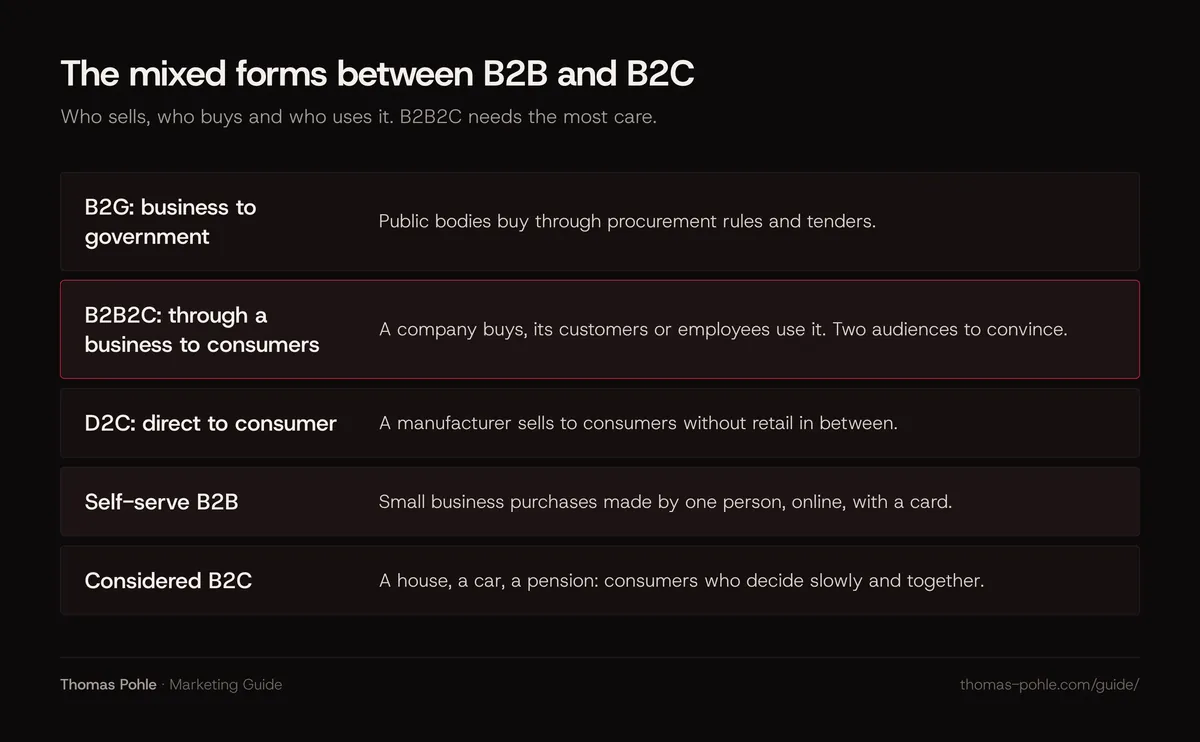
- B2B2C. An employee app bought by an employer, a payment service sold to shops, an insurance sold through a bank. One audience pays, another uses. Your marketing has to win the buyer and make the user want it.
- B2G. Public buyers purchase through procurement rules and tenders. EU public authorities spend around 2.6 trillion euros a year, about 15 % of EU GDP, on services, works and supplies, according to the European Commission.
- D2C. A manufacturer that used to sell through retail opens its own shop. It keeps its B2B business with retailers and adds a B2C business with its own rules.
- Self-serve B2B. Small software subscriptions or office supplies bought by one person with a card. B2B on paper, consumer behavior in practice.
- Considered B2C. A house, a car, a pension. Consumers research for months and decide together.
Should your marketing follow B2B or B2C logic?
Follow the logic of the buyer who brings most of your revenue and makes the decision. If organizations decide and pay, use B2B logic, even for small orders. If private people decide, use B2C logic, even when a company sits in between. Sell to both? Then you need two plans. One compromise plan fits neither side.
The thresholds below are my rule of thumb. They aren't a published standard. Their job is to force a decision, so you don't end up with a mix that fits nobody.
| Your situation | Logic to follow | What it means in practice |
|---|---|---|
| 80 % or more of revenue from organizations | B2B | Account list, buying group content, sales and marketing as one team |
| Between 20 and 80 % | Two plans | Separate pages, prices, budgets and owners per audience |
| 20 % or less from organizations | B2C | Reach and conversion first, a small business desk for company buyers |
| A business pays, consumers or employees use | B2B2C | Sell to the buyer with B2B logic, design adoption for the users |
| Two or more people sign off a typical order | B2B process | Material for each role, even when the order value is small |
Once you know the logic, the next steps are the same as for any B2B company. Decide whom you serve and why you win, as in the guide to B2B positioning. Then turn it into a plan with the B2B marketing strategy guide.
What to do this week
One week is enough to find out which logic your business follows and where your marketing mixes the two. Split last year's revenue by buyer type, count the people involved in recent deals, and check whether your website, prices and terms speak to the buyer who actually decides.
- Split last year's revenue into organizations and private buyers. Place yourself in the decision table.
- For your last five deals, write down how many people took part and in which roles.
- Count your target accounts if you're B2B. Can't write the list? That's your first task.
- Check your homepage. Does it speak to the buyer who decides, or to the user who doesn't?
- Check prices and terms. Net or total, and for which audience?
- If you sell B2B2C, write one sentence for the buyer and one for the user. Compare them.
- If you serve both worlds, name one owner per audience.
Does the table show two businesses running on one plan? A one-day Momentum Workshop sets positioning, ideal customer and the first channel for the side that matters most. Your team leaves with a plan it can run on Monday.
Plan for how the decision gets made. The channels follow.
Frequently asked questions
What is the main difference between B2B and B2C?
Who buys. In B2B an organization buys, usually through a group of people who share the decision and the risk. In B2C a private person buys for personal use. Everything else follows from that: longer decisions, smaller and countable target groups, contracts and net prices in B2B; larger audiences, faster purchases and consumer protection in B2C.
What does B2B2C mean?
B2B2C stands for business-to-business-to-consumer. You sell your product to another business, and that business's customers or employees use it. Think of an employee app bought by an employer, a payment service sold to shops or an insurance sold through a bank. Your marketing has to convince the business that pays and make the end users want the product.
Is B2B or B2C marketing harder?
Neither is harder in general. They're hard in different ways. B2C marketing has to win attention from a large anonymous audience and compete on reach and conversion. B2B marketing has to convince several people in each organization, stay known over long buying cycles and support sales. My take: the hardest case is a company that tries to do both with one plan.
Can one company be B2B and B2C?
Yes, many are. A manufacturer can supply retailers and run its own shop. A software company can sell team plans and private plans. Treat the two sides as separate audiences with their own pages, prices and owners. And have a lawyer check the consumer side, because rules such as total price display and withdrawal rights apply only there.
Does emotion matter in B2B buying?
Yes, a lot. Binet and Field's analysis of B2B cases in the IPA Databank found that emotions play a much larger role in B2B than many marketers believe, even though rational messages matter a little more than in consumer markets. Business buyers carry personal risk for a decision. So trust, reputation and the feeling of a safe choice weigh heavily.
Sources
- Forrester: The State of Business Buying, 2024 (press release)
- Les Binet and Peter Field, LinkedIn B2B Institute: The 5 Principles of Growth in B2B Marketing
- John Dawes, LinkedIn B2B Institute: Advertising effectiveness and the 95-5 rule
- German Civil Code (BGB), section 13: Verbraucher
- German Civil Code (BGB), section 14: Unternehmer
- German Civil Code (BGB), section 312g: Widerrufsrecht
- German Civil Code (BGB), section 355: Widerrufsrecht bei Verbraucherverträgen
- Preisangabenverordnung (PAngV), section 3: Pflicht zur Angabe des Gesamtpreises
- KMU-Portal (Swiss Confederation): Widerrufsrecht in der Schweiz und der EU
- European Commission: Public procurement

Thomas PohleB2B marketing advisor in Zurich. More than ten years in B2B marketing at Link11, Beekeeper and smino, most recently as Head of Marketing. CEO and co-founder of TEISENDA. Researched and drafted with AI tools, checked against the sources listed above. More about Thomas