How do you plan the marketing for a B2B product launch?

Plan a B2B product launch from the inside out. Write one positioning page, then equip sales with a talk track, demo, objections and pricing. Offer the product to existing customers and 20 to 30 named target accounts next. Website, press release and trade show come last, once you have customer proof to show.
This guide is for founders, CEOs and marketing leads of B2B companies who have a new product, module or service ready and a launch date in the calendar. The strategy around it (target market, motion, pipeline math) is in the pillar on how to build a go-to-market strategy. This article is the launch plan itself: who hears about it in which order, and what has to be true before you go public.
Why do B2B product launches start in the wrong place?
Most B2B launches start with what is visible: a press release, a new web page, a booth at the trade fair. The people who decide whether the product sells hear about it last. Sales gets a deck the day before, and existing customers get a newsletter. That order wastes the attention the launch creates.
Three findings explain why the order matters.
- Buyers decide before they talk to you. In 6sense's 2025 Buyer Experience Report, with nearly 4,000 B2B buyers, the first contact with a seller came when buyers were 61% through their buying process. 94% had ranked their shortlist before contacting any vendor, and 79% initiated the contact themselves.
- Launches rarely hit every target. In Gartner's 2019 product manager survey (205 product managers), 45% of launches were delayed by at least one month, and only 11% of organizations said all their products met 100% of their internal launch targets. Gartner names the introduction phase as the point where marketing, sales, sales enablement and finance all get involved.
- Journalists want substance. In Muck Rack's State of Journalism 2026 (897 journalists in the final analysis, surveyed January to March 2026), 71% ignore or delete pitches that are overly promotional, and 58% want interview access to relevant sources with a pitch. A press release without a single customer to talk to is exactly that promotional pitch.
My take: the launch date is the day the first customer can buy and the first rep can explain it. The press date comes later.
How big does your launch need to be?
Not every release deserves the full plan. Size the launch by how much it changes for the buyer: a new product for a new buying group needs the full sequence, a new module for existing customers needs a shorter one, and a feature needs release notes and a sales update. Deciding the tier first protects your team from launching everything at full volume.
| Launch tier | Typical case | What it gets | Duration |
|---|---|---|---|
| Tier 1: new product | New offer, new price, often a new buying group | Full plan: positioning, enablement, existing customers, 20 to 30 target accounts, website, press, event | About 12 weeks |
| Tier 2: new module or package | Add-on for the same buyers, separate price | Positioning page, sales update, existing customers, website section | About 6 weeks |
| Tier 3: feature or update | Improvement inside the current price | Release notes, short sales briefing, customer newsletter | 1 to 2 weeks |
The durations are my planning values, not a benchmark. Short on time? Keep the order and compress each step.
What does sales need before anyone outside hears about it?
Sales enablement means giving everyone who talks to customers what they need to explain, demo and price the new product without calling product management. It comes before every external step, because the first questions from customers and prospects land with sales and account management first. If they hesitate, the launch loses its best moment.
The enablement kit for a B2B launch fits on a short list:
- Positioning page. One page: who the product is for, which problem it solves, what it replaces, why now, the proof you have. Product, sales and management sign it. The product page, the deck and the press release are built from it. The pillar on B2B positioning explains how to get to that sentence.
- Talk track. The first two minutes of a call in your reps' words, plus three qualifying questions.
- Demo script. One standard demo of 15 minutes that shows the problem first and the product second.
- Objection list. The five objections you expect, each with a written answer. Price, effort to switch and "we already have something" are almost always on it.
- Pricing and packaging. List price, discount rules and who approves exceptions, in writing.
- Competitor note. One page per main alternative, including "do nothing".
- CRM setup. A product field, so every opportunity counts from day one.
Then train it: every rep runs one practice demo before talking to a customer. In my view, founders should stay close to customers and sales, and a launch is the moment that pays off most: when the founder runs the first training, the team hears the reasoning behind the product. How product, marketing and sales split this work is covered in go-to-market vs. marketing strategy.
Why should existing customers hear about it first?
Existing customers already trust you, they answer your calls, and they can tell you within days whether the new product solves a real problem. They are also where your first references come from, the proof that press, website and trade show need later.
Start with the customers for whom the product clearly fits. Account managers call them, show the demo and offer early access, ideally as a paid pilot with an end date. Then the wider customer base gets a short email.
A typical scenario to size the work: you have 120 customers, 40 of them fit the new product, and two account managers can each hold eight launch conversations a week alongside their normal work. Then the personal round takes two and a half weeks. These numbers are an illustration, not a benchmark.
Email to existing customers has its own legal rules. In Germany, Section 7 (3) UWG allows advertising email without prior consent only if you got the address from the customer in connection with a sale, you promote your own similar goods or services, the customer has not objected, and you point out clearly, when collecting the address and in every email, that the customer can object at any time at no cost beyond basic transmission rates. Switzerland has a comparable rule in Art. 3 para. 1 lit. o UWG for customers whose contact details you received in a sale. Whether a new product counts as "similar" is a question for your lawyer. This is no legal advice.
How do you choose the first 20 to 30 target accounts?
After the customer round, take the product to 20 to 30 named companies that are not customers yet. Pick accounts that look like the customers who reacted best, and give each a named owner in sales. A small, named list shows quickly whether the positioning works outside your installed base.
- Fit first. Same industry, size and problem as the customers who said yes in the first round. If nobody said yes, fix the positioning before you go further.
- Named people. Two to four contacts per account: the user, the budget owner, often IT or procurement.
- One sequence per account. A personal letter or email, a call, a LinkedIn contact, a demo invitation. Sales owns it, marketing builds the material.
- A defined end. Four weeks per round, then review: meetings, opportunities, objections heard.
This is small-scale account-based marketing, explained in full in the guide to account-based marketing, and how the round feeds a lasting system is in B2B lead generation.
What does a week-by-week launch plan look like?
A Tier 1 launch fits into twelve weeks. The first four belong to positioning, pricing and sales enablement. Weeks five to eight belong to existing customers and the first 20 to 30 target accounts. Only weeks nine to twelve go public: website, press, trade show or event, and a review. Each week ends with something you can check.
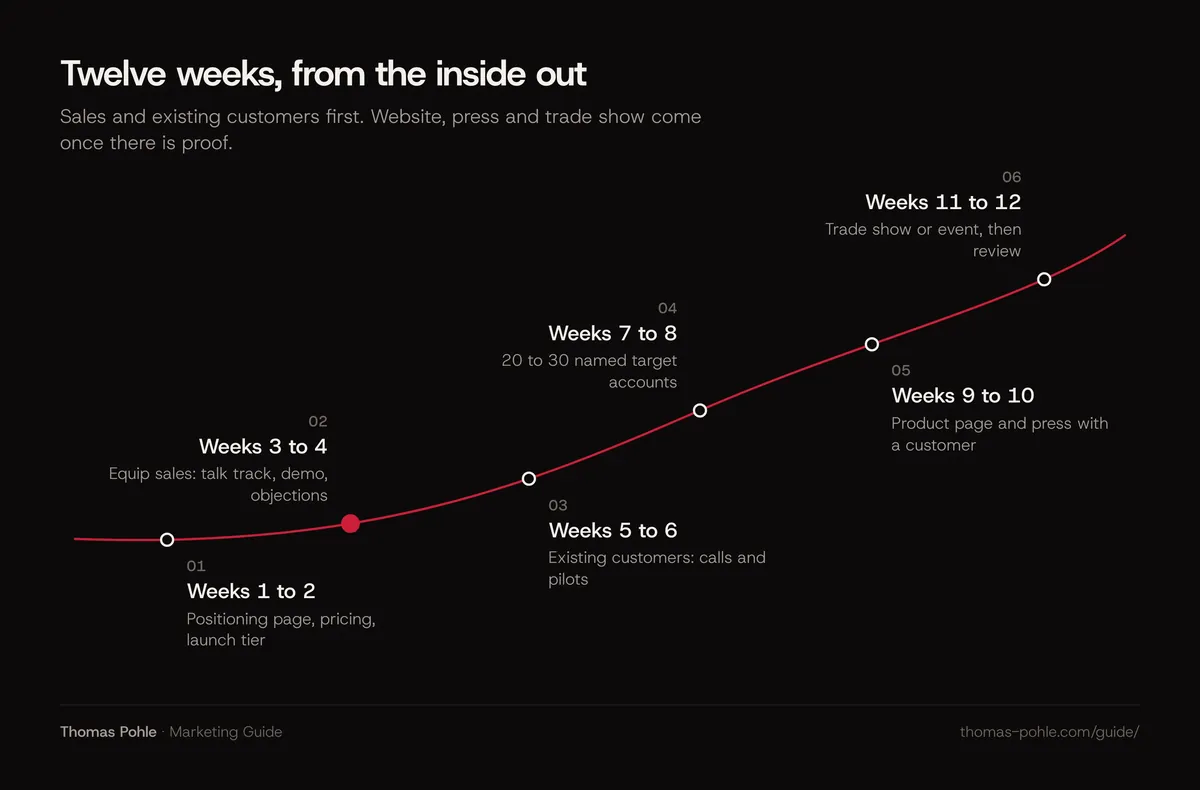
| Week | What happens | Done when |
|---|---|---|
| 1 | Positioning page, launch tier, launch goal | Product, sales and management have signed the page |
| 2 | Pricing, packaging, discount rules | Price list and approval rules are in writing |
| 3 | Talk track, demo script, objection list, competitor note | Kit is in the shared sales folder |
| 4 | Sales training, practice demos, CRM field | Every rep has done one practice demo |
| 5 | Personal calls to the best-fit customers | Calls booked for all of them |
| 6 | Early access or paid pilots, email to all customers | First customers use the product |
| 7 | Outreach to 20 to 30 named target accounts | Every account has an owner and a first touch |
| 8 | Feedback round, adjust talk track and page | Top objections have new written answers |
| 9 | Product page live, customer quote, LinkedIn | Page shows at least one named customer |
| 10 | Press release and pitches to trade media | Interview partner from a customer confirmed |
| 11 | Trade show, event or webinar | Meetings with target accounts booked in advance |
| 12 | Review: pipeline, objections, next round | Decision on round two of target accounts |
Before week nine, I use a simple go-public gate. At least three customers use the product, two of them agreed to be named or quoted, every rep has run a practice demo, and the five most common objections have a written answer. These thresholds are my rule of thumb. If the gate isn't met, move the public date. A planned shift beats a public launch without proof.
When do website, press release and trade show come in?
The public channels come in when you can show proof: a customer who uses the product, a quote, a person a journalist can interview. Without proof, every public channel only announces a claim.
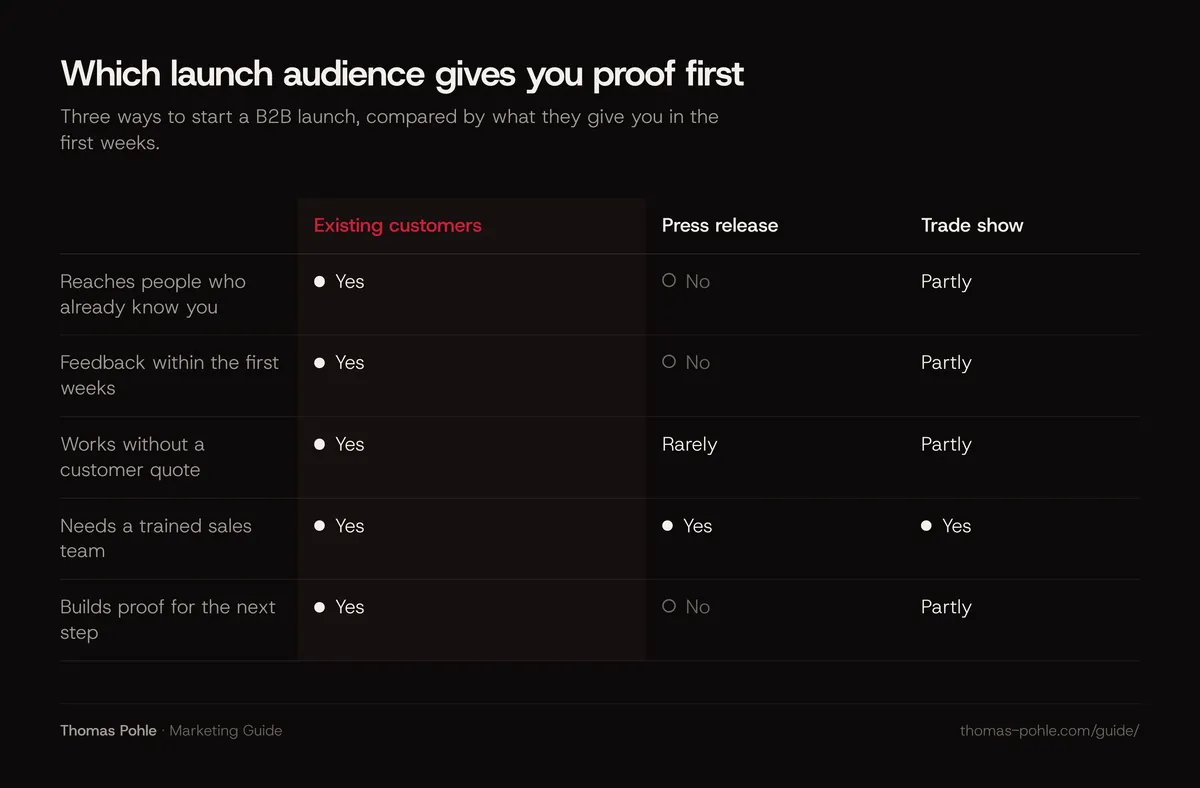
- Website. One product page built from the positioning page, with the demo video and the first customer quote. Write it yourself from your sales notes. AI can help with a draft, but the examples and objections have to come from your own customer conversations. That is what makes the page credible.
- Press release. Pitch the trade media that your buyers read, with the customer as interview partner. Journalists in the Muck Rack survey said relevance to their beat (70%) and interview access (58%) matter most in a pitch. More on that in the guide to B2B PR.
- Trade show or event. Book meetings with target accounts and customers before the fair. The AUMA Exhibitor Outlook 2026/2027 (404 exhibiting companies from Germany, surveyed October and November 2025) found that 78% of companies that focus on regional fairs do so for proximity to existing customers and partners. Around 49% judge their fair success mainly by leads, contacts and new customers.
How do you measure whether the launch worked?
Measure a B2B launch by what sales and customers do. Reach is secondary. The useful numbers are how many reps actively sell the product, how many existing customers took a pilot or bought, how many meetings and opportunities came from the 20 to 30 target accounts, and which objections came up most often. Check them at 30, 60 and 90 days.
- Readiness: share of reps who have run a customer demo of the new product.
- Customers: conversations held, pilots started, upgrades or orders.
- Target accounts: meetings, opportunities and the stage they reached.
- Pipeline: value of opportunities tagged with the new product in the CRM.
Press mentions and page views are signals, nothing more. The setup is covered in the guide to marketing measurement.
What to do this week
- Decide the launch tier of your next release with the table above.
- Write the positioning page on one page and get product, sales and management to sign it.
- Collect the five objections your sales team expects and write an answer to each.
- List the existing customers for whom the product clearly fits, and assign each one to an account manager.
- Draft the first list of 20 to 30 target accounts that look like those customers.
- Create a CRM field or campaign for the new product before the first conversation.
- Put the go-public gate in the plan and move the press date behind it.
A launch rarely fails on a weak press release. It fails when the first buyer calls and nobody can answer. If you want to run your next launch this way with your own team, that is the kind of work a Momentum Project is built for: one campaign, one channel or one launch, set up with your team until it runs without me.
Frequently asked questions
How long before launch should B2B marketing start planning?
For a new product, about twelve weeks before the public date: four weeks for positioning, pricing and sales enablement, four for existing customers and 20 to 30 target accounts, four public. A new module needs about six weeks, a feature one to two. These are my planning values, not an industry benchmark.
Do we still need a press release for a B2B product launch?
Yes, if you have something to tell: a customer who uses the product and can be interviewed. In Muck Rack's 2026 survey, 71% of journalists ignore or delete pitches that are overly promotional and 58% want interview access to relevant sources. Send the release after the first customers are live, and pitch the trade media your buyers actually read.
Can we send existing customers a launch email without consent?
In Germany, Section 7 (3) UWG allows it only for your own similar products, with an address you received in a sale, no objection from the customer, and a clear opt-out notice when collecting the address and in every email. Switzerland has a comparable rule in Art. 3 para. 1 lit. o UWG. Check with your lawyer whether the new product counts as similar. This is no legal advice.
Should a B2B product launch be timed around a trade show?
Only if the product is already in customer use by then. A trade show works best as the third step, when you can book meetings with target accounts in advance and show a real customer case. Launching at a fair means your sales team learns the questions in front of the buyers.
Sources
- Gartner: Survey finds that 45 percent of product launches are delayed by at least one month (September 2019)
- 6sense: 2025 B2B Buyer Experience Report
- Muck Rack: State of Journalism 2026 (PDF)
- AUMA: Aussteller-Ausblick 2026/2027, Messebeteiligungen zwischen Wirkung und Wirtschaftlichkeit (PDF)
- Gesetz gegen den unlauteren Wettbewerb (UWG), § 7 Unzumutbare Belästigungen
- Bundesgesetz gegen den unlauteren Wettbewerb (UWG), SR 241, Art. 3

Thomas PohleB2B marketing advisor in Zurich. More than ten years in B2B marketing at Link11, Beekeeper and smino, most recently as Head of Marketing. CEO and co-founder of TEISENDA. Researched and drafted with AI tools, checked against the sources listed above. More about Thomas