What is the difference between go-to-market and marketing strategy?

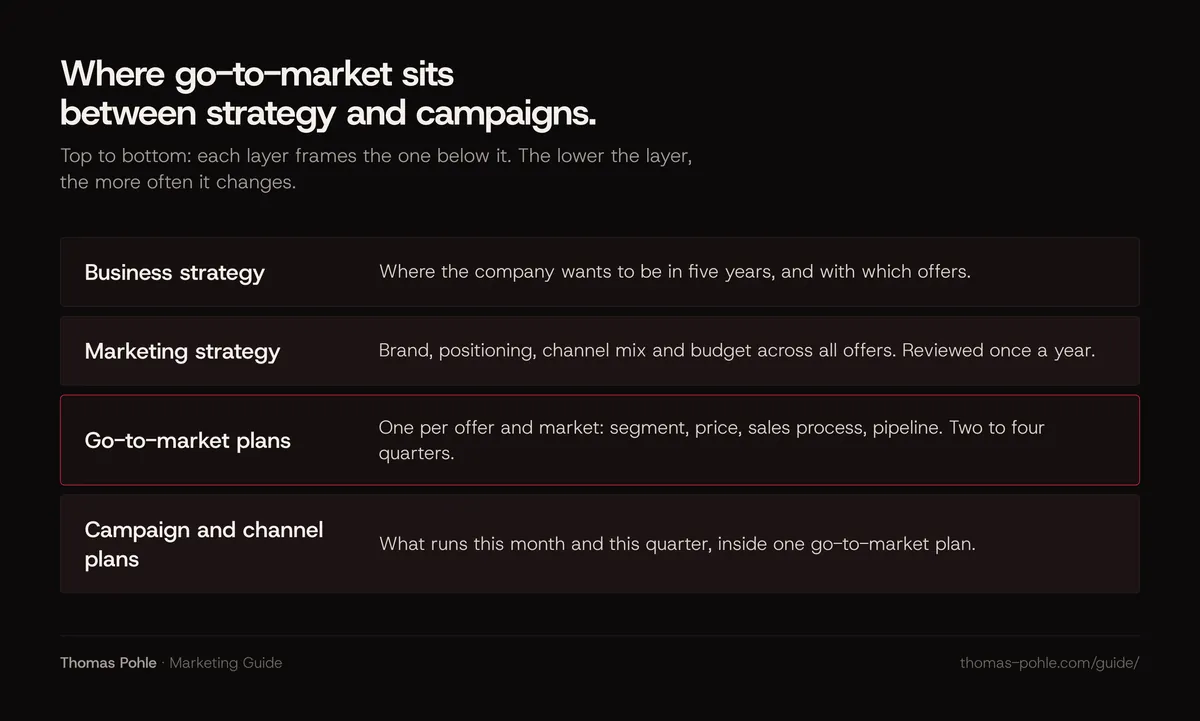
A marketing strategy decides how your company builds demand and preference for all its offers over several years. A go-to-market (GTM) strategy decides how one offer reaches one market and turns into revenue in the next few quarters, with price, sales process and who closes the deal. Marketing is one part of every GTM plan.
The two terms get mixed up in board meetings, job ads and agency briefs. That mix-up costs money. A company writes a campaign plan, calls it a go-to-market strategy and launches without a price or a sales process. This guide is for founders, CEOs and heads of marketing in B2B companies who need to know which document to write, who owns it and how the two fit together.
The full method for building a GTM plan is in the guide on how to build a go-to-market strategy. This one is about the boundary: which decision lives where, who signs it, and which one you need first.
What does GTM mean in marketing?
In marketing, GTM almost always means go-to-market: the plan for bringing one specific offer to one specific group of buyers. The same three letters also name Google Tag Manager, a tool for managing tracking tags on a website. Context decides. If the sentence mentions tags, triggers or analytics, it's the tool.
Google describes Tag Manager as a tag management system that lets you set up and manage tags on your site without editing the site's code. It has nothing to do with strategy. It still shares the abbreviation, the search results and sometimes the job ads. A posting for a "GTM specialist" can mean a launch planner or a tracking engineer. Read the task list before you apply or hire.
German-speaking companies use the abbreviation the same way, usually as an English loan word: "GTM-Strategie" or "Go-to-Market-Strategie". Three related terms you'll meet:
- GTM motion. How the first deal happens: sales-led, product-led or partner-led.
- GTM team. The people from product, marketing and sales who run one launch together.
- GTM plan. The dated version of the strategy, with budget, targets and owners.
Is marketing part of go-to-market?
Yes. Marketing is one of the functions every go-to-market strategy needs, next to product, pricing and sales. A GTM plan takes positioning and channels from marketing. Then it adds what marketing alone doesn't decide: what gets sold at which price, who sells it, how a deal closes and how much pipeline the launch has to produce.
It doesn't work the other way around. A marketing strategy is wider than any single launch. The American Marketing Association defines marketing as the activity, set of institutions and processes for creating, communicating, delivering and exchanging offerings that have value for customers, clients, partners and society at large. That covers brand, research and long-term demand across every offer. Most of it keeps running whether a launch is on or not.
The fastest way to see the boundary: list the decisions and ask where each one is made.
| Decision | Marketing strategy | Go-to-market strategy |
|---|---|---|
| Positioning and core message | Yes, set once for the brand | Yes, sharpened for one segment |
| Ideal customer | Broad, for the company | Narrow, for the first segment |
| Price and packaging | Input only | Yes |
| Sales process and who closes | No | Yes |
| Brand building and long-term reach | Yes | Partly, as context |
| Channel mix and budget | Yes, across all offers | Yes, two or three channels for this launch |
| Pipeline target | Partly | Yes, as math from the revenue goal |
Four rows cause the trouble: price, sales process, who closes and the pipeline target. A document that leaves all four open is a marketing or campaign plan. It doesn't matter what the title says.
Where do the two strategies collide?
They collide over time horizon and budget. The marketing strategy needs money for brand and reach that pays off over years. Each go-to-market plan needs money for pipeline this quarter. Without a written rule that splits the budget, the next launch always wins the argument. The long-term work quietly stops.
The LinkedIn B2B Institute puts a number on that tension. Its 95-5 rule says about 95 % of potential B2B buyers aren't ready to buy today. A GTM plan aimed only at the few who are in market can look efficient for a quarter. Then it runs out of buyers. The marketing strategy keeps the other 95 % aware of you until they're ready.
The second collision is positioning. Every launch team wants to write its own message. My take: positioning belongs to the marketing strategy and changes rarely. A GTM plan may sharpen it for one segment. It should never contradict it. The guide on B2B positioning shows how to set it in the first place.
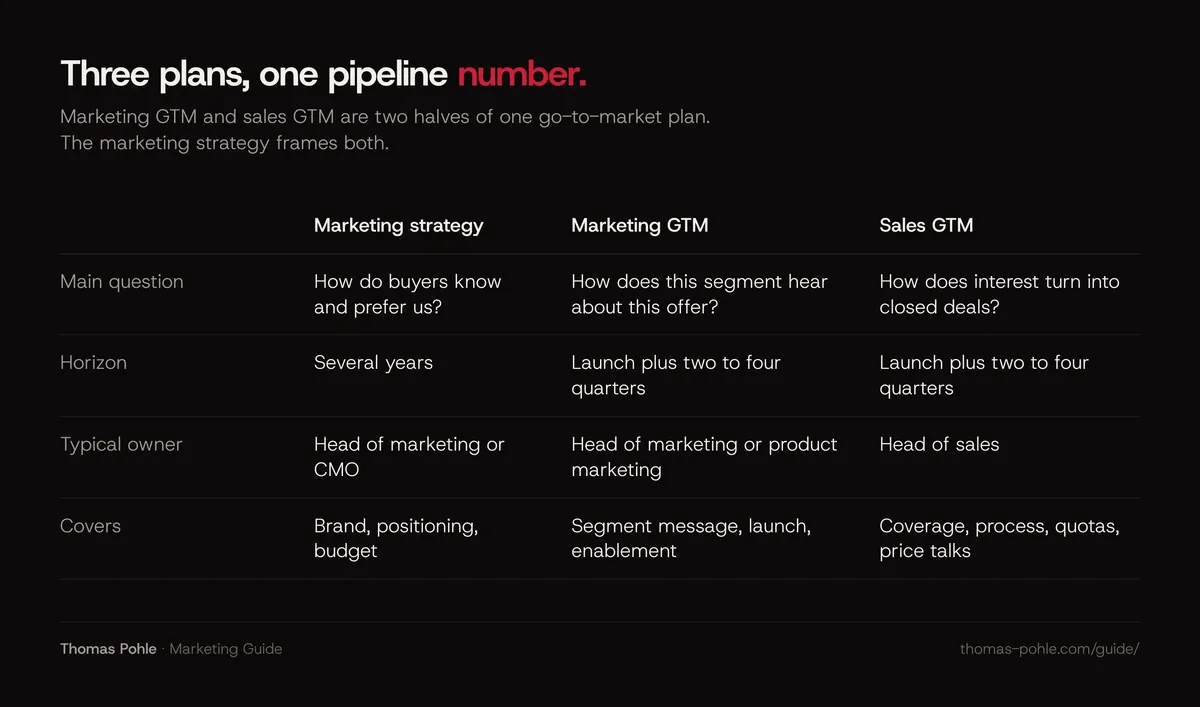
The third collision is credit for the pipeline. Philip Kotler, Neil Rackham and Suj Krishnaswamy described the friction between the functions in Harvard Business Review in 2006: sales and marketing each tend to undervalue the other's contribution. My take: the most practical fix is one GTM plan with one pipeline number that both teams report on.
Who owns which strategy in a B2B company?
The marketing strategy belongs to your most senior marketing person, usually the head of marketing or the CMO. The CEO approves it. A go-to-market strategy needs one owner with authority across product, marketing and sales. In small companies that's the CEO. In scale-ups it's often a chief revenue officer or a product marketing lead.
My rule of thumb by company stage, not a survey:
- Founder-led, up to about 20 people. The founder or CEO owns both. Write them as one short document until a second offer or market shows up.
- 20 to 200 people with a head of marketing. The head of marketing owns the marketing strategy. The CEO owns each GTM plan, and the head of marketing runs it day to day.
- Scale-up with several products or countries. The CMO owns the marketing strategy. Each offer or market gets its own GTM lead, often from product marketing or reporting to a CRO.
As Head of Marketing at smino I was responsible for marketing and expansion strategy, and we ran marketing and sales as one team. My take: that setup makes the boundary easier to hold. The person who owns the brand also sits in the pipeline meeting. More on the role itself is in the guide on what a B2B head of marketing does.
The failure mode is shared ownership. A GTM plan signed by three department heads has nobody who changes it when the numbers go wrong.
What is the difference between sales GTM and marketing GTM?
Sales GTM and marketing GTM are two halves of one plan. The sales half covers territories, account coverage, the sales process, quotas and who closes. The marketing half covers positioning for the segment, launch material, demand programs and sales enablement. Both work toward one pipeline target. So they belong in one document with one owner.
The US Bureau of Labor Statistics draws a similar line in its job profiles. Marketing managers estimate demand and identify potential markets, and may also develop pricing strategies. Sales managers plan, direct or coordinate the delivery of a product or service to the customer, set sales goals and develop plans to acquire new customers.
Here's my view: price is the decision most often left without an owner. Marketing assumes sales will negotiate it. Sales assumes product has set it. The GTM plan is where it finally gets a name next to it.
Which strategy do you need first?
Start with the document that matches the change you're facing. A new product, segment or country needs a go-to-market plan first, because revenue depends on price and sales process. A company without a clear position, or with several offers that all speak differently, needs the marketing strategy first. Every GTM plan will borrow from it.
| Situation | Write first | Why |
|---|---|---|
| First product, first customers | GTM plan | One offer, one market; a separate marketing strategy is premature |
| New product for existing customers | GTM plan | Brand and positioning exist, price and launch do not |
| Entering a new country | GTM plan per country | Buyer, language and outreach rules change, the brand stays |
| Three offers, three different messages | Marketing strategy | Positioning has to be settled before the next launch |
| First marketing hire | Marketing strategy | The hire needs a frame for budget and channels across offers |
| Growth stalled with a known product | GTM review, then marketing strategy | Check segment, price and motion before blaming the brand |
If the marketing strategy is the one you need, the guide on building a B2B marketing strategy walks through its five decisions.
How do you keep both strategies consistent?
You need a few shared pieces and one meeting. One page that defines the ideal customer and the positioning. One budget rule that splits money between long-term marketing and launch pipeline. One pipeline number per GTM plan that marketing and sales both report on. And a monthly review where everyone looks at the same figures.
The thresholds below are my own rules of thumb. They aren't industry standards:
- One customer definition. If you find more than one description of the target customer across your decks, consolidate before the next launch.
- A protected budget share. Reserve part of the marketing budget for long-term brand and reach that no launch can grab mid-year. The size of that share is a decision. Write it down.
- One pipeline number per GTM plan. Marketing and sales report it from the same CRM report. Two spreadsheets don't count.
- Two review rhythms. Monthly for each GTM plan, yearly for the marketing strategy. A marketing strategy that changes more than once a year is probably a campaign plan.
- An end date. Every GTM plan says when the offer becomes business as usual, usually after two to four quarters.
I'm allergic to slide decks nobody runs. So I keep both documents short: the marketing strategy on a few pages, each GTM plan on one or two.
Which mistakes come from mixing them up?
My take: the most expensive mistake is a campaign plan labeled as a go-to-market strategy. Channels, content and a launch date, with no price, no sales process and no pipeline target. It looks complete and gets approved. Then it stalls in the first sales calls, because nobody decided what the salesperson actually sells.
- Rewriting the marketing strategy for every launch. Brand and positioning drift a little with each product until nobody can say what the company stands for.
- A GTM plan without sales. Marketing writes it alone, and sales sees it for the first time at the kickoff.
- Judging the marketing strategy by launch pipeline only. Long-term reach gets cut after one weak quarter.
- Confusing the two GTMs. Ask an agency for "GTM support" and you get a launch plan or a tag setup, depending on who reads the brief.
- No end date. A GTM plan that never ends turns into a second marketing strategy that contradicts the first.
What to do this week
- Collect every document in your company called a strategy or a GTM plan. Label each one: marketing strategy, GTM plan or campaign plan.
- Check each GTM plan for the four decisions marketing alone doesn't make: price, sales process, who closes, pipeline target.
- Write one owner's name on each document. Shared ownership counts as no owner.
- Compare the ideal customer and the positioning across all documents. Where they differ, decide which version wins.
- Agree on one pipeline number per GTM plan that marketing and sales report on together.
- Put a monthly GTM review and a yearly marketing strategy review in the calendar.
Keeping the two apart is easy once each has an owner and each GTM plan has an end date. The marketing strategy is the frame that lasts. GTM plans come and go inside it. Want to sort out both with your team in one day? That's what a Momentum Workshop is for.
Frequently asked questions
Is a go-to-market strategy the same as a marketing plan?
No. A marketing plan is the dated, budgeted execution of the marketing strategy: campaigns, content, events and spend for a year or a quarter. A go-to-market strategy is a cross-functional plan for one offer in one market. It also sets price and sales process. A GTM plan usually contains a marketing plan for its launch. A marketing plan never contains a GTM strategy.
Does a small B2B company need both strategies?
With one product in one market, you can run on a single document for a while: the GTM plan, with a short section on brand and positioning. Split them as soon as you add a second offer, a second country or a dedicated marketing hire. From then on, the positioning has to hold across plans that change at different speeds.
What is a GTM team?
A GTM team is the group that runs one go-to-market plan. Usually that's one lead each from product, marketing and sales, plus customer success once the first customers sign. It's a working group with one owner. It isn't a new department. When the offer becomes business as usual, the team hands its work back to the normal functions.
Who writes the GTM strategy, product marketing or sales?
Where a product marketing role exists, it usually drafts the GTM strategy and runs the launch, because it sits between product, marketing and sales. Sales owns the parts it has to deliver: coverage, process and forecast. My take: the final decisions belong with one person who has authority over all three functions. In a mid-sized company that's often the CEO.
What does GTM mean in Google Analytics or tracking?
In tracking, GTM means Google Tag Manager, Google's tag management system for setting up and managing tags on a website without editing the site's code. Teams use it to install analytics, advertising and conversion tags. It has no connection to go-to-market strategy. They just share the abbreviation.
Sources
- American Marketing Association: Definitions of marketing
- Google Tag Manager Help: Tag Manager overview
- LinkedIn B2B Institute: The 95-5 rule
- Kotler, Rackham, Krishnaswamy: Ending the War Between Sales and Marketing, Harvard Business Review (2006)
- US Bureau of Labor Statistics: Advertising, promotions, and marketing managers
- US Bureau of Labor Statistics: Sales managers

Thomas PohleB2B marketing advisor in Zurich. More than ten years in B2B marketing at Link11, Beekeeper and smino, most recently as Head of Marketing. CEO and co-founder of TEISENDA. Researched and drafted with AI tools, checked against the sources listed above. More about Thomas