Which B2B marketing measures are worth it?

A B2B marketing measure is worth it when it either creates pipeline with your target accounts or builds memory among the category buyers who will buy later. Score each measure on both with six simple questions. Keep what scores 4 of 6 on one side, fix what sits in between, and stop what scores low on both.
This is for founders and marketing leads with more measures than budget. Most teams judge them by what's easy to count: visitors, likes, registrations. That's attention, and it decides nothing.
Below: a scorecard with thresholds, a rating of the common instruments, a worked example and stop rules. How B2B marketing works as a whole, including the budget split between brand and demand, is in the guide to B2B marketing.
How do you judge whether a B2B marketing measure is worth it?
Judge a B2B marketing measure by two effects. Pipeline: does it create conversations and opportunities with accounts you want? Brand: does it make buyers who aren't shopping yet more likely to think of you when they are? A measure that does neither isn't worth its budget, however busy it looks.
The two effects run on different clocks. Pipeline shows up in the CRM within weeks. Brand shows up over quarters and years. The Ehrenberg-Bass Institute's report How B2B Brands Grow (2023) puts it simply: buyers choose brands that are easy to mind and easy to find.
Why is attention the wrong yardstick?
Attention is a step before both effects, and it's cheap to buy. Impressions, booth visitors and webinar sign-ups say someone noticed you. They don't say whether that person is on your account list, got a meeting with sales or will remember you in a year.
In the LinkedIn B2B Institute report The 5 Principles of Growth in B2B Marketing (2019), Les Binet and Peter Field describe activation as good for short-term selling but unlikely to be very memorable, so its effects don't last long. Brand building needs broad reach and repeated exposure, and its effects accumulate. Its foreword cites a LinkedIn survey: only 4 % of B2B marketers measured impact beyond six months. And on the LinkedIn B2B Institute's page on the 95-5 rule, Ty Heath reports that 96 % of B2B marketers in a LinkedIn study expected to see the main effect of their ad campaigns within two weeks.
Trade shows show the habit in numbers. In the AUMA exhibitor outlook 2026/2027, a survey of 404 German exhibitors in late 2025, about 49 % judge their trade show success mainly by leads, contacts and new customers. About 20 % use visitor numbers or booth traffic, about 17 % name revenue or orders, about 10 % have no real KPI, and only about 4 % name awareness or image as their main measure.
How do you score a measure on pipeline and brand?
Score every measure with six questions, three for pipeline and three for brand, and give each 0, 1 or 2 points. That gives a pipeline score and a brand score from 0 to 6. Score before you spend, then again after the test window. The questions force you to name who it reaches and what happens next.
| Question | 0 points | 1 point | 2 points |
|---|---|---|---|
| P1 Does it reach named target accounts? | Mostly people outside your list | Some target accounts in a mixed audience | Mostly target accounts and their buying group |
| P2 Does it create a next step for sales? | No contact data or no reason to talk | Contacts, follow-up is cold | Meetings or replies sales can act on within two weeks |
| P3 Can you trace it to opportunities? | Not visible in the CRM | Visible as influence on some deals | Opportunities tagged to it within 90 days |
| B1 Does it reach category buyers broadly and repeatedly? | Once, to a few | Repeatedly, to a small share | Repeatedly, to most of the buyers in your category |
| B2 Will people remember it as you? | Generic, could be anyone | Your name, mixed message | Same name, same message, your own view |
| B3 Does it add trust others give you? | Only you talk about you | Some third-party mention | Press, customers, partners or reviews vouch for you |
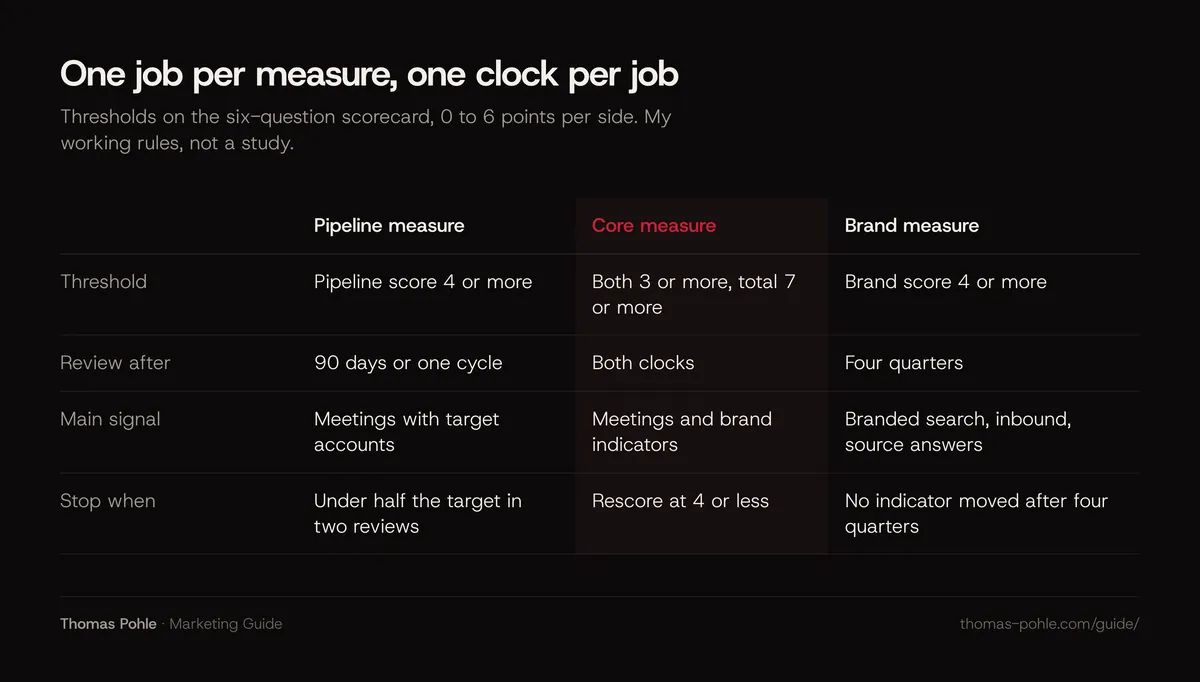
Then read both scores against fixed thresholds. They're my own working rules, not backed by a study. They make a team decide the same way every time.
- Pipeline measure: pipeline score 4 or more. Judge it on meetings and opportunities with target accounts.
- Brand measure: brand score 4 or more. Judge it on memory and findability, and give it at least four quarters.
- Core measure: both scores at least 3 and a total of 7 or more. Protect it in budget cuts.
- Fix or test: a total of 5 or more that fits none of the groups above. Change one thing that lifts one side, then score again.
- Stop: total of 4 or less. Don't start it, or end it at the next exit point.
One rule sits inside B2. Content only scores 2 there when it carries your own experience and view. AI can draft and edit, but text without real input from your company sounds like everyone else's. Writing it yourself, or at least feeding in your own examples, is still the best way to earn the 2.
How do the common B2B marketing instruments score?
Most B2B instruments lean clearly toward one side. Outbound, direct mail and small field events lean toward pipeline. PR, content, founder posts and review platforms lean toward brand. Trade shows and partner marketing can do both when they're planned for both. The table shows my typical rating; your own scores decide.
| Instrument | Pipeline | Brand | Worth it when |
|---|---|---|---|
| Trade show with your own booth | Medium | Medium | Meetings with target accounts are booked before the fair |
| Visiting a fair with booked meetings | High | Low | Your buyers go there anyway |
| Own roundtable or field event | High | Medium | Guests come from your account list |
| Webinar | Low to medium | Low to medium | A customer or partner co-hosts and sales follows up |
| Content and SEO | Medium | High | It answers what buyers ask, in your own words |
| Founder posts on LinkedIn | Low | High | Two to three posts a week for at least a year |
| LinkedIn ads | Medium | Medium | Targeted to your accounts and run long enough |
| Outbound email and calls | High | Low | The list is small, named and relevant |
| Direct mail | High | Medium | 20 to 30 accounts with a real reason to write |
| Partner marketing | Medium to high | Medium | The partner already sells to your buyers |
| PR | Low | High | The media your buyers read cover you |
| Review platforms | Low to medium | Medium | Your buyers check them before a shortlist |
- Trade shows: a booth without pre-booked meetings is an attention buy. AUMA's visitor study from November 2026 found that almost 40 % of visitors decide one to four weeks before the event, so invitations to target accounts belong in exactly that window.
- LinkedIn ads: they can be a pipeline or a brand measure. Mixing both in one campaign usually scores medium on each. The LinkedIn guide has a decision table for ads.
- Outbound and direct mail: both score high on pipeline when the list is short and named. See the guides to account-based marketing and B2B direct mail.
Which measures build brand that later turns into pipeline?
Brand measures work on the buyers who aren't in the market yet, and that's most of them. They pay off when a need appears and your name comes to mind first. PR, consistent content, founder posts and steady reach in the right channels do that job. Their numbers move slowly, so they need patience and their own indicators.
The LinkedIn B2B Institute's 95-5 rule puts the share of potential buyers who aren't ready to buy today at 95 %, and advises advertising mostly to them. John Dawes, who wrote the Ehrenberg-Bass report behind it (2021), calls the 95 % a heuristic. The direction matters: a pipeline-only plan talks only to the few who are buying now.
Two experiences of mine sit behind this. In one year I placed more than 100 media pieces in Switzerland alone, reaching roughly half a million people. That reach number is what lands in a report, and in my view it's the weakest number in it. What counts is whether your target accounts read those outlets.
The second is LinkedIn. On my own profile I don't aim for short-term leads. I aim for reach, credibility, a network and recognition among founders and marketing leads, so I score it as a brand measure on purpose. More on PR as a channel is in what B2B PR does.
Brand indicators that need no heavy tooling:
- Branded search: searches for your company name in Google Search Console, quarter over quarter.
- Self-reported source: "How did you hear about us?" as a required field and a question in the first sales call.
- Inbound from target accounts: requests from accounts on your list that no campaign touched.
When should you stop a B2B marketing measure?
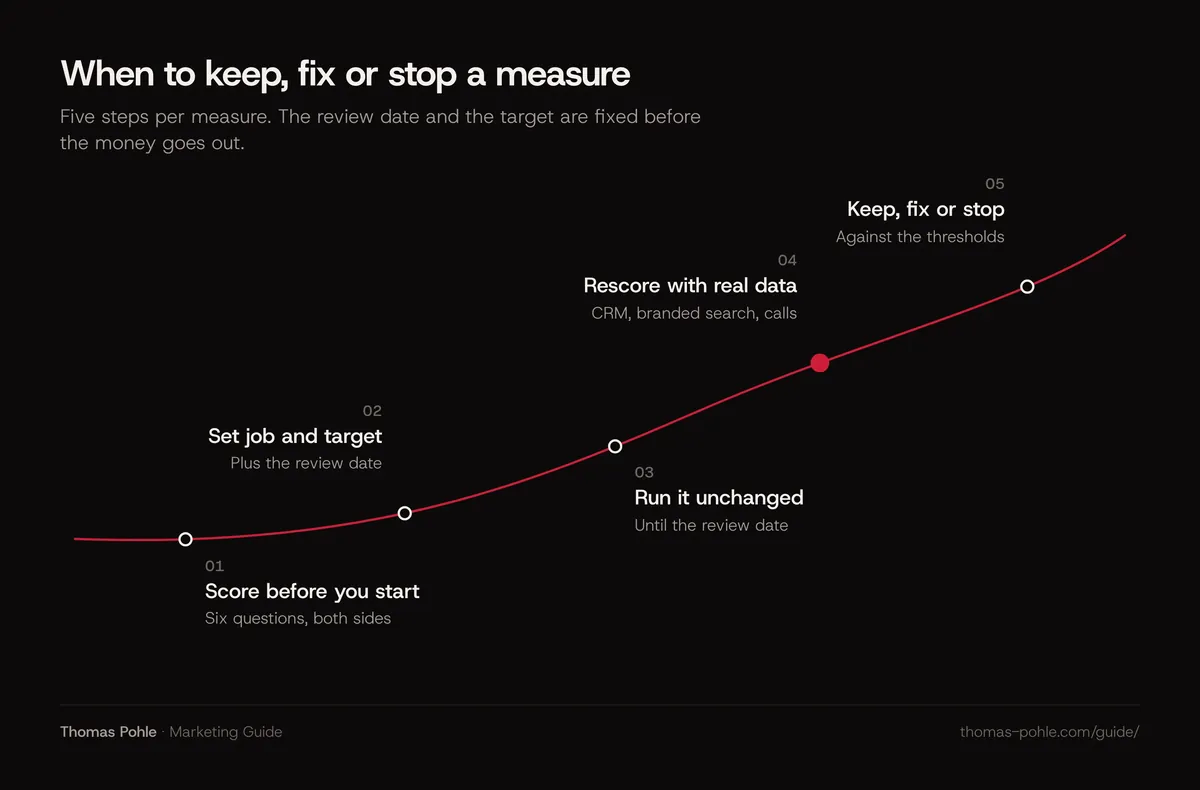
Stop a measure when it misses the target you set before it started, measured on its own clock. My working rule: about 90 days or one full cycle for a pipeline measure, four quarters for a brand measure. Stopping without a target set in advance is a feeling. Keeping a measure without one is habit.
Set three things before the money goes out: the job, the target (for example meetings with target accounts) and the review date. Then run the measure unchanged until that date.
My stop rules, as working rules without a study behind them:
- Pipeline measure: stop when it reaches less than half of its meeting or opportunity target in two reviews in a row.
- Brand measure: stop when none of the brand indicators moved after four quarters and the brand score is still under 4.
- Any measure: stop when the rescore lands at 4 or less in total, or when most of the reach goes to people outside your account list.
- Exception: don't stop a brand measure because pipeline is short this quarter. Fix pipeline with a pipeline measure.
Freed-up money goes to the best-scoring measure that can absorb more. How to shift budget between channels is in how to split the marketing budget.
What does a scoring round look like in practice?
A scoring round takes one meeting with marketing and sales together. List every running and planned measure, score each on the six questions and sort them into pipeline, brand, core, fix and stop. The example uses a fictional company and invented scores. They show the arithmetic, not results.
A typical scenario: a fictional Swiss software company with about 400 target accounts and four measures.
| Measure | Pipeline score | Brand score | Decision |
|---|---|---|---|
| Booth at the main industry fair | 4 (1 + 2 + 1) | 3 (1 + 1 + 1) | Core measure, total 7: book meetings beforehand |
| Monthly webinar | 3 (1 + 1 + 1) | 2 (1 + 1 + 0) | Fix, total 5: customer as co-host, sales calls back |
| LinkedIn ads to the account list | 3 (2 + 0 + 1) | 3 (2 + 1 + 0) | Fix, total 6: run as a brand measure for a year |
| Outbound to 30 named accounts | 6 (2 + 2 + 2) | 1 (0 + 1 + 0) | Pipeline measure: keep, review after 90 days |
Look at the two fixes. The webinar gains a point on B3 with a customer on stage and a point on P2 when sales calls every registrant from the account list. That makes 4 and 3, a core measure. The ads gain a point on B2 with one message and the same look for twelve months, which makes the brand score 4. Neither fix costs more money.
What to do this week
- List every marketing measure that is running or planned for the next two quarters.
- Score each one on the six questions with marketing and sales in the same room.
- Give every measure one job: pipeline, brand or core.
- Write down a target and a review date for each one before the next euro or franc goes out.
- Mark everything with a total of 4 or less and decide when its next exit point is.
- Add "How did you hear about us?" to your contact form and your first sales call.
- Pull branded search from Search Console as the baseline for your brand measures.
Most B2B teams need fewer measures, each with a clear job and an honest review. If you want to sort your list with your team in one day, that's a typical topic for a one-day Momentum Workshop.
Frequently asked questions
How long should you test a B2B marketing measure?
My working rule: give a pipeline measure about 90 days or one full cycle, such as one trade show including follow-up. Give a brand measure at least four quarters, because Binet and Field describe brand effects as building up over time. Set the target and the review date before you start, and change nothing until then.
Are trade shows still worth it in B2B?
Often yes, when you plan them for pipeline. In AUMA's survey of 404 German exhibitors from late 2025, about 49 % judge fairs mainly by leads, contacts and new customers. A booth pays off when meetings with target accounts are booked before the fair and sales follows up within days.
How do you measure the brand effect of a B2B measure?
Use indicators that move when more buyers know you: branded search in Google Search Console, direct traffic, inbound requests from target accounts no campaign touched, and the answer to "How did you hear about us?" in forms and first calls. Look at them quarter over quarter and over at least a year.
Should a small B2B company run brand measures at all?
Yes, in a small and steady form. Most buyers aren't in the market at any given time, so pipeline measures alone only reach the few who are. Keep one brand measure, such as founder posts or PR in the trade media your buyers read, and run it consistently for at least a year.
Sources
- Les Binet and Peter Field, LinkedIn B2B Institute: The 5 Principles of Growth in B2B Marketing (2019)
- LinkedIn: How B2B marketing really drives growth (Binet and Field, October 2019)
- Ehrenberg-Bass Institute: How B2B Brands Grow (2023)
- LinkedIn B2B Institute: The 95-5 rule
- Ehrenberg-Bass Institute, John Dawes: Advertising effectiveness and the 95-5 rule (May 2021)
- AUMA: AUMA-Aussteller-Ausblick 2026/2027 (survey of 404 exhibitors, October and November 2025)
- AUMA press release via presseportal.de: visitor study on trade fair decisions (2 November 2026)

Thomas PohleB2B marketing advisor in Zurich. More than ten years in B2B marketing at Link11, Beekeeper and smino, most recently as Head of Marketing. CEO and co-founder of TEISENDA. Researched and drafted with AI tools, checked against the sources listed above. More about Thomas