Does direct mail still work in B2B?

Yes, when you send it to few people. A signed letter to a named decision maker at 20 to 30 target accounts arrives outside an inbox that holds about 117 emails a day, costs a few euros per piece and is legal in Germany without prior consent. It only works as the first touch of a sequence that sales follows up within a week.
This guide is for founders and marketing leads who sell to a small, known set of companies and are tired of sequences nobody answers. It covers when a letter wins, what goes into it, how to follow up, what it costs and the legal basics in Germany and Switzerland. For how direct marketing fits into the wider system, start with the guide on what B2B marketing is and how it works.
What is B2B direct marketing?
B2B direct marketing is any message a company sends to a named person at another company, with a clear ask and a response you can count. Letters, emails, phone calls and LinkedIn messages all qualify. Direct mail is the physical part of it: an addressed letter or package that lands on a specific desk instead of in a feed.
The difference to advertising is the address: a direct message reaches one person you chose, and you know whether that person replied. That makes direct marketing the natural tool for account-based marketing, where you work a short list of companies instead of a market.
When does a letter beat the tenth email?
A letter beats another email when the list is short, the deal is large and the person you want is buried in messages. Microsoft's Work Trend Index from June 2025 counts 117 emails and 153 Teams messages a day for the average employee. A sealed envelope with a real name on it is one object on a desk.
Microsoft took that number from anonymized Microsoft 365 signals plus a worker survey across 31 markets. My take: once you have sent three emails without a reply, the fourth one is noise. A letter changes the channel, and that alone gets it looked at.
The letter loses when you need volume: with 2,000 contacts and small deals, nobody can follow up personally.
| Situation | Better first touch | Why |
|---|---|---|
| 20 to 30 named accounts, deal value in the tens of thousands | Letter | Few pieces, each one can be researched and followed up by phone |
| A decision maker who ignored three emails | Letter | New channel, no inbox filter, no consent problem in Germany |
| Existing customers you want to win back | Letter or email | Email to own customers is allowed under narrow conditions; a letter stands out more |
| Hundreds of contacts, low deal value | Email to people who opted in, or ads | A letter cannot be followed up personally at that scale |
| Event invitation four weeks out | Letter, then email reminder | The printed invite stays on the desk; the reminder carries the link |
What does the evidence on direct mail actually show?
The evidence for direct mail is thinner than its fans claim, and most of it comes from postal operators. It points in one direction, though: people spend more time with physical mail and remember it better. Reliable B2B response rates for small, personal mailings are not published anywhere I trust.
The best-known study is a 2015 report by the US Postal Service's Office of Inspector General with Temple University. Participants saw ads on postcards and in emails while eye tracking, biometrics and brain scans ran. They processed the digital ads faster but spent more time with the physical ones, had a stronger emotional response and remembered them better. It is a consumer lab study for a mail operator: a hint about attention, nothing more.
Deutsche Post's Dialogmarketing Monitor 2026 (June 2026, 1,505 marketing decision makers surveyed with Statista+) puts German spending on print mailings at 5.8 billion euros in 2025, fourth among all ad media. 89 % of the companies that use mailings send them to existing customers. So mailings mostly serve existing customers; the monitor says nothing about how well they open new accounts. Deutsche Post sells mail, so read the numbers accordingly.
How do you choose the accounts and the person?
Choose accounts where one won deal pays for the whole campaign, and write to a person, never to a company. Twenty to thirty accounts is a good size for a first round: enough to learn something, few enough that every letter is researched and every follow-up call actually happens.
- Accounts. Take them from your ideal customer profile and your sales team's wish list. If you already run ABM, use the same tier-one list.
- The person. One or two names per account: who owns the problem and, if known, who signs. Check name, title and address on the company website. A letter to someone who left a year ago is worse than no letter.
- The reason. Write down one observation per account before you write anything else: a new site, a job ad that shows a gap, a statement in the annual report. No observation, no letter.
For the research I work with tools like Apollo, Clay and Leadinfo. They find names and signals. The observation that makes the letter worth reading still comes from a person reading what the company published.
What should go into the envelope?
Put one signed page into the envelope, built around one specific observation about the recipient's company, plus at most one insert that is useful on its own. The letter has to say why you are writing to this person now, and what the next step is.
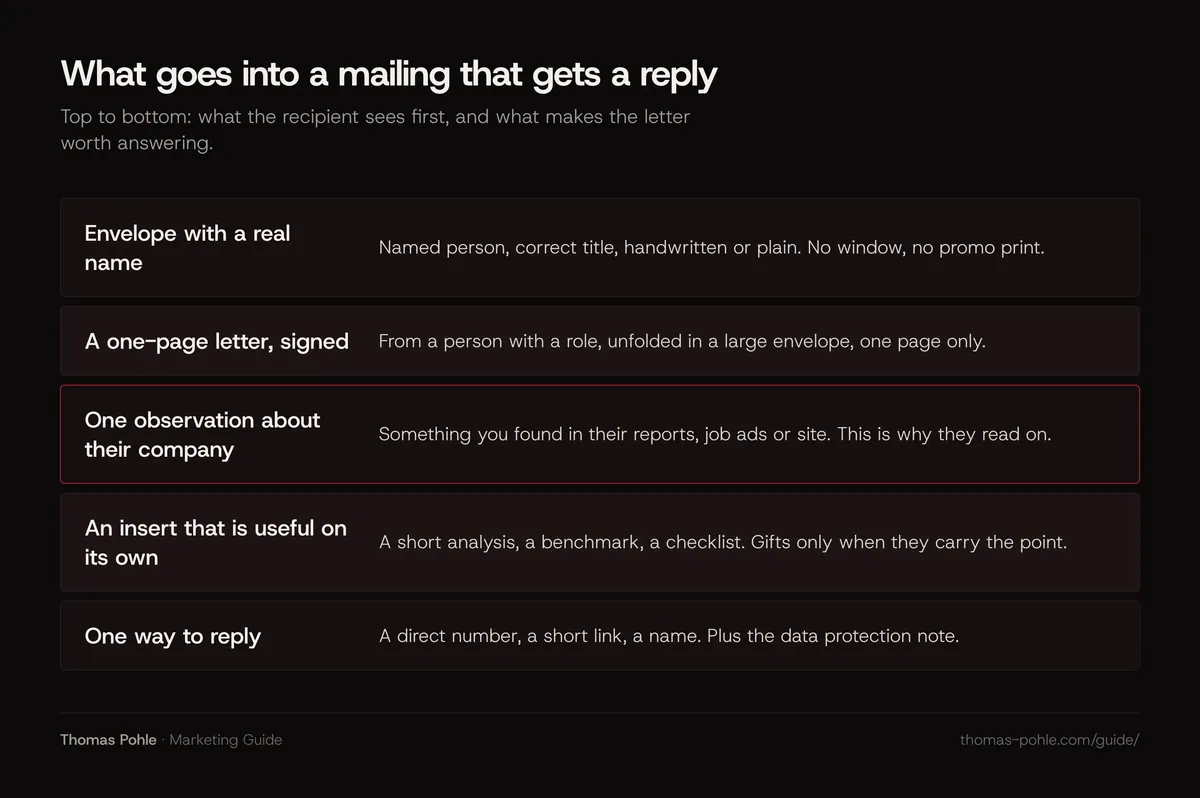
- Envelope. Name and correct title, by hand or printed plainly. No window, no promo print.
- Letter. One page, signed by someone with a real role, ideally the founder or the account executive who will call. An unfolded A4 page in a large envelope looks different from a bill.
- The observation. First paragraph. What you noticed, what it usually means, what others in their position do about it. Specific enough that it could not go to their competitor unchanged.
- Insert. A short analysis, a benchmark, a checklist or a printed case study. A bottle of wine says nothing about your product.
- Reply path. A direct number, a short link, the name of who will follow up, plus a data protection note.
If the letter would work for any company on your list, it's not ready.
How do you sequence a letter with calls, email and LinkedIn?
Treat the letter as the first touch of a short sequence, never as the whole campaign. Send it, then call or message the person five to seven days later and refer to the letter. The follow-up is where meetings come from. A letter nobody follows up is an expensive brochure.
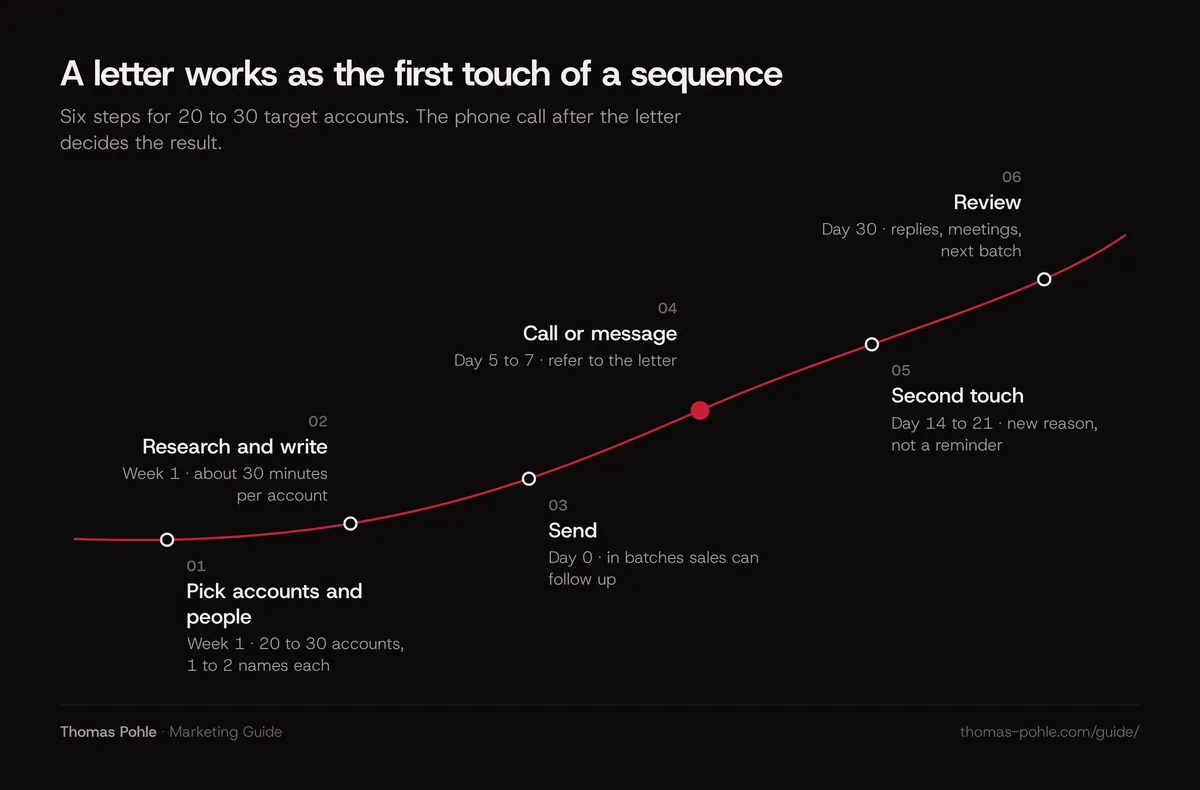
- Week 1, research and write. Plan time per account for the observation and the letter; the cost example below assumes 30 minutes.
- Day 0, send. Send in batches your sales team can follow up within the week.
- Day 5 to 7, call or message. "I sent you a letter about your new plant in Poland last week." In Germany a call to a business needs at least presumed consent, so the call has to fit the recipient's business. A follow-up email needs prior consent, and German lawyers commonly apply that rule to LinkedIn messages too, so call.
- Day 14 to 21, second touch. A new reason: a short piece of analysis, an invitation, a case. Never "just checking in".
- Day 30, review. Replies, meetings, wrong addresses.
When outbound was my main offer, it always started with a value proposition workshop, then setup, then running the campaigns. A letter without a sharp value proposition is just paper.
What does a mailing to 30 accounts cost?
A mailing to 30 accounts costs a few hundred euros in postage and print, plus about three days of work. Postage is the smallest line. In Germany a large letter (Großbrief, up to 500 g) costs 1.80 euros with Deutsche Post, in Switzerland an A-Post Grossbrief costs CHF 2.50, both as of November 2026.
Deutsche Post's discounted advertising rate, Dialogpost, needs hundreds of pieces at minimum (500 with the small-volume service Easy), so a personal mailing pays normal letter postage. The money is in the research.
A typical scenario, with assumptions you should replace by your own numbers:
| Line | Assumption | Cost |
|---|---|---|
| Letters | 30 accounts, 2 people each | 60 pieces |
| Postage Germany | Großbrief at 1.80 euros | 108 euros |
| Print, envelope, insert | Assumed 8 euros per piece | 480 euros |
| Research and writing | Assumed 30 minutes per account | 15 hours |
| Follow-up calls | Assumed 20 minutes per account across two touches | 10 hours |
| Cash total | Without internal time | 588 euros |
The real cost is 25 hours of senior time. Do the math backwards: if your average first-year deal is worth 40,000 euros and your team wins one in four qualified opportunities, you need four opportunities from 30 accounts to expect one deal. Nobody publishes reliable response rates for this kind of mailing, so run one batch and measure it.
Count meetings and opportunities per account, and tag every account in the CRM with the date of the letter, so opportunities that come three months later still get counted.
Is letter advertising to businesses legal in Germany and Switzerland?
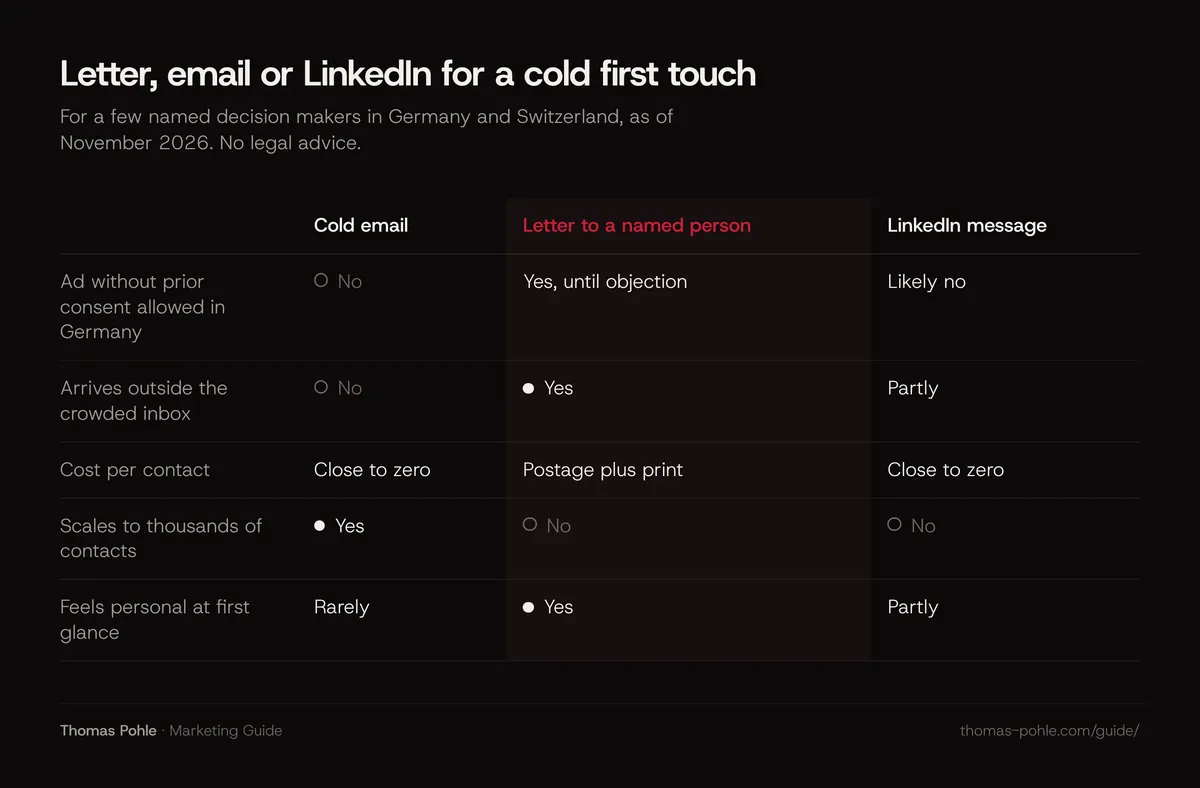
In Germany an addressed advertising letter to a business contact is allowed without prior consent, unlike advertising email. In Switzerland the consent rule for telecommunication does not cover letters, but a directory rule may. In both countries the name is personal data: say where you got the address and stop the moment someone objects. This is no legal advice.
| Question | Germany | Switzerland |
|---|---|---|
| Consent needed for an ad letter? | No. Section 7 (2) UWG requires prior express consent for email, fax and automated calls, not for letters | No. Art. 3 para. 1 lit. o UWG covers mass advertising by telecommunication, not letters |
| When does it become unlawful? | Section 7 (1) UWG: advertising although it is recognizable that the recipient does not want it, for example after an objection | Art. 3 para. 1 lit. u UWG: ignoring the directory note that someone wants no advertising from companies they have no business relationship with; people without an entry count as if they had the note |
| Data protection basis | GDPR: direct marketing can be a legitimate interest (recital 47, Art. 6 para. 1 lit. f) | DSG: processing is allowed unless it unlawfully violates personality rights; an express objection must be respected (Art. 30 para. 2 lit. b, 31) |
| Information and objection | Inform at the latest with the first letter (Art. 14 para. 3 lit. b GDPR); after an objection, stop (Art. 21 (2) and (3)) | Inform appropriately about the collection, also when the data came from elsewhere (Art. 19 DSG) |
In practice: check every name against a suppression list before you print, put a short data protection note into every letter (who you are, where the address comes from, how to object), and honor objections at once.
One open point for Switzerland. Art. 3 para. 1 lit. u UWG speaks of advertising messages in general and treats people without a directory entry as if they had asked for no advertising. The case law on this rule is mainly about phone marketing. Whether the rule also reaches a personal letter to a business address is not settled by the wording, so get a Swiss lawyer's view before a cold mailing there. Phone follow-ups and LinkedIn messages have their own rules, which the lead generation guide covers.
What to do this week
- Pick 20 accounts where one deal pays for the campaign many times over.
- Find one or two names per account and check them on the company site.
- Write one observation per account before you write any letter. No observation, no letter.
- Draft one letter of one page and have the person who will call sign it.
- Add the data protection note and set up a suppression list in your CRM.
- Block the follow-up calls for day 5 to 7 in sales' calendar before you send anything.
- Tag the accounts in the CRM so opportunities are counted for months, not days.
Direct mail won't return as a mass channel. For a few accounts it earns its place again, because every other channel got louder. If you want help choosing the accounts and the one message that opens them, that is what a one-day Momentum Workshop is for.
Frequently asked questions
Is direct mail still effective for B2B?
It is effective as a precision tool for a short list of accounts with high deal values, and weak as a mass channel. A 2015 neuromarketing study for the US Postal Service's Inspector General found that people spent more time with physical ads and remembered them better. Reliable B2B response rates for small personal mailings are not published, so measure your own batch.
Can I send advertising letters to companies in Germany without consent?
Generally yes. Section 7 (2) of the German UWG requires prior express consent for advertising by email, fax and automated calls, not for letters. A letter becomes unlawful under section 7 (1) when it is recognizable that the recipient does not want it, for example after an objection. Data protection rules still apply to the named person. This is no legal advice.
How many target accounts should a first direct mail campaign have?
Twenty to thirty is a good size for the first round. Every letter can still be researched by hand, and sales can call each recipient within a week. Above that, quality drops and the follow-up calls stop happening.
What should a B2B mailing include besides the letter?
At most one insert that is useful on its own: a short analysis of the recipient's situation, a benchmark, a checklist or a printed case study. Add a direct phone number, the name of the person who will follow up and a short data protection note. Gifts only make sense when they carry the point of the letter.
Sources
- Gesetz gegen den unlauteren Wettbewerb (UWG), § 7 Unzumutbare Belästigungen
- Bundesgesetz gegen den unlauteren Wettbewerb (UWG), SR 241, Art. 3 (Stand 1. Januar 2025)
- Bundesgesetz über den Datenschutz (DSG), SR 235.1, Art. 19, 30, 31
- Regulation (EU) 2016/679 (GDPR), recital 47, Art. 6, 14, 21
- Deutsche Post: Briefe in Deutschland 2026 (Porto)
- Deutsche Post: Dialogpost (Mindestmengen und Preise)
- Swiss Post: Briefe Schweiz (Preise A-Post und B-Post)
- Deutsche Post: Dialogmarketing-Monitor 2026 (Stand Juni 2026)
- Microsoft: New Microsoft study reveals the rise of the infinite workday (June 2025)
- USPS Office of Inspector General: Enhancing the Value of Mail, The Human Response (RARC-WP-15-012, 2015)

Thomas PohleB2B marketing advisor in Zurich. More than ten years in B2B marketing at Link11, Beekeeper and smino, most recently as Head of Marketing. CEO and co-founder of TEISENDA. Researched and drafted with AI tools, checked against the sources listed above. More about Thomas