How do you position a product in B2B?
Product positioning in B2B is the choice of which buying situation one product wins, against which alternatives, and why. For a complex product, write it for the whole buying group: the trigger that starts the purchase, the alternatives they compare, what only your product does, the value for each role, proof each role can check, and the category frame.
This guide is for founders, product owners and marketing leads who sell something that needs explaining. The company question is covered in the pillar on how a B2B company finds its positioning. This one covers a single product, with a template, a scenario and tests.
What is product positioning, and how is it different from company positioning?
Product positioning defines how one product is different and better than the alternatives for a particular set of customers in a particular buying situation. Company positioning sets the frame for the whole firm. A company with three products needs one company position and three product positions that fit inside it, each with its own alternatives and proof.
April Dunford, whose book Obviously Awesome is a widely used reference here, defines positioning as how "our product is different and better than alternatives for a particular set of customers." In my view, most product positioning goes wrong when a team tries to position the company and the product in one sentence.
| Level | What it decides | Who owns it | How often it changes |
|---|---|---|---|
| Company positioning | Which customers the firm serves and why it wins overall | Leadership | Rarely, every few years |
| Brand positioning | How that choice is remembered and recognized | Marketing | Rarely |
| Product positioning | Which buying situation one product wins, against which alternatives | Product and marketing, with sales | With every major release or new segment |
Why do complex B2B products need a positioning of their own?
Complex B2B products need their own positioning because buyers can't judge them at a glance. When a product takes a demo, a trial and an internal business case to understand, every unclear point turns into delay. The biggest competitor is often doing nothing, and a vague product story makes doing nothing feel safe.
The research on stalled deals is sobering. Matthew Dixon and Ted McKenna built their book The JOLT Effect on a study of more than two and a half million sales conversations. In a 2022 interview about the findings, Dixon said their research shows that between 40 and 60 % of deals are lost to the customer doing nothing. Status quo preference explains less than half of those losses, he said. The larger part is indecision: buyers worried about making a big mistake.
Indecision is a positioning problem too. If the buying group can't say what your product is for, what it replaces and what could go wrong, waiting feels safest. My take: for explain-heavy products, the positioning has to remove doubt before it adds excitement.
Trials make this concrete. Forrester's State of Business Buying 2026 reports that more than 60 % of business buyers use a trial before they buy, and 78 % of buyers in purchases of $10 million or more run a trial first. A trial with a positioning tests the promise you made.
How do buying groups change what a product positioning has to do?
A buying group changes product positioning because your story has to work for several people who never sit in the same meeting. Forrester counts 13 internal stakeholders and 9 external influencers in a typical buying decision. Each role asks a different first question, and many of them will meet your product without a seller in the room.
Gartner's survey of 645 B2B buyers, fielded in August and September 2025 and published in May 2026, shows how buyers gather that information. Buyers used an average of seven information sources in a recent purchase, and 45 % used generative AI, mainly to research vendors and products. 67 % prefer a rep-free experience. At the same time, 69 % prefer to validate AI-generated insights with sales reps.
Forrester's January 2026 release adds that procurement professionals are decision-makers in 53 % of business buying cycles. So the price logic and the risk story belong in the positioning, too.
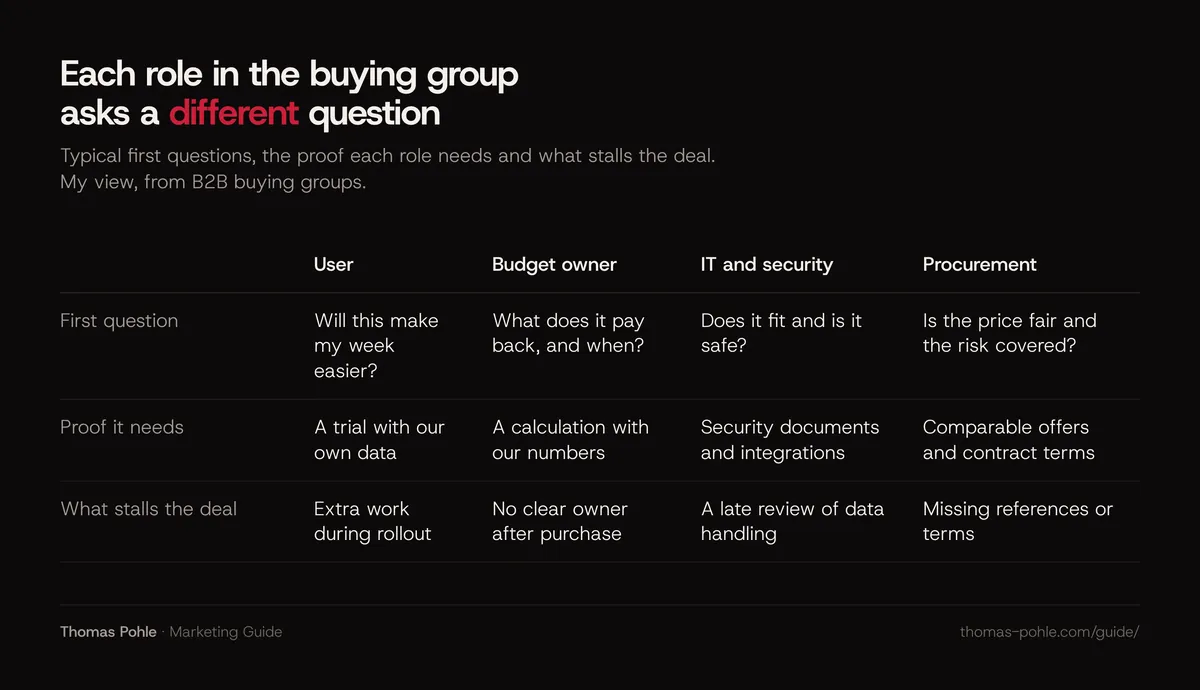
In practice, write for forwarding. Your champion will retell your story to people you never meet, so give them one value line per role and proof they can check without you.
Which questions does a product positioning have to answer?
A product positioning for a complex B2B offer answers six questions: which event triggers the purchase, which alternatives the buying group compares, what only this product does, what each role gains, which proof each role can check, and which category frame makes the value obvious. Dunford's definition covers the alternatives, the difference and the customers; the buying group adds the trigger, the per-role value and the proof.
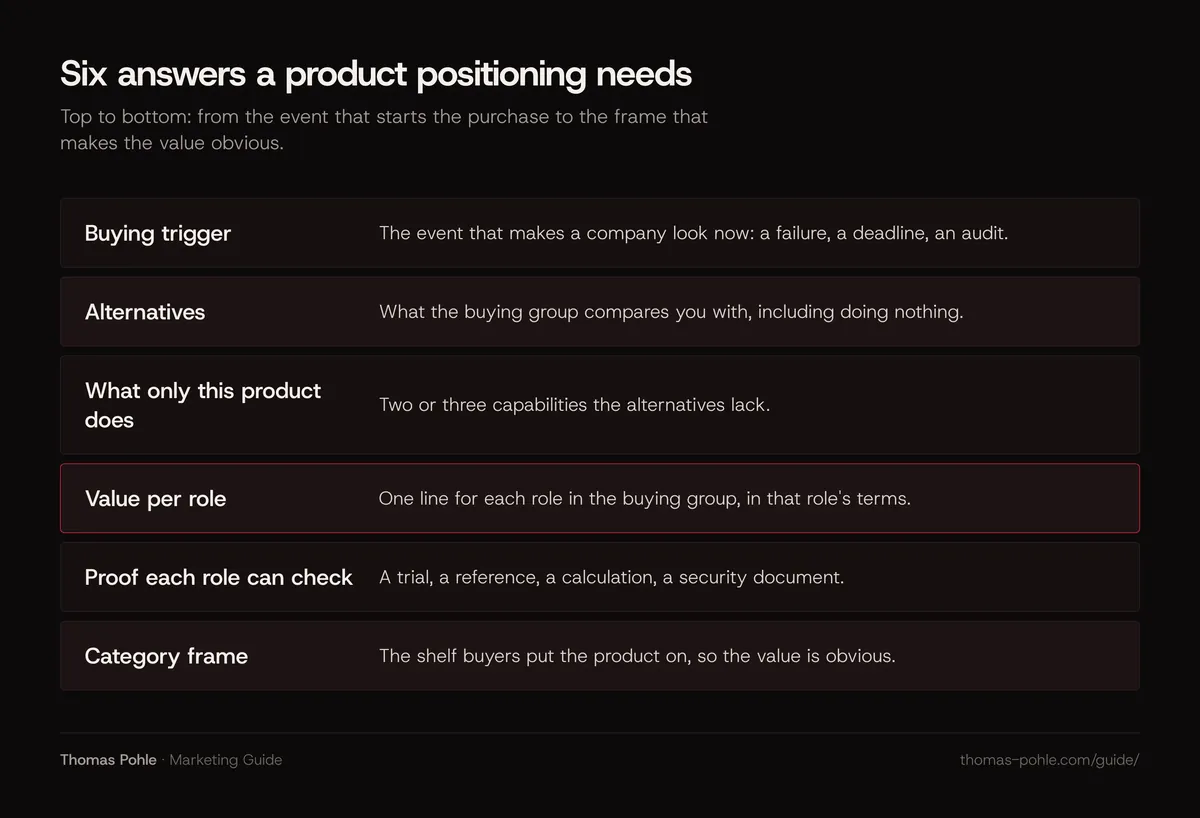
Start with the trigger and the alternatives, then the capabilities. The buyer wants to know why now and compared with what. For the competitive side, a positioning map built on real buying criteria helps you see where the alternatives sit before you write a word.
When my own homepage was reviewed against the pages of April Dunford, Andy Raskin and Ross Simmonds, the finding was that mine told a service provider's story: channels, packages, logos. Theirs led with a stance and let others provide the proof. Product pages have the same problem. A feature list is the vendor's story. The positioning is the buyer's.
How do you fill in a product positioning template?
Fill in the template from evidence: interviews with recent buyers, notes from won and lost deals, and the words customers used in the first call. Each field gets one or two sentences, and each field has a test it must pass. If a field fails its test, the product isn't ready to position, or you're guessing.
| Field | What you write | Test it must pass |
|---|---|---|
| Buying trigger | The event that makes a company look for this now | At least three of five recent buyers name it unprompted |
| Buying group | The roles involved, with the one who starts and the one who signs | Every role named appeared in at least one real deal |
| Alternatives | What the group compares you with, including doing nothing and building it themselves | Comes from buyers' words, never from your competitor list alone |
| What only this product does | Two or three capabilities the alternatives lack | A competitor's sales rep couldn't say the same sentence |
| Value per role | One line per role, in that role's terms | Each line names a time, cost, risk or workload effect |
| Proof per role | Trial plan, reference, calculation, security document | Each role has at least one item it can check without you |
| Category frame | The shelf buyers put the product on | A new buyer understands it in one sentence |
| What it is not for | The situations and customers you'll turn away | Sales agrees and has a deal it would now decline |
Finish with one positioning sentence for internal use: for [best-fit customer] facing [trigger], [product] is the [category] that [value], unlike [main alternative], because [what only it does]. It stays internal and keeps everyone aligned. If you need to know whether the capability field holds a real USP or just a strength, test it there.
What does a filled-in product positioning look like?
A worked example shows how the fields connect. The scenario below is invented. Every entry is a choice the team would have to verify with its own customers, and no field contains a result, because a positioning is a hypothesis until deals confirm it.
A typical scenario: a mid-sized Swiss pump manufacturer launches a software module that warns maintenance teams about pump failures from vibration data.
- Buying trigger. An unplanned shutdown in the last twelve months, or an audit that asks for a maintenance plan.
- Buying group. The maintenance lead starts it, the plant manager owns the budget, IT checks data access, procurement compares terms.
- Alternatives. Fixed-interval maintenance, a general monitoring platform, or a technician with a handheld device.
- What only this product does. It knows the pump's design data from the factory, so it can tell wear from a sensor fault.
- Value per role. Fewer night calls for maintenance, plannable downtime for the plant manager, no new cloud system to approve for IT, one supplier for procurement.
- Proof per role. A trial on two pumps with the plant's own data, a data flow diagram for IT, contract terms next to the pump service contract.
- Category frame. Predictive maintenance for pumps. Too broad would be industrial IoT platform.
- Not for. Plants that run mixed pump brands and want one system for all of them.
Look at the last line. The team gives up a large market on purpose, and that makes the rest believable. The trade-offs behind such a choice are the subject of the guide on which positioning strategy fits.
How do you test a product positioning before launch?
Test a product positioning in real conversations before it reaches the website. Run it in ten sales or discovery calls, hand the one-pager to people who weren't in the room, and check your lost deals for the no-decision pattern. I plan about two weeks for these checks. They show whether the story holds without you.
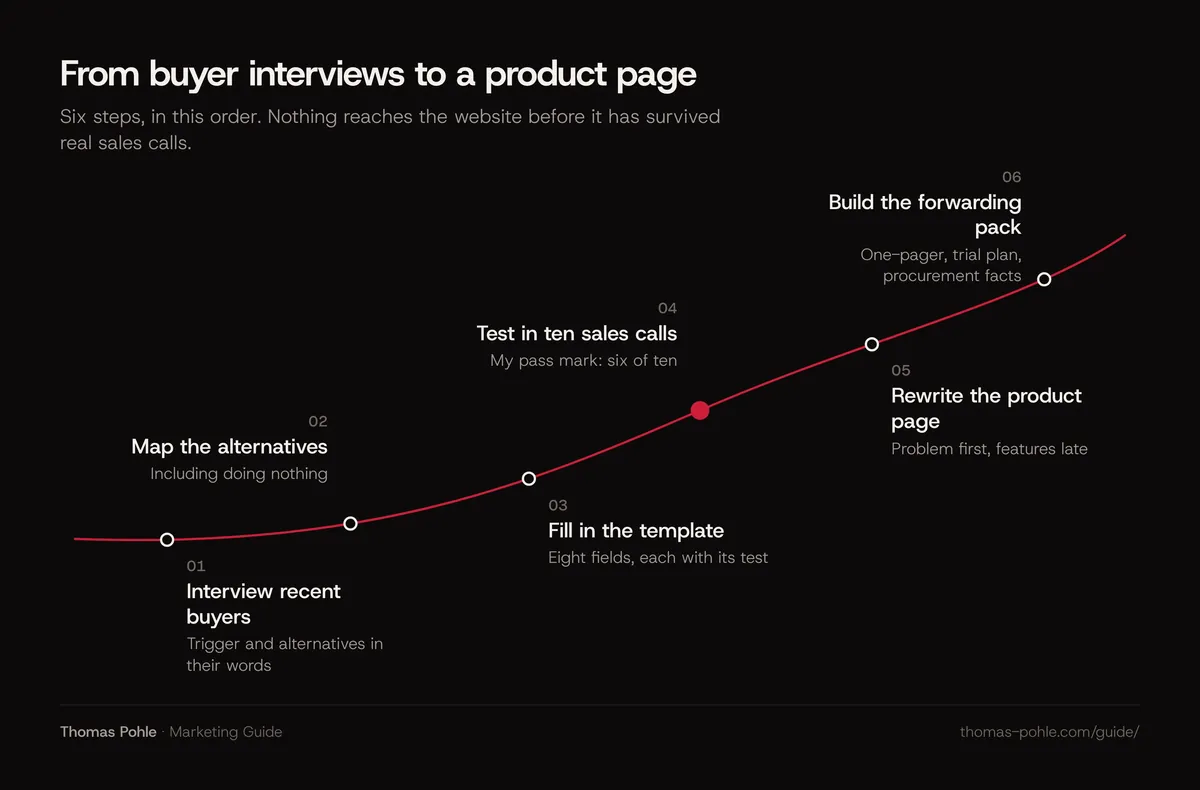
- Call test. Use the trigger and the value lines in ten calls. Pass: in at least six, the buyer repeats the trigger or the value in their own words.
- Forwarding test. Give the one-pager to three people from target roles who didn't hear your pitch. Pass: at least two can explain what the product is for and what it replaces.
- Role test. For each role in the buying group, ask a colleague to play that role and look for the proof. Pass: every role finds one item it can check alone.
- No-decision check. Look at the deals you lost in the last two quarters. If more than half ended in no decision, the trigger is too weak or the risk story is missing.
These thresholds are my own rules of thumb. Adjust them to your deal volume, and set the pass mark before the test.
Where does a product positioning have to show up?
A product positioning has to show up wherever a member of the buying group meets the product without you: the product page, the demo script, the one-pager a champion forwards, the trial plan and the procurement pack. Each one retells the same trigger, alternatives and proof in the format that role uses.
My own site follows a fixed order: what I believe, the real problem, what I do differently, how it works, who says it's true, who I am, the next step, with the CV late. In my view, a product page works best in the same order, with the team behind it in place of the CV and the specification table late.
- Product page. Trigger and problem in the first screen, alternatives named honestly, proof before the feature list.
- Demo script. Starts with the buyer's trigger and shows only the capabilities the alternatives lack.
- Champion one-pager. One page, one value line per role, the trial plan and a contact for IT questions.
- Trial plan. Tests the promise in the positioning, with success criteria agreed before it starts.
- Procurement pack. Price logic, contract terms, references and the security documents in one place.
Buyers research with AI assistants too, so the product page needs plain sentences about what the product is for and what it replaces.
What to do this week
- Pick one product, the one with the most stalled deals, and write its current positioning sentence from memory.
- Book five calls with customers who bought in the last twelve months and ask what triggered the purchase and what else they considered.
- List the roles in your last three deals, including procurement and IT.
- Fill in the eight fields of the template above, one or two sentences each.
- Mark every field that fails its test and decide who gets the missing evidence.
- Count how many of your lost deals in the last two quarters ended in no decision.
Revisit the template with every major release or new segment. If you want to work through the template with your product, sales and marketing leads in one room, that's a typical topic for a one-day Momentum Workshop.
Frequently asked questions
What is the difference between product positioning and a value proposition?
Product positioning is the strategic choice: which buying situation the product wins, against which alternatives, for whom. A value proposition is one expression of that choice, usually a sentence on a page that states the main benefit. Write the positioning first. Without it, value propositions drift toward generic benefits every competitor can claim.
How long does it take to position a new B2B product?
My rule of thumb is two to four weeks for a first version: one week for buyer interviews and deal notes, a few days to fill in the template, and about two weeks to run the call and forwarding tests. A brand-new product with no buyers yet can only start from a hypothesis, which you test with the first 20 to 30 target accounts before you commit the product page.
Can a product have a different positioning in each country?
The core should stay the same: what the product does that alternatives can't. The trigger, the alternatives and the proof can differ by market, because buyers in Germany, Switzerland or the UK may compare you with different local providers. Keep one template per market where the alternatives differ, and keep the category frame identical if you can.
Can I use AI to draft a product positioning?
AI is useful for sorting interview notes, clustering the alternatives buyers named and checking the template for gaps. The decisions and the words should come from you and your customers. Write the positioning yourself, or at least give the model your own interview material and judgment, because a positioning that comes from real buyer conversations is what makes people respond.
Sources
- April Dunford: Positioning (definition on her homepage)
- Forrester: The State of Business Buying, 2026 (press release, 21 January 2026)
- Gartner Survey Finds 69% of B2B Buyers Turn to Sales Reps to Validate AI-Generated Insights (press release, 20 May 2026, Business Wire copy on Yahoo Finance)
- Gartner newsroom: Gartner Survey Finds 69% of B2B Buyers Turn to Sales Reps to Validate AI-Generated Insights (20 May 2026)
- Penguin: The JOLT Effect by Matthew Dixon and Ted McKenna (publisher page)
- CustomerThink: The problem of customer indecision, interview with Matt Dixon (October 2022)

Thomas PohleB2B marketing advisor in Zurich. More than ten years in B2B marketing at Link11, Beekeeper and smino, most recently as Head of Marketing. CEO and co-founder of TEISENDA. Researched and drafted with AI tools, checked against the sources listed above. More about Thomas