How do you enter the US market from the DACH region?

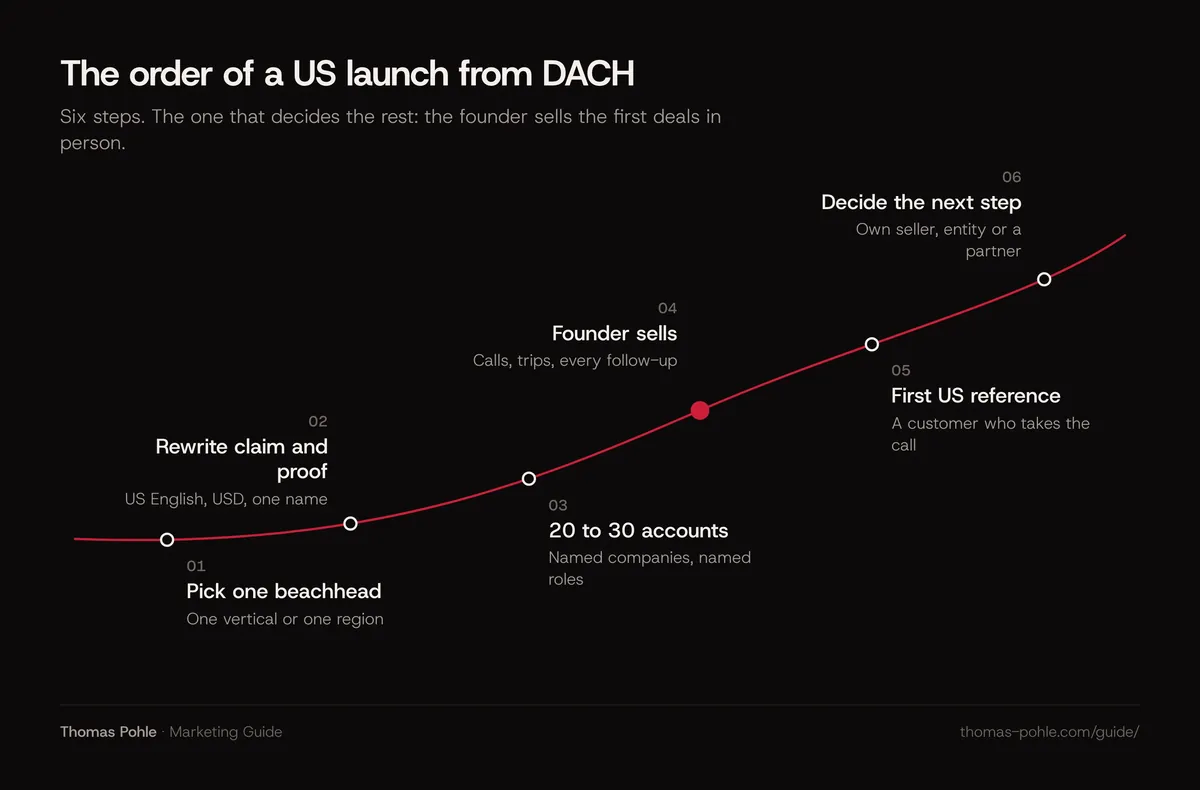
Enter the US market from the DACH region with one beachhead, a single vertical or region, instead of the whole country. Rewrite your positioning in US English with the claim and the proof up front, price in US dollars, answer within one business day, and let the founder or your own salesperson sell before any rep or distributor.
This guide is for founders and sales or marketing heads of DACH B2B companies that want US customers. The general plan for a new market is in the pillar on go-to-market strategy, the entry modes in international market entry.
Why can't you treat the US as one market?
The US is too big and too divided to enter as one market. The World Bank puts US GDP for 2025 at about USD 30.8 trillion, roughly 4.6 times Germany, Switzerland and Austria combined (about USD 6.7 trillion). By law the country is divided into nine time zones, and sales tax is a matter for each state.
Destatis (February 2026) reports goods exports to the US of EUR 146.2 billion in 2025, down 9.4 %, still the top destination for German exports. Swiss customs (BAZG, January 2026) puts 2025 goods exports to the US at CHF 54.7 billion, ahead of Germany at CHF 43.1 billion. Both leave out gold, precious metals, gems and art. Statistik Austria (June 2026) ranks the US second among Austria's export partners, with a share of 6.7 %.
None of these numbers tells you where to start. A beachhead does: one vertical or one region where you win the first customers and a reference.
What do US buyers expect from a supplier they've never heard of?
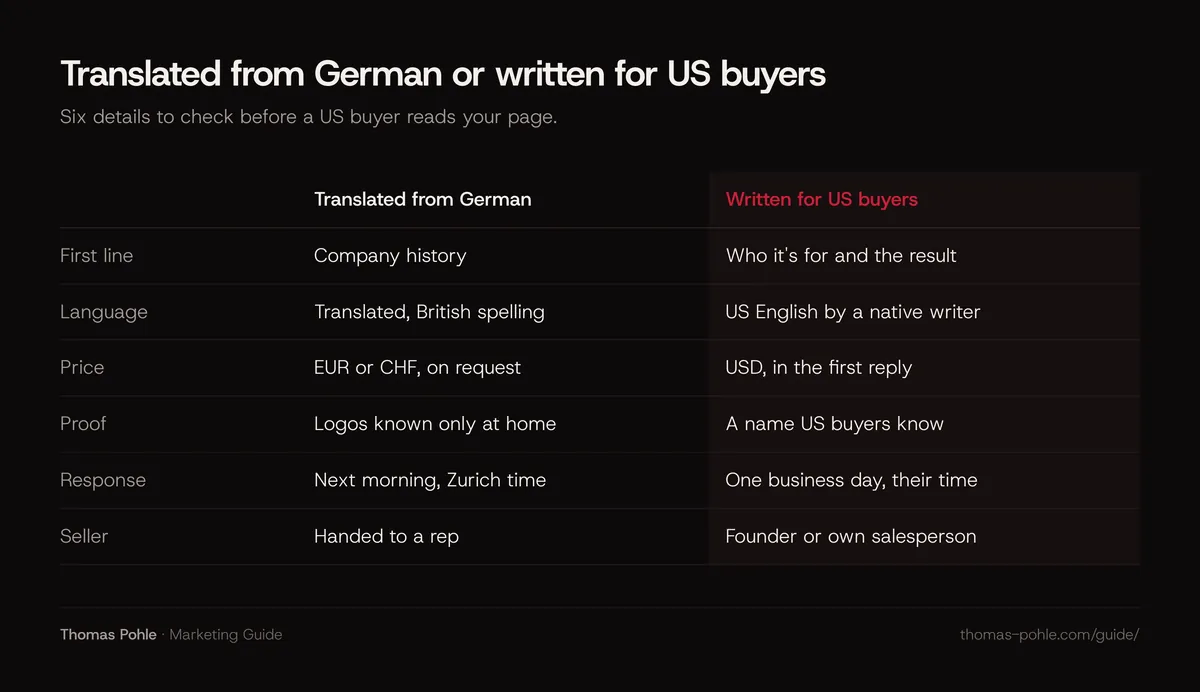
Expect a US buyer who has never heard of you to check a few things fast: a page in US English that says what you do and for whom, a price in dollars, proof from a company they recognize, a fast answer during their working day, and a way to sign and pay without friction. In my view, each gap is a reason not to reply.
| What buyers look for | What to show | Gap to watch for |
|---|---|---|
| Claim | One sentence: who it's for, what it does, the result | Company history and technology first |
| Language | US English, written for US readers | German page translated, British spelling |
| Price | US dollars, on the page or in the first reply | EUR or CHF, "on request" |
| Proof | A US customer or a name US buyers know | Logos known only at home |
| Response | An answer within one business day, their time | Reply the next morning, Zurich time |
| Paperwork | English contract, tax form, payment in USD | Home-market terms in German |
How do you sharpen your positioning and claims for the US?
Put the claim first and the proof right behind it. Say who it's for, what changes for them and by how much, then name the customer who can confirm it. If your site opens with company history and certificates, move them below the claim, where they work as proof.
A typical scenario, invented to make it concrete: a Swiss maker of inspection software. The translated home page opens with "Since 1998 we have been developing high-precision inspection solutions for the packaging industry." The US version opens with "Inspection software for food packaging lines. It catches seal defects before the pallet leaves the plant. Running at [customer], reference call on request." The bracket is where a real customer goes. Without one, leave the line out.
I keep words like "10x", "rocket" and "synergy" out of my own copy, and I'd keep them out of yours. My view on proof: it comes from other people, a customer quote or a reference call, rather than from a list of your own milestones. How to find the claim is covered in B2B positioning.
What has to change in language, pricing and reachability?
Four things change before the first campaign: the copy is written in US English instead of translated from German, prices and proposals are in US dollars, the proof names companies a US buyer knows, and your contact details work during their day.
- US English. Spelling, dates (11/25/2026 is November 25), units and job titles differ from British English. Have a native US writer edit the site, the deck and the proposal. AI drafts the translation fast, but write the substance yourself or give the draft your own input: the questions US prospects asked, the objections from your calls. More on translating versus localizing in multilingual B2B marketing.
- US dollars. Quote and invoice in USD and decide up front who carries the currency risk.
- Proof. Lead with a US customer, or with a customer that has US operations. The first US reference is the goal of the whole beachhead.
- Reachability. Show a booking link or phone hours in US time zones.
Under 15 U.S.C. §§ 261 and 263, Eastern standard time is five hours behind UTC and Pacific eight. Zurich, Berlin and Vienna are one hour ahead of UTC, so New York is six hours behind you and Los Angeles nine. A 9-to-6 day in Zurich overlaps a 9-to-5 day in New York by three hours, in Chicago by two, in Denver by one and in Los Angeles by none.
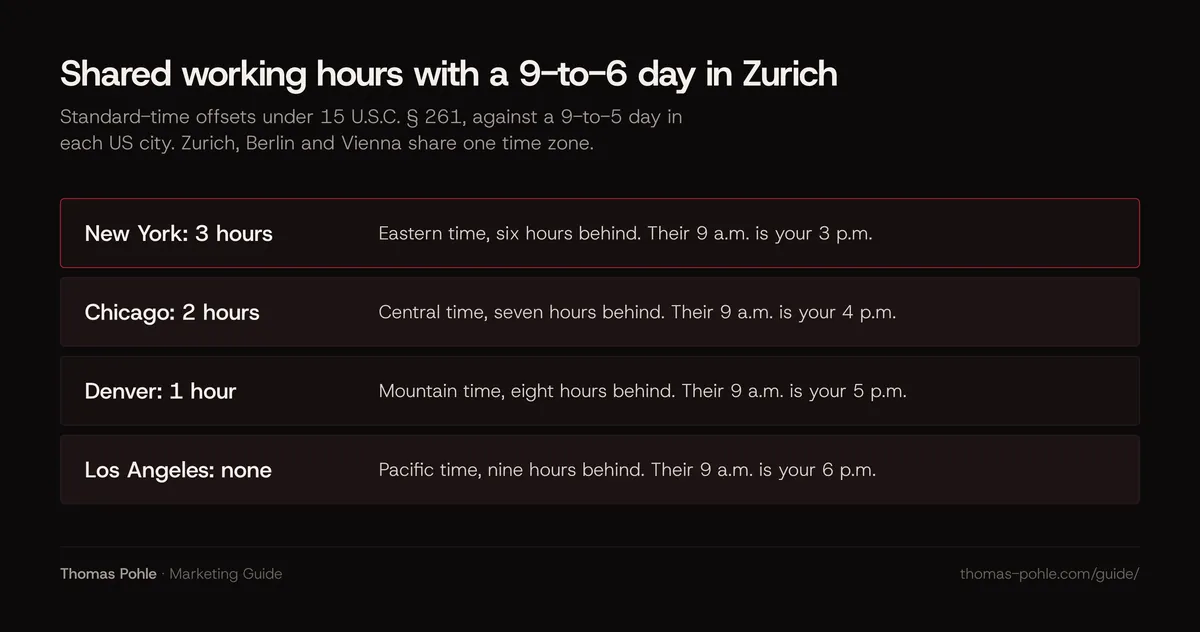
My rule: answer every US inquiry within one business day in the buyer's time zone. If nobody works evenings, start on the East Coast.
Which beachhead should you pick first?
Pick the beachhead where you already have pull and can be present: one vertical where a home customer has US sites or your product solves a problem US buyers have, or one region where buyers cluster and the time difference is workable. My rule is to stay there until three customers have bought and one of them takes reference calls.
| Your situation | Beachhead | Why |
|---|---|---|
| A home customer has US plants or a US parent | That company's US sites, then its vertical | A warm introduction and proof that already exists |
| Your buyers cluster in one region | That region and its one trade show | One trip can cover many meetings |
| You sell remotely and buyers are spread out | One vertical, East Coast accounts first | Three shared working hours a day |
| Your machines need service visits | One region a service partner can reach | Buyers need fast help on site |
Then test the candidate with three questions. Can you name 20 to 30 target accounts in it, with the roles you need to reach? Do you have at least one existing link into it, a customer, a partner or a former colleague? Can someone on your team be reachable for at least two of their working hours every day? With fewer than two yeses, pick another beachhead. That threshold is my rule of thumb.
Places to start: the Swiss Business Hub USA in New York, the German American Chambers of Commerce, ADVANTAGE AUSTRIA, and the SelectUSA Investor Guide.
Who should sell in the US, your own people or a rep?
Sell with your own people first: the founder, then one salesperson on your payroll. They hear what US buyers ask and own the relationships. Bring in an independent rep or a distributor only where buyers need local stock, on-site service or a supplier with a US company.
In my view, when a market goes to an external firm early, the learning and the customer contacts go with it. The same choice for Germany is in market entry Germany.
US Customs and Border Protection says the Visa Waiver Program lets eligible travelers from participating countries stay up to 90 days for business or tourism. Placing someone in the US is a different matter. USCIS describes the E-2 classification for nationals of treaty countries who invest substantial capital in a US business they own at least 50 % of or control, and the L-1A classification for an executive or manager who has worked for the company abroad for one continuous year within the last three. Ask an immigration lawyer which route fits. This isn't legal advice.
Which legal and tax basics should you know before the first deal?
Know five pointers before the first deal: whether you need a US entity and in which form, how you get a US tax number, which tax form US customers ask for, when states expect sales tax from you, and what applies to goods. This is orientation from official sources, no legal or tax advice.
- Entity. Whether you can start by selling from your GmbH or AG is the first question for a tax advisor who knows both countries. The US Small Business Administration (SBA) describes a C corporation as a legal entity separate from its owners whose profits can be taxed twice. Its overview excludes non-resident aliens and corporations as S corporation shareholders, so in my reading a foreign parent ends up comparing a C corporation with an LLC. Delaware requires a registered agent with a street address there.
- Tax number. The IRS says applicants whose principal place of business is outside the US apply for an Employer Identification Number by phone, fax or mail.
- Tax form. The IRS describes Form W-8BEN-E as the form foreign entities use to document their status for US withholding rules. If you sell from your European company, have it filled in before a US customer's finance team asks.
- Sales tax. In South Dakota v. Wayfair (June 21, 2018) the US Supreme Court dropped the rule that a state can only require sellers with a physical presence to collect its sales tax. The South Dakota law in the case covered sellers with more than USD 100,000 of goods or services or 200 or more separate transactions a year delivered into the state. Thresholds and taxable products differ by state, so check every state where you have customers.
- Goods. US tariff rules changed more than once in 2026. Switzerland's economic affairs office SECO (checked November 2026) lists a variable additional duty of up to 12.5 % on Swiss goods since July 24, 2026, with the regular duty counted against it and many exempt product groups. Sector duties, such as those on steel and cars, remain separate. For EU goods the European Commission documents the Joint Statement of August 21, 2025. On November 25, 2026, the US Trade Representative proposed further tariffs, up to 15 % on Swiss goods and 15 % on EU goods, both net of the regular duty and existing Section 301 tariffs, with exemptions. They aren't in force; hearings start in January 2027. Check with your customs broker before you quote delivered prices.
What rules apply to cold email and calls in the US?
US rules for cold email are looser than Germany's and still strict on form. The Federal Trade Commission's CAN-SPAM guide sets requirements for every commercial email, business-to-business included, and Federal Communications Commission rules under the Telephone Consumer Protection Act (TCPA) require consent for autodialed or prerecorded calls and texts to mobile numbers.
The FTC's guide spells out the duties, among them honest headers and subject lines, your postal address, and an opt-out you honor within 10 business days. It says the law "makes no exception for business-to-business email" and puts the penalty at up to USD 53,088 per email. It lists no general requirement to get consent first.
Germany works the other way: § 7 UWG requires prior express consent for advertising email, with a narrow exception for existing customers. Keep US and German lists apart.
For phones, the FCC's consumer guide (updated November 20, 2026) says callers need consent before an autodialed or prerecorded call or text to a wireless number, and that commercial texts need written consent. Dialing by hand doesn't lift the Do Not Call Registry rules for private numbers. Skip automated texts and have a US lawyer look at any calling campaign. This is general information, not legal advice.
Permitted doesn't mean welcome. My view: write to 20 to 30 named accounts, and have the person who takes the meeting write the message. AI can research the account. The reason you're writing has to come from you.
What to do this week
- Open your English page and mark British spelling, EUR or CHF prices and a first line about your history.
- Rewrite the first line: who it's for, what it does, the result, the customer who confirms it.
- Choose one beachhead and run the three-question test on it.
- Write down 20 to 30 target accounts with the roles you need to reach.
- Decide who sells: the founder first, then one own salesperson.
- Book a tax advisor who knows both countries, and bring the entity, sales tax and W-8BEN-E questions.
The GTM strategy template shows how to put the plan on slides for your board.
If you want a second view on your US plan, a one-day Momentum Workshop sets the beachhead, the claim and the first accounts with your team.
Frequently asked questions
Do I need a US company to sell to US customers?
That's the first question for a tax advisor who knows both countries. The US Small Business Administration excludes non-resident aliens and corporations as S corporation shareholders, so in my reading a foreign parent compares a C corporation with an LLC.
Should I start on the East Coast or the West Coast?
Start where your buyers are. If they're spread out, start on the East Coast. A DACH workday shares three hours with New York and none with Los Angeles. West Coast accounts need someone who works evenings or sits in the US.
Is cold email legal in the US?
The FTC's CAN-SPAM guide regulates how you send commercial email, business-to-business included, and lists no general requirement to get consent first. You need honest headers, a postal address and an opt-out honored within 10 business days, among other duties. German recipients remain under § 7 UWG. This is not legal advice.
When should I hire a salesperson in the US?
When the founder can no longer answer every US conversation within one business day, or when West Coast accounts need local hours. My preference is the founder first, then one own salesperson, before any rep or distributor.
Sources
- World Bank Open Data: GDP (current US$), United States, Germany, Switzerland, Austria, 2025 (updated 11 November 2026)
- Statistisches Bundesamt (Destatis), Pressemitteilung Nr. 056 vom 20. Februar 2026: China im Jahr 2025 wieder wichtigster Handelspartner Deutschlands
- BAZG, media release of 29 January 2026: Swiss foreign trade 2025 (in German)
- Statistik Austria (30 June 2026): Außenhandel 2025, vorläufige Ergebnisse
- 15 U.S.C. § 261, Zones for standard time (govinfo.gov)
- Federal Trade Commission: CAN-SPAM Act, A Compliance Guide for Business
- Federal Communications Commission: Stop Unwanted Robocalls and Texts (updated 20 November 2026)
- U.S. Small Business Administration: Choose a business structure
- Internal Revenue Service: Employer identification number (reviewed 17 July 2026)
- Supreme Court of the United States: South Dakota v. Wayfair, Inc., No. 17-494, decided June 21, 2018 (Cornell LII)
- USCIS: E-2 Treaty Investors (reviewed 20 August 2026)
- U.S. Customs and Border Protection: Visa Waiver Program

Thomas PohleB2B marketing advisor in Zurich. More than ten years in B2B marketing at Link11, Beekeeper and smino, most recently as Head of Marketing. CEO and co-founder of TEISENDA. Researched and drafted with AI tools, checked against the sources listed above. More about Thomas