How do you enter the German market as a B2B company?
Enter the German market as a B2B company with a site in standard German and prices in euros, a complete imprint and GDPR-clean forms, one trade fair your buyers attend, and your own person selling. From Switzerland or Austria, settle VAT invoicing and outreach rules before the first campaign. Most costly launch mistakes are small and avoidable.
This guide is for founders and sales or marketing heads of Swiss and Austrian B2B companies who want to win German customers on purpose. The general plan for any new market sits in the pillar on go-to-market strategy, and the choice between export, partner and subsidiary in international market entry. This one stays on Germany.
Why is Germany the first market for Swiss and Austrian B2B companies?
Germany is Austria's most important trading partner and one of Switzerland's biggest. Swiss customs (BAZG, March 2026) reports provisional 2025 exports to Germany of CHF 50.5 billion and imports of CHF 63.7 billion, well ahead of Italy and France and, on imports, above the USA (CHF 55.6 billion). Statistik Austria (June 2026) puts Austria's provisional 2025 exports to Germany at EUR 56.18 billion, 29.6 % of all Austrian exports.
The shared language makes Germany look like a short step. That's the trap. Spelling, currency, law and the people who vouch for you all change at the border. The barriers in all three DACH countries are compared in market entry barriers. Here we go through Germany step by step.
What do German B2B buyers expect from a new supplier?
German B2B buyers expect a supplier who looks like it plans to stay: a German-language site and documents in standard German, prices in euros, a complete imprint, forms that handle personal data properly, someone they can reach in Germany, and references from German customers. Each missing piece raises a question before the first call.
| What buyers look for | What to show | Typical gap from CH or AT |
|---|---|---|
| Language | Site, PDFs, offers and contracts in standard German | Swiss spelling without ß, Austrian terms |
| Price | Prices and invoices in euros | CHF price list on the German page |
| Who you are | Imprint with company, address, register, VAT ID | Thin imprint, no VAT ID |
| Data | Privacy notice at every form, data processing agreement ready | Form without notice, no agreement on file |
| Reachability | German number or address, a named contact | +41 number only, info@ address |
| Proof | One German customer who takes a reference call | Home-market logos only |
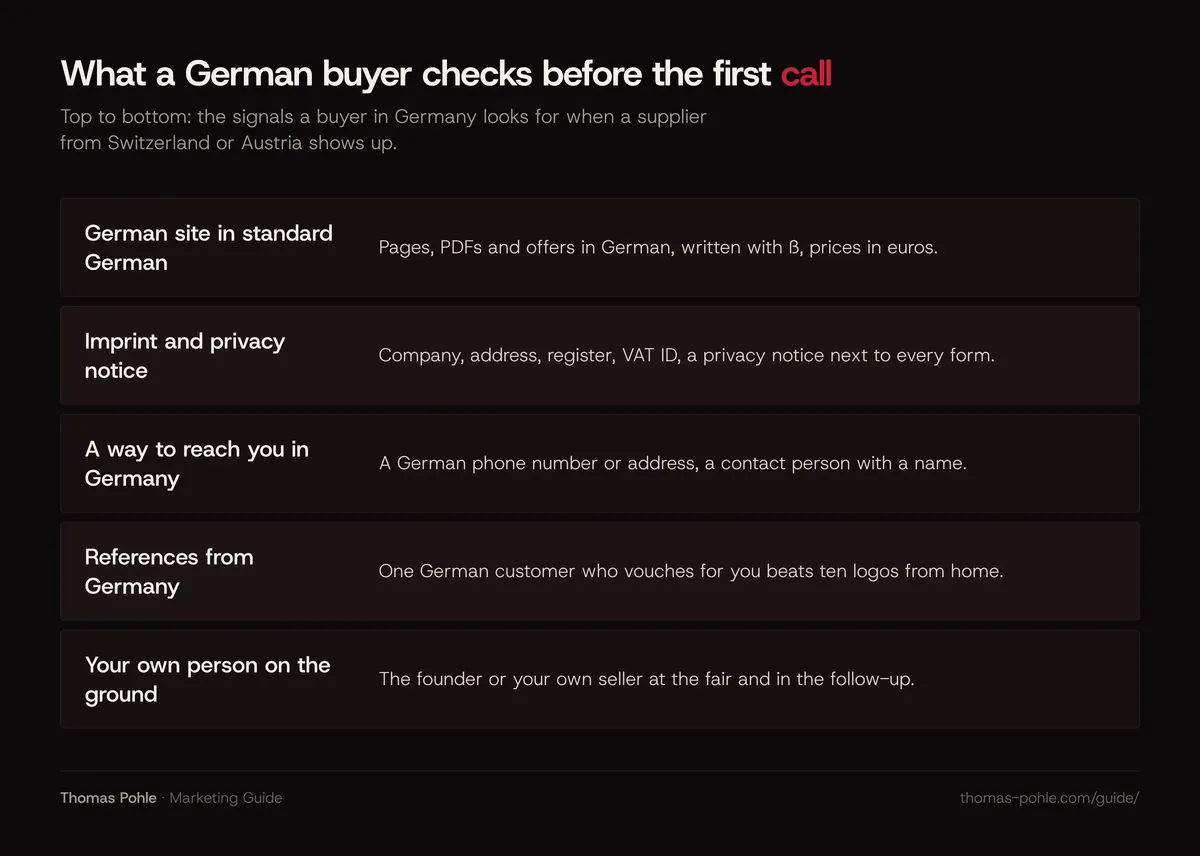
My view on references: a single German customer who vouches for you does more than ten logos from Zurich or Vienna. Buyers in a new market don't know your home logos, so the first German reference is the asset you build toward from day one.
What has to be on your German website before launch?
Before launch your German site needs four things: text in standard German with ß and prices in euros, a clear signal that it targets Germany (a .de domain or a /de/ folder with hreflang), a German contact route, and a complete imprint and privacy notice. Google lists local language, currency, addresses and phone numbers as signals of a page's audience.
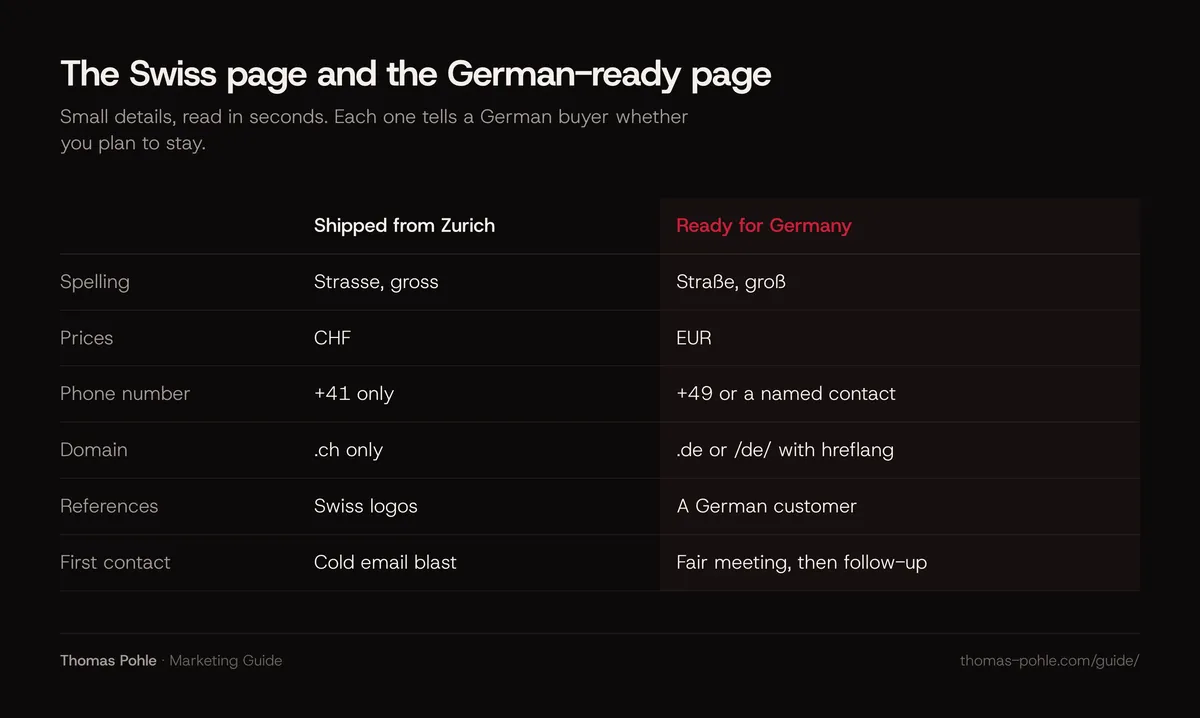
- Standard German. The official German spelling rules (Rat für deutsche Rechtschreibung, 2024 edition, § 25 E2) allow ss instead of ß in Switzerland and Liechtenstein. German readers see "Strasse" and "gross" as Swiss at once. Have a German native from Germany proofread the site, the PDFs and the offer template.
- Domain and hreflang. Google's documentation on multi-regional sites says a country domain sends "a strong signal" that a site targets that country, while a subdirectory on a generic domain is low maintenance. With either, use hreflang so the German page shows in Germany and the Swiss page in Switzerland. Details are in the technical SEO checklist.
- Imprint. Germany's Digitale-Dienste-Gesetz (DDG), in force since 14 May 2024 (BGBl. 2024 I Nr. 149), sets out the imprint in § 5: name and address, for companies the legal form and the authorized representatives, a fast electronic contact including email, the commercial register and number, and the VAT ID where one exists.
- Forms and data. The GDPR applies to a company outside the EU when it offers goods or services to people in the EU or monitors their behavior there (Article 3(2)), and business contacts are people. Article 13 requires the privacy information at the moment you collect the data, so put a short notice and a link next to every form. A Swiss company covered by Article 3(2) must name a representative in the EU in writing (Article 27(1)). The exception in Article 27(2) is narrow: processing that is only occasional, does not include large-scale processing of sensitive data or criminal records, and is unlikely to put people's rights at risk. Austrian companies are in the EU and need no such representative.
This is general information, not legal advice. Have a lawyer check the imprint and privacy notice before launch.
Which legal and tax points matter when you sell from Switzerland or Austria?
Three points come up in almost every launch: who owes German VAT on your services, what your invoice must say, and whether staff you send to Germany must be registered. The answers differ for Swiss and Austrian sellers, because Austria is in the EU and Switzerland isn't. Treat this as an orientation. It isn't legal or tax advice.
- Place of supply. Under § 3a(2) of the German VAT Act (UStG), a service to a business customer is supplied where the customer runs its business. For a German customer that's Germany.
- Reverse charge. Under § 13b(5) UStG the German business customer owes the VAT for services from a supplier based abroad, both for EU suppliers under § 13b(1) and for non-EU suppliers under § 13b(2) No. 1.
- Invoice wording. From Switzerland, § 14a(5) UStG requires the note "Steuerschuldnerschaft des Leistungsempfängers" on the invoice. From Austria, you invoice under Austrian rules (EU VAT Directive, Article 219a), and the Directive requires the mention "Reverse charge" and both VAT IDs, yours and your customer's (Article 226).
- Goods. Switzerland is not part of the EU customs territory, which Article 4 of the Union Customs Code defines by the territories of the member states, so physical goods from Switzerland cross a customs border. Clarify customs and import VAT with your forwarder before you quote delivered prices.
- Staff on site. Employers based abroad who send workers to Germany in sectors listed in § 2a of the Schwarzarbeitsbekämpfungsgesetz, among them construction and trade fair set-up, must notify German customs in writing before the work starts (§ 16 Minimum Wage Act). The Mindestlohn-Meldeportal handles this online. If your team builds its own fair booth or installs equipment, check this early.
Have a tax advisor who knows both countries confirm your invoicing before the first German order.
Which trade fairs open doors in your industry?
My view: a trade fair is the one place in German B2B where buyers expect to meet suppliers they don't know yet. Pick the one fair your buyers attend and plan the year around it. Large industry fairs run on fixed cycles, most yearly, some every two or three years, so check the next date with the organiser before you budget.
- Industrial technology. Hannover Messe, Hanover, every April (Deutsche Messe).
- Automation. SPS, Nuremberg, every November (Mesago Messe Frankfurt).
- Intralogistics. LogiMAT, Stuttgart, every March (Euroexpo).
- IT security. it-sa Expo&Congress, Nuremberg, every October (NürnbergMesse).
- Medical technology. MEDICA, Düsseldorf, every November (Messe Düsseldorf).
- Building and construction. BAU, Munich, every two years in January, next in January 2027 (Messe München).
For other industries, the German trade fair association AUMA runs a database of fairs in Germany. Swiss companies can ask the Swiss Business Hub Germany in Stuttgart, part of Switzerland Global Enterprise (S-GE), about partner searches; S-GE also runs SWISS Pavilion stands at trade fairs. Austrian companies have the ADVANTAGE AUSTRIA offices of the Austrian Economic Chamber (WKO) in Berlin and Munich. My rule: visit a fair once before you exhibit there. Walk it with your target list, then decide on a stand.
How do German buyers buy from a new supplier?
Expect more than one person on the buyer side, a supplier onboarding step and paperwork your home-market customers never asked for. Have the documents ready in German before the first meeting, so procurement doesn't stall a deal your champion already wants.
What to have ready, in German:
- Company file. Register extract, VAT ID, bank details, insurance certificate, your contact person.
- Data processing agreement. If your product or service processes personal data on the customer's behalf, Article 28(3) GDPR requires a contract with fixed content. Have a German version on file before procurement asks.
- Reference contact. A customer who agrees to take a call, ideally one from Germany.
Which marketing mistakes cost the most at launch?
The most expensive launch mistakes are small: a German page in Swiss spelling with CHF prices, a +41 number as the only contact, a .ch domain with no German version, home-market references only, and cold email to German companies. The first four cost trust. The last one can cost an injunction and legal fees.
Cold email deserves its own warning. Under § 7(2) No. 2 of the German Act against Unfair Competition (UWG), advertising by email without the recipient's prior express consent is an unreasonable nuisance, also between businesses. The exception in § 7(3) only covers existing customers under strict conditions. In judgment 23 C 120/25 (20 November 2025) the Düsseldorf district court ordered the sender of two advertising emails to a company address to stop. The court applied the standards of § 7 UWG and held that presumed consent is not enough for advertising email, so an indirect LinkedIn connection between the sender and the company's managing director didn't help. Advertising calls to businesses need at least presumed consent (§ 7(2) No. 1).
So don't treat unsolicited advertising emails or LinkedIn advertising messages as permitted in Germany. Switzerland and Austria have their own rules, and a habit that passed at home can still fail in Germany. This is general information, not legal advice.
Who should sell in Germany, your own people or a distributor?
Start with your own people: the founder, a country manager, or one salesperson you hire for Germany. They learn what buyers ask and own the relationships. Bring in a distributor only where buyers need local stock, local service or a German invoice from a German company.
That's my preference, and it's deliberate. When the market goes to an external firm early, the learning and the customer data go with it, and you end up with a contract instead of a market.
| Situation | Who sells first | Why |
|---|---|---|
| Software or services, sold remotely | Founder or one own seller | No stock, no local service needed |
| Machines that need service visits | Own seller, plus a service partner | Keep the customer, buy the service |
| Buyers expect local stock or delivery | Distributor, with your seller alongside | Stock and logistics are the job |
| Buyers only order from German companies | Distributor or German entity | Invoicing is the barrier |
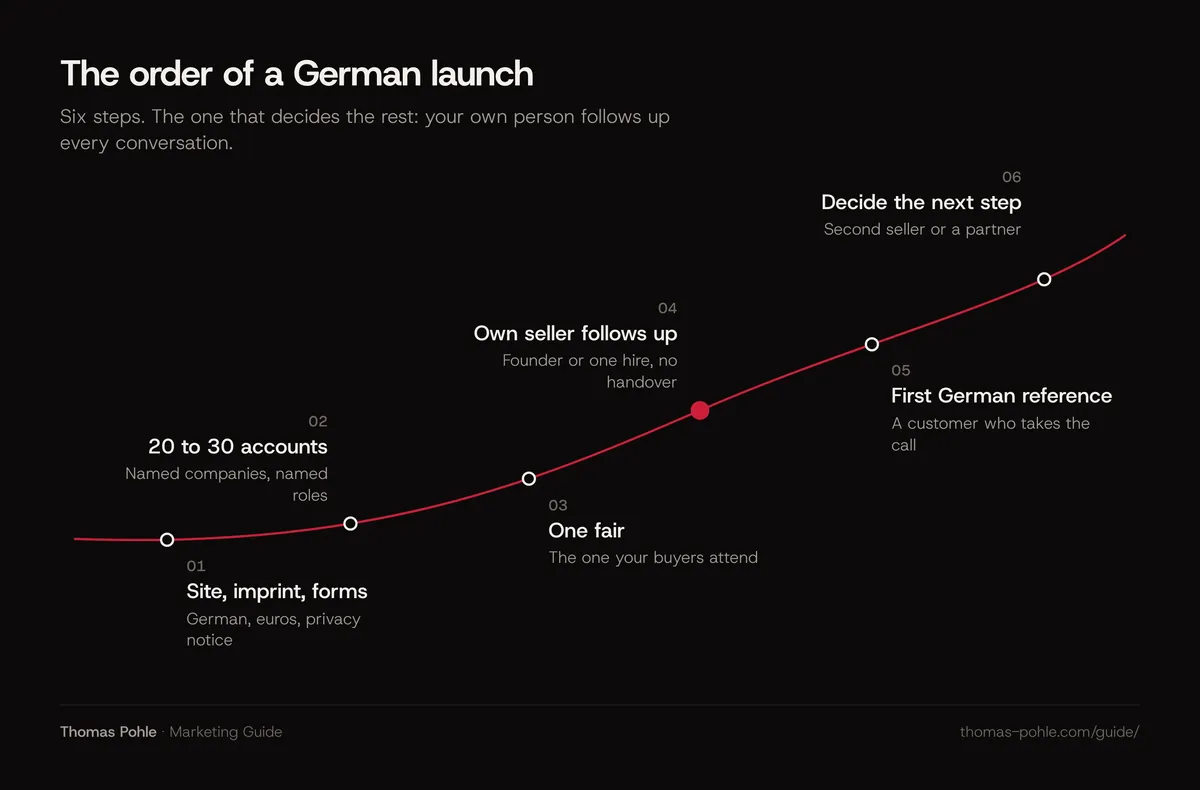
Keep the first round small: 20 to 30 named target accounts, one fair, one person who owns the follow-up. How to put that plan on a few slides for your board is shown in the GTM strategy template.
The same goes for content. AI can draft your German pages and emails, but write the substance yourself or at least give the draft your own input: the questions German buyers asked you, the objections you heard at the fair. That first-hand material is what makes buyers answer. I work in German with clients and publish in English and German, and I took a Swiss German business course in Zurich, so I see both sides of the border in my own work.
What to do this week
- Open your German page and look for ss instead of ß, CHF prices and a +41 number as the only contact.
- Check your imprint against § 5 DDG: company, legal form, representative, address, email, register, VAT ID.
- Put a privacy notice and link next to every form on the German site.
- Ask your tax advisor for the exact reverse-charge wording on your German invoices.
- Stop any cold email campaign to German companies until you have consent.
- Pick the one fair your German buyers attend and check the next date with the organiser.
- Write down 20 to 30 German target accounts with the roles you need to reach.
- Decide who sells in Germany: you, a country manager or one hire.
Germany rewards suppliers who look local and follow up in person. Plan every step toward the first German reference.
If you want a second view on your German launch, a one-day Momentum Workshop sets the target accounts, the fair and the first steps with your team.
Frequently asked questions
Do I need a German company to sell in Germany?
Not to start. You can sell services to German business customers directly and invoice under the reverse charge in § 13b UStG. A German entity becomes relevant when buyers only order from German companies, when you hold stock there, or when staff work there permanently. Ask a tax advisor before you decide, since it changes VAT, payroll and liability.
Can I use my Swiss website for Germany?
You can, but it costs trust. Swiss spelling without ß, CHF prices and a +41 number signal a visitor. Add a German version in standard German with euro prices, a German contact route and a full imprint, and connect the versions with hreflang so Google shows the German page in Germany. Google lists language, currency, addresses and phone numbers as audience signals.
Is LinkedIn outreach allowed in Germany?
Don't treat unsolicited advertising messages as permitted. § 7 UWG requires prior express consent for advertising by email, and in case 23 C 120/25 (November 2025) the Düsseldorf district court held that presumed consent is not enough for advertising emails, so an indirect LinkedIn connection didn't help the sender. Use LinkedIn to build relationships, comment and invite to meetings, and ask a lawyer before any outreach campaign.
Which trade fair should I start with?
Start with the fair your buyers attend, even if a bigger one looks more impressive. Ask your best customers which German fair they visit, check AUMA's database for your industry, and visit once before you exhibit. Book meetings in advance with your 20 to 30 target accounts. A stand without booked meetings is expensive brand building.
When should I hire a salesperson in Germany?
When the founder can no longer follow up every German conversation personally. My preference is the founder or a country manager first, then one own salesperson, before any distributor. The seller should be a native German speaker who knows your industry. A distributor fits only where buyers need local stock, service or a German invoice.
Sources
- Digitale-Dienste-Gesetz (DDG), § 5 Allgemeine Informationspflichten
- Gesetz gegen den unlauteren Wettbewerb (UWG), § 7 Unzumutbare Belästigungen
- AG Düsseldorf, Urteil vom 20.11.2025, 23 C 120/25 (NRWE)
- Umsatzsteuergesetz (UStG), § 13b Leistungsempfänger als Steuerschuldner (with § 3a and § 14a)
- Regulation (EU) 2016/679 (GDPR), Articles 3, 13, 27 and 28, EUR-Lex
- Google Search Central: Managing multi-regional and multilingual sites
- Rat für deutsche Rechtschreibung: Amtliches Regelwerk 2024, § 25 E2
- BAZG (18 March 2026): Fakten und Zahlen 2025, Schweizer Aussenhandel
- Statistik Austria (30 June 2026): Außenhandel 2025, vorläufige Ergebnisse
- Council Directive 2006/112/EC (EU VAT Directive), Articles 219a and 226, EUR-Lex

Thomas PohleB2B marketing advisor in Zurich. More than ten years in B2B marketing at Link11, Beekeeper and smino, most recently as Head of Marketing. CEO and co-founder of TEISENDA. Researched and drafted with AI tools, checked against the sources listed above. More about Thomas