How do you enter a foreign market, from export to subsidiary?

You enter a foreign market through one of a handful of entry modes: indirect export, direct export, a commercial agent, a distributor, a branch, a subsidiary, or a joint venture or acquisition. Each step up gives you more control and costs more commitment. Choose by who should own the customer, the price and the brand in that country.
The entry mode is often treated as a legal or tax question. In my view it's a marketing question first. The mode decides who talks to your buyers, who sets the price they see, whose name is on the invoice and who keeps the contacts when the deal ends. That's why I start with my own sales wherever I can.
This guide is for founders and marketing leads of B2B companies with a market abroad on the list. The wider plan, from segment to pipeline math, is in the guide on how to build a go-to-market strategy. Timing and sequence (pioneer or follower, one market or several) are covered in market entry strategies.
Which forms of international market entry are there?
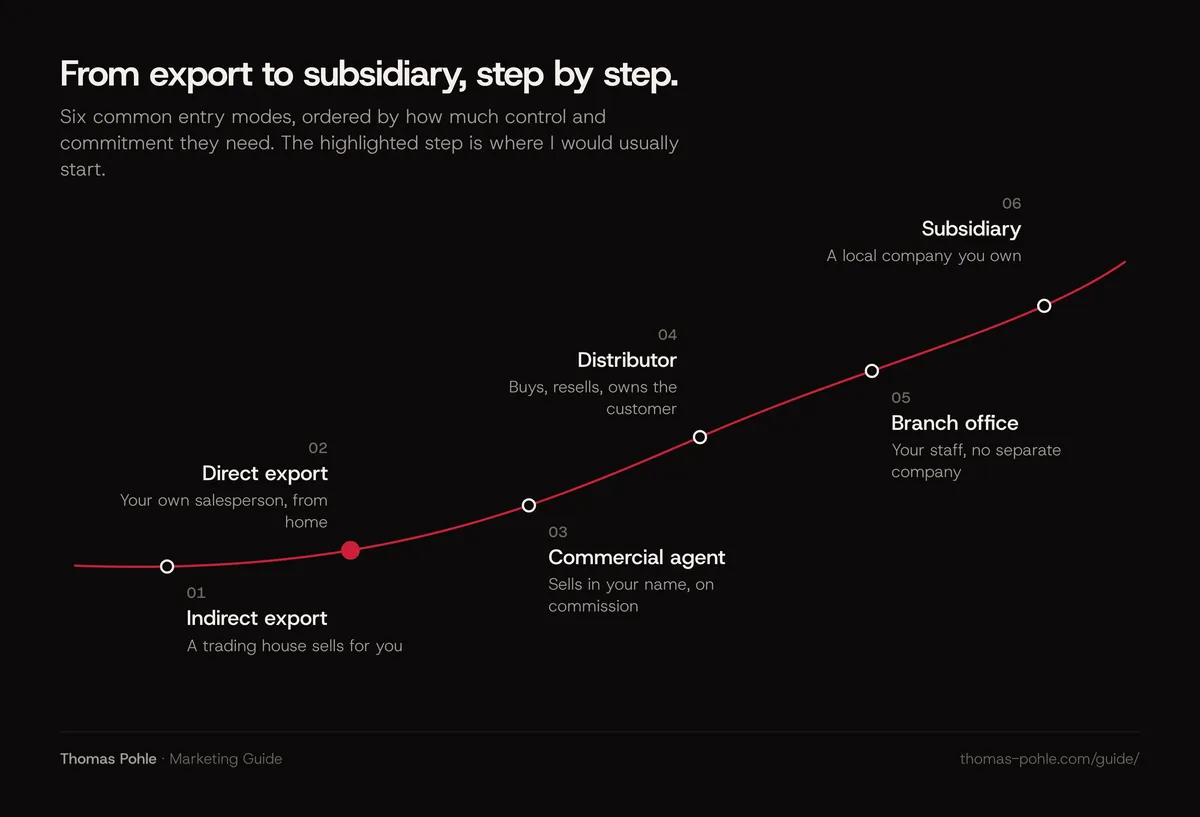
International entry modes run from indirect export through a trading house, to direct export from home, a commercial agent, a distributor, a branch office, a local subsidiary, and finally a joint venture or acquisition. Each mode trades control against resource commitment.
That trade-off is the core of a classic paper. Erin Anderson and Hubert Gatignon, in the Journal of International Business Studies in 1986, grouped 17 entry modes by the degree of control they give the entrant. They argued that the most efficient mode depends on a trade-off between control and the cost of committing resources. The table is my simplified version for B2B.
| Entry mode | Who sells to the buyer | Who owns the customer | Your control of price and brand |
|---|---|---|---|
| Indirect export | A trading house or exporter at home | The intermediary | Low |
| Direct export | You or a salesperson of your own, from home | You | High, at long distance |
| Commercial agent | A local agent, in your name | You, with an agent's claim on exit | High |
| Distributor | A local company that buys and resells | The distributor, unless the contract says otherwise | Low to medium |
| Branch office | Your own staff in the country | You | High |
| Subsidiary | A local company you own | You | High |
| Joint venture or acquisition | A shared or bought local company | Shared, or you after the purchase | Medium to high |
Why does the entry mode decide your marketing?
Whoever sells in the market collects what you need most: buyer contacts, objections, price reactions, references and a local network. With a distributor that knowledge sits outside your company. With your own team it stays inside. So the entry mode decides how fast your marketing learns about the new country, and whether the learning is yours to keep.
The Uppsala model by Jan Johanson and Jan-Erik Vahlne sees internationalization as building knowledge about foreign markets step by step. Their 2009 revision puts networks at the center. In their words: “Outsidership, in relation to the relevant network, more than psychic distance, is the root of uncertainty.”
My reading for marketing: a partner sells you access to a network, which is the right start only where you can't build that network yourself. If the contract doesn't give you the end customers and their feedback, you stay an outsider in your own market.
Agent or distributor, what is the difference for marketing?
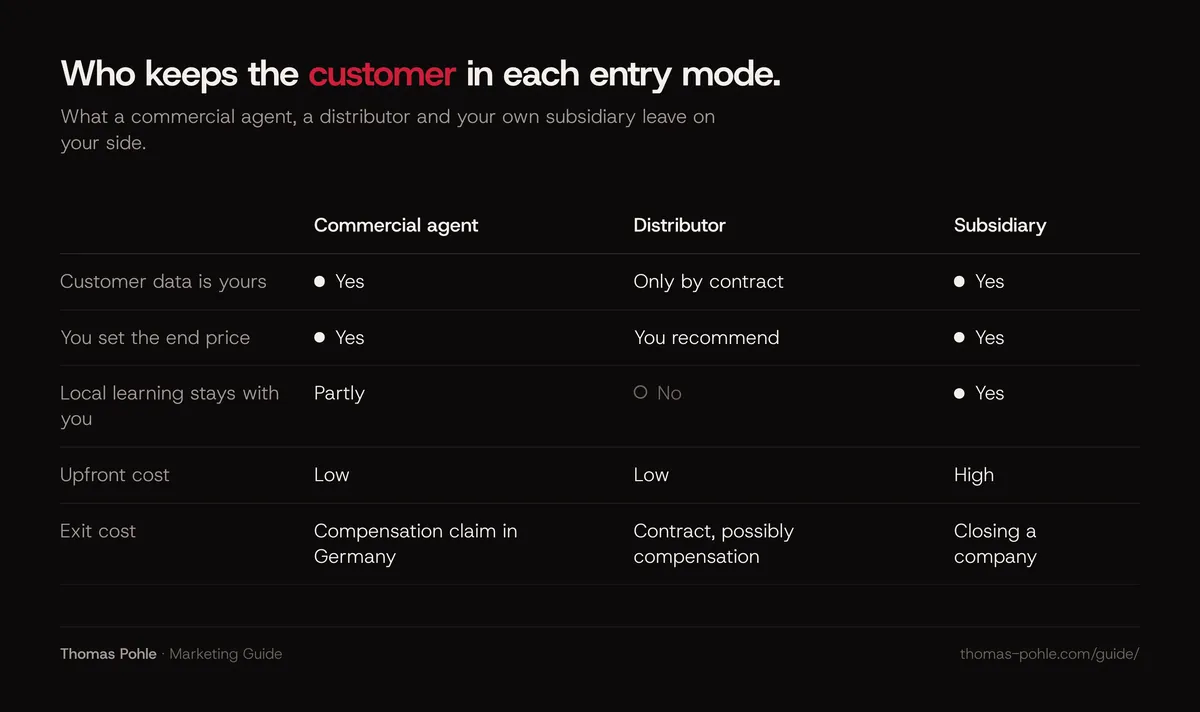
A commercial agent finds buyers and negotiates or closes deals in your name, for a commission. The customer contract, the price and the brand stay with you. A distributor buys your product and resells it on its own account. It sets its own resale price and owns the customer relationship unless the contract says otherwise. That single difference changes most of your marketing.
- Price. With an agent you publish one price list and keep it. With a distributor you can recommend prices, but its margin and pricing shape what buyers see.
- Data. With an agent, every deal lands in your CRM. With a distributor you see sell-in to the distributor and, without a reporting clause, little about the end customer.
- Exit. In Germany, Section 89b of the Commercial Code (HGB) gives an agent a claim to fair compensation after the contract ends, if you keep substantial benefits from customers the agent won. The amount is capped at one annual commission, averaged over the last five years. The claim can't be excluded in advance.
That's general information about German law, not legal advice. Have the contract checked locally. For marketing, the exit cost belongs in the plan on day one.
When does your own branch or subsidiary pay off?
Your own presence pays off when the margin you hand to a partner exceeds the full annual cost of a local team, and you can fund that team through the ramp-up. Above it, every extra sale through the partner costs you money you could have kept, plus the customer data.
A typical scenario, with assumptions you replace with your own: a German company sells measurement software and devices to industrial labs in France. In year three it sells EUR 1.2 million at list price there. The distributor buys at a 35 % discount. An own subsidiary would need two salespeople, one application engineer, a marketing program and an office.
| Year three, France | Via distributor | Own subsidiary |
|---|---|---|
| Sales at list price | EUR 1,200,000 | EUR 1,200,000 |
| Distributor margin (35 %) | EUR 420,000 | None |
| Two salespeople, fully loaded | None | EUR 220,000 |
| Application engineer | None | EUR 90,000 |
| Marketing program | None | EUR 70,000 |
| Office, admin, accounting | None | EUR 60,000 |
| Cost of the channel | EUR 420,000 | EUR 440,000 |
| Customer data and local references | With the distributor | With you |
At EUR 1.2 million the two are almost even. Break-even sits near EUR 1.26 million, where 35 % of sales equals the EUR 440,000 team. Don't forget what the table leaves out: one-off setup, a ramp-up year with lower sales, and the cost of ending the partner contract.
The comparison also skips the step I'd take first: one salesperson of your own. In the same scenario that person costs EUR 110,000 a year fully loaded, half the two-person line. A 35 % distributor margin costs as much from about EUR 314,000 in sales. Below that the partner is cheaper, but the customers aren't yours.
Waiting has its own price. In a study of 214 Danish exporters, Torben Pedersen, Bent Petersen and Gabriel Benito found that only about one in seven (32 of 214) completed the switch from an independent intermediary to its own sales organization within five years. Market growth and market potential had no significant effect on switching. Long notice periods, customers loyal to the intermediary and the cost of hiring held firms back.
In a previous in-house role I ran field marketing for a set of regions, and pipeline there grew 83 % from 2020 to 2021. It still shaped my view: a team on the ground, working in the buyer's language, learns faster than any partner report can tell you.
Which marketing questions do Mittelstand companies forget?
Mid-sized companies, the German Mittelstand among them, often settle product, logistics and contracts first. The marketing questions come after the partner is signed. By then the answers are fixed in a contract. Ask them before: customer data, trademark, domain, local budget, references and exit.
- Who owns the customer record? Write into the partner contract that end customers, deals and contacts are reported to you and land in your CRM. Know its price: in Germany, a closely integrated distributor that must hand over customer data can claim compensation like an agent.
- Is your trademark protected there? Trademark protection is territorial. The EU's Your Europe portal points to the EUIPO for protection in all EU countries. That covers EU member states only, so Switzerland and the UK need their own protection. The WIPO Madrid System lets you file one international application with one set of fees for up to 133 countries, based on a registration or application at home.
- Which domain and language version? Google's documentation on multi-regional sites lists the trade-offs of a country domain, a subdomain or a subdirectory, and says Google ignores locational meta tags. Use hreflang, as in the technical SEO checklist. And register the country domain before the partner does.
- Who pays for local marketing, and who approves it? Agree a budget split, brand rules and an approval path for anything the partner runs with your name.
- Who owns the local references? The first three local case studies carry your entry. Make sure you may publish them under your brand.
- What happens on exit? List what you need back: data, domain, social accounts, material, and any compensation you owe.
How do you choose the entry mode for your company?
Start from your own sales and let four tests show whether you really need a partner: how much revenue the market can bring in three years, whether buyers need local stock, service or invoicing, whether someone on your side can sell in the buyer's language, and how much you can fund before the market pays back.
No study or export agency I checked publishes thresholds for this. Export guides such as the US trade administration's list pros and cons, not months or revenue levels. The rules below are mine:
- Your own salesperson first. My default for anything that needs explaining: one own salesperson who sells in the buyer's language, from home or on site, or the founder or country manager sells personally.
- Commercial agent. You need local contacts but want to keep price, contract and customer. Budget the compensation claim from the start where the law grants one.
- Distributor. Only where buyers need local stock, service or invoicing you can't provide yourself, or where many small orders make own sales uneconomic. Sign only with a customer reporting clause, a short notice period and a defined exit.
- Branch or subsidiary. The first seller has won customers, the market carries a second person and local service, and the margin you'd pay a partner exceeds the cost of that team.
- Joint venture or acquisition. Access you need, such as licenses, tender lists or long-standing relationships, would take more than three years to build yourself.
In my view, language is the test most often answered too optimistically. I check who on the team will hold the sales conversation before I discuss the entry mode. If nobody can, I'd rather hire one person who can than hand the market to a partner.
David Arnold argued in Harvard Business Review in 2000 that companies should keep control of their market strategy, and described the usual arc: a company limits its exposure with an independent distributor, sales plateau, and the blame begins. The US trade administration says a good partner should know local regulations, logistics and after-sales service.
Score the obstacles in the target country first, with the method in market entry barriers.
How do you move from a partner to your own company later?
Plan the move up when you sign the partner. Set the review date, the revenue level that triggers it, what the partner hands back and how customers are told. Skip this and you renegotiate later under pressure, with the customer data on the other side of the table.
- Put a review date, a short notice period and the revenue level at which you may take over into the contract.
- Keep the domain, the social profiles and the CRM in your name from the first day.
- Hire the first local person while the partner still sells, so customers meet them before the switch.
What to do this week
- Write down your target market and the entry mode you'd pick today, in one line.
- Work out with your own margin and salaries the sales level at which a salesperson of your own costs less than the partner margin.
- Draft the five clauses marketing needs in any partner contract: customer reporting, CRM access, brand approval, budget split, exit.
- Put a review date for the entry mode in the calendar, with the revenue level that triggers a move up.
The entry mode isn't a one-time choice. Companies that keep the customer, the brand and the learning on their side from the start move up the ladder more cheaply. If you want to settle the first market, the mode and the first channel with your team in one day, look at how a Momentum Workshop works.
Frequently asked questions
What is the difference between direct and indirect export?
In indirect export you sell to an intermediary in your home country, such as a trading house, which then sells abroad. You never meet the foreign buyer. In direct export you sell to the foreign buyer yourself, from home. You keep the customer and the price, and you carry the sales effort.
Is a distributor or a commercial agent better for a B2B company?
It depends on what the buyers need. If they expect local stock, service and invoicing, a distributor solves that. If you want to keep the price, the contract and the customer data, an agent fits better. My take: for software and high-value equipment, I'd start with a salesperson of your own or the founder selling, and use a distributor only where buyers need local stock or service.
Do I need to register my trademark before entering a market?
Trademark protection is territorial, so a registration at home doesn't protect you abroad. Check before you launch, because a partner or competitor could register your name first. An EU trade mark covers the EU member states only. Switzerland and the United Kingdom need their own protection, for example through the WIPO Madrid System. Have a trademark attorney check your case.
When should you switch from a distributor to your own subsidiary?
Earlier than most companies do. No study gives a fixed threshold. My rule: when the margin you pay exceeds the cost of your own team. In a study of Danish exporters only about one in seven completed the switch, held back by notice periods and loyal customers. Plan it when you sign, with a short notice period and a data handover clause.
Sources
- Anderson, E. and Gatignon, H. (1986): Modes of Foreign Entry: A Transaction Cost Analysis and Propositions. Journal of International Business Studies 17(3)
- Johanson, J. and Vahlne, J.-E. (2009): The Uppsala internationalization process model revisited. Journal of International Business Studies 40(9)
- Handelsgesetzbuch (HGB), § 89b Ausgleichsanspruch
- IHK Frankfurt am Main: Der Vertragshändler
- Your Europe (European Union): Trade marks
- WIPO: Madrid System, the international trademark system
- Google Search Central: Managing multi-regional and multilingual sites
- Arnold, D. (2000): Seven Rules of International Distribution. Harvard Business Review, November/December 2000
- Pedersen, T., Petersen, B. and Benito, G.R.G.: Change of foreign operation method: impetus and switching costs. LINK working paper 2000-25, published 2002 in International Business Review 11(3)
- International Trade Administration (trade.gov): Sales Channels

Thomas PohleB2B marketing advisor in Zurich. More than ten years in B2B marketing at Link11, Beekeeper and smino, most recently as Head of Marketing. CEO and co-founder of TEISENDA. Researched and drafted with AI tools, checked against the sources listed above. More about Thomas