What are market entry barriers, and how do you overcome them?

Market entry barriers are the costs and obstacles a newcomer faces that established suppliers no longer carry: scale, capital, switching costs, access to distribution, regulation and, in B2B, missing trust. You overcome them by naming the highest one before you budget, then choosing a counter-move for it: a partner, a reference customer, a certification or a narrower segment.
This is for founders and marketing leads of B2B companies planning a new country or segment. You get Porter's list translated into B2B practice, the barriers that differ between Germany, Austria and Switzerland, and a scoring table with thresholds.
Picking the strategy is covered in market entry strategies, the full plan in how to build a go-to-market strategy.
What are market entry barriers?
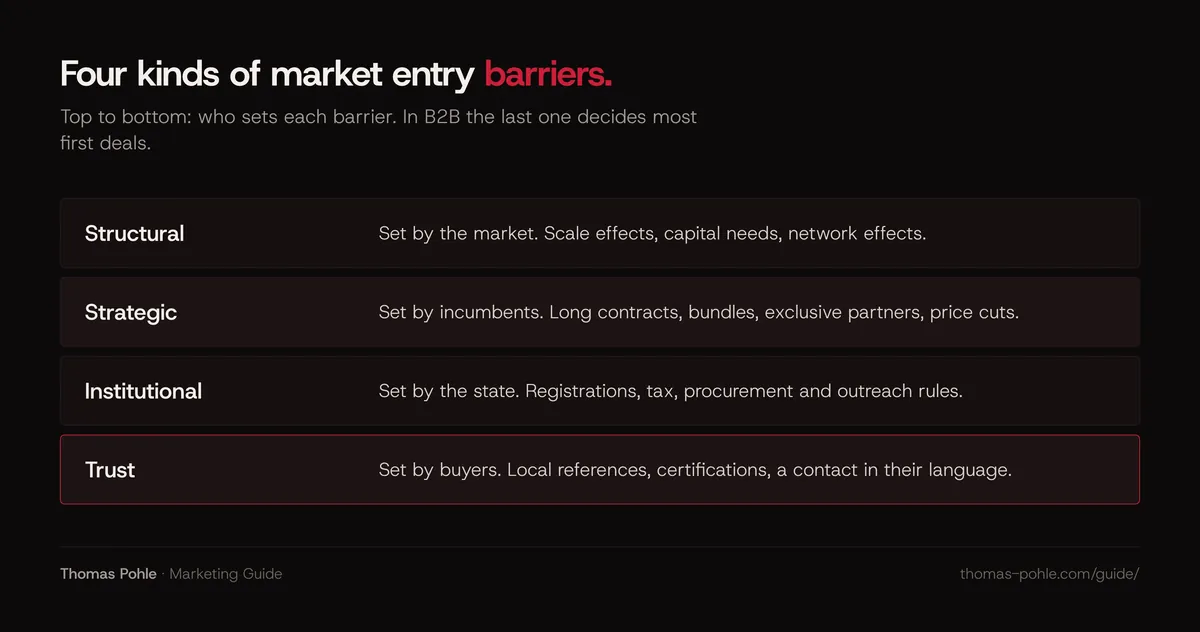
Market entry barriers are everything that makes it harder or more expensive for a new supplier to win customers in a market than for the companies already there. They come in four kinds: structural barriers built into the market, strategic barriers incumbents build on purpose, institutional barriers set by law and authorities, and trust barriers set by buyers.
- Structural. Scale effects, capital needs, network effects. They follow from how the market works.
- Strategic. Long contracts, bundles, exclusive partner deals, price cuts when a newcomer shows up.
- Institutional. Registrations, tax, procurement and outreach rules. They hit every newcomer the same way.
- Trust. Local references, certifications, a contact in the buyer's language. Buyers set them, deal by deal.
Classic lists focus on the first three. My take: in B2B the fourth is usually the highest. Capital you can raise. A reference customer in Zurich or Munich you have to earn.
Which entry barriers did Porter describe?
Michael Porter named seven sources of entry barriers in his 2008 Harvard Business Review article on the five competitive forces: supply-side economies of scale, demand-side benefits of scale, customer switching costs, capital requirements, incumbency advantages independent of size, unequal access to distribution channels, and restrictive government policy. Each one shows up in B2B in its own shape.
Harvard Business School's Institute for Strategy and Competitiveness adds that the threat of entry caps an industry's profit potential. For you, barriers are the price of the ticket.
| Barrier (Porter 2008) | How it looks in B2B |
|---|---|
| Supply-side economies of scale | A rival spreads sales and support across ten times your customers |
| Demand-side benefits of scale | Integrations, partner networks, "everyone in our industry uses it" |
| Customer switching costs | Data migration, retraining, a running contract |
| Capital requirements | A local team for a full sales cycle before the first deal |
| Incumbency advantages independent of size | Known brand, proven references, the best partners already taken |
| Unequal access to distribution channels | Resellers and integrators already sell a competitor |
| Restrictive government policy | Licenses, tax registration, outreach and procurement rules |
Why is trust the highest barrier in B2B?
In my view, trust is the highest B2B entry barrier because the buyer carries the risk of a wrong choice personally, in front of colleagues, often for years. So buyers ask for proof from their own market: a reference they can call, a certificate their IT department knows, a contact who speaks their language. A newcomer has none of that on day one.
Some proof is formal. In the German automotive supply chain, information security is assessed with TISAX, governed by the ENX Association and based on the ISA catalogue published by the VDA. For cloud services, Germany's Federal Office for Information Security (BSI) publishes the C5 catalogue of minimum requirements; customers evaluate C5 reports in their own risk analysis. If your buyers' procurement asks for one of these, the certificate is your barrier. Plan the months it takes.
The rest is informal. Logos from home mean little in Graz. A case study from their own region means a lot, so I'd write a case study that gets cited with your first local customer. Local press works too. In one year I placed more than 100 media pieces in Switzerland alone, so I count B2B PR among the fastest ways to borrow trust.
Which barriers do you face in Germany, Austria and Switzerland?
Germany, Austria and Switzerland share a language and differ in most of what slows down an entry: outreach rules, tax and registration, and, in Switzerland, four national languages. Treat DACH as three markets with a shared starting point.
- Germany. Under Section 7 UWG, advertising by email without prior express consent is an unacceptable nuisance, also between businesses. Calls to businesses need at least presumed consent.
- Austria. Section 174 of the Telecommunications Act 2021 requires prior consent for direct-marketing email. The Austrian Economic Chamber (WKO) states that businesses and consumers are treated the same and that advertising calls need prior consent without exception.
- Switzerland. Article 3 (1)(o) of the Unfair Competition Act treats mass advertising by telecommunication as unfair if prior consent, a correct sender or a note on a free, easy opt-out is missing. A foreign supplier becomes liable for Swiss VAT at a worldwide turnover of CHF 100,000 a year and must appoint a Swiss tax representative, says the Federal Tax Administration. The Federal Constitution names four national languages.
This is general information. It isn't legal or tax advice. Have outreach and registration checked locally before the first campaign.
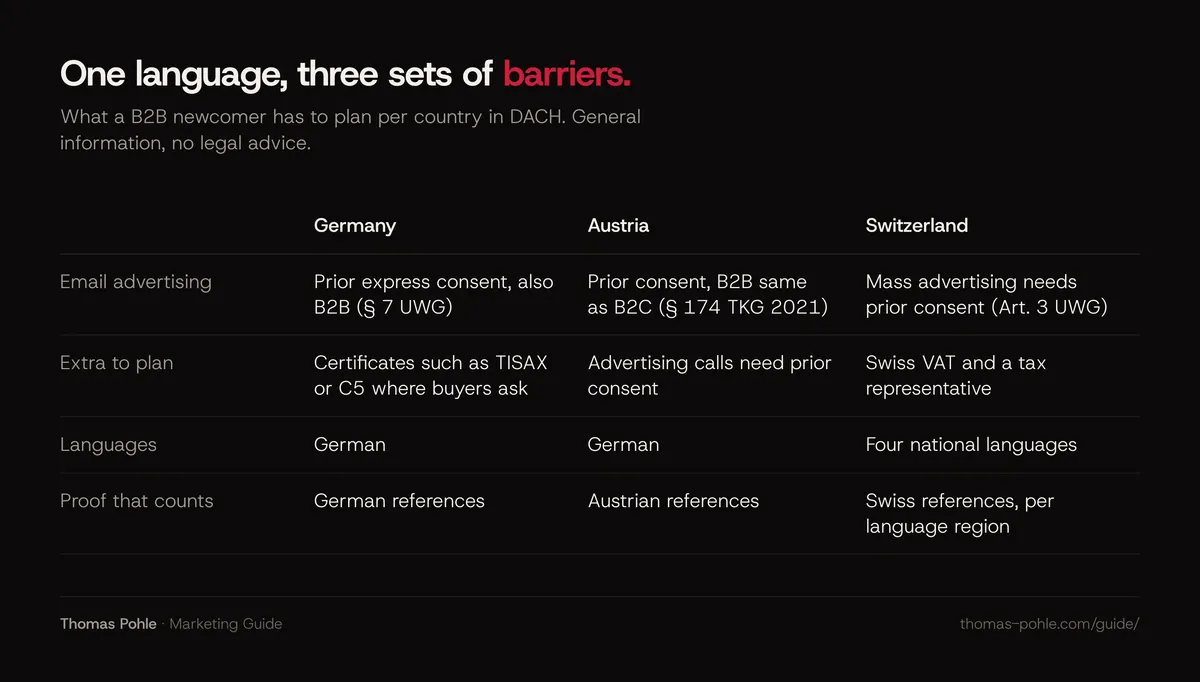
I've run marketing for eight markets, among them Germany, Switzerland and Austria. My take from that: plan proof per country. A reference from Munich doesn't open doors in Graz or Zurich by itself, and French-speaking Switzerland needs its own material and its own first customer.
How do you overcome market entry barriers?
You overcome an entry barrier with a counter-move that costs less than the barrier itself. Borrow scale through partners, lower switching costs with a pilot, earn trust with one local reference, and turn regulation into a checklist before launch. Fighting every barrier at once is the expensive way. Start with the highest one.
- Scale and distribution. Sell through an integrator or reseller who already serves your buyers. You trade margin for reach.
- Switching costs. A paid pilot with fixed scope, a migration package, or a start beside the incumbent system.
- Capital. Narrow the segment until one person can cover it for a full sales cycle.
- Incumbency. Attack the leader where it's weak. The guide on B2B positioning shows how to find that spot.
- Regulation and trust. Solve consent, tax and contracts once per country. Then win one local reference.
How do you rate the barriers before you enter?
Score each barrier from 0 (no issue) to 3 (blocks the first deal) for your target market, then act on the result. My rule of thumb: every barrier at 3 needs a named counter-move before you spend launch budget. A total of 12 or more out of 18 means you enter through a partner or a pilot customer first.
A typical scenario, with assumptions you replace with your own: a German software company for construction firms plans to enter Switzerland.
| Barrier | Score | Why, in this scenario |
|---|---|---|
| Capital | 1 | One salesperson can cover German-speaking Switzerland |
| Switching costs | 3 | Buyers run an incumbent system with years of project data |
| Distribution | 2 | The relevant integrators already sell a competitor |
| Regulation | 2 | VAT registration with a tax representative, Swiss outreach rules |
| Language | 1 | German works first; French-speaking Switzerland comes later |
| Trust | 3 | No Swiss reference, no local contact |
| Total | 12 of 18 | Enter through a pilot customer, then partners |
The scores are invented. The method holds. Two barriers at 3 mean two counter-moves before launch: a migration package and one Swiss pilot customer. The pilot becomes the first local case study, which lowers the trust score for every deal after it. And once you're in, the same proof keeps the next newcomer out. My thresholds are rules of thumb. They aren't research results.
What to do this week
- Score the six barriers from the scoring table for your target market.
- Write one counter-move next to every barrier at 3.
- Ask three prospects there which proof they'd need before a first meeting.
- Check whether procurement asks for a certificate such as TISAX or a C5 report.
- Have outreach and tax registration checked for each country separately.
- Name one pilot customer you could win in the first quarter.
Barriers don't disappear. They get cheaper once you know their price. If you want to score them for your next market with your team in one day, a Momentum Workshop is built for that.
Frequently asked questions
What is the difference between structural and strategic market entry barriers?
Structural barriers come from how a market works: economies of scale, capital needs, network effects. Nobody built them on purpose. Strategic barriers are created by incumbents to keep newcomers out, for example long contracts, bundles, exclusive partner deals or price cuts when a new supplier appears. You can plan around structural barriers. Strategic ones change once you show up.
What are institutional market entry barriers?
Institutional barriers are set by laws and authorities: registrations, licenses, tax rules, procurement rules and the rules for email and phone outreach. In DACH they differ by country. Switzerland, for example, makes foreign suppliers liable for VAT at a worldwide turnover of CHF 100,000 a year and requires a Swiss tax representative. Check them per country with a local advisor.
Are market entry barriers in Germany higher than in Switzerland?
They're different. Germany's Section 7 UWG requires prior express consent for any advertising email, also between businesses, while the Swiss rule targets mass advertising. Switzerland adds VAT registration with a tax representative for foreign suppliers and four national languages. Which market is harder for you depends on your offer, so score both with the same table before you decide.
Can a small company overcome high entry barriers?
Yes, if it doesn't fight all of them at once. A small company borrows scale and distribution from a partner, lowers switching costs with a paid pilot and earns trust with one local reference customer. Narrow the segment until one person can cover it for a full sales cycle, then widen it once the first references exist.
Sources
- Michael E. Porter: The Five Competitive Forces That Shape Strategy, Harvard Business Review, January 2008
- Harvard Business School, Institute for Strategy and Competitiveness: The Five Forces
- ENX Association: TISAX
- BSI: Cloud Computing Compliance Criteria Catalogue (C5)
- Gesetz gegen den unlauteren Wettbewerb (UWG), § 7 Unzumutbare Belästigungen
- Telekommunikationsgesetz 2021 (TKG 2021), § 174, Rechtsinformationssystem des Bundes
- WKO: E-Mail-, Fax- und Telefonwerbung nach dem Telekommunikationsgesetz
- Bundesgesetz gegen den unlauteren Wettbewerb (UWG, SR 241), Art. 3
- Swiss Federal Tax Administration: VAT liability of foreign companies
- Federal Constitution of the Swiss Confederation, Art. 4 National languages

Thomas PohleB2B marketing advisor in Zurich. More than ten years in B2B marketing at Link11, Beekeeper and smino, most recently as Head of Marketing. CEO and co-founder of TEISENDA. Researched and drafted with AI tools, checked against the sources listed above. More about Thomas