Which template helps you plan your go-to-market?

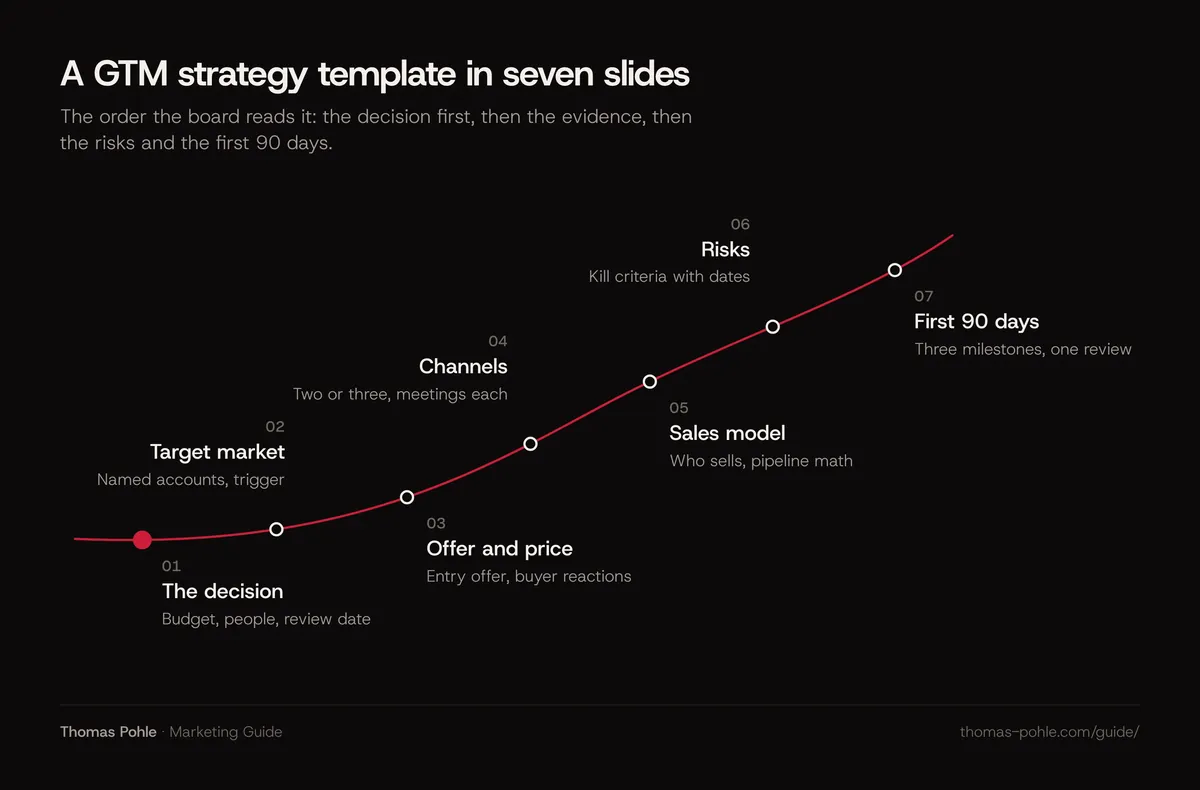
Use a GTM strategy template of seven slides: the decision you ask for, target market, offer and price, channels, sales model with pipeline math, risks with kill criteria, and the first 90 days. Each slide answers fixed questions with evidence, so your board can approve, change or stop the plan in one meeting.
This guide is for founders, CEOs and marketing leads who must put a go-to-market plan in front of an advisory board, a board of directors or the management team. The strategy itself is covered in the guide on how to build a go-to-market strategy. Here you get the template: slide by slide, the questions each slide must answer, and a filled example for a fictional company.
What belongs in a GTM strategy template?
A GTM strategy template needs seven slides: one summary slide with the decision you want, then target market, offer and price, channels, sales model and pipeline, risks and assumptions, and the first 90 days. Everything else goes into an appendix. If a slide can't answer its questions with evidence from deals, calls or tests, the plan isn't ready yet.
| Slide | Questions it must answer | Evidence that belongs on it |
|---|---|---|
| 1. The decision | What do you want approved, with which budget and people, and when do you report back? | The ask in one sentence, the date of the review |
| 2. Target market | Who exactly buys first, how many of them can you name, and what triggers their search? | A named account list, won and lost deals, interview notes |
| 3. Offer and price | What do you sell, what does it cost, and what does the buyer use today instead? | Price reactions from real buyer calls, the entry offer |
| 4. Channels | Which two or three channels reach this buyer, and what must each deliver per month? | Meetings per channel as a target, what you leave out |
| 5. Sales model | Who sells, how long does a deal take, and how many meetings does the goal need? | A named seller, the pipeline math |
| 6. Risks | Which assumptions could break the plan, and at what point do you stop or change course? | Kill criteria with numbers and dates |
| 7. First 90 days | What happens in each month, and what will the board see at day 90? | Three milestones and the review date |
The template keeps the six building blocks of the pillar guide and adds what a board needs: a clear ask and a risk slide that says when to stop. Unsure whether you need a GTM plan at all? Read the guide on go-to-market versus marketing strategy first.
Why do a few slides work better than a long plan for the board?
A board meeting has limited time and one job: decide. Seven slides force you to pick one market, one offer and one sales model, and they show the board at a glance where the evidence is thin. A 40-page plan hides those gaps between chapters. Keep the long version as a pre-read or appendix.
A counterpoint: in his 2017 letter to shareholders, Jeff Bezos wrote that Amazon doesn't use slide presentations and instead writes narratively structured six-page memos, read silently at the start of each meeting. I think both fit: send a two-page memo ahead, then use the seven slides in the meeting to steer toward the decision.
In Switzerland the stakes are formal. Under Art. 716a para. 1 of the Swiss Code of Obligations, the ultimate direction of the company and the design of accounting, financial control and, where needed, financial planning are non-transferable duties of the board of directors. A voluntary advisory board (Beirat) in Germany isn't regulated by law: the owners set its tasks and powers, and its usual role is to advise. This is a description, not legal advice.
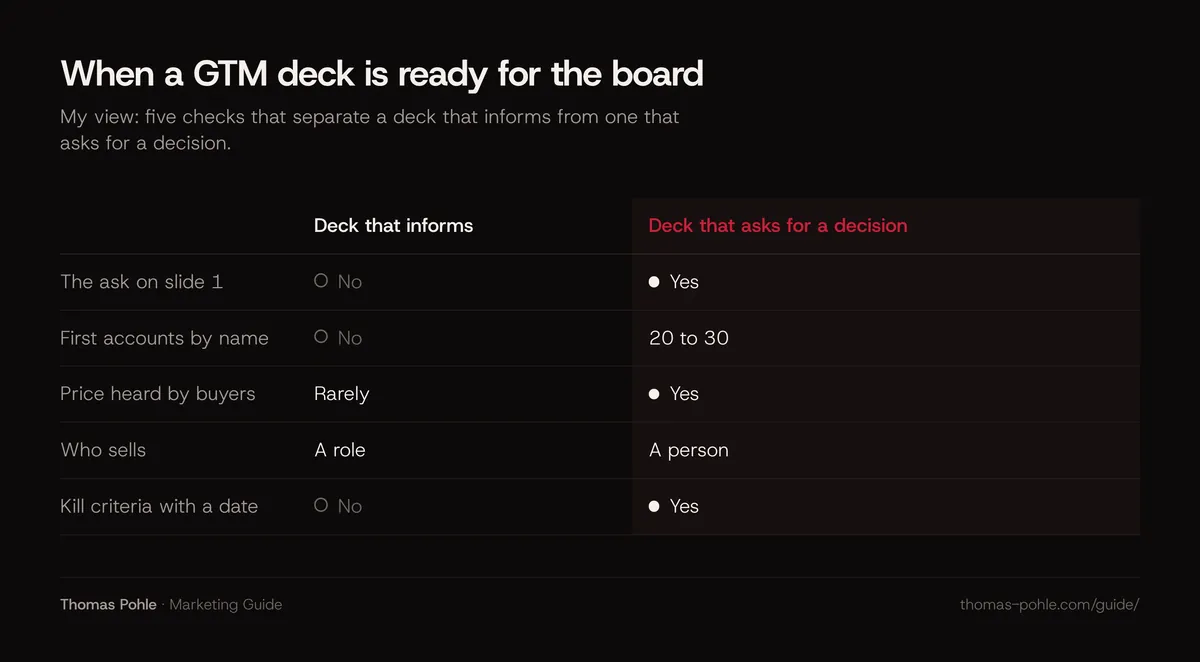
My stance is blunt: I'm allergic to slide decks that nobody runs. So every slide below ends in something you can do or measure.
How do you fill the target market and offer slides?
The target market slide names the first buyers precisely: industry, company size, region, the trigger that starts their search and the roles in the buying group. It should show how many accounts you can list by name. The offer slide states what you sell, the price, the entry offer and what the buyer does today instead of buying from you.
Start from evidence: your last ten won and lost deals beat any market report. Then show the list: a few hundred named accounts for the segment, with the first 20 to 30 marked as the accounts you'll approach in the first round. LinkedIn's B2B Institute states that 95 % of your potential buyers aren't ready to buy today. So the slide names the trigger that moves an account into the buying 5 %.
The offer slide answers three questions:
- What exactly is sold. Product, services, contract length, in one sentence.
- What it costs. The list price and an entry offer, such as a paid pilot. A price no buyer has heard yet is an assumption and belongs on the risk slide too.
- What the buyer uses today. Spreadsheets, a competitor or nothing. Your positioning is the reason to switch.
How do you show channels, pricing logic and the sales model?
The channels slide picks two or three channels that reach the named buyers and gives each a monthly target in first meetings. The sales model slide says who sells, by name if possible, how long a deal takes and how many meetings the revenue goal needs. Together they show whether the plan can produce the pipeline it promises.
On the channels slide, also write down what you leave out. In a new country, check the rules for each channel. In Germany, for example, Section 7 of the Act against Unfair Competition (UWG) treats advertising emails sent without prior express consent as an unacceptable nuisance, while calls to businesses need at least presumed consent. That shapes your outreach mix. Get legal advice before you rely on either.
On the sales model slide, my preference is clear: someone from your own company sells. Early on that's one salesperson of your own, or the founder or country manager selling personally. Handing a new market to an external sales firm too early means someone else collects what you learn. Distributors make sense where buyers need local stock, service or invoicing. The guide on international market entry compares the entry modes in detail.
Then add the pipeline math in one line: from the revenue goal to deals, opportunities and first meetings per month. If that number exceeds what your channels deliver, the board will see it.
Which risks and kill criteria belong on the risk slide?
The risk slide lists the three to five assumptions that would break the plan if they turn out wrong, how you test each one in the first weeks, and the threshold at which you stop, change course or continue. Kill criteria with a number and a date turn a hopeful plan into one the board can hold you to.
A practical way to find the risks is the premortem that Gary Klein described in Harvard Business Review in 2007. The team imagines the project has already failed and writes down why. Run it for 30 minutes with sales, marketing and product before finishing the deck.
Typical assumptions to test in a GTM plan:
- Demand. The named accounts agree to a first meeting. Threshold example: at least 5 of the first 25 accounts within 60 days.
- Price. Buyers accept the entry offer without discounts.
- Sales capacity. The salesperson starts on time, or the founder covers the gap.
- Proof. Buyers in the new segment accept references from another segment or country.
Set the thresholds before the first result comes in. Otherwise every number gets explained away.
What does the first 90 days slide look like?
The first 90 days slide splits the start into three months with one milestone each: preparation and the first conversations, first meetings and offers, first pilots or deals. It ends with a fixed review date where the board sees actual numbers against the plan and decides whether to continue, adjust or stop.
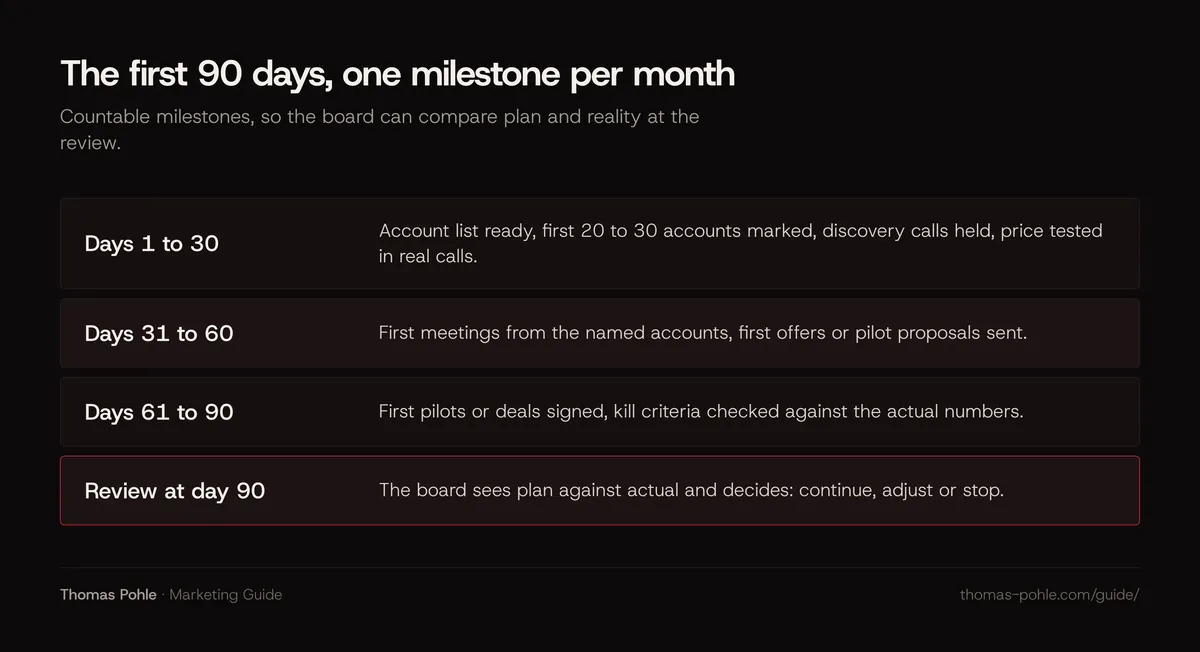
Keep the milestones countable: accounts contacted, meetings held, offers sent, pilots signed. Nobody can review awareness after 90 days. If you're launching a product rather than entering a market, the guide on B2B product launch planning has a twelve-week sequence that fits into this slide.
What does a filled GTM template look like?
Below is the template filled for a fictional company. Arvenwerk AG is invented for this guide: a Swiss maker of maintenance-planning software that wants to win mid-sized food and beverage producers in southern Germany. Every number is an assumption for the example, so replace each one with your own data before you show it to anyone.
| Slide | Arvenwerk AG (fictional example, all figures assumed) |
|---|---|
| 1. The decision | Approve entry into southern Germany for 12 months: one sales hire based in Munich and EUR 60,000 for marketing. Review at day 90. |
| 2. Target market | Food and beverage producers with their own maintenance team in Bavaria and Baden-Württemberg. 300 named accounts, the first 25 for round one. Trigger: a new production line or an audit finding. |
| 3. Offer and price | Subscription per plant at EUR 18,000 a year including onboarding. Entry offer: a paid 90-day pilot at EUR 4,500, credited to year one. Today buyers plan in spreadsheets. |
| 4. Channels | Phone and LinkedIn to maintenance heads at the 25 accounts, a case study with the Swiss reference customer, one trade fair visit with booked meetings. |
| 5. Sales model | Own salesperson, the founder joins first meetings until the hire starts. No distributor in year one. Goal: 8 plants, EUR 144,000 in annual subscriptions. |
| 6. Risks | Fewer than 5 of 25 accounts take a meeting by day 60: rework the segment. No pilot signed by day 90: test the price. Hire delayed: founder sells. |
| 7. First 90 days | Month 1: list and 15 discovery calls. Month 2: first meetings, 2 pilot offers. Month 3: 1 to 2 pilots signed. Board review at day 90. |
The pipeline math behind slide 5 runs like this. Eight plants at an assumed win rate of 25 % need 32 opportunities. If 40 % of first meetings turn into an opportunity, that's 80 first meetings in a year, or about 7 per month. The channels slide then has to show where those 7 meetings come from. After round one the list has to grow, or 25 accounts won't carry that.
How do you present the template to your advisory board?
Send the slides and a short written pre-read a few days before the meeting, open with the decision you need, and spend most of the time on the risk slide. Ask the board to attack the weakest assumption. A plan that survives a tough board discussion is worth more than a plan that gets waved through.
I want my own ideas challenged, and I'd ask the same of any board: say clearly when an angle is weak and suggest a better one. Mark the assumption you trust least and ask who in the room has sold to this buyer.
End the meeting with three things written down: what was approved, what changed, and the date of the 90-day review. The template is done when the first call to an account on the list has happened. If you want a second pair of eyes on the plan, a one-day Momentum Workshop is built for exactly this step.
What to do this week
- Copy the seven slide titles into a blank deck and write the one-sentence ask on slide 1.
- Pull your last ten won and ten lost deals and write down what they have in common.
- Build the named account list and mark the first 20 to 30 accounts for round one.
- Write the pipeline math on slide 5 with your own deal size and win rate.
- Run a 30-minute premortem with sales, marketing and product and pick three kill criteria with dates.
- Put the day-90 review into the board calendar before the plan starts.
A template won't decide for you. It shows which decisions are missing. If a slide stays empty after a week, that's the work to finish before the board meeting.
Frequently asked questions
How many slides should a GTM strategy presentation have?
Seven core slides are enough for a board or management meeting: the decision, target market, offer and price, channels, sales model, risks and the first 90 days. Put market data, budgets and account lists in an appendix. Needing more than ten slides usually means the plan covers more than one market or offer.
Is there a free GTM strategy template in PowerPoint?
You can build one in a few minutes from the table in this guide: seven slide titles, and on each slide the questions it must answer as placeholders. The value comes from filling each slide with evidence from your own deals, calls and price tests, which no downloadable file does for you.
What is the difference between a GTM template and a product marketing GTM template?
A product marketing GTM template usually focuses on launching one product: positioning, messaging, launch assets and sales enablement. The board template in this guide is broader. It covers the market, the price, the sales model, the budget ask and the stop criteria, because a board decides on money and people.
Who should present the GTM plan to the board?
The person who owns the plan and will answer for the numbers at day 90. In a smaller company that's often the CEO or founder. Others can present parts, but one name should own the ask, so the board knows who is accountable.
How often should the GTM template be updated?
Update it at each review date, at the latest after the first 90 days, and then quarterly. Change the slides when a kill criterion is hit or an assumption proves wrong. A template that still shows the original assumptions after six months is no longer a plan. It's a record.
Sources
- LinkedIn B2B Institute: The 95-5 rule
- Amazon: 2017 Letter to Shareholders (Jeff Bezos)
- Klein, G.: Performing a Project Premortem, Harvard Business Review, September 2007
- Gesetz gegen den unlauteren Wettbewerb (UWG), § 7 Unzumutbare Belästigungen
- Swiss Code of Obligations (SR 220), Art. 716a: Non-transferable duties of the board of directors
- IHK Darmstadt: Beirat im Familienunternehmen

Thomas PohleB2B marketing advisor in Zurich. More than ten years in B2B marketing at Link11, Beekeeper and smino, most recently as Head of Marketing. CEO and co-founder of TEISENDA. Researched and drafted with AI tools, checked against the sources listed above. More about Thomas