How do you market a B2B company in several languages?

Market a B2B company in several languages by localizing the pages that sell first (home, services, pricing, contact), researching keywords separately in each language, giving every language its own URL with hreflang, and running AI translation through a glossary, a native review and a check of every claim and number. Have native speakers answer the leads.
This guide is for founders and marketing leads who sell in more than one language, or are about to. Multilingual digital marketing loses money quietly: the French page exists, but nobody searches for its words. Which market to enter and how is covered in the pillar on go-to-market strategy. This article is about the languages themselves, with Switzerland as the worked example.
What is multilingual B2B marketing?
Multilingual B2B marketing means running your website, content, campaigns and sales conversations in every language your buyers use, so each market gets pages it can find, read and trust. It's more than translation. Each language version needs its own keywords, its own proof and a person who answers in that language.
A global content strategy is the plan behind it: which content exists in which language, who writes or adapts it, and how the versions stay in sync. Without it, languages drift: the German site gets the new case study, the French one keeps last year's pricing.
Three methods sit on a scale, and the words get mixed up all the time:
- Translation carries the text into another language and keeps its meaning and structure.
- Localization adapts content to a target market. The W3C describes it as meeting the "language, cultural and other requirements" of a locale, including number, date and currency formats, address formats and varying legal requirements.
- Transcreation rewrites the message for the market. The promise stays, the headline, examples and tone can change completely.
Should you translate, localize or transcreate?
Most B2B websites need all three, on different pages. Translate documentation and help pages, where accuracy matters more than voice. Localize service pages, pricing and case studies, where buyers compare. Transcreate the home page, ads and outbound messages, where one sentence decides whether anyone reads on.
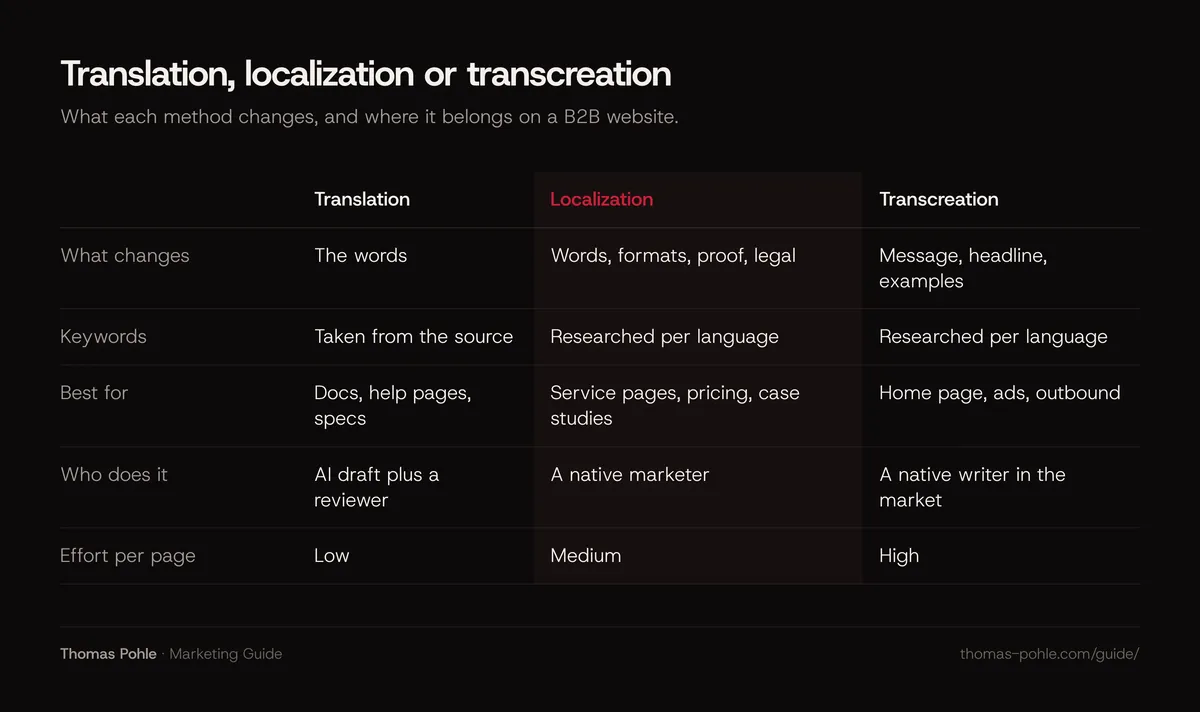
My rule of thumb: the closer a page sits to the buying decision, the more it needs a native person behind it.
Which content should you localize first?
Localize the pages that sit closest to a sales conversation first: home page, service or product pages, pricing, contact and forms. Then case studies and the guide articles that have search demand in the new language. Documentation and help pages come last, because only customers who already bought read them.
| Page type | Method | Wave | Why |
|---|---|---|---|
| Home page | Transcreation | 1 | A translated headline reads like a translation |
| Service or product pages | Localization | 1 | Buyers compare here and your keywords land here |
| Pricing and offer | Localization | 1 | Currency, VAT and terms differ by market |
| Contact, forms, privacy | Localization plus legal check | 1 | A form in the wrong language loses the lead |
| Case studies | Localization, local customer first | 2 | Proof from their own market counts more |
| Guide articles | Localization where demand exists | 2 | Only where keyword research shows searches |
| Docs and help pages | Translation, AI plus review | 3 | Read by customers after the sale |
| Ads, outbound, social posts | Written natively | Per campaign | One sentence decides if anyone reads on |
Don't translate only the template. Google's documentation on multi-regional sites warns that translating just the boilerplate, while the content stays in another language, gives users a poor experience.
How does it work in Switzerland with German, French and English?
Switzerland is the textbook case. According to the Swiss Federal Statistical Office (FSO), 61 % of the population named German as a main language in 2024, 23 % French and 8 % Italian, with Romansh at 0.4 %. People can name more than one main language, so the shares add up to more than 100 %.
English is the fourth language that matters for B2B. The FSO's publication on languages at work (June 2026) reports that 24 % of employed people usually spoke English at work in 2024, up from about 19 % in 2014. The same publication puts the share usually speaking at least two languages at work at 28 %.
Two details catch companies from abroad:
- Swiss spelling. The Swiss Federal Chancellery's guide to German spelling says ß has not been written in Switzerland since the 1970s. Double s is used instead: Strasse, not Straße. My view: ß on a Swiss page looks imported, and ss on a page for Germany looks Swiss. The reverse problem is covered in market entry in Germany.
- Swiss French. Buyers in Lausanne or Geneva read standard French. In my view, the examples, references and terms on the page should still come from Romandie, not from Paris. Have the French pages reviewed by someone from the region you sell to.
A typical scenario, with numbers for illustration only: a Zurich software company with a German site of 40 pages wants customers in Romandie. Wave 1 is seven pages in French: home, three service pages, pricing, contact and one case study, ideally from a French-speaking customer. Wave 2 adds the five guide articles with French search demand. English goes up in parallel as a short version for international teams. Italian waits until the target list for Ticino holds at least 20 to 30 named accounts, the same size I'd use for any first round.
How do you research keywords in each language?
Research keywords in each language from scratch, with the terms local buyers actually type. Translated keywords miss, because buyers in each market name the same problem differently and often borrow English words. Start from what customers say in sales calls, then check the terms in a keyword tool set to that country and language.
- Collect the words of the market. Ask your seller or a customer there how they describe the problem, including English loanwords.
- Set location and language. Google's Keyword Planner lets you set the location (country, region, city) and the language for keyword ideas. Run Switzerland plus French separately from France plus French.
- Test variants side by side. A Swiss buyer may ask for an "Offerte" where a German one asks for an "Angebot". Treat such pairs as hypotheses and let the data decide.
- Map one main term per page. Each language version gets its own main term in the title, the headline and the first paragraph.
Volumes in small markets are low. Don't let that stop you: in B2B, a term with a few dozen searches a month can still bring the one buyer who matters.
How do you set up a multilingual website?
Give every language version its own URL, keep one language per page, connect the versions with hreflang and let visitors switch language themselves. Google recommends different URLs for each language version, advises against changing the language by cookies or browser settings, and asks you to avoid automatic redirects between language versions.
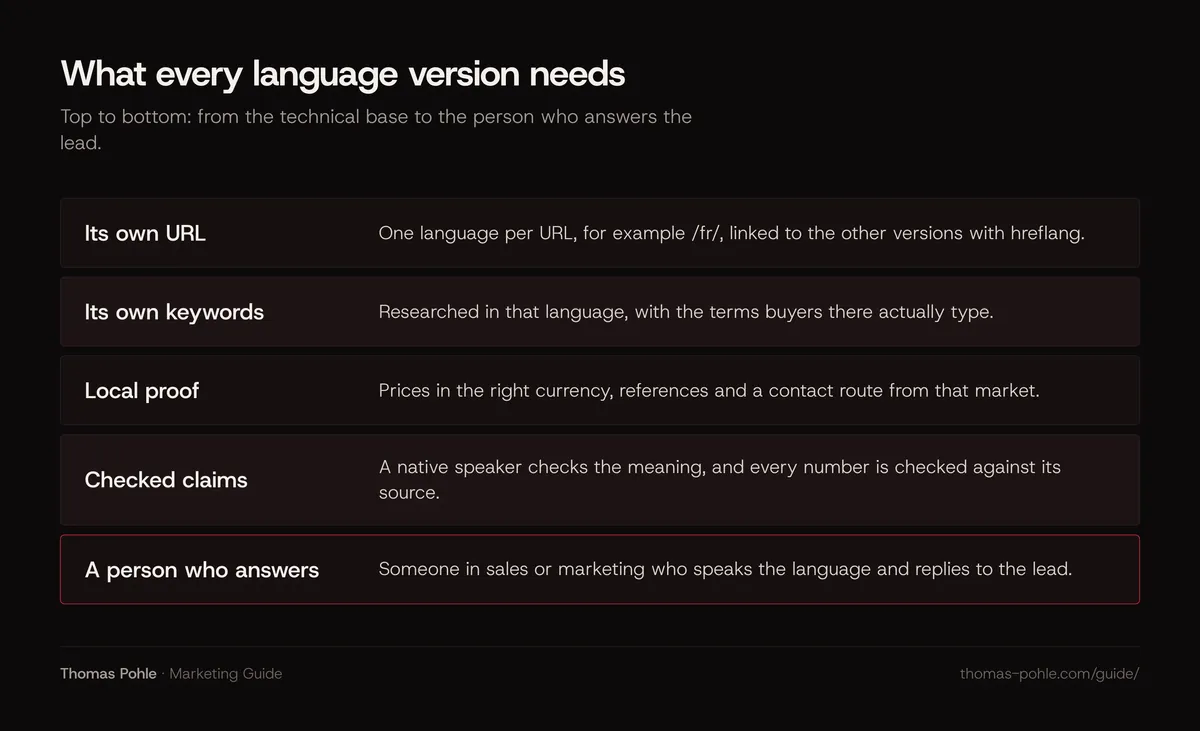
- URL structure. Google's documentation lists country domains (example.ch), subdomains (fr.example.com) and subdirectories (example.com/fr/), with pros and cons for each. URL parameters such as
?lang=frare not recommended. For most B2B companies a subdirectory on one domain is the low-maintenance choice. - One language per page. Google asks for a single language for content and navigation on each page and advises against side-by-side translations.
- hreflang in both directions. Each language version must list itself and all other versions. If two pages don't point to each other, Google ignores the tags. Add x-default for visitors whose language you don't serve.
- The lang attribute isn't enough. Google says it doesn't use hreflang or the HTML lang attribute to detect a page's language. The text itself has to be in that language.
The code details, from language codes such as de-CH to the sitemap method, are in the technical SEO checklist. My own site works this way: the English page comes first, the German version is built from it, and both are connected with hreflang pairs. Every guide article ships in both languages. In client work, I work in German.
Can you use AI to translate your marketing?
Yes, for drafts, and only with a quality check before anything goes live. Give the AI a glossary and the target keywords, then have a native speaker review meaning and tone, and check every claim and number against its source. Anything published under your name you write yourself in that language, or at least give your own input.
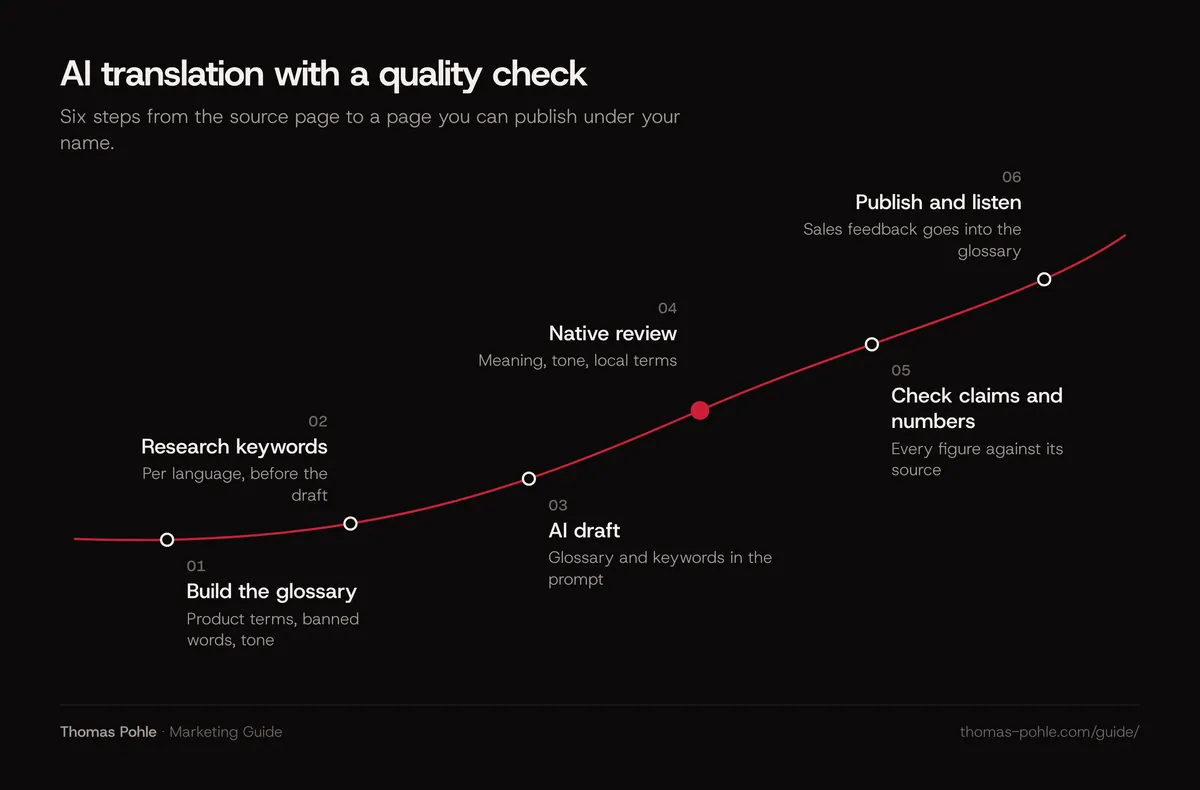
- Build the glossary. Product names, terms you always translate the same way, terms you never translate, words you avoid, the form of address (du or Sie, tu or vous).
- Research keywords first. The draft should use the terms buyers type, so they go into the prompt.
- Let the AI draft. One page at a time, with glossary, keywords and the target market named.
- Native review. Someone from the market reads the page for meaning, tone and local terms. Ideally the person who will answer the leads.
- Check claims and numbers. Compare every figure, date, price and legal statement with the source. A wrong number in an offer is expensive, and a reviewer reading for style easily misses it.
- Publish and listen. What sales hears in the market goes back into the glossary.
Google is clear on the risk of skipping the check. Its spam policies define scaled content abuse as generating many pages mainly to manipulate rankings, including through automated transformations such as translating, where little value is provided to users. A reviewed, localized page isn't. A thousand unreviewed machine translations published to rank can be.
Here's my view on the rest. Your LinkedIn posts, the CEO letter, your opinion pieces: write them yourself in the language, or have a native colleague write them from your notes. Real interaction comes from real experience, and a translated opinion sounds borrowed. The same rule applies to marketing copy in general, as in AI marketing copy.
Who should run marketing and sales in each language?
Have native speakers on your own team run each language, in marketing and in sales. A translation agency can deliver pages, but it cannot answer a lead, hold a sales conversation or notice that buyers use a different word. Early on, one person per language who reviews content and handles the leads is enough.
I prefer your own people over handing a language market to an outside firm. A translation partner can handle documentation. The conversations with buyers should stay with someone who works for you. That's how you learn what the market says, and that knowledge should stay in your company. It's the same reason I see the handover to the client's team as part of my job. The choice between own team, partner and subsidiary is worked through in international market entry.
The minimum setup per language:
- One owner. A native speaker who reviews every page and campaign in that language before it goes out.
- One responder. Leads in that language get an answer in that language within one working day.
- One shared glossary. Marketing, sales and support use the same terms.
What to do this week
- List your languages. For each one, write down revenue or pipeline today and the number of named target accounts. Fewer than 20 accounts: no full website version yet.
- Audit wave 1. Check home, service pages, pricing, contact and forms in every language. Any page still in the source language goes on the list.
- Check hreflang. Pick three pages and confirm each version lists itself and all others.
- Start a glossary. 30 to 50 terms per language: product names, key terms, words you avoid, form of address.
- Run keyword research per language. One main term for each wave 1 page, set to the right country and language.
- Name one owner per language. If nobody on your team is a native speaker, that's your first hire or your first gap to close.
- Test your response time. Send a request through the French or English form and measure how long the answer takes, and in which language it comes.
The pages are the visible part. The person who answers in the buyer's language is what makes them work. If you want to set the order for your languages with someone who has done it, a one-day Momentum Workshop is a good place to start.
Frequently asked questions
What is the difference between translation and localization?
Translation carries the text into another language and keeps its meaning. Localization also adapts everything around it to the target market: currency, number and date formats, address formats, legal requirements, references and examples. For B2B pages that sell, such as service pages and pricing, localization is the standard. Plain translation fits documentation and help pages.
Do I need a separate domain for each language?
No. Google's documentation lists country domains, subdomains and subdirectories as options, each with pros and cons, and advises against URL parameters. For most B2B companies, subdirectories such as /fr/ and /en/ on one domain are the low-maintenance choice. What matters more is one language per URL and hreflang annotations that point in both directions.
Should a Swiss B2B website use ß in German?
No. The Swiss Federal Chancellery's guide to German spelling says ß is not written in Switzerland and double s is used instead. For a page aimed at Swiss buyers, write Strasse and gross. For a page aimed at Germany or Austria, use ß, because buyers there read ss as Swiss.
Is machine translation bad for SEO?
Not by itself. Google's spam policies target scaled content abuse: many pages generated mainly to manipulate rankings, including through automated transformations such as translating, where little value is provided to users. A page drafted by AI, reviewed by a native speaker, localized and built on its own keyword research gives users value. Mass-translated pages without review are the risk.
Which language should a Swiss company add after German?
It depends on where your buyers are. French covers the second-largest language region; according to the FSO, 23 % of the population named French as a main language in 2024. English matters for international teams: 24 % of employed people usually spoke English at work in 2024. Start with the language of your largest target account list.
Sources
- Swiss Federal Statistical Office (FSO/BFS): Sprachen (main languages 2024, languages at work)
- FSO/BFS: Sprachen bei der Arbeit (Statistik der Schweiz, June 2026, Strukturerhebung and ESRK 2024)
- FSO/BFS infographic: Sprachen 2024 (Strukturerhebung 2024, Erhebung zur Sprache, Religion und Kultur 2024), 2026
- Swiss Federal Chancellery: Leitfaden zur deutschen Rechtschreibung (4th edition 2017)
- Google Search Central: Managing multi-regional and multilingual sites
- Google Search Central: Tell Google about localized versions of your page
- Google Search Central: Spam policies for Google web search (scaled content abuse)
- Google Ads Help: Refine your new keywords in Keyword Planner
- W3C Internationalization: Localization vs. Internationalization

Thomas PohleB2B marketing advisor in Zurich. More than ten years in B2B marketing at Link11, Beekeeper and smino, most recently as Head of Marketing. CEO and co-founder of TEISENDA. Researched and drafted with AI tools, checked against the sources listed above. More about Thomas