How do you write marketing copy with AI that doesn't sound like AI?

AI copy sounds like AI when the model has nothing but the topic, so it writes the most likely text. Give it four things instead: a brief with one reader, one claim and real proof, three to five of your own best texts as examples, voice rules phrased as instructions, and a phrase check before anything goes out.
This guide is for founders and marketing leads who use an AI text generator for landing pages, emails, ads and posts, and keep rewriting what comes back. The big picture is in the pillar on using AI in marketing without losing quality. This one is about the writing craft: brief, examples, voice rules and a checklist of AI phrases with thresholds.
Why does AI marketing copy sound like AI?
AI copy sounds generic because a language model predicts likely word sequences. With a thin prompt, the likeliest text about your product is the average of every similar text the model has seen. That average has a recognizable vocabulary, a recognizable rhythm and no facts that belong to you.
The vocabulary is measurable. Dmitry Kobak and colleagues analyzed more than 15 million biomedical abstracts in PubMed from 2010 to 2024, published in Science Advances in July 2025. Certain style words rose abruptly after LLMs arrived, and the authors estimate that at least 13.5% of 2024 abstracts were processed with an LLM. Their list of 900 excess words includes pivotal, crucial, showcasing, underscores, intricate, fostering, harnessing, realm, comprehensive, notably and additionally. In my view, marketing copy shares that vocabulary.
The sameness is measurable too. In a 2024 experiment in Science Advances, Anil Doshi and Oliver Hauser found that stories written with AI ideas were rated better individually but were more similar to each other. When three suppliers use the same tools, your copy blends in. The fix is your material in the prompt and a check afterwards.
What goes into a brief for AI copy?
A brief for a piece of copy is shorter than a content brief and stricter. It names one reader, one claim, the proof for that claim, one action and the format limits. Anthropic's prompting guide puts the test well: if a colleague with minimal context on the task would be confused by your prompt, the model will be too.
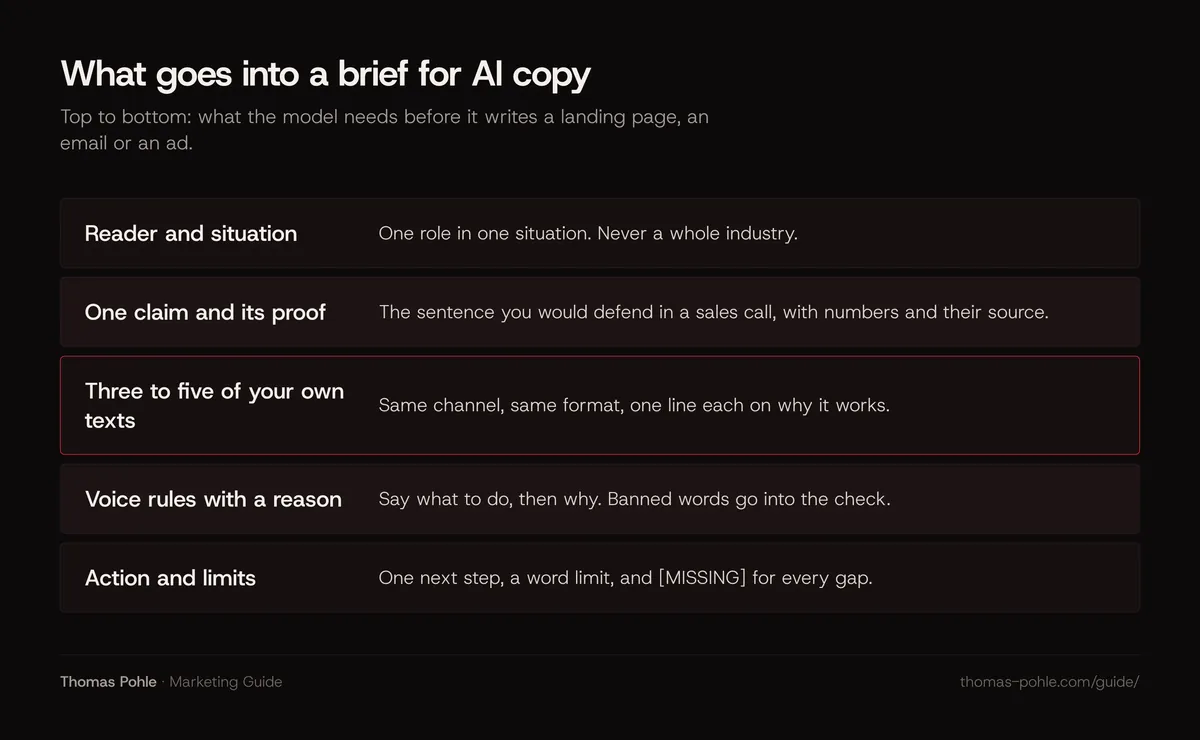
- The reader. One role in one situation. "Head of service at a machine builder with 30 field technicians" works. "Decision makers in manufacturing" gives you the average again.
- The claim. The one thing this piece says, in a sentence you'd defend in a sales call.
- The proof. Numbers with their source, a customer the reader recognizes, a decision you made. If you have none, the brief says so, and the copy makes a smaller claim.
- The action. What the reader does next: a 20-minute call, a PDF, a reply.
- The limits. Channel, length in words, what must not appear, and the instruction to mark missing facts as [MISSING] instead of filling them.
Anthropic also recommends explaining why an instruction matters, because the model generalizes from the reason: "max 90 words, because this runs as a LinkedIn ad" beats "max 90 words". For long-form pieces, the brief in the guide on AI in content marketing covers interviews and sources.
How many examples should you give the model, and which?
Give the model three to five examples of your own copy in the same format as the piece you want. All three big model providers recommend examples. Anthropic suggests three to five, Google recommends always including a few, and both ask for varied examples so the model doesn't pick up unintended patterns.
- Anthropic. Examples are one of the most reliable ways to steer format, tone and structure. Make them relevant, diverse, and wrap them in example tags so they don't mix with instructions.
- Google. Prompts without few-shot examples are likely to be less effective. Too many can make the model overfit. Keep their formatting identical.
- OpenAI. Show a diverse range of possible inputs with the desired outputs.
My rule of thumb for picking them: use texts your best customers reacted to, from the same channel, written by a person on your team. Never a competitor's copy, because the model will write like them. And never old AI drafts, which feed the average straight back in. Add one line per example on why it works ("opens with the reader's problem, one number, no adjectives").
How do you write voice rules a model actually follows?
Write voice rules as instructions for what to do, with a reason. A model tends to follow "write short sentences with one claim each, because buyers skim" more reliably than "don't be wordy". Anthropic's formatting guidance agrees: tell the model what to do instead of what not to do, and match the style of your prompt to the output you want.
| Weak rule | Rule a model can follow | Why it works |
|---|---|---|
| Don't sound like AI | Write like a founder explaining this to a peer: contractions, short sentences, one claim per paragraph | Describes the target, not the problem |
| No buzzwords | Use concrete verbs: set up, run, ship, measure. Replace every adjective of quality with a number or a name | Gives the model a replacement |
| Be concise | Max 90 words. Cut any sentence that repeats the headline | A limit the model can count |
| No dashes | Use periods and commas instead of dashes, because our style guide bans them | The reason lets the model generalize |
Anthropic also notes that the formatting of a prompt can influence the formatting of the answer. A prompt full of bullet points invites copy full of bullet points. Write the brief in the voice you want back.
A banned-word list still belongs in your rules. My own voice guide bans 10x, rocket, synergy, journey and ecosystem. Run that list as a check on the finished draft. My view: a model told to avoid one word often drifts into its cousins.
Which AI phrases should you check for before you publish?
Check every piece against a written list of AI tells with a threshold for each. Headlines, first sentences and calls to action get zero tolerance. In body text, every hit gets replaced with something concrete. My view: a list beats gut feeling, because the eye gets used to these phrases.
My site's design follows the same idea. When I researched what makes websites look AI-generated, I wrote a rulebook for my pages: no eyebrow labels, no pill above the headline, no default AI fonts, no purple, no icon-card grids, no stat banners, no generic fade-ups. I even switched my typeface. Copy works the same way. Write down the tells once, check every page against them.
| AI tell | What it looks like | Threshold |
|---|---|---|
| Style words | pivotal, crucial, showcasing, underscores, intricate, fostering, harnessing, realm, comprehensive, notably, additionally | 0 in headline, first sentence and CTA; elsewhere replace each with a concrete verb or fact |
| Your own banned words | The list in your voice guide | 0 |
| Triplets | Three adjectives or three short sentences in a row ("Faster. Smarter. Simpler.") | Max 1 per page, never in a headline |
| Contrast formula | "It's not about X, it's about Y" | 0; say what it is about |
| Throat-clearing opener | A rhetorical question or a sentence that repeats the headline | 0; the first sentence makes the claim |
| Vague optimistic close | "A testament to", "the future is bright", "take your business to the next stage" | 0; the last sentence names the action |
| Unproven quality words | leading, powerful, innovative, best-in-class | Each one backed by a number or a name, or cut |
| Placeholder people | "Sarah, a marketing manager", "companies like yours" | 0; name the real customer type |
In the Russell, Karpinska and Iyyer study described below, expert annotators named vocabulary in 53.1% of their explanations and sentence structure, including lists of three, in 35.9%. They also flagged optimistically vague conclusions; one flagged names like Emily and Sarah.
What does a before and after look like?
The difference shows up best in one short text. The example below is illustrative: I wrote both versions for this guide, for a made-up company, to show the typical pattern of a one-line prompt and the result after a brief, examples and a phrase check.
A typical scenario: a Swiss software company sells remote diagnostics for industrial machines. The one-line prompt is "Write a LinkedIn ad for our maintenance software." The pattern that comes back reads like this:
Maintenance is a crucial part of every manufacturing business. With our comprehensive platform, you can streamline processes, reduce downtime and boost efficiency. Discover how we help companies like yours thrive.
Two style words, a triplet, a placeholder audience, no checkable fact. Now the brief: reader is the head of service at a machine builder; claim is that technicians leave with the right part; proof is the share of repeat visits from the customer's own ticket data; action is a 20-minute call with last month's tickets. The draft after examples and one editing pass:
Your technicians drive to a machine without knowing which part failed. Our software reads the error code before they leave, so the right part is already in the van. [MISSING: share of repeat visits from your pilot data.] Bring last month's tickets to a 20-minute call and we'll show you which visits it would have saved.
The [MISSING] marker is the point. The brief told the model not to invent a percentage, so a person fills the gap with a real number or drops the sentence.
How do you edit an AI draft so it sounds like you?
Edit an AI draft in fixed passes, one problem per pass, instead of rereading it until it feels right. Phrases, padding, proof, adjectives, sound, facts. Each pass has a clear finish, so you know when you're done.
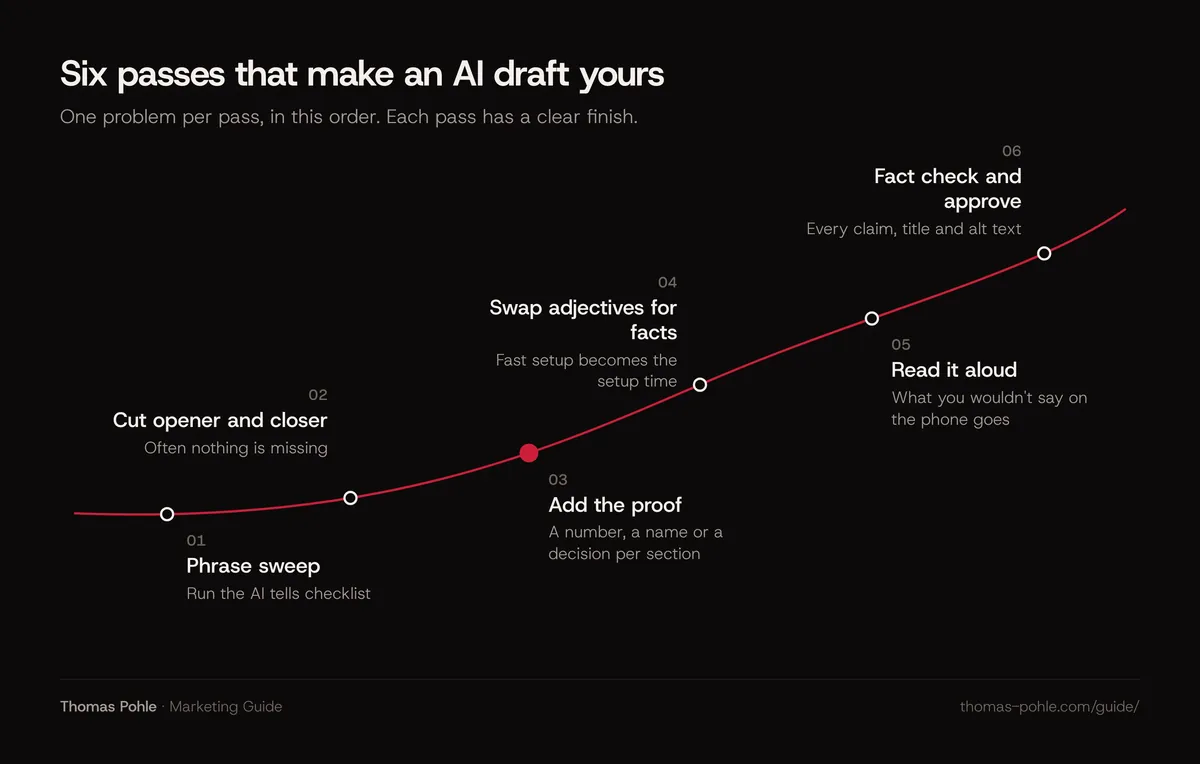
- Phrase sweep. Run the checklist above.
- Cut the first and last paragraph. Read the piece without them. Often nothing is missing, which tells you both were throat-clearing.
- Add the proof. One number, one name or one decision per section that only your company could have written. None? The section isn't ready.
- Swap adjectives for facts. "Fast setup" becomes the actual setup time, from your onboarding data.
- Read it aloud. What you wouldn't say on the phone goes.
- Fact check and approve. Every number and claim against an opened source, including title, meta description and alt texts. Google's review requirement covers metadata too.
My take: edit by hand, don't regenerate. Rewriting one weak paragraph shows you what the brief was missing.
Do AI detectors tell you whether your copy sounds like AI?
AI detectors aren't a reliable quality check for marketing copy. Research shows that people who often write with AI spot AI text better than most detectors, while people who rarely use AI guess at chance. Some detectors also misflag human writing by non-native speakers. Use a skilled human reader as your test.
- Experienced readers beat tools. Jenna Russell, Marzena Karpinska and Mohit Iyyer (ACL 2025) had annotators label 300 non-fiction articles. The majority vote of five annotators who frequently use LLMs for writing misclassified only 1 of 300 and outperformed most commercial and open-source detectors, also on paraphrased and humanized text.
- Inexperienced readers guess. Annotators who rarely use LLMs reached a true positive rate of 56.7% with a false positive rate around 52%, close to chance.
- Detectors can be biased. Weixin Liang and colleagues found that several GPT detectors classified more than half of TOEFL essays by non-native English writers as AI-generated, while classifying essays by US eighth graders almost perfectly.
Google doesn't rank by "AI or not" either. Its guidance, checked in November 2026, says generating many pages without adding value may violate its spam policy on scaled content abuse. So ask the person on your team who uses AI most to read the copy and mark every sentence that sounds generated.
What to do this week
- Pick five pieces of your own copy that worked, from one channel, and write one line on why each works.
- Turn the brief above into a template: reader, claim, proof, action, limits, plus the [MISSING] instruction.
- Rewrite your three most-used voice rules as instructions with a reason, using the table above.
- Copy the AI tells checklist into your style guide and add your own banned words.
- Run the six editing passes on the next email or ad before it goes out, and time them.
- Name one reviewer who writes with AI every day and give them the final read on anything customer-facing.
Models and their tells will keep changing. The method won't. If you want to set up the brief, the examples and the voice rules together with your team, that's a typical topic for a one-day Momentum Workshop. For the tools themselves, see which AI tools a B2B marketing team needs.
Frequently asked questions
Which AI text generator writes the best marketing copy?
The model matters less than the input. ChatGPT, Claude and Gemini all produce generic copy from a one-line prompt and usable copy from a brief with examples. Pick the tool your team already has under a data processing agreement, then invest in the brief, the examples and the phrase check.
Should I tell the model to avoid AI-sounding words?
Yes, but don't rely on it. Anthropic's guide recommends positive instructions over prohibitions, so describe the voice you want first. Keep the banned-word list too, and run it as a check on the finished draft, where it catches close relatives of the banned words.
Can I use competitors' copy as examples for the AI?
I wouldn't. The model copies the patterns of its examples, so competitors' copy makes you sound like your competitors. Use your own texts that customers reacted to. If you have too few, write two strong examples by hand first.
Does Google penalize AI-written marketing copy?
Not for being AI-written. Google's guidance says AI can help with research and structure, and that generating many pages without adding value may violate its spam policy on scaled content abuse. It also asks for a manual fact check of all AI-generated content, titles and descriptions included.
Sources
- Anthropic: Prompting best practices (Claude documentation)
- OpenAI: Prompt engineering guide
- Google: Prompt design strategies (Gemini API)
- Google Search Central: Guidance on using generative AI content on your website
- Google Search Central: Spam policies for Google web search (scaled content abuse)
- Kobak, González-Márquez, Horvát, Lause (2025): Delving into LLM-assisted writing in biomedical publications through excess vocabulary, Science Advances (arXiv version)
- Berens lab: list of 900 excess words (llm-excess-vocab, results/excess_words.csv)
- Russell, Karpinska, Iyyer (2025): People who frequently use ChatGPT for writing tasks are accurate and robust detectors of AI-generated text, ACL 2025
- Liang, Yuksekgonul, Mao, Wu, Zou (2023): GPT detectors are biased against non-native English writers
- Doshi and Hauser (2024): Generative AI enhances individual creativity but reduces the collective diversity of novel content, Science Advances
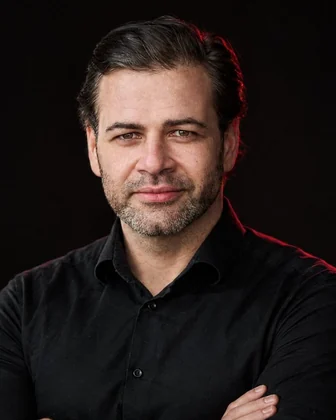
Thomas PohleB2B marketing advisor in Zurich. More than ten years in B2B marketing at Link11, Beekeeper and smino, most recently as Head of Marketing. CEO and co-founder of TEISENDA. Researched and drafted with AI tools, checked against the sources listed above. More about Thomas