What should AI do in your content marketing, and what not?
In B2B content marketing, AI handles the work around the substance: research, outlines, first drafts from your own material, editing, repurposing and metadata. People keep the substance: first-hand experience, evidence, opinion and the final yes. My rule of thumb: if a sentence needs your customer, your data or your judgment, AI doesn't write it.
This guide is for founders and marketing leads whose team already drafts with ChatGPT, Claude or Copilot and who wonder why the output reads like everyone else's. The general rules for AI in marketing are in the pillar guide on using AI in marketing without losing quality. This one goes narrower: where the line runs inside content work, which content types need more human input, and a check before anything AI-assisted goes live.
Where does the line run between AI and people in content marketing?
The line runs between the material and the craft. AI is good at the craft around a text: structure, a clean first version, shortening, variants, summaries. It can't supply the material that makes B2B content worth reading: what happened at a customer, what your own data shows, what you decided and why. Without that material, content is a paraphrase of what already exists.
Google draws the same line. Its guidance on generative AI says AI can be particularly useful for researching a topic and adding structure to original content. Its helpful content questions ask whether a page shows first-hand expertise and provides original information, reporting, research or analysis.
Google's quality rater guidelines, the handbook for its human evaluators, are explicit. The use of generative AI tools alone doesn't determine the level of effort or the page quality rating. The Lowest rating applies when all or almost all of a page is copied or paraphrased with little to no effort, originality or added value. So stop asking "was AI involved?" Ask one question of every piece: "what does this page add that the others don't?"
What does the evidence say about AI-written content?
AI makes content faster and often better written. It doesn't make it perform better on its own. Most B2B teams already use it for writing. Fewer see results, and research on creative writing shows AI-assisted texts drifting toward each other. Search engines don't punish AI use as such. That puts the whole burden on substance.
- Use is near universal. In the Content Marketing Institute's survey of 1,015 B2B marketers, fielded in summer 2025, 89% name content creation tools for generating or optimizing written content among the AI tools they use.
- Results lag behind use. Among marketers who use AI for content creation, 87% say productivity improved and 58% say quality improved. Only 39% say content performance improved. 12% say quality decreased.
- Texts converge. In an experiment published in Science Advances in 2024, Anil Doshi and Oliver Hauser gave 293 writers access to AI story ideas or none. AI help made individual stories rate as more creative and better written. Yet the AI-assisted stories were more similar to each other. The authors describe a narrower range of novel content overall.
- Rankings don't care about the tool. Ahrefs analyzed 600,000 top-20 pages for 100,000 keywords in 2025: 4.6% looked purely AI-generated, 13.5% purely human, 81.9% mixed. The correlation between AI share and ranking was 0.011, effectively zero. Ahrefs adds that no AI detector is perfect.
AI is a writing aid. A writing aid won't make a piece distinct. In B2B, where buyers compare a few suppliers who all publish, sounding like everyone else is the expensive failure.
Which content tasks can AI take over?
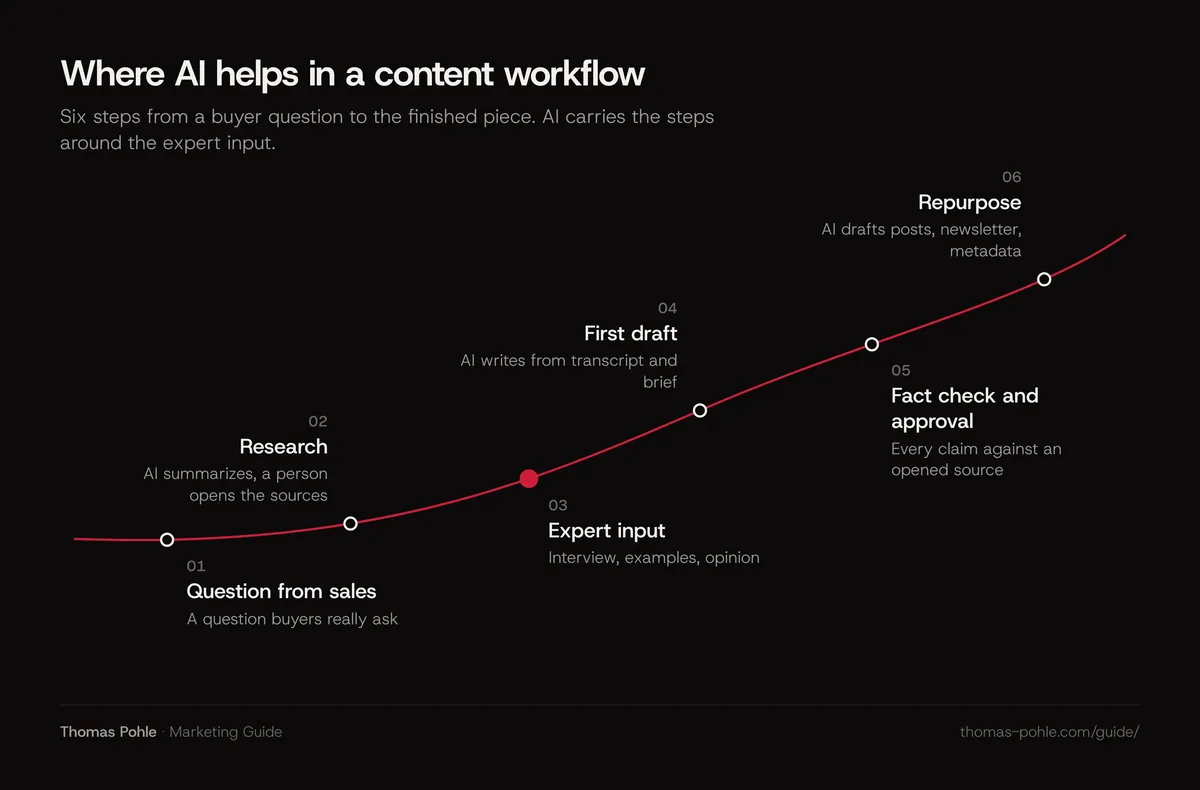
AI can take over most of the production steps of a content piece. It takes over none of the steps that decide what the piece says. That means research summaries, outlines, transcripts, first drafts from your own notes, editing, metadata, repurposing and translation drafts go to AI. A person chooses the question, supplies the proof, checks every fact and approves.
| Step | What AI does | What a person does |
|---|---|---|
| Choosing the question | Clusters questions from sales notes and search data | Picks the question a buyer actually asks |
| Research | Summarizes sources, lists open points | Opens every source that will be cited |
| Expert input | Prepares interview questions, transcribes, sorts quotes | Gives the interview, adds examples and opinions |
| First draft | Writes from the transcript, the brief and your examples | Rewrites the passages that carry the argument |
| Editing | Shortens, checks consistency, flags banned phrases | Decides what stays |
| Fact check | Lists every claim and number in the draft | Verifies each one against an opened source |
| Metadata and repurposing | Drafts titles, descriptions, alt texts, posts, a newsletter paragraph | Checks titles and descriptions as carefully as the text |
The fact check row is there for a reason. Google asks for all AI-generated content to be reviewed for accuracy before publishing, and says this review also covers metadata such as title elements. My take: the expert input row is where teams most often save time in the wrong place. The pillar on what content marketing is shows how to get that input from busy experts in a recorded hour.
Which content types need more human work than others?
Content types differ in how much of their value sits in material only you have. A glossary entry or a content refresh can be largely AI-drafted and checked. A case study, an opinion piece or a pricing page depends almost entirely on facts, people and decisions from inside your company. There, AI can only help with the form.
| Content type | AI share of the work | What only you can add |
|---|---|---|
| Case study | Low | The customer, the numbers they approved, their words |
| Opinion or thought leadership | Low | A position you defend, the reason behind it |
| Product and pricing pages | Low | Exact features, prices, limits, legal wording |
| How-to guide | Medium | The method you actually use, examples, mistakes |
| Newsletter and social posts | Medium | The angle, the story from this week |
| Glossary or definition | High | Your example, the link to your context |
| Content refresh | High | Which facts changed, what you now think differently |
A case study that gets cited is the clearest example of a low row. AI can structure a transcript in minutes. It can't know the result, and it must never guess one.
How do you brief AI so it works from your substance?
Brief AI the way you'd brief a freelance writer who has never met your customers: the question, the reader, your position, the proof and your voice. A one-line prompt makes the model fill gaps with the average of the web. A full brief makes it arrange your material. That's the job it does well.
The brief I'd use for any B2B piece has six parts:
- The question. One sentence, phrased the way a buyer asks it.
- The reader. Role, company size, what they already know.
- Your position. The answer you give, in two or three sentences, including where you disagree with the usual advice.
- The proof. Transcript excerpts, your own numbers with their source, links you opened, an example from a project.
- The voice. Three to five of your best texts as examples, plus a list of phrases you never use.
- The limits. No numbers that aren't in the proof section, no invented examples, mark every gap instead of filling it.
The last point does most of the work. Tell a model to mark gaps and it hands you a list of what's missing. Tell it to write a complete article and it fills those gaps with plausible inventions.
How do you keep AI content from sounding like everyone else's?
Start from material nobody else has, then edit toward your own voice. A generic prompt produces the same structure, phrases and examples your competitors get from the same models. Your interviews, decisions and numbers produce a text only your company could have published.
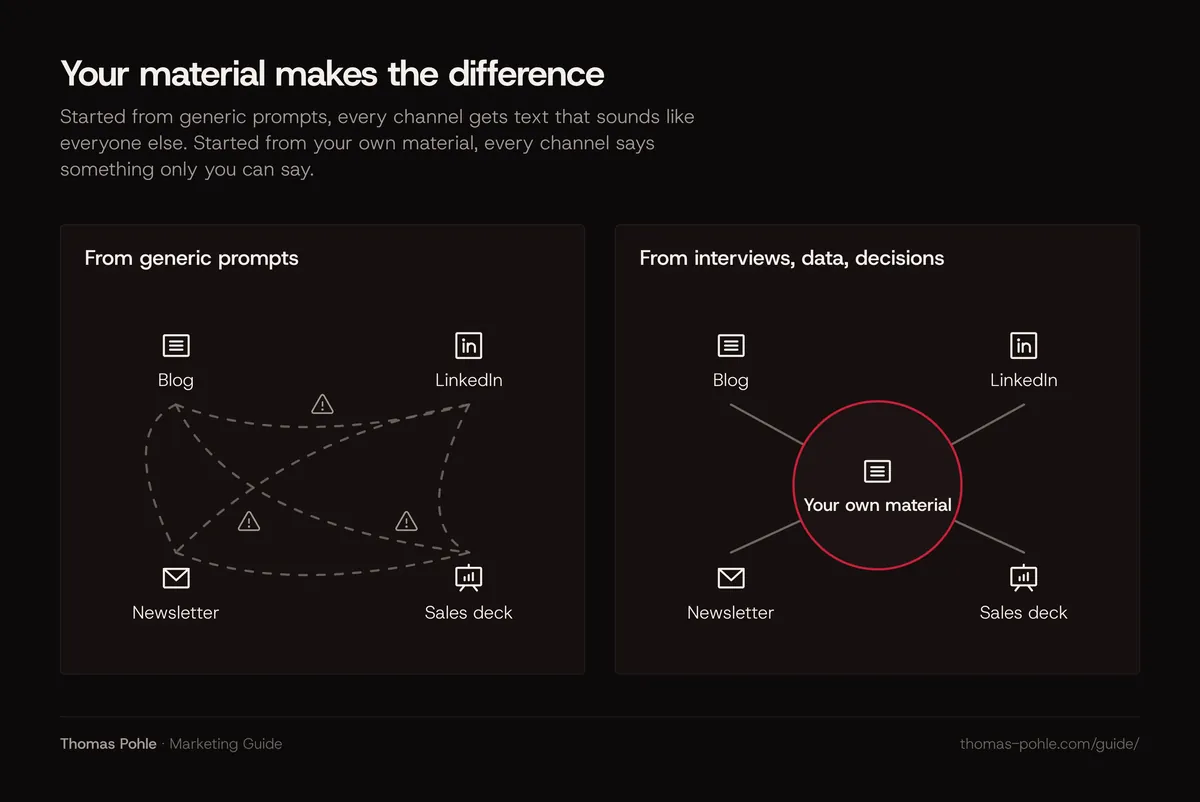
My take: AI news alone isn't content. A piece about a new model or a new feature earns its place only when it says what that means for your buyers or your own company. Same for any topic. The angle is the part a reader can't get from the model directly.
Two habits help in practice:
- One sentence only you could write. Mark at least one passage per section that depends on your experience or data. None? Then the section isn't ready.
- Edit, don't regenerate. Rewriting a weak paragraph by hand teaches you what's missing. Asking for version five rarely does.
Here's my view: AI will change marketing work a lot, and the fundamentals still decide. A clear audience, a real question, proof and a reason to act. AI shortens the way from material to text. It doesn't shorten the way to the material.
What should you check before AI-assisted content goes live?
Check five things before you publish. Every number and claim has a source a person opened. The piece contains material only your company has. Nothing is paraphrased from a single source. Titles and metadata got the same review as the text. And you've decided how to disclose AI use. Each check has a threshold, so the answer is yes or no.
| Check | Threshold to publish | Why |
|---|---|---|
| Sources | 100% of numbers and factual claims traced to an opened source | Google asks for manual fact-checking of all AI-generated content |
| Own material | At least one example, number or decision from your company per H2 | Helpful content shows first-hand expertise and original information |
| Paraphrase | No section that mainly rewords one other page | Paraphrasing without added value is rated Lowest by Google's raters |
| Metadata | Title, description and alt texts read by a person | Google's review requirement explicitly includes title elements |
| Disclosure | A written rule on when you say how the piece was made | Google recommends it where readers would expect it; the EU AI Act sets duties for some texts |
On disclosure, two sources matter. Google says sharing how a piece of content was created can give readers context. Article 50(4) of the EU AI Act, which applies from 2 August 2026, requires deployers to disclose AI-generated text published to inform the public on matters of public interest. The exception: the text went through human review or editorial control and someone holds editorial responsibility. Whether that covers your content is a question for your counsel. This isn't legal advice.
On ownership, the US Copyright Office concluded in January 2025 that AI output is protected only where a human author determined sufficient expressive elements. Prompts alone aren't enough. Other jurisdictions decide this under their own law. So human editing matters for ownership as much as for quality.
The guide on showing expertise to Google and AI assistants covers bylines, author pages and sources in more depth.
What to do this week
- Collect the last ten pieces your team published and mark which were AI-drafted. Note for each whether it contains material only you have.
- Sort your content plan by the decision table above. Schedule expert time for every low row before any drafting starts.
- Turn the six-part brief into a template and use it for the next three pieces.
- Add the instruction to mark gaps instead of filling them to every content prompt your team uses.
- Put the five pre-publish checks into your review step, with a named person who signs off.
- Decide your disclosure rule and write it down, together with the question for your counsel on the EU AI Act.
- Pick one existing article and refresh it with AI: new facts, your current view, checked sources.
My take: the teams that win with AI in content are the ones with the best material. Want help setting up the workflow and the first pieces with your team? A one-day Momentum Workshop is a good place to decide where to start.
Frequently asked questions
Can AI-assisted content rank on Google?
Yes. Google's rater guidelines state that the use of generative AI tools alone doesn't determine page quality. Its spam policy targets unoriginal content at scale, no matter how it's created. Ahrefs found effectively no correlation between AI share and ranking across 600,000 pages. What Google acts against is many pages generated without adding value for users. Its spam policies call that scaled content abuse.
Should we tell readers that AI helped write an article?
Google suggests explaining how content was created where readers would reasonably wonder, for example with a short note on your process. The EU AI Act adds a duty for AI-generated text published to inform the public on matters of public interest, with an exception for human-reviewed text under editorial responsibility. Write one rule for your team. Ask counsel how the law applies to you.
Can ChatGPT build our content strategy?
It can help you build one: clustering questions from sales notes, summarizing competitor pages, drafting a plan from your inputs. It can't know which questions your buyers ask, which deals you lose and why, or what your company believes. Those inputs decide the strategy. Use ChatGPT to structure and challenge your plan. Then decide the topics yourself.
How much faster is content production with AI?
There's no reliable general number for B2B content. In the Content Marketing Institute's 2025 survey, 87% of marketers using AI for content say productivity improved. The survey doesn't measure hours, though. Measure it yourself: time per piece for a few weeks without AI, then with AI and the same review steps.
Who owns content that AI wrote?
That depends on the jurisdiction and the amount of human work. The US Copyright Office concluded in 2025 that prompts alone don't make AI output protectable, while human selection, arrangement or modification can. European and Swiss courts apply their own laws. For marketing teams the practical answer is the same everywhere: substantial human editing protects both quality and your claim to the text.
Sources
- Google Search Central: Guidance on using generative AI content on your website
- Google Search Central: Creating helpful, reliable, people-first content
- Google Search Central: Spam policies for Google web search (scaled content abuse)
- Google: Search Quality Rater Guidelines (version of 11 September 2025), sections 4.6.5 and 4.6.6
- Content Marketing Institute: B2B Content and Marketing Trends, Insights for 2026
- Doshi and Hauser (2024): Generative AI enhances individual creativity but reduces the collective diversity of novel content, Science Advances
- Ahrefs (2025): AI-generated content does not hurt your Google rankings, 600,000 pages analyzed
- EU AI Act, Article 50: Transparency obligations for providers and deployers of certain AI systems
- Regulation (EU) 2024/1689 (AI Act), Official Journal of the EU, EUR-Lex
- US Copyright Office (2025): Copyright and Artificial Intelligence, Part 2, Copyrightability (press release)

Thomas PohleB2B marketing advisor in Zurich. More than ten years in B2B marketing at Link11, Beekeeper and smino, most recently as Head of Marketing. CEO and co-founder of TEISENDA. Researched and drafted with AI tools, checked against the sources listed above. More about Thomas