What does Google's AI mean for your company's visibility?

Google's AI answers more searches on the results page, so you lose clicks first on research questions, where AI Overviews show most often. Commercial searches are next. Visibility now means being cited in AI Overviews and AI Mode. For a B2B company the question is which searches still bring buyers, and how to stay named in the rest.
This is the business view for founders, CEOs and marketing leads. You get the features as of October 2026, the numbers on lost clicks, a decision table by type of search and a worked example. How SEO itself changes is covered in the pillar guide on how SEO changes when AI answers the search.
Which Google AI features affect your visibility?
Four Google AI features decide how visible a B2B company is in search today: AI Overviews on the results page, AI Mode as the conversational search, preferred sources as a user setting, and ads placed inside AI answers. AI Overviews and AI Mode run on Gemini, Google's model family. The Gemini app is a separate product with its own audience.
The scale puts this on the management agenda. At I/O in May 2026, Google reported more than 2.5 billion monthly active users for AI Overviews and more than one billion for AI Mode, one year after its launch. The Gemini app passed 900 million. In January 2026 Google made Gemini 3 the default model for AI Overviews worldwide. Since then people can ask a follow-up straight from an AI Overview and continue in AI Mode, so the two are one flow.
| Feature | What it does with your content | What it means for you |
|---|---|---|
| AI Overviews | Summarizes an answer above the results and links supporting pages | Fewer clicks on research questions; a citation is the new top spot |
| AI Mode | Answers longer, multi-step questions in a conversation, with links | Buyers compare vendors without opening ten tabs |
| Preferred sources | Labels links from sites a user has chosen in Top Stories, AI Overviews and AI Mode | Pays off if you publish regularly and have readers who care |
| Ads in AI Overviews | Places text and Shopping ads inside the answer | Only in English, in 12 countries so far; not in DACH |
Google's documentation adds one fact that matters for the business case: both features may use query fan-out, running several related searches across subtopics to build one answer. Your page can show up for a question you never targeted.
How many clicks does Google's AI cost a B2B website?
On searches with an AI Overview, the top organic result now gets far fewer clicks. Ahrefs compared Search Console data for 300,000 keywords from December 2023 and December 2025 and found that an AI Overview correlates with a 58 % lower click-through rate for position one. Lower positions lose less, but still lose.
The study, published in February 2026, uses desktop data and shows correlation, not proof. Its estimates: about 58 % fewer clicks for position one, 51 % for position two, 46 % for position three and 19 % for position ten, measured against a modeled baseline without AI Overviews.
Google reads the same shift differently. Its documentation on AI features says clicks from results pages with AI Overviews are "higher quality", with users spending more time on the site. Both can be true at once: fewer visits, better ones. Search Console can't settle it for you, because its generative AI report shows impressions by page, country, device and date, but no clicks.
My view: for most B2B companies the loss in clicks is bigger than the loss in pipeline. Research traffic was always the part that converted worst. That's the reason not to panic, and also the reason to stop reporting clicks as if they were revenue.
Which of your searches are affected, and which are not?
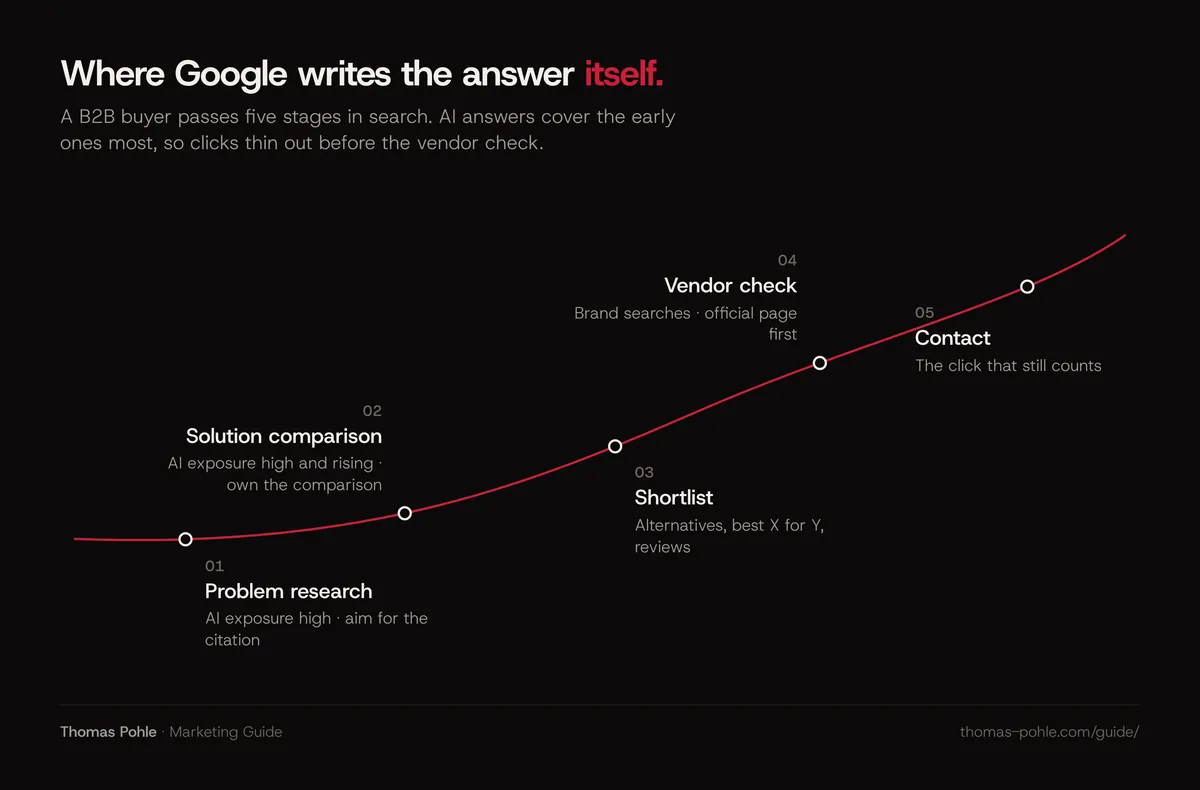
Research questions are hit hardest and commercial comparisons are catching up fast. Searches for your company name, in my view, hold up best. That split decides what Google AI does to your pipeline. A B2B buyer moves through all three, so the real question is at which stage you lose them and where you can still be named.
Commercial searches were long treated as safe. In a fixed panel of 400 commercial keywords in banking, software and e-commerce, Semrush found AI Overviews on 45.75 % of them in September 2025 and on 88 % in August 2026, based on US desktop data published in October 2026. Weighted by search volume, 97.08 % of those commercial searches showed one. Reviews, "best X for Y", alternatives and brand versus brand queries all climbed above 80 %.
For searches for your own company name I found no study with the same rigor. My assumption is that they hold up best, because the buyer already wants your page.
| Type of search | B2B example | AI exposure | What I would do |
|---|---|---|---|
| Research question | "How long does a CRM migration take?" | High | Aim for the citation; judge the page by mentions and inquiries, not clicks |
| Comparison and shortlist | "Best CRM for construction companies" | High and rising | Own pages for alternatives and comparisons, with facts a model can check |
| Brand and vendor check | "[Your company] pricing" | Lower | Make the official page the clearest answer; same facts everywhere |
| Local or very specific need | "ERP partner Zurich food industry" | Varies | Check the results page by hand; small volume, high intent |
What does it mean to be cited instead of clicked?
Being cited means Google names and links your page inside its AI answer, even if the reader never clicks. For a B2B company that's still visibility. The buyer sees your name next to the answer to their question, like a recommendation during research, and it shows up later as a brand search or an inquiry.
A good ranking no longer guarantees the citation. Ahrefs analyzed 863,000 keyword results pages with four million cited URLs in March 2026 and found that only about 38 % of the pages cited in AI Overviews also ranked in the top ten for that search. About 31 % didn't appear in the top 100 at all. Ahrefs says its method changed since the earlier study, so the trend is not like for like, and suggests that fan-out searches explain part of the gap. That part is their interpretation.
So rankings alone hide what happens. I would track three things per quarter: AI impressions in Search Console, branded searches, and the answer to "Where did you first hear about us?" in every inquiry. How to set that up without heavy tracking is in the guide on measuring organic and AI search visibility.
One thing I do on my own profiles helps here, in my view: identical identity data everywhere. One role line, one claim, company names written exactly as the companies write them. A model that finds the same facts in five places has less room to describe you wrongly. The guide on connecting your website and profiles into one brand walks through it.
Should you opt out of Google's AI features?
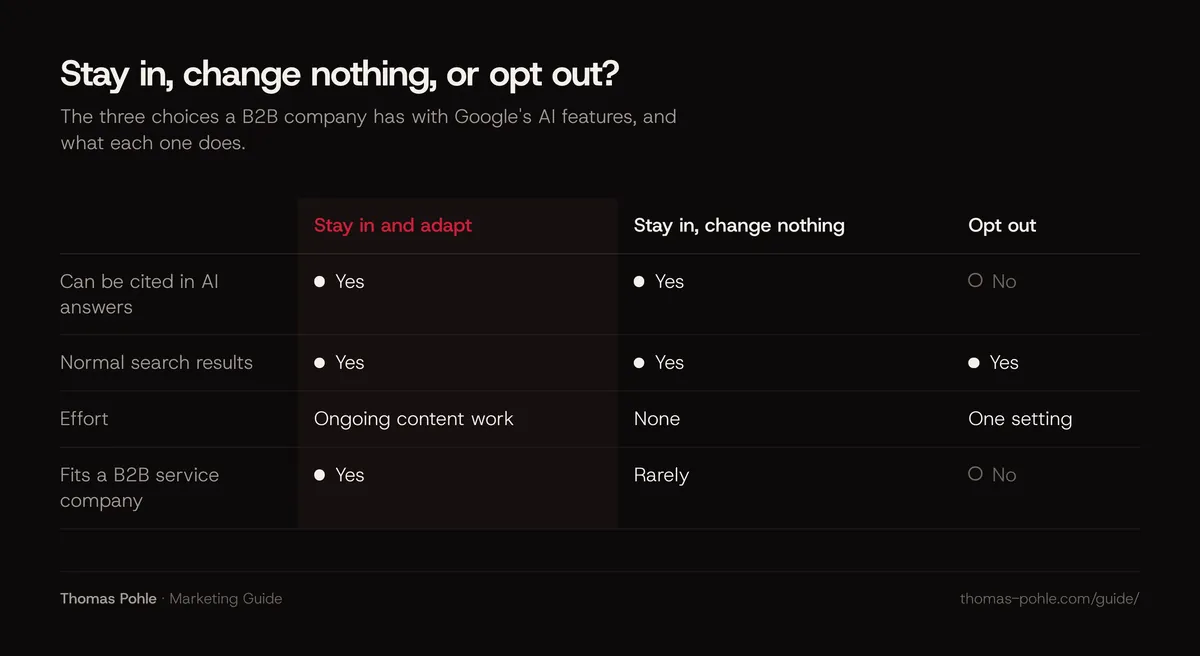
For almost every B2B company, no. Since 31 August 2026 every site can exclude itself from AI Overviews, AI Mode and the AI features in Discover with one setting in Search Console. Opting out removes you from the answers your buyers read, while normal search results stay. In my view it makes sense only when your content is the product you sell.
Google's help page says inclusion is the default, excluded content disappears within one to two days, and the setting is no ranking signal elsewhere in Search. It doesn't affect AI training either; that's Google-Extended in robots.txt. Finer controls exist too: preview controls such as nosnippet and max-snippet limit what Google shows from a page, page by page.
Do preferred sources matter for a B2B company?
Preferred sources matter if you publish regularly and have readers who return. Users could already mark sites as preferred for Top Stories. Since May 2026 Google also labels those sites in AI Overviews and AI Mode. For a B2B company with a blog, research or a newsletter, that's a way to stay visible to people who already know you.
In May 2026 Google said people are twice as likely to click through to a preferred source and that users had selected more than 345,000 unique sources. Any site that publishes fresh content is eligible, with nothing to apply for. Per Google's documentation, your site must be included in the generative AI features in Search Console, and only domains and subdomains qualify, never a subfolder like /blog.
My take: for a brochure site without new content, this is irrelevant. If you publish weekly, add Google's button to your articles. It takes two lines of HTML.
What does this mean in numbers for a typical B2B site?
In a typical case, total clicks fall clearly while inquiries fall far less, because the lost clicks come from research pages that rarely convert. The scenario below shows the arithmetic with assumed numbers. Replace them with your own Search Console and CRM data to see your exposure.
A typical scenario: a Swiss software company gets 1,500 organic clicks a month. 600 come from guide pages that rank in positions one to three for research questions. 900 come from product, comparison and brand pages. The guide pages convert at an assumed 0.3 % to inquiries, the other pages at an assumed 2 %.
- Research pages. If AI Overviews appear on those queries and click-through falls by about half, in line with Ahrefs' estimate of 46 to 58 % for positions one to three, 600 clicks become roughly 300. Inquiries from them go from about 1.8 to 0.9 a month.
- Commercial and brand pages. No public study measures the click loss for these with the same rigor. If they hold, they still bring about 18 inquiries.
- Result. Clicks fall by 20 %. Inquiries fall by about 5 %. The second number is the one that matters.
The risk sits in the comparison pages. If they start losing clicks the way research pages did, the pipeline takes the hit.
What should leadership decide now?
Leadership has three decisions to make about Google AI: whether to stay included in the AI features, which searches the content budget goes into, and which numbers count as success. None of them is technical. Each one takes an hour of preparation by marketing and a sign-off by someone with budget authority.
- Inclusion. Stay in the AI features unless your content is the product. Check the setting in Search Console and document it.
- Content budget. Shift effort from generic research articles to comparison pages, pricing information and pages with your own data. My rule: if a page only repeats what ten others say, it has no reason to be cited. How Google itself puts it is in the guide on getting your content into AI Overviews.
- Success measure. Report inquiries and pipeline first, then AI impressions and branded searches, then clicks and rankings.
My view: AI will fundamentally change marketing, and the fundamentals still matter. A clear position, real expertise, facts a buyer can check. Google's AI surfaces them faster. It doesn't create them. The page work is in the guide on optimizing your website for AI search.
What to do this week
- Open Search Console, go to settings and check that your site is included in the Search generative AI features.
- Open the generative AI performance report and list the ten pages with the most impressions.
- Sort your top 30 organic queries into research, comparison, brand and local, as in the table above.
- Search your five most valuable comparison queries by hand and note who gets cited in the AI Overview.
- Add "Where did you first hear about us?" to your contact form and first-call notes.
- Run the worked example with your own clicks and conversion rates.
- If you publish weekly, add the preferred sources button to your articles.
Google will keep moving: in 2026 alone it changed the model behind AI Overviews, merged the features into one flow and brought preferred sources into AI answers. Check the official documentation every quarter. If you want to make these three decisions with your team in one day, a Momentum Workshop is built for that.
Frequently asked questions
Does Google AI hurt B2B companies more than B2C?
No public study compares the two cleanly. The data shows research questions get AI Overviews most often, and B2B buyers research a lot before talking to sales. So B2B companies that lived on guide traffic feel it early. Companies that win business through referrals, events or outbound depend less on Google.
Is AI Mode available in Germany, Austria and Switzerland?
Yes. As of October 2026, Google's AI Mode help page lists Germany, Austria and Switzerland among the supported countries and German among the supported languages. What you see can still differ by account and device, so check it yourself on google.de or google.ch.
Can I buy my way into Google's AI answers?
Not into the citations. Organic citations in AI Overviews and AI Mode come from Google's ranking systems. Ads can appear above, below and, in some markets, inside AI Overviews. As of October 2026, Google's help page lists ads inside AI Overviews only for English in 12 countries, including the US, Canada and Australia. Germany, Austria and Switzerland are not on the list.
Will opting out of AI Overviews protect my rankings?
It won't change them. Google says the Search generative AI control is no ranking or inclusion signal elsewhere in Search. Excluding your site only removes your content from AI Overviews, AI Mode and the AI features in Discover. It also doesn't stop AI training, which is a separate decision through Google-Extended in your robots.txt.
How do I know if Google's AI is costing me traffic?
Compare clicks and impressions for your research pages in Search Console over twelve months, then check those queries by hand for AI Overviews. Rising impressions with falling clicks is the typical pattern. The generative AI report shows impressions in AI features by page, but no clicks, so you can't see AI clicks separately yet.
Sources
- Google Search Central: AI features and your website
- Google: Sundar Pichai's opening keynote at I/O 2026 (May 2026)
- Google: AI Mode in Google Search and AI Overviews get Gemini upgrades (January 2026)
- Google Search Help: Get AI-powered responses with AI Mode in Google Search
- Ahrefs: Update, AI Overviews reduce clicks by 58% (February 2026)
- Semrush: AI Overviews have nearly doubled across five commercial search modifiers (October 2026)
- Ahrefs: Update, 38% of AI Overview citations pull from the top 10 (March 2026)
- Search Console Help: Search generative AI control
- Search Console Help: Generative AI performance report (Search)
- Google: New ways to find your favorite sources and original content in AI Search (May 2026)
- Google Search Central: Preferred sources in Google Search
- Google Ads Help: About ads and AI Overviews

Thomas PohleB2B marketing advisor in Zurich. More than ten years in B2B marketing at Link11, Beekeeper and smino, most recently as Head of Marketing. CEO and co-founder of TEISENDA. Researched and drafted with AI tools, checked against the sources listed above. More about Thomas